Thank you for visiting SNEWPapers!
Sign up free
The National Intelligencer And Washington Advertiser
Washington, District Of Columbia
What is this article about?
Joseph Alston transmits South Carolina legislature's unanimous resolutions of June 29, 1808, approving the federal administration's handling of European belligerents and the embargo. President Jefferson replies on August 4, 1808, from Monticello, praising the state's support and unity.
Clipping
OCR Quality
Full Text
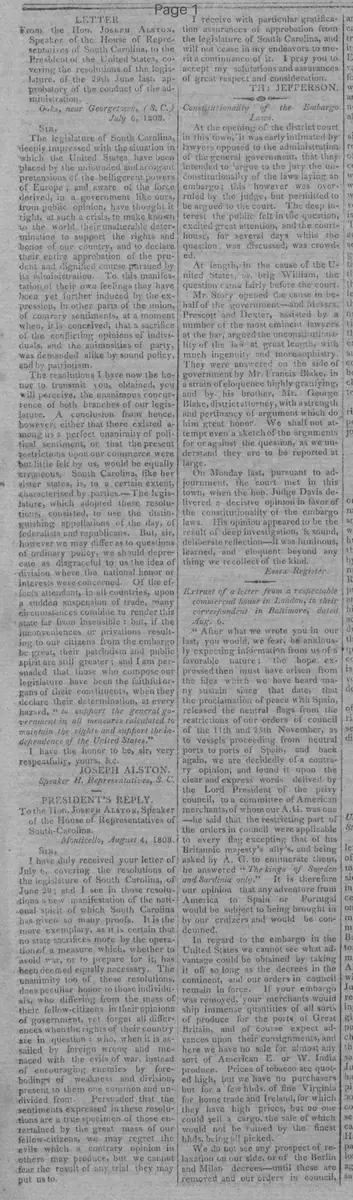
From the Hon. Joseph Alston,
Speaker of the House of Representatives of South Carolina, to the
President of the United States, covering the resolutions of the legis-
lature, of the 29th June last, approbatory of the conduct of the ad-
ministration.
Oaks, near Georgetown, (S. C.)
July 6, 1808.
SIR,
The legislature of South Carolina,
deeply impressed with the situation in
which the United States have been
placed by the unfounded and arrogant
pretensions of the belligerent powers
of Europe; and aware of the force
derived, in a government like ours,
from public opinion, have thought it
right, at such a crisis, to make known
to the world their unalterable deter-
mination to support the rights and
honor of our country, and to declare
their entire approbation of the pru-
dent and dignified course pursued by
its administration. To this manifes-
tation of their own feelings they have
been yet further induced by the ex-
pression, in other parts of the union,
of contrary sentiments, at a moment
when, it is conceived, that a sacrifice
of the conflicting opinions of indivi-
duals, and the animosities of party,
was demanded alike by sound policy,
and by patriotism.
The resolutions I have now the ho-
nor to transmit you, obtained, you
will perceive, the unanimous concur-
rence of both branches of our legis-
lature. A conclusion from hence,
however, either that there existed a-
mong us a perfect unanimity of poli-
tical sentiment, or that the present
restrictions upon our commerce were
but little felt by us, would be equally
erroneous. South Carolina, like her
sister states, is, to a certain extent,
characterised by parties.—The legis-
lature, which adopted these resolu-
tions, consisted, to use the distin-
guishing appellations of the day, of
federalists and republicans. But, sir,
however we may differ as to questions
of ordinary policy, we should depre-
ciate as disgraceful to us the idea of
division wherever the national honor or
interests were concerned. Of the ef-
fects attendant, in all countries, upon
a sudden suspension of trade, many
circumstances combine to render this
state far from insensible: but, if the
inconveniences or privations result-
ing to our citizens from the embargo
be great, their patriotism and public
spirit are still greater; and I am per-
suaded that those who compose our
legislature have been the faithful or-
gans of their constituents, when they
declare their determination, at every
hazard, "to support the general go-
vernment in all measures calculated to
maintain the rights and support the in-
dependence of the United States."
I have the honor to be, sir, very
respectfully, yours, &c.
JOSEPH ALSTON.
Speaker H. Representatives, S. C.
PRESIDENT'S REPLY.
To the Hon. Joseph Alston, Speaker
of the House of Representatives of
South-Carolina.
Monticello, August 4, 1808.
SIR,
I have duly received your letter of
July 6, covering the resolutions of
the legislature of South Carolina, of
June 29; and I see in those resolu-
tions a new manifestation of the nati-
nal spirit of which South Carolina
has given so many proofs. It is the
more exemplary, as it is certain that
no state sacrifices more by the opera-
tion of a measure which, whether to
avoid war, or to prepare for it, has
been deemed equally necessary. The
unanimity too of these resolutions,
does peculiar honor to those individu-
als, who differing from the mass of
their fellow-citizens in their opinions
of government, yet forget all differ-
ences when the rights of their country
are in question: who, when it is as-
sailed by foreign wrong and me-
naced with the evils of war, instead
of encouraging enemies by fore-
bodings of weakness and division,
present to them one common and un-
divided front. Persuaded that the
sentiments expressed in these resolu-
tions are a true specimen of those en-
tertained by the great mass of our
fellow-citizens, we may regret the
evils which a contrary opinion in
others may produce, but we cannot
fear the result of any trial they may
put us to,
I receive with particular gratifica-
tion assurances of approbation from
the legislature of South Carolina, and
will not cease in my endeavors to me-
rit a continuance of it. I pray you to
accept my salutations and assurances
of great respect and consideration.
TH: JEFFERSON.
What sub-type of article is it?
What keywords are associated?
What entities or persons were involved?
Where did it happen?
Domestic News Details
Primary Location
South Carolina
Event Date
June 29, 1808
Key Persons
Outcome
unanimous passage of resolutions by south carolina legislature approving administration's conduct; president's reply expressing gratitude and confidence in national unity.
Event Details
South Carolina legislature passes unanimous resolutions on June 29, 1808, supporting the U.S. administration's prudent course amid European belligerents' pretensions and the embargo's restrictions. Joseph Alston transmits them to President Jefferson on July 6, 1808, from Oaks near Georgetown, emphasizing unity despite parties. Jefferson replies on August 4, 1808, from Monticello, praising the state's sacrifice and unanimity.