Thank you for visiting SNEWPapers!
Sign up free
Literary
January 17, 1856
Yorkville Enquirer
York, York County, South Carolina
What is this article about?
Historical sketch of Pocahontas's marriage to John Rolfe in 1613 at Jamestown, Virginia, detailing her rescue of Captain Smith, conversion to Christianity, the wedding ceremony, life in England, and her death in 1617. Emphasizes her role in fostering peace between English settlers and Powhatan confederacy.
Clipping
OCR Quality
95%
Excellent
Full Text
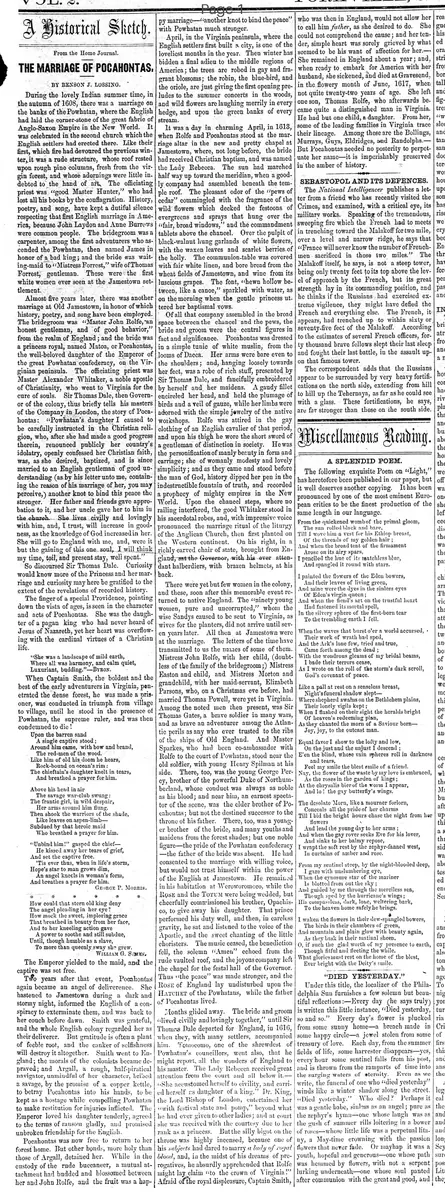
A Historical Sketch.
From the Home Journal.
THE MARRIAGE OF POCAHONTAS
BY BENSON J. LOSSING.
During the lovely Indian summer time, in the autumn of 1608, there was a marriage on the banks of the Powhatan, where the English had laid the corner-stone of the great fabric of Anglo-Saxon Empire in the New World. It was celebrated in the second church which the English settlers had erected there. Like their first, which fire had devoured the previous winter, it was a rude structure, whose roof rested upon rough pine columns, fresh from the virgin forest, and whose adornings were little indebted to the hand of art. The officiating priest was "good Master Hunter," who had lost all his books by the conflagration. History, poetry, and song, have kept a dutiful silence respecting that first English marriage in America, because John Laydon and Anne Burrows were common people. The bridegroom was a carpenter, among the first adventurers who ascended the Powhatan, then named James in honor of a bad king; and the bride was waiting-maid to "Mistress Forrest," wife of Thomas Forrest, gentleman. These were the first white women ever seen at the Jamestown settlement.
Almost five years later, there was another marriage at Old Jamestown, in honor of which history, poetry, and song have been employed. The bridegroom was "Master John Rolfe, an honest gentleman, and of good behavior," from the realm of England: and the bride was a princess royal, named Matoa, or Pocahontas, the well-beloved daughter of the Emperor of the great Powhatan confederacy, on the Virginian peninsula. The officiating priest was Master Alexander Whitaker, a noble apostle of Christianity, who went to Virginia for the cure of souls. Sir Thomas Dale, then Governor of the colony, thus briefly tells his masters of the Company in London, the story of Pocahontas: "Powhatan's daughter I caused to be carefully instructed in the Christian religion, who, after she had made a good progress therein, renounced publicly her country's idolatry, openly confessed her Christian faith, was, as she desired, baptized, and is since married to an English gentleman of good understanding (as by his letter unto me, containing the reason of his marriage of her, you may perceive,) another knot to bind this peace the stronger. Her father and friends gave approbation to it, and her uncle gave her to him in the church. She lives civilly and lovingly with him, and, I trust, will increase in goodness, as the knowledge of God increaseth in her. She will go to England with me, and, were it but the gaining of this one soul, I will think my time, toil, and present stay, well spent."
So discoursed Sir Thomas Dale. Curiosity would know more of the Princess and her marriage and curiosity may here be gratified to the extent of the revelations of recorded history. The finger of a special Providence, pointing down the vista of ages, is seen in the character and acts of Pocahontas. She was the daughter of a pagan king who had never heard of Jesus of Nazareth, yet her heart was overflowing with the cardinal virtues of a Christian life.
"She was a landscape of mild earth,
Where all was harmony, and calm quiet.
Luxuriant, budding."—Byron.
When Captain Smith, the boldest and the best of the early adventurers in Virginia, penetrated the dense forest, he was made a prisoner, was conducted in triumph from village to village, until he stood in the presence of Powhatan, the supreme ruler, and was then condemned to die!
Upon the barren sand
A single captive stood;
Around him came, with bow and brand,
The red-men of the wood.
Like him of old his doom he hears,
Rock-bound on ocean's rim:
The chieftain's daughter knelt in tears,
And breathed a prayer for him.
Above his head in air
The savage war-club swung:
The frantic girl, in wild despair,
Her arms around him flung.
Then shook the warriors of the shade,
Like leaves on aspen-limb—
Subdued by that heroic maid
Who breathed a prayer for him.
"Unbind him!" gasped the chief—
He kissed away her tears of grief,
And set the captive free.
'Tis ever thus, when in life's storm,
Hope's star to man grows dim,
An angel kneels in woman's form,
And breathes a prayer for him.
GEORGE P. MORRIS.
How could that stern old king deny
The angel pleading in her eye?
How mock the sweet, imploring grace
That breathed in beauty from her face.
And to her kneeling action gave
A power to soothe and still subdue,
Until, though humble as a slave,
To more than queenly sway she grew.
WILLIAM G. SIMMS.
The Emperor yielded to the maid, and the captive was set free. Two years after that event, Pocahontas again became an angel of deliverance. She hastened to Jamestown during a dark and stormy night, informed the English of a conspiracy to exterminate them, and was back to her couch before dawn. Smith was grateful, and the whole English colony regarded her as their deliverer. But gratitude is often a plant of feeble root, and the canker of selfishness will destroy it altogether. Smith went to England; the morals of the colonists became depraved; and Argall, a rough, half-piratical navigator, unmindful of her character, bribed a savage, by the promise of a copper kettle, to betray Pocahontas into his hands, to be kept as a hostage while compelling Powhatan to make restitution for injuries inflicted. The Emperor loved his daughter tenderly, agreed to the terms of ransom gladly, and promised unbroken friendship for the English.
Pocahontas was now free to return to her forest home. But other bonds, more holy than those of Argall, detained her. While in the custody of the rude buccaneer, a mutual attachment had budded and blossomed between her and John Rolfe, and the fruit was a happy marriage—"another knot to bind the peace" with Powhatan much stronger.
April, in the Virginia peninsula, where the English settlers first built a city, is one of the loveliest months in the year. Then winter has bidden a final adieu to the middle regions of America; the trees are robed in gay and fragrant blossoms; the robin, the blue-bird, and the oriole, are just giving the first opening preludes to the summer concerts in the woods, and wild flowers are laughing merrily in every hedge, and upon the green banks of every stream.
It was a day in charming April, in 1613, when Rolfe and Pocahontas stood at the marriage altar in the new and pretty chapel at Jamestown, where, not long before, the bride had received Christian baptism, and was named the Lady Rebecca. The sun had marched half way up toward the meridian, when a goodly company had assembled beneath the temple roof. The pleasant odor of the "pews of cedar" commingled with the fragrance of the wild flowers which decked the festoons of evergreens and sprays that hung over the "fair, broad windows," and the commandment tablets above the chancel. Over the pulpit of black-walnut hung garlands of white flowers, with the waxen leaves and scarlet berries of the holly. The communion-table was covered with fair white linen, and bore bread from the wheat fields of Jamestown, and wine from its luscious grapes. The font, "hewn hollow between, like a canoe," sparkled with water, as on the morning when the gentle princess uttered her baptismal vows.
Of all that company assembled in the broad space between the chancel and the pews, the bride and groom were the central figures in fact and significance. Pocahontas was dressed in a simple tunic of white muslin, from the looms of Dacca. Her arms were bare even to the shoulders; and, hanging loosely towards her feet, was a robe of rich stuff, presented by Sir Thomas Dale, and fancifully embroidered by herself and her maidens. A gaudy fillet encircled her head, and held the plumage of birds and a veil of gauze, while her limbs were adorned with the simple jewelry of the native workshops. Rolfe was attired in the gay clothing of an English cavalier of that period, and upon his thigh he wore the short sword of a gentleman of distinction in society. He was the personification of manly beauty in form and carriage; she of womanly modesty and lovely simplicity; and as they came and stood before the man of God, history dipped her pen in the indestructible fountain of truth, and recorded a prophecy of mighty empires in the New World. Upon the chancel steps, where no railing interfered, the good Whitaker stood in his sacerdotal robes, and, with impressive voice pronounced the marriage ritual of the liturgy of the Anglican Church, then first planted on the Western continent. On his right, in a richly carved chair of state, brought from England, sat the Governor, with his ever attendant halberdiers, with brazen helmets, at his back.
There were yet but few women in the colony and these, soon after this memorable event returned to native England. The "ninety young women, pure and uncorrupted," whom the wise Sandys caused to be sent to Virginia, as wives for the planters, did not arrive until seven years later. All then at Jamestown were at the marriage. The letters of the time have transmitted to us the names of some of them. Mistress John Rolfe, with her child, (doubtless of the family of the bridegroom;) Mistress Easton and child, and Mistress Morton and grandchild, with her maid-servant, Elizabeth Parsons, who, on a Christmas eve before, had married Thomas Powell, were yet in Virginia.
Among the noted men then present, was Sir Thomas Gates, a brave soldier in many wars, and as brave an adventurer among the Atlantic perils as any who ever trusted to the ribs of the ships of Old England. And Master Sparkes, who had been co-ambassador with Rolfe to the court of Powhatan, stood near the old soldier, with young Henry Spilman at his side. There, too, was the young George Percy, brother of the powerful Duke of Northumberland, whose conduct was always as noble as his blood; and near him, an earnest spectator of the scene, was the elder brother of Pocahontas; but not the destined successor to the throne of his father. There, too, was a younger brother of the bride, and many youths and maidens from the forest shades: but one noble figure—the pride of the Powhatan confederacy—the father of the bride was absent. He had consented to the marriage with willing voice, but would not trust himself within the power of the English at Jamestown. He remained in his habitation at Werowocomoco, while the Rose and the Thorn were being wedded, but cheerfully commissioned his brother, Opachisco, to give away his daughter. That prince performed his duty well, and then, in careless gravity, he sat and listened to the voice of the Apostle, and the sweet chanting of the little choristers. The music ceased, the benediction fell, the solemn "Amen" echoed from the rude vaulted roof, and the joyous company left the chapel for the festal hall of the Governor.
Thus "the peace" was made stronger, and the Rose of England lay undisturbed upon the Heart of the Powhatans, while the father of Pocahontas lived.
Months glided away. The bride and groom "lived civilly and lovingly together," until Sir Thomas Dale departed for England, in 1616 when they, with many settlers, accompanied him. Tomocomo, one of the shrewdest of Powhatan's councillors, went also, that he might report all the wonders of England to his master. The Lady Rebecca received great attention from the court and all below it. "She accustomed herself to civility, and carried herself as daughter of a king." Dr. King, the Lord Bishop of London, entertained her "with festival state and pomp," beyond what he had ever given to other ladies; and at court she was received with the courtesy due to her rank as a princess. But the silly bigot on the throne was highly incensed, because one of his subjects had dared to marry a lady of royal blood, and, in the midst of his dreams of prerogatives, he absurdly apprehended that Rolfe might lay claim "to the crown of Virginia!"
Afraid of the royal displeasure, Captain Smith, who was then in England, would not allow her to call him father, as she desired to do. She could not comprehend the cause; and her tender, simple heart was sorely grieved by what seemed to be his want of affection for her.
She remained in England about a year; and, when ready to embark for America with her husband, she sickened, and died at Gravesend, in the flowery month of June, 1617, when not quite twenty-two years of age. She left one son, Thomas Rolfe, who afterwards became quite a distinguished man in Virginia. He had but one child, a daughter. From her, some of the leading families in Virginia trace their lineage. Among these are the Bollings, Murrays, Guys, Eldridges, and Randolphs.
But Pocahontas needed no posterity to perpetuate her name—it is imperishably preserved in the amber of history.
From the Home Journal.
THE MARRIAGE OF POCAHONTAS
BY BENSON J. LOSSING.
During the lovely Indian summer time, in the autumn of 1608, there was a marriage on the banks of the Powhatan, where the English had laid the corner-stone of the great fabric of Anglo-Saxon Empire in the New World. It was celebrated in the second church which the English settlers had erected there. Like their first, which fire had devoured the previous winter, it was a rude structure, whose roof rested upon rough pine columns, fresh from the virgin forest, and whose adornings were little indebted to the hand of art. The officiating priest was "good Master Hunter," who had lost all his books by the conflagration. History, poetry, and song, have kept a dutiful silence respecting that first English marriage in America, because John Laydon and Anne Burrows were common people. The bridegroom was a carpenter, among the first adventurers who ascended the Powhatan, then named James in honor of a bad king; and the bride was waiting-maid to "Mistress Forrest," wife of Thomas Forrest, gentleman. These were the first white women ever seen at the Jamestown settlement.
Almost five years later, there was another marriage at Old Jamestown, in honor of which history, poetry, and song have been employed. The bridegroom was "Master John Rolfe, an honest gentleman, and of good behavior," from the realm of England: and the bride was a princess royal, named Matoa, or Pocahontas, the well-beloved daughter of the Emperor of the great Powhatan confederacy, on the Virginian peninsula. The officiating priest was Master Alexander Whitaker, a noble apostle of Christianity, who went to Virginia for the cure of souls. Sir Thomas Dale, then Governor of the colony, thus briefly tells his masters of the Company in London, the story of Pocahontas: "Powhatan's daughter I caused to be carefully instructed in the Christian religion, who, after she had made a good progress therein, renounced publicly her country's idolatry, openly confessed her Christian faith, was, as she desired, baptized, and is since married to an English gentleman of good understanding (as by his letter unto me, containing the reason of his marriage of her, you may perceive,) another knot to bind this peace the stronger. Her father and friends gave approbation to it, and her uncle gave her to him in the church. She lives civilly and lovingly with him, and, I trust, will increase in goodness, as the knowledge of God increaseth in her. She will go to England with me, and, were it but the gaining of this one soul, I will think my time, toil, and present stay, well spent."
So discoursed Sir Thomas Dale. Curiosity would know more of the Princess and her marriage and curiosity may here be gratified to the extent of the revelations of recorded history. The finger of a special Providence, pointing down the vista of ages, is seen in the character and acts of Pocahontas. She was the daughter of a pagan king who had never heard of Jesus of Nazareth, yet her heart was overflowing with the cardinal virtues of a Christian life.
"She was a landscape of mild earth,
Where all was harmony, and calm quiet.
Luxuriant, budding."—Byron.
When Captain Smith, the boldest and the best of the early adventurers in Virginia, penetrated the dense forest, he was made a prisoner, was conducted in triumph from village to village, until he stood in the presence of Powhatan, the supreme ruler, and was then condemned to die!
Upon the barren sand
A single captive stood;
Around him came, with bow and brand,
The red-men of the wood.
Like him of old his doom he hears,
Rock-bound on ocean's rim:
The chieftain's daughter knelt in tears,
And breathed a prayer for him.
Above his head in air
The savage war-club swung:
The frantic girl, in wild despair,
Her arms around him flung.
Then shook the warriors of the shade,
Like leaves on aspen-limb—
Subdued by that heroic maid
Who breathed a prayer for him.
"Unbind him!" gasped the chief—
He kissed away her tears of grief,
And set the captive free.
'Tis ever thus, when in life's storm,
Hope's star to man grows dim,
An angel kneels in woman's form,
And breathes a prayer for him.
GEORGE P. MORRIS.
How could that stern old king deny
The angel pleading in her eye?
How mock the sweet, imploring grace
That breathed in beauty from her face.
And to her kneeling action gave
A power to soothe and still subdue,
Until, though humble as a slave,
To more than queenly sway she grew.
WILLIAM G. SIMMS.
The Emperor yielded to the maid, and the captive was set free. Two years after that event, Pocahontas again became an angel of deliverance. She hastened to Jamestown during a dark and stormy night, informed the English of a conspiracy to exterminate them, and was back to her couch before dawn. Smith was grateful, and the whole English colony regarded her as their deliverer. But gratitude is often a plant of feeble root, and the canker of selfishness will destroy it altogether. Smith went to England; the morals of the colonists became depraved; and Argall, a rough, half-piratical navigator, unmindful of her character, bribed a savage, by the promise of a copper kettle, to betray Pocahontas into his hands, to be kept as a hostage while compelling Powhatan to make restitution for injuries inflicted. The Emperor loved his daughter tenderly, agreed to the terms of ransom gladly, and promised unbroken friendship for the English.
Pocahontas was now free to return to her forest home. But other bonds, more holy than those of Argall, detained her. While in the custody of the rude buccaneer, a mutual attachment had budded and blossomed between her and John Rolfe, and the fruit was a happy marriage—"another knot to bind the peace" with Powhatan much stronger.
April, in the Virginia peninsula, where the English settlers first built a city, is one of the loveliest months in the year. Then winter has bidden a final adieu to the middle regions of America; the trees are robed in gay and fragrant blossoms; the robin, the blue-bird, and the oriole, are just giving the first opening preludes to the summer concerts in the woods, and wild flowers are laughing merrily in every hedge, and upon the green banks of every stream.
It was a day in charming April, in 1613, when Rolfe and Pocahontas stood at the marriage altar in the new and pretty chapel at Jamestown, where, not long before, the bride had received Christian baptism, and was named the Lady Rebecca. The sun had marched half way up toward the meridian, when a goodly company had assembled beneath the temple roof. The pleasant odor of the "pews of cedar" commingled with the fragrance of the wild flowers which decked the festoons of evergreens and sprays that hung over the "fair, broad windows," and the commandment tablets above the chancel. Over the pulpit of black-walnut hung garlands of white flowers, with the waxen leaves and scarlet berries of the holly. The communion-table was covered with fair white linen, and bore bread from the wheat fields of Jamestown, and wine from its luscious grapes. The font, "hewn hollow between, like a canoe," sparkled with water, as on the morning when the gentle princess uttered her baptismal vows.
Of all that company assembled in the broad space between the chancel and the pews, the bride and groom were the central figures in fact and significance. Pocahontas was dressed in a simple tunic of white muslin, from the looms of Dacca. Her arms were bare even to the shoulders; and, hanging loosely towards her feet, was a robe of rich stuff, presented by Sir Thomas Dale, and fancifully embroidered by herself and her maidens. A gaudy fillet encircled her head, and held the plumage of birds and a veil of gauze, while her limbs were adorned with the simple jewelry of the native workshops. Rolfe was attired in the gay clothing of an English cavalier of that period, and upon his thigh he wore the short sword of a gentleman of distinction in society. He was the personification of manly beauty in form and carriage; she of womanly modesty and lovely simplicity; and as they came and stood before the man of God, history dipped her pen in the indestructible fountain of truth, and recorded a prophecy of mighty empires in the New World. Upon the chancel steps, where no railing interfered, the good Whitaker stood in his sacerdotal robes, and, with impressive voice pronounced the marriage ritual of the liturgy of the Anglican Church, then first planted on the Western continent. On his right, in a richly carved chair of state, brought from England, sat the Governor, with his ever attendant halberdiers, with brazen helmets, at his back.
There were yet but few women in the colony and these, soon after this memorable event returned to native England. The "ninety young women, pure and uncorrupted," whom the wise Sandys caused to be sent to Virginia, as wives for the planters, did not arrive until seven years later. All then at Jamestown were at the marriage. The letters of the time have transmitted to us the names of some of them. Mistress John Rolfe, with her child, (doubtless of the family of the bridegroom;) Mistress Easton and child, and Mistress Morton and grandchild, with her maid-servant, Elizabeth Parsons, who, on a Christmas eve before, had married Thomas Powell, were yet in Virginia.
Among the noted men then present, was Sir Thomas Gates, a brave soldier in many wars, and as brave an adventurer among the Atlantic perils as any who ever trusted to the ribs of the ships of Old England. And Master Sparkes, who had been co-ambassador with Rolfe to the court of Powhatan, stood near the old soldier, with young Henry Spilman at his side. There, too, was the young George Percy, brother of the powerful Duke of Northumberland, whose conduct was always as noble as his blood; and near him, an earnest spectator of the scene, was the elder brother of Pocahontas; but not the destined successor to the throne of his father. There, too, was a younger brother of the bride, and many youths and maidens from the forest shades: but one noble figure—the pride of the Powhatan confederacy—the father of the bride was absent. He had consented to the marriage with willing voice, but would not trust himself within the power of the English at Jamestown. He remained in his habitation at Werowocomoco, while the Rose and the Thorn were being wedded, but cheerfully commissioned his brother, Opachisco, to give away his daughter. That prince performed his duty well, and then, in careless gravity, he sat and listened to the voice of the Apostle, and the sweet chanting of the little choristers. The music ceased, the benediction fell, the solemn "Amen" echoed from the rude vaulted roof, and the joyous company left the chapel for the festal hall of the Governor.
Thus "the peace" was made stronger, and the Rose of England lay undisturbed upon the Heart of the Powhatans, while the father of Pocahontas lived.
Months glided away. The bride and groom "lived civilly and lovingly together," until Sir Thomas Dale departed for England, in 1616 when they, with many settlers, accompanied him. Tomocomo, one of the shrewdest of Powhatan's councillors, went also, that he might report all the wonders of England to his master. The Lady Rebecca received great attention from the court and all below it. "She accustomed herself to civility, and carried herself as daughter of a king." Dr. King, the Lord Bishop of London, entertained her "with festival state and pomp," beyond what he had ever given to other ladies; and at court she was received with the courtesy due to her rank as a princess. But the silly bigot on the throne was highly incensed, because one of his subjects had dared to marry a lady of royal blood, and, in the midst of his dreams of prerogatives, he absurdly apprehended that Rolfe might lay claim "to the crown of Virginia!"
Afraid of the royal displeasure, Captain Smith, who was then in England, would not allow her to call him father, as she desired to do. She could not comprehend the cause; and her tender, simple heart was sorely grieved by what seemed to be his want of affection for her.
She remained in England about a year; and, when ready to embark for America with her husband, she sickened, and died at Gravesend, in the flowery month of June, 1617, when not quite twenty-two years of age. She left one son, Thomas Rolfe, who afterwards became quite a distinguished man in Virginia. He had but one child, a daughter. From her, some of the leading families in Virginia trace their lineage. Among these are the Bollings, Murrays, Guys, Eldridges, and Randolphs.
But Pocahontas needed no posterity to perpetuate her name—it is imperishably preserved in the amber of history.
What sub-type of article is it?
Essay
What themes does it cover?
Political
Religious
War Peace
What keywords are associated?
Pocahontas Marriage
John Rolfe
Jamestown
Powhatan
Virginia Colony
Captain Smith
Christian Baptism
English Natives Peace
What entities or persons were involved?
By Benson J. Lossing
Literary Details
Title
The Marriage Of Pocahontas
Author
By Benson J. Lossing
Subject
Historical Sketch Of Pocahontas's Marriage
Form / Style
Prose Historical Narrative With Embedded Poetry
Key Lines
Upon The Barren Sand
A Single Captive Stood;
Around Him Came, With Bow And Brand,
The Red Men Of The Wood.
Like Him Of Old His Doom He Hears,
Rock Bound On Ocean's Rim:
The Chieftain's Daughter Knelt In Tears,
And Breathed A Prayer For Him.
'Tis Ever Thus, When In Life's Storm,
Hope's Star To Man Grows Dim,
An Angel Kneels In Woman's Form,
And Breathes A Prayer For Him.
How Could That Stern Old King Deny
The Angel Pleading In Her Eye?
How Mock The Sweet, Imploring Grace
That Breathed In Beauty From Her Face.
And To Her Kneeling Action Gave
A Power To Soothe And Still Subdue,
Until, Though Humble As A Slave,
To More Than Queenly Sway She Grew.