Thank you for visiting SNEWPapers!
Sign up free
Literary
December 24, 1887
The Citizen
Chicago, Cook County, Illinois
What is this article about?
This article explores the mythological life of Finn McCool, blending solar myths, Celtic traditions, and historical elements. It covers his weaknesses, marriages, exploits, leadership of the Fenian militia, their privileges and downfall, and lasting impact on Irish character and chivalry.
Clipping
OCR Quality
95%
Excellent
Full Text
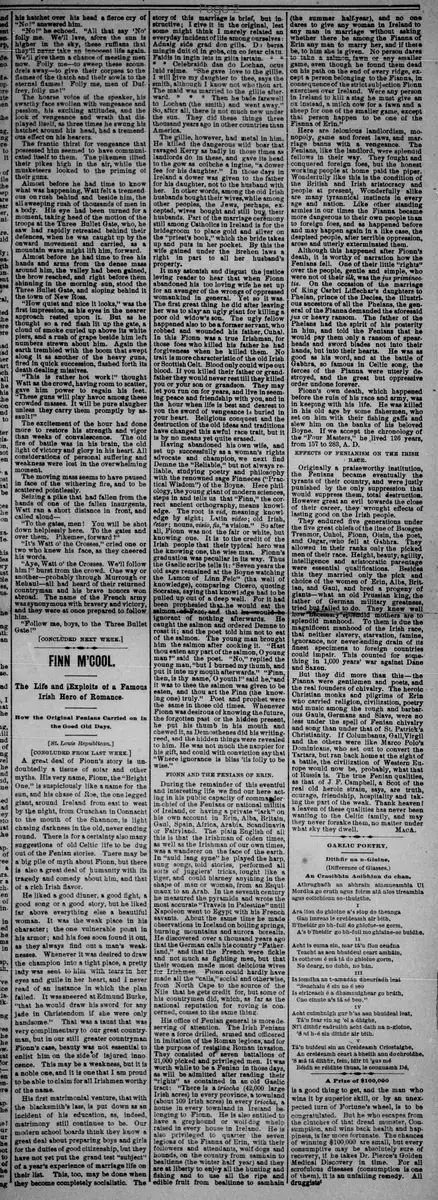
FINN M'COOL.
The Life and Exploits of a Famous Irish Hero of Romance.
How the Original Fenians Carried on in the Good Old Days.
[St. Louis Republican.]
[CONCLUDED FROM LAST WEEK.]
A great deal of Fionn's story is undoubtedly a tissue of solar and other myths. His very name, Fionn, the "Bright One," is suspiciously like a name for the sun, and his chase of Roe, the one-legged giant, around Ireland from east to west by the night, from Cruachan in Connacht to the mouth of the Shannon, is light chasing darkness in the old, never-ending round. There is for a certainty also many suggestions of old Celtic life to be dug out of the Fenian stories. There may be a big pile of myth about Fionn, but there is also a great deal of humanity with its tragedy and comedy about him, and that of a rich Irish flavor.
He liked a good dinner, a good fight, a good song or a good story, but he liked far above everything else a beautiful woman. It was the weak place in his character; the one vulnerable point in his armor; and his foes soon found it out, as they always find out a man's weaknesses. Whenever it was desired to draw the champion into a tight place, a pretty lady was sent to him with tears in her eyes and guile in her heart, and I never read of an instance in which the plan failed. It was sneered at Edmund Burke, "that he would draw his sword for any jade in Christendom if she were only handsome." That was a taunt that was very complimentary to our great countryman, but in our still greater countryman Fionn's case, beauty was not essential to enlist him on the side of injured innocence. This may be a weakness, but it is a noble one, and it is one that I am proud to be able to claim for all Irishmen worthy of the name.
His first matrimonial venture, that with the blacksmith's lass, is put down as an incident of his education, as, indeed, matrimony still continues to be. Our modern school boards think they know a great deal about preparing boys and girls for the duties of good citizenship, but they have not yet put the grand test "subject" of a year's experience of marriage life on their list. This, too, may be done when they become completely socialistic. The story of this marriage is brief, but instructive; I give it in the original, lest some might think I merely related an everyday incident of life among ourselves:
Adnaig side grad don gilla. Do bersa mingin duit o in goba, cin co fetar ciatu. Faldis in ingin leis in gilia isrtain. * * Celebraidh dan do Lochan, ocus luid reime. "She gave love to the gillie. I will give my daughter to thee, says the smith, although I know not who thou art. The maid was married to the gillie afterward. * * Then he bade farewell to Lochan (the smith) and went away."
So, after all, there is not much new under the sun. They did these things three thousand years ago in other countries than America.
The gillie, however, had metal in him. He killed the dangerous wild boar that ravaged Kerry as badly in those times as landlords do in these, and gave its head to the gow as coibche a ingine, "a dower fee for his daughter." In those days in Ireland a dower was given to the father for his daughter, not to the husband with her. In other words, among the old Irish husbands bought their wives, while among other peoples, the Jews, perhaps, excepted, wives bought and still buy their husbands. Part of the marriage ceremony still among Catholics in Ireland is for the bridegroom to place gold and silver on the "priest's book," which the bride takes up and puts in her pocket. By this the wife gained under the Brehon laws a right in part to all her husband's property.
It may astonish and disgust the justice loving reader to hear that when Fionn abandoned his too loving wife he set up for an avenger of the wrongs of oppressed womankind in general. Yet so it was. The first great thing he did after leaving her was to slay an ugly giant for killing a poor old widow's son. The ugly fellow happened also to be a former servant, who robbed and wounded his father, Cuhal. In this Fionn was a true Irishman, for those foes who killed his father he had no forgiveness when he killed them. No trait is more characteristic of the old Irish or Scottish Celt. Blood only could wipe out blood. If you killed their father or grandfather they would never rest till they killed you or your son or grandson. They may let you run on for years, and live in seeming peace and friendship with you, and in the hour when life is best and dearest to you the sword of vengeance is buried in your heart. Religious conquest and the destruction of the old ideas and traditions have changed this awful race trait, but it is by no means yet quite erased.
Having abandoned his own wife, and set up successfully as a woman's rights advocate and champion, we next find Demne the "Reliable," but not always reliable, studying poetry and philosophy with the renowned sage Finneces ("Practical Wisdom") of the Boyne. Here philology, the young giant of modern sciences, steps in and tells us that "Finn," the correct ancient orthography, means knowledge. The root is vid, meaning knowledge by sight; Latin video; old Irish, fetar; nouns, visio, fis, "a vision." So after all, Fionn was not the fair or white, but the knowing one. It is to the credit of the Irish people that their typical hero was the knowing one, the wise man. Fionn's graduation was peculiar in its way. Thus the Gaelic scribe tells it: "Seven years the old sage remained at the Boyne watching the Salmon of Linn Feic" (the well of knowledge), comparing Cicero, quoting Socrates, saying that knowledge had to be pulled up out of a deep well. "For it had been prophesied that he would eat the salmon of Fezcr and that he would be ignorant of nothing afterwards. He caught the salmon and ordered Demne to roast it; and the poet told him not to eat of the salmon. The young man brought him the salmon after cooking it. 'Hast thou eaten any part of the salmon, O young man?' said the poet. 'No,' replied the young man, 'but I burned my thumb, and put it into my mouth afterwards.' 'Finn, then, is thy name,' O youth!' said he, 'and it was to thee the salmon was given to be eaten, and thou art the Finn (the knowing one) truly.'" Poet and prophet were the same in those old times. Whenever Fionn was desirous of knowing the future, the forgotten past or the hidden present, he put his thumb in his mouth and chewed it, as Demosthenes did his writing reed, and the hidden things were revealed to him. He was not much the happier for his gift, and could with conviction say that "Where ignorance is bliss 'tis folly to be wise."
FIONN AND THE FENIANS OF ERIN.
During the remainder of this eventful and interesting life we find our hero acting in his public capacity of commander-in-chief of the Fenians or national militia of Ireland, or having a private "lark" on his own account in Erin, Alba, Britain, Gaul, Spain, Africa, Arabia, Scandinavia or Fairyland. The plain English of all this is that the Irishman of olden times, as well as the Irishman of our own times, was a wanderer on the face of the earth. In "auld lang syne" he played the harp, sung songs, told stories, performed all sorts of jugglers' tricks, fought like a tiger, and could blarney anything in the shape of man or woman, from an Esquimaux to an Arab. In the seventh century he measured the pyramids and wrote the most accurate "Travels in Palestine" until Napoleon went to Egypt with his French savants. About the same time he made observations in Iceland on boiling springs, burning mountains and aurora borealis. He discovered over a thousand years ago that the German calls his country "Fatherland," and that the French were fickle and not much as fighting men, but that their women made most delicious wives for Irishmen. Fionn could hardly have made all the "calls," social and otherwise, from North Cape to the source of the Nile that he gets credit for, but some of his countrymen did, which, as far as the national reputation for roving is concerned, comes to the same thing.
His office of Fenian general is more deserving of attention. The Irish Fenians were a force drilled, armed and officered in imitation of the Roman legions, and for the purpose of resisting Roman invasion. They consisted of seven battalions of 3,000 picked and privileged men. It was worth while to be a Fenian in those days, as will be admitted after reading their "rights" as contained in an old Gaelic tract: "There is a triocha (3,000 large Irish acres) in every province, a townland (about 100 Irish acres) in every triocha, a house in every townland in Ireland belonging to Fionn. He is also entitled to have a greyhound or wolf dog whelp raised in every house in Ireland. He is also privileged to quarter the seven legions of the Fianna of Erin, with their followers and attendants, wolf dogs and hounds, on the country from Samhain to Bealtinne (the winter half year) and they are at liberty to enjoy all the hunting and fishing and to use all the ripe and edible fruit from Bealtinne to Samhain (the summer half-year), and no one dares to give any woman in Ireland to any man in marriage without asking whether there be among the Fianna of Erin any man to marry her, and if there be, to him she is given. No person dares to take a salmon fawn or any smaller game, even though he found them dead on his path on the end of every ridge, except a person belonging to the Fianna, in consequence of the strict subjection Fionn exercises over Ireland. Were any person in Ireland to kill a stag he must give an ox instead, a milch cow for a fawn and a sheep for one of the smaller game, except that person happen to be one of the Fianna of Erin."
Here are felonious landlordism, monopoly, game and forest laws, and marriage banns with a vengeance. The Fenians, like the landlord, were splendid fellows in their way. They fought and conquered foreign foes, but the honest working people at home paid the piper. Wonderfully like this is the condition of the British and Irish aristocracy and people at present. Wonderfully alike are many tyrannical instincts in every age and nation. Like other standing armies in our times the Fianna became more dangerous to their own people than to foreign foes, and as happened before and may happen again in a like case, the despised people, after terrible oppression, arose and utterly exterminated them.
Although this happened after Fionn's death, it is worthy of narration how the Fenians fell. One of their little "rights" over the people, gentle and simple, who were not of their ilk, was the jus prim noctis. On the occasion of the marriage of King Cormac Liffechar's daughters to Phelan, prince of the Decies, the illustrious ancestors of all the Phelans, the general of the Fianna demanded the aforesaid jus or heavy ransom. The father of the Phelans had the spirit of his posterity in him, and told the Fenians that he would pay them only a ransom of spearheads and sword blades not into their hands, but into their hearts. He was as good as his word, and at the battle of Gabhra, so famous in Celtic song, the forces of the Fianna were utterly destroyed, and the great but oppressive order undone forever.
Fionn's own death, which happened before the ruin of his race and army, was in keeping with his life. He was killed in his old age by some fishermen, who set on him with their fishing gaffs and slew him on the banks of his beloved Boyne. If we accept the chronology of the "Four Masters," he lived 126 years, from 157 to 283, A.D.
EFFECTS OF FENIANISM ON THE IRISH RACE.
Originally a praiseworthy institution, the Fenians became eventually the tyrants of their country, and were justly punished by the only suppression that would suppress them, total destruction. However great an evil towards the close of their career, they wrought effects of lasting good on the Irish people. They endured five generations under the five great chiefs of the line of Baosgne Trenmor, Cuhul, Fionn, Oisin, the poet, and Oscar, who fell at Gabhra. They allowed in their ranks only the picked men of their race. Height, beauty, agility, intelligence and aristocratic parentage were essential qualifications. Besides this they married only the pick and choice of the women of Erin, Alba, Britain, and Gaul, and bred a progeny of giants—what an old Prussian king, the father of German military greatness, tried but failed to do. They knew well how necessary splendid mothers are to splendid manhood. To them is due the magnificent manhood of the Irish race, that neither slavery, starvation, famine, ignorance, nor never-ending drain of its finest specimens to foreign countries could impair. This counted for something in 1,000 years' war against Dane and Saxon.
But they did more than this—the Fianna were gentlemen and poets, and the real founders of chivalry. The heroic Christian monks and pilgrims of Erin who carried religion, civilization, poetry and music among the rough and barbarous Gauls, Germans and Slavs, were no less under the spell of Fenian chivalry and song than under that of St. Patrick's Christianity. If Columbanus, Gall, Virgil and the others were like Marco Polo's Dominicans, who set out to convert the Tartars, but ran back home at the sight of a battle, the civilization of Western Europe would now be, probably, what that of Russia is. The true Fenian qualities, as that of J. F. Campbell, a Scot of the real old heroic strain, says, are truth, courage, friendship, hospitality and taking the part of the weak. Thank heaven! a leaven of these qualities has never been wanting to the Celtic family, and may they never forsake them, no matter under what sky they dwell.
MACA.
The Life and Exploits of a Famous Irish Hero of Romance.
How the Original Fenians Carried on in the Good Old Days.
[St. Louis Republican.]
[CONCLUDED FROM LAST WEEK.]
A great deal of Fionn's story is undoubtedly a tissue of solar and other myths. His very name, Fionn, the "Bright One," is suspiciously like a name for the sun, and his chase of Roe, the one-legged giant, around Ireland from east to west by the night, from Cruachan in Connacht to the mouth of the Shannon, is light chasing darkness in the old, never-ending round. There is for a certainty also many suggestions of old Celtic life to be dug out of the Fenian stories. There may be a big pile of myth about Fionn, but there is also a great deal of humanity with its tragedy and comedy about him, and that of a rich Irish flavor.
He liked a good dinner, a good fight, a good song or a good story, but he liked far above everything else a beautiful woman. It was the weak place in his character; the one vulnerable point in his armor; and his foes soon found it out, as they always find out a man's weaknesses. Whenever it was desired to draw the champion into a tight place, a pretty lady was sent to him with tears in her eyes and guile in her heart, and I never read of an instance in which the plan failed. It was sneered at Edmund Burke, "that he would draw his sword for any jade in Christendom if she were only handsome." That was a taunt that was very complimentary to our great countryman, but in our still greater countryman Fionn's case, beauty was not essential to enlist him on the side of injured innocence. This may be a weakness, but it is a noble one, and it is one that I am proud to be able to claim for all Irishmen worthy of the name.
His first matrimonial venture, that with the blacksmith's lass, is put down as an incident of his education, as, indeed, matrimony still continues to be. Our modern school boards think they know a great deal about preparing boys and girls for the duties of good citizenship, but they have not yet put the grand test "subject" of a year's experience of marriage life on their list. This, too, may be done when they become completely socialistic. The story of this marriage is brief, but instructive; I give it in the original, lest some might think I merely related an everyday incident of life among ourselves:
Adnaig side grad don gilla. Do bersa mingin duit o in goba, cin co fetar ciatu. Faldis in ingin leis in gilia isrtain. * * Celebraidh dan do Lochan, ocus luid reime. "She gave love to the gillie. I will give my daughter to thee, says the smith, although I know not who thou art. The maid was married to the gillie afterward. * * Then he bade farewell to Lochan (the smith) and went away."
So, after all, there is not much new under the sun. They did these things three thousand years ago in other countries than America.
The gillie, however, had metal in him. He killed the dangerous wild boar that ravaged Kerry as badly in those times as landlords do in these, and gave its head to the gow as coibche a ingine, "a dower fee for his daughter." In those days in Ireland a dower was given to the father for his daughter, not to the husband with her. In other words, among the old Irish husbands bought their wives, while among other peoples, the Jews, perhaps, excepted, wives bought and still buy their husbands. Part of the marriage ceremony still among Catholics in Ireland is for the bridegroom to place gold and silver on the "priest's book," which the bride takes up and puts in her pocket. By this the wife gained under the Brehon laws a right in part to all her husband's property.
It may astonish and disgust the justice loving reader to hear that when Fionn abandoned his too loving wife he set up for an avenger of the wrongs of oppressed womankind in general. Yet so it was. The first great thing he did after leaving her was to slay an ugly giant for killing a poor old widow's son. The ugly fellow happened also to be a former servant, who robbed and wounded his father, Cuhal. In this Fionn was a true Irishman, for those foes who killed his father he had no forgiveness when he killed them. No trait is more characteristic of the old Irish or Scottish Celt. Blood only could wipe out blood. If you killed their father or grandfather they would never rest till they killed you or your son or grandson. They may let you run on for years, and live in seeming peace and friendship with you, and in the hour when life is best and dearest to you the sword of vengeance is buried in your heart. Religious conquest and the destruction of the old ideas and traditions have changed this awful race trait, but it is by no means yet quite erased.
Having abandoned his own wife, and set up successfully as a woman's rights advocate and champion, we next find Demne the "Reliable," but not always reliable, studying poetry and philosophy with the renowned sage Finneces ("Practical Wisdom") of the Boyne. Here philology, the young giant of modern sciences, steps in and tells us that "Finn," the correct ancient orthography, means knowledge. The root is vid, meaning knowledge by sight; Latin video; old Irish, fetar; nouns, visio, fis, "a vision." So after all, Fionn was not the fair or white, but the knowing one. It is to the credit of the Irish people that their typical hero was the knowing one, the wise man. Fionn's graduation was peculiar in its way. Thus the Gaelic scribe tells it: "Seven years the old sage remained at the Boyne watching the Salmon of Linn Feic" (the well of knowledge), comparing Cicero, quoting Socrates, saying that knowledge had to be pulled up out of a deep well. "For it had been prophesied that he would eat the salmon of Fezcr and that he would be ignorant of nothing afterwards. He caught the salmon and ordered Demne to roast it; and the poet told him not to eat of the salmon. The young man brought him the salmon after cooking it. 'Hast thou eaten any part of the salmon, O young man?' said the poet. 'No,' replied the young man, 'but I burned my thumb, and put it into my mouth afterwards.' 'Finn, then, is thy name,' O youth!' said he, 'and it was to thee the salmon was given to be eaten, and thou art the Finn (the knowing one) truly.'" Poet and prophet were the same in those old times. Whenever Fionn was desirous of knowing the future, the forgotten past or the hidden present, he put his thumb in his mouth and chewed it, as Demosthenes did his writing reed, and the hidden things were revealed to him. He was not much the happier for his gift, and could with conviction say that "Where ignorance is bliss 'tis folly to be wise."
FIONN AND THE FENIANS OF ERIN.
During the remainder of this eventful and interesting life we find our hero acting in his public capacity of commander-in-chief of the Fenians or national militia of Ireland, or having a private "lark" on his own account in Erin, Alba, Britain, Gaul, Spain, Africa, Arabia, Scandinavia or Fairyland. The plain English of all this is that the Irishman of olden times, as well as the Irishman of our own times, was a wanderer on the face of the earth. In "auld lang syne" he played the harp, sung songs, told stories, performed all sorts of jugglers' tricks, fought like a tiger, and could blarney anything in the shape of man or woman, from an Esquimaux to an Arab. In the seventh century he measured the pyramids and wrote the most accurate "Travels in Palestine" until Napoleon went to Egypt with his French savants. About the same time he made observations in Iceland on boiling springs, burning mountains and aurora borealis. He discovered over a thousand years ago that the German calls his country "Fatherland," and that the French were fickle and not much as fighting men, but that their women made most delicious wives for Irishmen. Fionn could hardly have made all the "calls," social and otherwise, from North Cape to the source of the Nile that he gets credit for, but some of his countrymen did, which, as far as the national reputation for roving is concerned, comes to the same thing.
His office of Fenian general is more deserving of attention. The Irish Fenians were a force drilled, armed and officered in imitation of the Roman legions, and for the purpose of resisting Roman invasion. They consisted of seven battalions of 3,000 picked and privileged men. It was worth while to be a Fenian in those days, as will be admitted after reading their "rights" as contained in an old Gaelic tract: "There is a triocha (3,000 large Irish acres) in every province, a townland (about 100 Irish acres) in every triocha, a house in every townland in Ireland belonging to Fionn. He is also entitled to have a greyhound or wolf dog whelp raised in every house in Ireland. He is also privileged to quarter the seven legions of the Fianna of Erin, with their followers and attendants, wolf dogs and hounds, on the country from Samhain to Bealtinne (the winter half year) and they are at liberty to enjoy all the hunting and fishing and to use all the ripe and edible fruit from Bealtinne to Samhain (the summer half-year), and no one dares to give any woman in Ireland to any man in marriage without asking whether there be among the Fianna of Erin any man to marry her, and if there be, to him she is given. No person dares to take a salmon fawn or any smaller game, even though he found them dead on his path on the end of every ridge, except a person belonging to the Fianna, in consequence of the strict subjection Fionn exercises over Ireland. Were any person in Ireland to kill a stag he must give an ox instead, a milch cow for a fawn and a sheep for one of the smaller game, except that person happen to be one of the Fianna of Erin."
Here are felonious landlordism, monopoly, game and forest laws, and marriage banns with a vengeance. The Fenians, like the landlord, were splendid fellows in their way. They fought and conquered foreign foes, but the honest working people at home paid the piper. Wonderfully like this is the condition of the British and Irish aristocracy and people at present. Wonderfully alike are many tyrannical instincts in every age and nation. Like other standing armies in our times the Fianna became more dangerous to their own people than to foreign foes, and as happened before and may happen again in a like case, the despised people, after terrible oppression, arose and utterly exterminated them.
Although this happened after Fionn's death, it is worthy of narration how the Fenians fell. One of their little "rights" over the people, gentle and simple, who were not of their ilk, was the jus prim noctis. On the occasion of the marriage of King Cormac Liffechar's daughters to Phelan, prince of the Decies, the illustrious ancestors of all the Phelans, the general of the Fianna demanded the aforesaid jus or heavy ransom. The father of the Phelans had the spirit of his posterity in him, and told the Fenians that he would pay them only a ransom of spearheads and sword blades not into their hands, but into their hearts. He was as good as his word, and at the battle of Gabhra, so famous in Celtic song, the forces of the Fianna were utterly destroyed, and the great but oppressive order undone forever.
Fionn's own death, which happened before the ruin of his race and army, was in keeping with his life. He was killed in his old age by some fishermen, who set on him with their fishing gaffs and slew him on the banks of his beloved Boyne. If we accept the chronology of the "Four Masters," he lived 126 years, from 157 to 283, A.D.
EFFECTS OF FENIANISM ON THE IRISH RACE.
Originally a praiseworthy institution, the Fenians became eventually the tyrants of their country, and were justly punished by the only suppression that would suppress them, total destruction. However great an evil towards the close of their career, they wrought effects of lasting good on the Irish people. They endured five generations under the five great chiefs of the line of Baosgne Trenmor, Cuhul, Fionn, Oisin, the poet, and Oscar, who fell at Gabhra. They allowed in their ranks only the picked men of their race. Height, beauty, agility, intelligence and aristocratic parentage were essential qualifications. Besides this they married only the pick and choice of the women of Erin, Alba, Britain, and Gaul, and bred a progeny of giants—what an old Prussian king, the father of German military greatness, tried but failed to do. They knew well how necessary splendid mothers are to splendid manhood. To them is due the magnificent manhood of the Irish race, that neither slavery, starvation, famine, ignorance, nor never-ending drain of its finest specimens to foreign countries could impair. This counted for something in 1,000 years' war against Dane and Saxon.
But they did more than this—the Fianna were gentlemen and poets, and the real founders of chivalry. The heroic Christian monks and pilgrims of Erin who carried religion, civilization, poetry and music among the rough and barbarous Gauls, Germans and Slavs, were no less under the spell of Fenian chivalry and song than under that of St. Patrick's Christianity. If Columbanus, Gall, Virgil and the others were like Marco Polo's Dominicans, who set out to convert the Tartars, but ran back home at the sight of a battle, the civilization of Western Europe would now be, probably, what that of Russia is. The true Fenian qualities, as that of J. F. Campbell, a Scot of the real old heroic strain, says, are truth, courage, friendship, hospitality and taking the part of the weak. Thank heaven! a leaven of these qualities has never been wanting to the Celtic family, and may they never forsake them, no matter under what sky they dwell.
MACA.
What sub-type of article is it?
Essay
Prose Fiction
What themes does it cover?
Patriotism
Political
Moral Virtue
What keywords are associated?
Finn Mccool
Fenians
Irish Hero
Mythology
Celtic Folklore
Fianna
Irish History
What entities or persons were involved?
Maca.
Literary Details
Title
Finn M'cool. The Life And Exploits Of A Famous Irish Hero Of Romance. How The Original Fenians Carried On In The Good Old Days.
Author
Maca.
Subject
[St. Louis Republican.] [Concluded From Last Week.]
Key Lines
Adnaig Side Grad Don Gilla. Do Bersa Mingin Duit O In Goba, Cin Co Fetar Ciatu. Faldis In Ingin Leis In Gilia Isrtain. * * Celebraidh Dan Do Lochan, Ocus Luid Reime. "She Gave Love To The Gillie. I Will Give My Daughter To Thee, Says The Smith, Although I Know Not Who Thou Art. The Maid Was Married To The Gillie Afterward. * * Then He Bade Farewell To Lochan (The Smith) And Went Away."
"Seven Years The Old Sage Remained At The Boyne Watching The Salmon Of Linn Feic" (The Well Of Knowledge), Comparing Cicero, Quoting Socrates, Saying That Knowledge Had To Be Pulled Up Out Of A Deep Well. "For It Had Been Prophesied That He Would Eat The Salmon Of Fezcr And That He Would Be Ignorant Of Nothing Afterwards. He Caught The Salmon And Ordered Demne To Roast It; And The Poet Told Him Not To Eat Of The Salmon. The Young Man Brought Him The Salmon After Cooking It. 'Hast Thou Eaten Any Part Of The Salmon, O Young Man?' Said The Poet. 'No,' Replied The Young Man, 'But I Burned My Thumb, And Put It Into My Mouth Afterwards.' 'Finn, Then, Is Thy Name,' O Youth!' Said He, 'And It Was To Thee The Salmon Was Given To Be Eaten, And Thou Art The Finn (The Knowing One) Truly.'"