Thank you for visiting SNEWPapers!
Sign up free
Story
June 1, 1939
Imperial Valley Press
El Centro, Imperial County, California
What is this article about?
Congressional subcommittee outlines WPA reforms including 60-day unpaid leave for long-term relief clients to find private work, administrative changes to reduce politics, and cuts to white-collar projects, amid Roosevelt's funding request.
Clipping
OCR Quality
100%
Excellent
Full Text
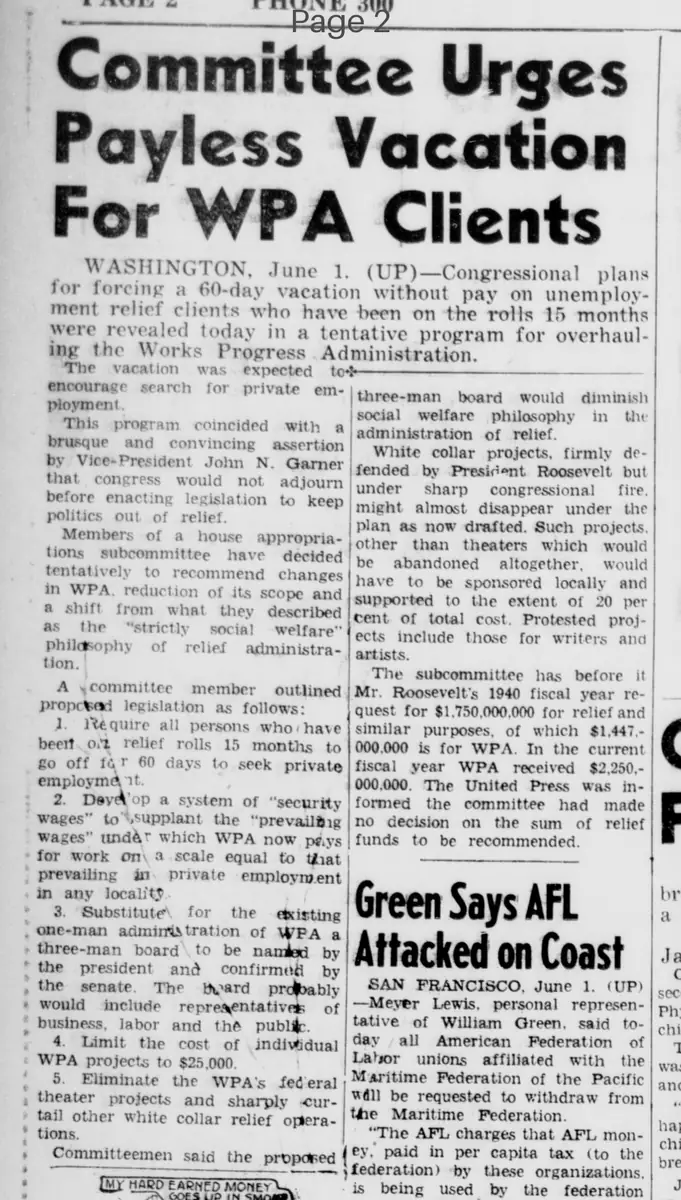
Committee Urges Payless Vacation For WPA Clients
WASHINGTON, June 1. (UP)—Congressional plans for forcing a 60-day vacation without pay on unemployment relief clients who have been on the rolls 15 months were revealed today in a tentative program for overhauling the Works Progress Administration.
The vacation was expected to encourage search for private employment.
This program coincided with brusque and convincing assertion by Vice-President John N. Garner that congress would not adjourn before enacting legislation to keep politics out of relief.
Members of a house appropriations subcommittee have decided tentatively to recommend changes in WPA, reduction of its scope and a shift from what they described as the "strictly social welfare" philosophy of relief administration.
A committee member outlined proposed legislation as follows:
1. Require all persons who have been on relief rolls 15 months to go off for 60 days to seek private employment.
2. Develop a system of "security wages" to supplant the "prevailing wages" under which WPA now pays for work on a scale equal to that prevailing in private employment in any locality.
3. Substitute for the existing one-man administration of WPA a three-man board to be named by the president and confirmed by the senate.
The board probably would include representatives of business, labor and the public.
4. Limit the cost of individual WPA projects to $25,000.
5. Eliminate the WPA's federal theater projects and sharply curtail other white collar relief operations.
Committeemen said the proposed three-man board would diminish social welfare philosophy in the administration of relief.
White collar projects, firmly defended by President Roosevelt but under sharp congressional fire, might almost disappear under the plan as now drafted. Such projects, other than theaters which would be abandoned altogether, would have to be sponsored locally and supported to the extent of 20 per cent of total cost. Protested projects include those for writers and artists.
The subcommittee has before it Mr. Roosevelt's 1940 fiscal year request for $1,750,000,000 for relief and similar purposes, of which $1,447,000,000 is for WPA. In the current fiscal year WPA received $2,250,000,000. The United Press was informed the committee had made no decision on the sum of relief funds to be recommended.
WASHINGTON, June 1. (UP)—Congressional plans for forcing a 60-day vacation without pay on unemployment relief clients who have been on the rolls 15 months were revealed today in a tentative program for overhauling the Works Progress Administration.
The vacation was expected to encourage search for private employment.
This program coincided with brusque and convincing assertion by Vice-President John N. Garner that congress would not adjourn before enacting legislation to keep politics out of relief.
Members of a house appropriations subcommittee have decided tentatively to recommend changes in WPA, reduction of its scope and a shift from what they described as the "strictly social welfare" philosophy of relief administration.
A committee member outlined proposed legislation as follows:
1. Require all persons who have been on relief rolls 15 months to go off for 60 days to seek private employment.
2. Develop a system of "security wages" to supplant the "prevailing wages" under which WPA now pays for work on a scale equal to that prevailing in private employment in any locality.
3. Substitute for the existing one-man administration of WPA a three-man board to be named by the president and confirmed by the senate.
The board probably would include representatives of business, labor and the public.
4. Limit the cost of individual WPA projects to $25,000.
5. Eliminate the WPA's federal theater projects and sharply curtail other white collar relief operations.
Committeemen said the proposed three-man board would diminish social welfare philosophy in the administration of relief.
White collar projects, firmly defended by President Roosevelt but under sharp congressional fire, might almost disappear under the plan as now drafted. Such projects, other than theaters which would be abandoned altogether, would have to be sponsored locally and supported to the extent of 20 per cent of total cost. Protested projects include those for writers and artists.
The subcommittee has before it Mr. Roosevelt's 1940 fiscal year request for $1,750,000,000 for relief and similar purposes, of which $1,447,000,000 is for WPA. In the current fiscal year WPA received $2,250,000,000. The United Press was informed the committee had made no decision on the sum of relief funds to be recommended.
What sub-type of article is it?
Historical Event
What themes does it cover?
Justice
Misfortune
What keywords are associated?
Wpa Reform
Unemployment Relief
Payless Vacation
Congressional Committee
Relief Administration
What entities or persons were involved?
John N. Garner
Franklin D. Roosevelt
Where did it happen?
Washington
Story Details
Key Persons
John N. Garner
Franklin D. Roosevelt
Location
Washington
Event Date
June 1
Story Details
Congressional subcommittee proposes WPA overhaul: 60-day payless vacation for relief clients on rolls 15 months to seek private jobs; shift to security wages; three-man board administration; project cost limits; elimination of federal theater and curtailment of white collar projects.