Thank you for visiting SNEWPapers!
Sign up free
The Midland Journal
Rising Sun, Cecil County, Maryland
What is this article about?
Old Salem, Massachusetts, famous for seafaring and Hawthorne, was central to early telephone history. Alexander Graham Bell experimented there and gave his first public demonstrations in 1877 at the Essex Institute, connecting to Boston via telegraph wires with assistant Thomas A. Watson. The city grew from 332 telephones in 1875 to 7601 by 1924.
Clipping
OCR Quality
Full Text
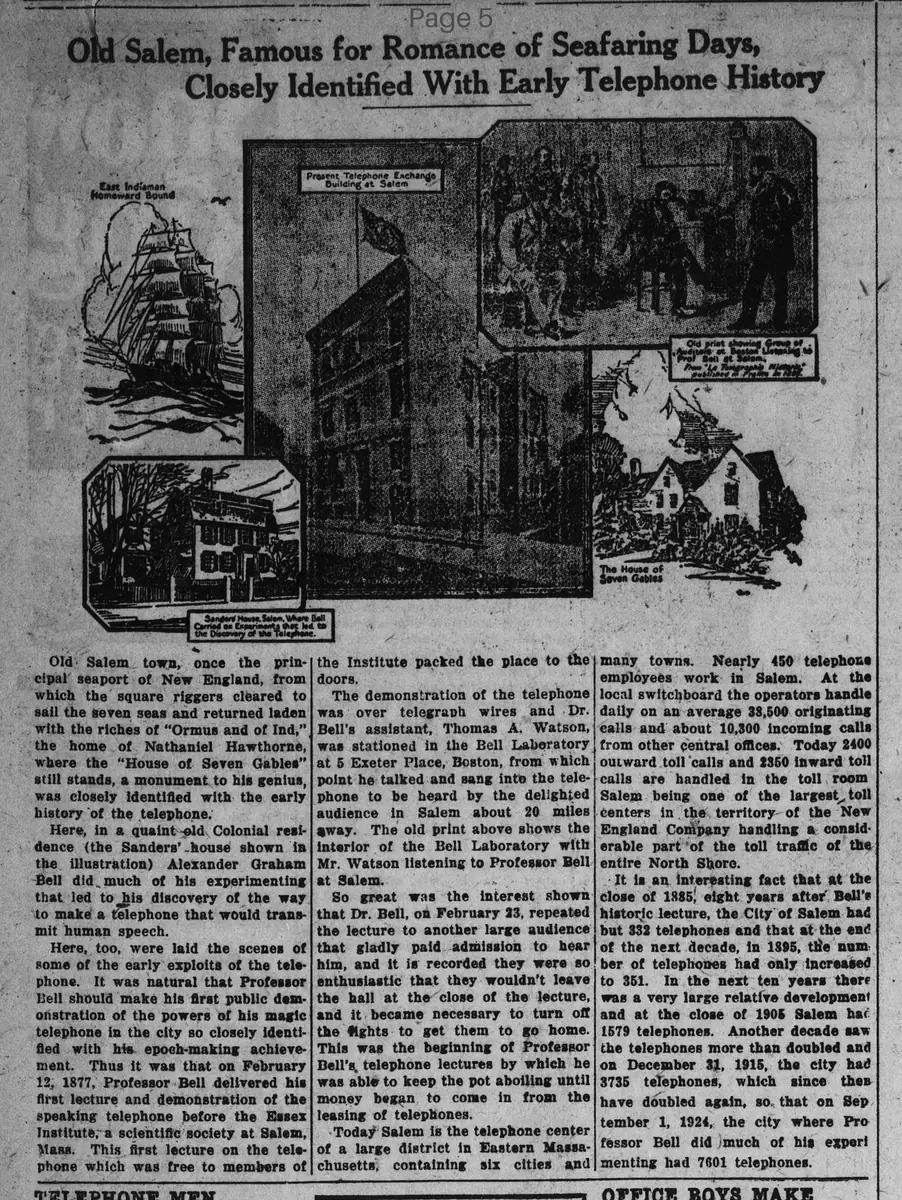
Old Salem town, once the principal seaport of New England, from which the square riggers cleared to sail the seven seas and returned laden with the riches of "Ormus and of Ind," the home of Nathaniel Hawthorne, where the "House of Seven Gables" still stands, a monument to his genius, was closely identified with the early history of the telephone.
Here, in a quaint old Colonial residence (the Sanders' house shown in the illustration) Alexander Graham Bell did much of his experimenting that led to his discovery of the way to make a telephone that would transmit human speech.
Here, too, were laid the scenes of some of the early exploits of the telephone. It was natural that Professor Bell should make his first public demonstration of the powers of his magic telephone in the city so closely identified with his epoch-making achievement. Thus it was that on February 12, 1877, Professor Bell delivered his first lecture and demonstration of the speaking telephone before the Essex Institute, a scientific society at Salem, Mass. This first lecture on the telephone which was free to members of the Institute packed the place to the doors.
The demonstration of the telephone was over telegraph wires and Dr. Bell's assistant, Thomas A. Watson, was stationed in the Bell Laboratory at 5 Exeter Place, Boston, from which point he talked and sang into the telephone to be heard by the delighted audience in Salem about 20 miles away. The old print above shows the interior of the Bell Laboratory with Mr. Watson listening to Professor Bell at Salem.
So great was the interest shown that Dr. Bell, on February 23, repeated the lecture to another large audience that gladly paid admission to hear him, and it is recorded they were so enthusiastic that they wouldn't leave the hall at the close of the lecture, and it became necessary to turn off the lights to get them to go home.
This was the beginning of Professor Bell's telephone lectures by which he was able to keep the pot aboiling until money began to come in from the leasing of telephones.
Today Salem is the telephone center of a large district in Eastern Massachusetts, containing six cities and many towns. Nearly 450 telephone employees work in Salem. At the local switchboard the operators handle daily on an average 38,500 originating calls and about 10,300 incoming calls from other central offices. Today 2400 outward toll calls and 2350 inward toll calls are handled in the toll room Salem, being one of the largest toll centers in the territory of the New England Company handling a considerable part of the toll traffic of the entire North Shore.
It is an interesting fact that at the close of 1875, eight years after Bell's historic lecture, the City of Salem had but 332 telephones and that at the end of the next decade, in 1885, the number of telephones had only increased to 351. In the next ten years there was a very large relative development and at the close of 1905 Salem had 1579 telephones. Another decade saw the telephones more than doubled and on December 31, 1915, the city had 3735 telephones, which since then have doubled again, so that on September 1, 1924, the city where Professor Bell did much of his experimenting had 7601 telephones.
What sub-type of article is it?
What themes does it cover?
What keywords are associated?
What entities or persons were involved?
Where did it happen?
Story Details
Key Persons
Location
Salem, Mass.; Boston
Event Date
February 12, 1877; February 23, 1877
Story Details
Alexander Graham Bell experimented on the telephone in Salem and gave his first public demonstrations there in 1877, connecting to assistant Thomas A. Watson in Boston, sparking enthusiasm and leading to the telephone's growth in the city from 332 in 1875 to 7601 by 1924.