Thank you for visiting SNEWPapers!
Sign up free
Domestic News
July 31, 1855
The Daily Union
Washington, District Of Columbia
What is this article about?
Overview of the organization, key personnel, and duties of the United States executive departments, including State, Attorney General's Office, Interior, Treasury, Navy, Post Office, and War, as of the mid-19th century.
Clipping
OCR Quality
75%
Good
Full Text
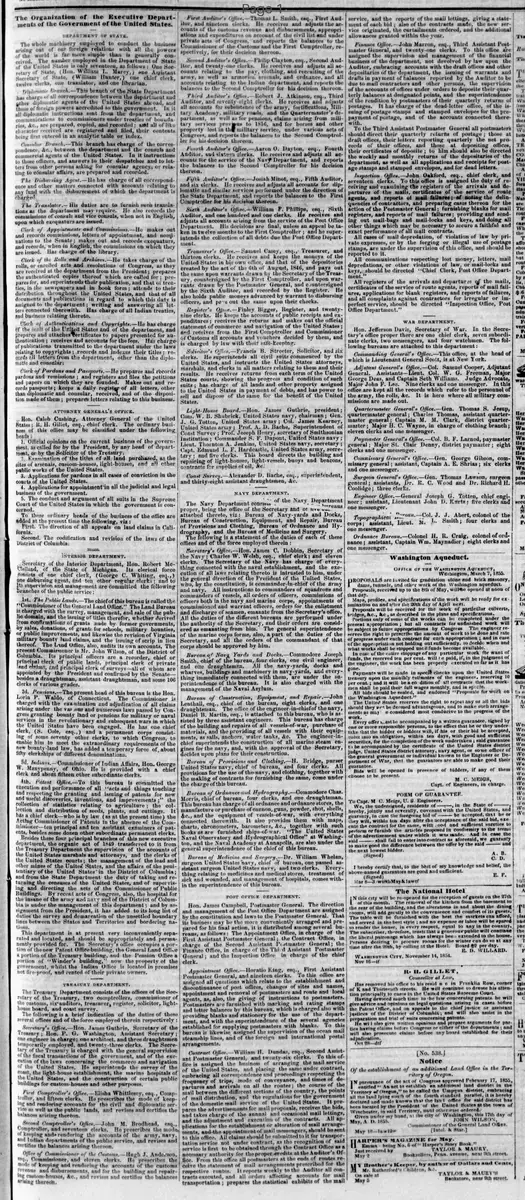
The Organization of the Executive Departments of the Government of the United States.
DEPARTMENT OF STATE.
The whole machinery employed to conduct the business arising out of our foreign relations with all the powers the world far more simple than generally conceived. The number employed in the Department of State of the United States is only seventeen, as follows: One Secretary of State, Hon. William Secretary of State, (William Hunter,) one chief clerk, twelve clerks, one translator, and one librarian.
Diplomatic Branch.-This branch of the State Department has charge of all correspondence between the department and other diplomatic agents of the United States abroad, and those of foreign powers accredited to this government. In it all diplomatic instructions sent from the department, and communications to commissioners under treaties of boundaries, &c., are prepared, copied, and recorded; and all of like character received are registered and filed, their contents being first entered in an analytic table or index.
Consular Branch.-This branch has charge of the correspondence, &c., between the department and the consuls and commercial agents of the United States. In it instructions to those officers, and answers to their despatches and to letters from other persons asking for consular agency, or relating to consular affairs, are prepared and recorded.
The Disbursing Agent.—He has charge of all correspondence and other matters connected with accounts relating to any fund with the disbursement of which the department is charged. The Translator.-His duties are to furnish such translations as the department may require. He also records the commissions of consuls and vice consuls, when not in English, upon which exequaturs are issued. Clerk of Appointments and Commissions.-He makes out and records commissions, letters of appointment, and nominations the Senate makes out and records exequaturs and records, when in English, the commissions on which they are issued. Has charge of the library.
Clerk of the Rolls and Archives.-He takes charge of the rolls, or enrolled acts and resolutions of Congress, as they are received at the department from the President; prepares the authenticated copies thereof which are called for; prepares for, and superintends their publication, and that of treaties, in the newspapers and in book form; attends to their distribution throughout the United States, and that of all documents and publications in regard to which this duty is assigned to the department; writing and answering all letters connected therewith. Has charge of all Indian treaties, and business relating thereto.
Clerk of Authentications and Copyrights.-He has charge of the seals of the United States and of the department, and prepares and attaches certificates to papers presented for authentication; receives and accounts for the fees. Has charge of publications transmitted to the department under the laws relating to copyrights; records and indexes their titles; records all letters from the department, other than the diplomatic and consular: Clerk of Pardons and Passports.-He prepares and records pardons and remissions; and registers and files the petitions and papers on which they are founded. Makes out and records passports; keeps a daily register of all letters, other than diplomatic and consular, received, and of the disposition made of them; prepares letters relating to this business.
ATTORNEY GENERAL'S OFFICE.
Hon. Caleb Cushing, Attorney General of the United States; R. H. Gillet, esq., chief clerk. The ordinary business of this office may be classified under the following heads: 1. Official opinions on the current business of the government, as called for by the President, by any head of department, or by the Solicitor of the Treasury. 2. Examination of the titles of all land purchased, as the sites of arsenals, custom-houses, light-houses, and all other public works of the United States. 3. Applications for pardons in all cases of conviction in the courts of the United States. 4. Applications for appointment in all the judicial and legal business of the government. 5. The conduct and argument of all suits in the Supreme Court of the United States in which the government is concerned. To these ordinary heads of the business of the office are added at the present time the following, viz; First. The direction of all appeals on land claims in California. Second. The codification and revision of the laws of the District of Columbia.
INTERIOR DEPARTMENT.
Secretary of the Interior Department, Hon. Robert McClelland, of the State of Michigan. Its clerical force consists of one chief clerk, (George C. Whiting, esq.,) one disbursing agent, and ten other regular clerks; and to its supervision and management are committed the following Branches of the public service:
1st. The Public Lands.—The chief of this bureau is called the "Commissioner of the General Land Office." The Land Bureau is charged with the survey, management, and sale of the public domain, and the issuing of titles therefor, whether derived from confirmations of grants made by former governments, by sales, donations, or grants for schools, military bounties, or public improvements, and likewise the revision of Virginia military bounty land claims, and the issuing of scrip in lieu thereof. The Land Office, also, audits its own accounts. The present Commissioner is Mr. John Wilson, of the District of Columbia. Its principal officers are a recorder, chief or principal clerk of public lands, principal clerk of private land claims, and principal clerk of surveys-all of whom are appointed by the President and confirmed by the Senate besides a draughtsman, assistant draughtsman, and some 106 clerks of various grades.
2d. Pensions.The present head of this bureau is the Hon. Lorin P. Waldo, of Connecticut. The Commissioner is charged with the examination and adjudication of all claims arising under the various and numerous laws passed by Congress granting bounty land or pensions for military or naval services in the revolutionary and subsequent wars in which the United States have been engaged. He has one chief clerk, (S. Cole, esq.,) and a permanent corps consisting of some seventy other clerks, to which Congress, to enable him to meet the extraordinary requirements of the new bounty-land law, has added a temporary force of about fifty clerkships of different denominations.
3d. Indians.-Commissioner of Indian Affairs, Hon. George W. Manypenny, of Ohio. He is provided with a chief clerk and about fifteen other subordinate clerks.
4th. Patent Office.--To this bureau is committed the execution and performance of all "acts and things touching and respecting the granting and issuing of patents for new and useful discoveries, inventions, and improvements;" the collection of statistics relating to agriculture; the collection and distribution of seeds, plants, and cuttings. It has a chief clerk-who is by law (as at the present time) the Acting Commissioner of Patents in the absence of the Commissioner—ten principal and ten assistant examiners of patents, besides some dozen other subordinate permanent clerks.
Besides these four principal branches of this new executive department, the organic act of 1849 transferred to it from the Treasury Department the supervision of the accounts of the United States marshals and attorneys, and the clerks of the United States courts: the management of the lead and other mines of the United States, and the affairs of the penitentiary of the United States in the District of Columbia; and from the State Department the duty of taking and returning the censuses of the United States, and of supervising and directing the acts of the Commissioner of Public Buildings. By recent acts of Congress, also, the hospital for the insane of the army and navy and of the District of Columbia is under the management of this department; and by assignment from the President, it has added to its long list of duties the survey and demarcation of the unsettled boundary lines between the States and Territories and bordering nations. This department is at present very inconveniently separated and located, and should be appropriately and permanently provided for. The Secretary's office occupies a portion of the new Patent Office building, the General Land Office a portion of the Treasury building, and the Pension Office a portion of "Winder's building," now the property of the government, whilst the Indian Office is located in premises not fire-proof, and rented of their private owners.
TREASURY DEPARTMENT.
The Treasury Department consists of the offices of the Secretary of the Treasury, two comptrollers, commissioner of the customs, six auditors, treasurer, register, solicitor, light-house board, and coast survey. The following is a brief indication of the duties of these several offices and of the force employed therein respectively:
Secretary's Office.-Hon. James Guthrie, Secretary of the Treasury; Hon. P. G. Washington, Assistant Secretary; one engineer in charge; one architect, and three draughtsmen temporarily employed and twenty-three clerks. The Secretary of the Treasury is charged with the general supervision of the fiscal transactions of the government, and of the execution of the laws concerning the commerce and navigation of the United States. He superintends the survey of the coast, the light-house establishment, the marine hospitals of the United States, and the construction of certain public buildings for custom-houses and other purposes.
First Comptroller's Office.—Elisha Whittlesey, esq., Comptroller, and fifteen clerks. He prescribes the mode of keeping and rendering accounts for the civil and diplomatic service as well as the public lands, and revises and certifies the balances arising thereon.
Second Comptroller's Office,-John M. Brodhead, esq., Comptroller, and seventeen clerks. He prescribes the mode of keeping and rendering the accounts of the army, navy, and Indian departments of the public service, and revises and certifies the balances arising thereon.
Office of Commissioner of the Customs.—Hugh J. Anderson, esq., Commissioner, and eleven clerks. He prescribes the mode of keeping and rendering the accounts of the customs revenue and disbursements, and for the building and repairing custom-houses, &c., and revises and certifies the balances arising thereon.
First Auditor's Office.-Thomas L. Smith, esq., First Auditor, and nineteen clerks. He receives and adjusts the accounts of the customs revenue and disbursements, appropriations and expenditures on account of the civil list and under private acts of Congress, and reports the balances to the Commissioner of the Customs and the First Comptroller, respectively, for their decision thereon.
Second Auditor's Office.-Philip Clayton, esq., Second Auditor, and twenty-one clerks. He receives and adjusts all accounts relating to the pay, clothing, and recruiting of the army, as well as armories, arsenals, and ordnance, and all accounts relating to the Indian department, and reports the balances to the Second Comptroller for his decision thereon.
Third Auditor's Office.-Robert J. Atkinson, esq., Third Auditor, and seventy-eight clerks. He receives and adjusts all accounts for subsistence of the army, fortifications, Military Academy, military roads, and the Quartermaster's department, as well as for pensions, claims arising from military services previous to 1816, and for horses and other property lost in the military service, under various acts of Congress, and reports the balances to the Second Comptroller for his decision thereon.
Fourth Auditor's Office.-Aaron O. Dayton, esq., Fourth Auditor, and thirteen clerks. He receives and adjusts all accounts for the service of the Navy Department, and reports the balances to the Second Comptroller for his decision thereon.
Fifth Auditor's Office.-Josiah Minot, esq., Fifth Auditor and six clerks. He receives and adjusts all accounts for diplomatic and similar services performed under the direction of the State Department, and reports the balances to the First Comptroller for his decision thereon.
Sixth Auditor's Office.-William F. Phillips, esq., Sixth Auditor, and one hundred and one clerks. He receives and adjusts all accounts arising from the service of the Post Office Department. His decisions are final, unless an appeal be taken in twelve months to the First Comptroller; and he superintends the collection of all debts due the Post Office Department.
Treasurer's Office.-Samuel Casey, esq., Treasurer, and thirteen clerks. He receives and keeps the moneys of the United States in his own office, and that of the depositories created by the act of the 6th of August, 1846, and pays out the same upon warrants drawn by the Secretary of the Treasury, countersigned by the First Comptroller, and upon warrants drawn by the Postmaster General, and countersigned by the Sixth Auditor, and recorded by the Register. He also holds public moneys advanced by warrant to disbursing officers, and pays out the same upon their checks.
Register's Office.-Finley Bigger, Register, and twenty-nine clerks. He keeps the accounts of public receipts and expenditures; receives the returns and makes out the official statement of commerce and navigation of the United States; and receives from the First Comptroller and Commissioner of Customs all accounts and vouchers decided by them, and is charged by law with their safe-keeping.
Solicitor's Office,—Francis B. Streeter, Solicitor, and six clerks. He superintends all civil suits commenced by the United States, and instructs the United States attorneys, marshals, and clerks in all matters relating to them and their results. He receives returns from each term of the United States courts, showing the progress and condition of such suits; has charge of all lands and other property assigned to the United States in payment of debts, and has power to sell and dispose of the same for the benefit of the United States.
Light-House Board.-Hon. James Guthrie, president; Com. W. B. Shubrick, United States navy, chairman; Gen. J. G. Totten, United States army; Col. James Kearney, United States army; Prof. A. D. Bache, Superintendent of Coast Survey; Prof. Joseph Henry, secretary of Smithsonian Institution; Commander S. F. Dupont, United States navy; Lieut. Thornton A. Jenkins, United States navy, secretary; Capt. Edmund L. F. Hardcastle, United States army, secretary; and five clerks. This board directs the building and repairing of light-houses, light-vessels, buoys and beacons, contracts for supplies of oil, &c.
Coast Survey.-Alexander D. Bache, esq., superintendent, and thirty-eight assistant draughtsmen, &c.
NAVY DEPARTMENT.
The Navy Department consists of the Navy Department proper, being the office of the Secretary and of five bureaus attached thereto, viz: Bureau of Navy-yards and Docks, Bureau of Construction, Equipment, and Repair, Bureau of Provisions and Clothing, Bureau of Ordnance and Hydrography, and the Bureau of Medicine and Surgery. The following is a statement of the duties of each of these offices and of the force employed therein:
Secretary's Office,--Hon. James C. Dobbin, Secretary of the Navy; Charles W. Welsh, esq., chief clerk; and eleven clerks. The Secretary of the Navy has charge of everything connected with the naval establishment, and the execution of all laws relating thereto is intrusted to him, under the general direction of the President of the United States, who, by the constitution, is commander-in-chief of the army and navy. All instructions to commanders of squadrons and commanders of vessels, all orders of officers, commissions of officers both in the navy and marine corps, appointments of commissioned and warrant officers, orders for the enlistment and discharge of seamen, emanate from the Secretary's office. All the duties of the different bureaus are performed under the authority of the Secretary, and their orders are considered as emanating from him. The general superintendence of the marine corps forms, also, a part of the duties of the Secretary, and all the orders of the commandant of that corps should be approved by him.
Bureau of Navy Yards and Docks.-Commodore Joseph Smith, chief of the bureau, four clerks, one civil engineer, and one draughtsman. All the navy-yards, docks and wharves, buildings and machinery in navy-yards, and everything immediately connected with them, are under the superintendence of this bureau. It is also charged with the management of the Naval Asylum.
Bureau of Construction, Equipment, and Repair.-John Lenthall, esq., chief of the bureau, eight clerks, and one draughtsman. The office of the engineer-in-chief of the navy, Daniel B. Martin, esq., is attached to this bureau, who is assisted by three assistant engineers. This bureau has charge of the building and repairs of all vessels-of-war, purchase of materials, and the providing of all vessels with their equipments, as sails, anchors, water tanks, &c. The engineer-in-chief superintends the construction of all marine steam engines for the navy, and, with the approval of the Secretary, decides upon plans for their construction.
Bureau of Provisions and Clothing.-H. Bridge, purser United States navy, chief of bureau, and four clerks. All provisions for the use of the navy, and clothing, together with the making of contracts for furnishing the same, come under the charge of this bureau.
Bureau of Ordnance and Hydrography.-Commodore Chas. Morris, chief of bureau, four clerks, and one draughtsman. This bureau has charge of all ordnance and ordnance stores, the manufacture or purchase of cannon, guns, powder, shot, shells, &c., and the equipment of vessels-of-war, with everything connected therewith. It also provides them with maps, charts, chronometers, barometers, &c., together with such books as are furnished ships-of-war. "The United States Naval Observatory and Hydrographical Office" at Washington, and the Naval Academy at Annapolis, are also under the general superintendence of the chief of this bureau.
Bureau of Medicine and Surgery.-Dr. William Whelan, surgeon United States navy, chief of bureau, one passed assistant surgeon United States navy, and two clerks. Everything relating to medicines and medical stores, treatment of sick and wounded, and management of hospitals, comes within the superintendence of this bureau.
POST OFFICE DEPARTMENT.
Hon. James Campbell, Postmaster General. The direction and management of the Post Office Department are assigned by the constitution and laws to the Postmaster General. That its business may be the more conveniently arranged and prepared for his final action, it is distributed among several bureaus, as follows: The Appointment Office, in charge of the First Assistant Postmaster General; the Contract Office, in charge of the Second Assistant Postmaster General; the Finance Office, in charge of the Third Assistant Postmaster General; and the Inspection Office in charge of the chief clerk.
Appointment Office.-Horatio King, esq., First Assistant Postmaster General, and nineteen clerks. To this office are assigned all questions which relate to the establishment and appointment and removal of postmasters and route and local agents, as, also, the giving of instructions to postmasters, providing blanks and stationery for the use of the department, and with the superintendence of the several agencies established for supplying postmasters with blanks. To this bureau is likewise assigned the supervision of the ocean mail steamship lines, and of the foreign and international postal arrangements of the United States.
Contract Office.-Second Assistant Postmaster General, and twenty-six clerks. To this office is assigned the business of arranging the mail service and placing the same under contract, embracing all correspondence and proceedings respecting the frequency of trips, mode of conveyance, and times of departures and arrivals on all the routes; the course of the mail between the different sections of the country, the points of mail distribution, and the regulations for the government of the domestic mail service of the United States. It prepares the advertisements for mail proposals, receives the bids, and takes charge of the annual and occasional mail lettings, and the adjustment and execution of the contracts. All applications for the establishment or alteration of mail arrangements, and the appointment of mail messengers, should be sent to this office. All claims should be submitted to it for transportation service not under contract, as the recognition of said service is first to be obtained through the Contract Office as a necessary authority for the proper credits at the Auditor's Office. From this office all postmasters at the ends of routes receive the statement of mail arrangements prescribed for the respective routes. It reports weekly to the Auditor all contracts executed, and all orders affecting accounts for mail transportation; prepares the statistical exhibits of the mail service, and the reports of the mail lettings, giving a statement of each bid; also of the contracts made, the new service originated, the curtailments ordered, and the additional allowances granted within the year.
Finance Office.-John Marron, esq., Third Assistant Postmaster General, and twenty-one clerks. To this office are assigned the supervision and management of the financial business of the department, not devolved by law upon the Auditor, embracing accounts with the draft offices and other depositaries of the department, the issuing of warrants and drafts in payment of balances reported by the Auditor to be due to mail contractors and other persons, the supervision of the accounts of offices under orders to deposit their quarterly balances at designated points, and the superintendence of the rendition by postmasters of their quarterly returns of postages. It has charge of the dead-letter office, of the issuing of postage stamps and stamped envelopes for the prepayment of postage, and of the accounts connected therewith. To the Third Assistant Postmaster General all postmasters should direct their quarterly returns of postage; those at draft offices, their letters reporting quarterly the net proceeds of their offices, and those at depositing offices, their certificates of deposit; to him should also be directed the weekly and monthly returns of the depositaries of the department, as well as all applications and receipts for postage stamps and stamped envelopes, and for dead letters.
Inspection Office.—John Oakford, esq., chief clerk, and seventeen clerks. To this office is assigned the duty of receiving and examining the registers of the arrivals and departures of the mails, certificates of the service of route agents, and reports of mail failures; of noting the delinquencies of contractors, and preparing cases thereon for the action of the Postmaster General; furnishing blanks for mail registers, and reports of mail failures; providing and sending out mail-bags and mail-locks and keys, and doing all other things which may be necessary to secure a faithful and exact performance of all mail contracts. All cases of mail depredation, of violation of law by private expresses, or by the forging or illegal use of postage stamps, come under the cognizance of this office, and should be reported to it. All communications respecting lost money, letters, mail depredations, or other violations of law, or mail-locks and keys, should be directed 'Chief Clerk, Post Office Department.' All registers of the arrivals and departures of the mails, certificates of the service of route agents, reports of mail failures, applications for blank registers, and reports of failures, and all complaints against contractors for irregular or imperfect service, should be directed "Inspection Office, Post Office Department."
WAR DEPARTMENT.
Hon. Jefferson Davis, Secretary of War. In the Secretary's office proper there are one chief clerk, seven subordinate clerks, two messengers, and four watchmen. The following bureaus are attached to this department:
Commanding General's Office.-This office, at the head of which is Lieutenant General Scott, is at New York.
Adjutant General's Office.-Col. Samuel Cooper, Adjutant General. Assistants-Lieut. Col. W. G. Freeman, Major George Deas, and Captain Seth Williams. Judge Advocate, Major John F. Lee. Nine clerks and one messenger. In this office are kept all the records which refer to the personnel of the army, the rolls, &c. It is here where all military commissions are made out.
Quartermaster General's Office.-Gen. Thomas S. Jesup, quartermaster general; Charles Thomas, assistant quartermaster general; Captain M. M. Clark, district quartermaster; Major H. C. Wayne, in charge of clothing branch; eleven clerks and one messenger.
Paymaster General's Office.--Col. B. F. Larned, paymaster general; Major St. Clair Denny, district paymaster; eight clerks and one messenger.
Commissary General's Office.-Gen. George Gibson, commissary general; assistant, Captain A. E. Shiras; six clerks and one messenger.
Surgeon General's Office.-Gen. Thomas Lawson, surgeon general; assistants, Dr. R. C. Wood and Dr. Richard H. Coolidge; three clerks.
Engineer Office.-General Joseph G. Totten, chief engineer; assistant, Lieutenant John D. Kurtz; five clerks and one messenger.
Topographical Bureau.—Col. J. J. Abert, colonel of the corps; assistant, Lieut. M. L. Smith; four clerks and one messenger.
Ordnance Bureau.-Colonel H. R. Craig, colonel of ordnance; assistant, Captain Wm. Maynadier; eight clerks and one messenger.
Washington Aqueduct.
DEPARTMENT OF STATE.
The whole machinery employed to conduct the business arising out of our foreign relations with all the powers the world far more simple than generally conceived. The number employed in the Department of State of the United States is only seventeen, as follows: One Secretary of State, Hon. William Secretary of State, (William Hunter,) one chief clerk, twelve clerks, one translator, and one librarian.
Diplomatic Branch.-This branch of the State Department has charge of all correspondence between the department and other diplomatic agents of the United States abroad, and those of foreign powers accredited to this government. In it all diplomatic instructions sent from the department, and communications to commissioners under treaties of boundaries, &c., are prepared, copied, and recorded; and all of like character received are registered and filed, their contents being first entered in an analytic table or index.
Consular Branch.-This branch has charge of the correspondence, &c., between the department and the consuls and commercial agents of the United States. In it instructions to those officers, and answers to their despatches and to letters from other persons asking for consular agency, or relating to consular affairs, are prepared and recorded.
The Disbursing Agent.—He has charge of all correspondence and other matters connected with accounts relating to any fund with the disbursement of which the department is charged. The Translator.-His duties are to furnish such translations as the department may require. He also records the commissions of consuls and vice consuls, when not in English, upon which exequaturs are issued. Clerk of Appointments and Commissions.-He makes out and records commissions, letters of appointment, and nominations the Senate makes out and records exequaturs and records, when in English, the commissions on which they are issued. Has charge of the library.
Clerk of the Rolls and Archives.-He takes charge of the rolls, or enrolled acts and resolutions of Congress, as they are received at the department from the President; prepares the authenticated copies thereof which are called for; prepares for, and superintends their publication, and that of treaties, in the newspapers and in book form; attends to their distribution throughout the United States, and that of all documents and publications in regard to which this duty is assigned to the department; writing and answering all letters connected therewith. Has charge of all Indian treaties, and business relating thereto.
Clerk of Authentications and Copyrights.-He has charge of the seals of the United States and of the department, and prepares and attaches certificates to papers presented for authentication; receives and accounts for the fees. Has charge of publications transmitted to the department under the laws relating to copyrights; records and indexes their titles; records all letters from the department, other than the diplomatic and consular: Clerk of Pardons and Passports.-He prepares and records pardons and remissions; and registers and files the petitions and papers on which they are founded. Makes out and records passports; keeps a daily register of all letters, other than diplomatic and consular, received, and of the disposition made of them; prepares letters relating to this business.
ATTORNEY GENERAL'S OFFICE.
Hon. Caleb Cushing, Attorney General of the United States; R. H. Gillet, esq., chief clerk. The ordinary business of this office may be classified under the following heads: 1. Official opinions on the current business of the government, as called for by the President, by any head of department, or by the Solicitor of the Treasury. 2. Examination of the titles of all land purchased, as the sites of arsenals, custom-houses, light-houses, and all other public works of the United States. 3. Applications for pardons in all cases of conviction in the courts of the United States. 4. Applications for appointment in all the judicial and legal business of the government. 5. The conduct and argument of all suits in the Supreme Court of the United States in which the government is concerned. To these ordinary heads of the business of the office are added at the present time the following, viz; First. The direction of all appeals on land claims in California. Second. The codification and revision of the laws of the District of Columbia.
INTERIOR DEPARTMENT.
Secretary of the Interior Department, Hon. Robert McClelland, of the State of Michigan. Its clerical force consists of one chief clerk, (George C. Whiting, esq.,) one disbursing agent, and ten other regular clerks; and to its supervision and management are committed the following Branches of the public service:
1st. The Public Lands.—The chief of this bureau is called the "Commissioner of the General Land Office." The Land Bureau is charged with the survey, management, and sale of the public domain, and the issuing of titles therefor, whether derived from confirmations of grants made by former governments, by sales, donations, or grants for schools, military bounties, or public improvements, and likewise the revision of Virginia military bounty land claims, and the issuing of scrip in lieu thereof. The Land Office, also, audits its own accounts. The present Commissioner is Mr. John Wilson, of the District of Columbia. Its principal officers are a recorder, chief or principal clerk of public lands, principal clerk of private land claims, and principal clerk of surveys-all of whom are appointed by the President and confirmed by the Senate besides a draughtsman, assistant draughtsman, and some 106 clerks of various grades.
2d. Pensions.The present head of this bureau is the Hon. Lorin P. Waldo, of Connecticut. The Commissioner is charged with the examination and adjudication of all claims arising under the various and numerous laws passed by Congress granting bounty land or pensions for military or naval services in the revolutionary and subsequent wars in which the United States have been engaged. He has one chief clerk, (S. Cole, esq.,) and a permanent corps consisting of some seventy other clerks, to which Congress, to enable him to meet the extraordinary requirements of the new bounty-land law, has added a temporary force of about fifty clerkships of different denominations.
3d. Indians.-Commissioner of Indian Affairs, Hon. George W. Manypenny, of Ohio. He is provided with a chief clerk and about fifteen other subordinate clerks.
4th. Patent Office.--To this bureau is committed the execution and performance of all "acts and things touching and respecting the granting and issuing of patents for new and useful discoveries, inventions, and improvements;" the collection of statistics relating to agriculture; the collection and distribution of seeds, plants, and cuttings. It has a chief clerk-who is by law (as at the present time) the Acting Commissioner of Patents in the absence of the Commissioner—ten principal and ten assistant examiners of patents, besides some dozen other subordinate permanent clerks.
Besides these four principal branches of this new executive department, the organic act of 1849 transferred to it from the Treasury Department the supervision of the accounts of the United States marshals and attorneys, and the clerks of the United States courts: the management of the lead and other mines of the United States, and the affairs of the penitentiary of the United States in the District of Columbia; and from the State Department the duty of taking and returning the censuses of the United States, and of supervising and directing the acts of the Commissioner of Public Buildings. By recent acts of Congress, also, the hospital for the insane of the army and navy and of the District of Columbia is under the management of this department; and by assignment from the President, it has added to its long list of duties the survey and demarcation of the unsettled boundary lines between the States and Territories and bordering nations. This department is at present very inconveniently separated and located, and should be appropriately and permanently provided for. The Secretary's office occupies a portion of the new Patent Office building, the General Land Office a portion of the Treasury building, and the Pension Office a portion of "Winder's building," now the property of the government, whilst the Indian Office is located in premises not fire-proof, and rented of their private owners.
TREASURY DEPARTMENT.
The Treasury Department consists of the offices of the Secretary of the Treasury, two comptrollers, commissioner of the customs, six auditors, treasurer, register, solicitor, light-house board, and coast survey. The following is a brief indication of the duties of these several offices and of the force employed therein respectively:
Secretary's Office.-Hon. James Guthrie, Secretary of the Treasury; Hon. P. G. Washington, Assistant Secretary; one engineer in charge; one architect, and three draughtsmen temporarily employed and twenty-three clerks. The Secretary of the Treasury is charged with the general supervision of the fiscal transactions of the government, and of the execution of the laws concerning the commerce and navigation of the United States. He superintends the survey of the coast, the light-house establishment, the marine hospitals of the United States, and the construction of certain public buildings for custom-houses and other purposes.
First Comptroller's Office.—Elisha Whittlesey, esq., Comptroller, and fifteen clerks. He prescribes the mode of keeping and rendering accounts for the civil and diplomatic service as well as the public lands, and revises and certifies the balances arising thereon.
Second Comptroller's Office,-John M. Brodhead, esq., Comptroller, and seventeen clerks. He prescribes the mode of keeping and rendering the accounts of the army, navy, and Indian departments of the public service, and revises and certifies the balances arising thereon.
Office of Commissioner of the Customs.—Hugh J. Anderson, esq., Commissioner, and eleven clerks. He prescribes the mode of keeping and rendering the accounts of the customs revenue and disbursements, and for the building and repairing custom-houses, &c., and revises and certifies the balances arising thereon.
First Auditor's Office.-Thomas L. Smith, esq., First Auditor, and nineteen clerks. He receives and adjusts the accounts of the customs revenue and disbursements, appropriations and expenditures on account of the civil list and under private acts of Congress, and reports the balances to the Commissioner of the Customs and the First Comptroller, respectively, for their decision thereon.
Second Auditor's Office.-Philip Clayton, esq., Second Auditor, and twenty-one clerks. He receives and adjusts all accounts relating to the pay, clothing, and recruiting of the army, as well as armories, arsenals, and ordnance, and all accounts relating to the Indian department, and reports the balances to the Second Comptroller for his decision thereon.
Third Auditor's Office.-Robert J. Atkinson, esq., Third Auditor, and seventy-eight clerks. He receives and adjusts all accounts for subsistence of the army, fortifications, Military Academy, military roads, and the Quartermaster's department, as well as for pensions, claims arising from military services previous to 1816, and for horses and other property lost in the military service, under various acts of Congress, and reports the balances to the Second Comptroller for his decision thereon.
Fourth Auditor's Office.-Aaron O. Dayton, esq., Fourth Auditor, and thirteen clerks. He receives and adjusts all accounts for the service of the Navy Department, and reports the balances to the Second Comptroller for his decision thereon.
Fifth Auditor's Office.-Josiah Minot, esq., Fifth Auditor and six clerks. He receives and adjusts all accounts for diplomatic and similar services performed under the direction of the State Department, and reports the balances to the First Comptroller for his decision thereon.
Sixth Auditor's Office.-William F. Phillips, esq., Sixth Auditor, and one hundred and one clerks. He receives and adjusts all accounts arising from the service of the Post Office Department. His decisions are final, unless an appeal be taken in twelve months to the First Comptroller; and he superintends the collection of all debts due the Post Office Department.
Treasurer's Office.-Samuel Casey, esq., Treasurer, and thirteen clerks. He receives and keeps the moneys of the United States in his own office, and that of the depositories created by the act of the 6th of August, 1846, and pays out the same upon warrants drawn by the Secretary of the Treasury, countersigned by the First Comptroller, and upon warrants drawn by the Postmaster General, and countersigned by the Sixth Auditor, and recorded by the Register. He also holds public moneys advanced by warrant to disbursing officers, and pays out the same upon their checks.
Register's Office.-Finley Bigger, Register, and twenty-nine clerks. He keeps the accounts of public receipts and expenditures; receives the returns and makes out the official statement of commerce and navigation of the United States; and receives from the First Comptroller and Commissioner of Customs all accounts and vouchers decided by them, and is charged by law with their safe-keeping.
Solicitor's Office,—Francis B. Streeter, Solicitor, and six clerks. He superintends all civil suits commenced by the United States, and instructs the United States attorneys, marshals, and clerks in all matters relating to them and their results. He receives returns from each term of the United States courts, showing the progress and condition of such suits; has charge of all lands and other property assigned to the United States in payment of debts, and has power to sell and dispose of the same for the benefit of the United States.
Light-House Board.-Hon. James Guthrie, president; Com. W. B. Shubrick, United States navy, chairman; Gen. J. G. Totten, United States army; Col. James Kearney, United States army; Prof. A. D. Bache, Superintendent of Coast Survey; Prof. Joseph Henry, secretary of Smithsonian Institution; Commander S. F. Dupont, United States navy; Lieut. Thornton A. Jenkins, United States navy, secretary; Capt. Edmund L. F. Hardcastle, United States army, secretary; and five clerks. This board directs the building and repairing of light-houses, light-vessels, buoys and beacons, contracts for supplies of oil, &c.
Coast Survey.-Alexander D. Bache, esq., superintendent, and thirty-eight assistant draughtsmen, &c.
NAVY DEPARTMENT.
The Navy Department consists of the Navy Department proper, being the office of the Secretary and of five bureaus attached thereto, viz: Bureau of Navy-yards and Docks, Bureau of Construction, Equipment, and Repair, Bureau of Provisions and Clothing, Bureau of Ordnance and Hydrography, and the Bureau of Medicine and Surgery. The following is a statement of the duties of each of these offices and of the force employed therein:
Secretary's Office,--Hon. James C. Dobbin, Secretary of the Navy; Charles W. Welsh, esq., chief clerk; and eleven clerks. The Secretary of the Navy has charge of everything connected with the naval establishment, and the execution of all laws relating thereto is intrusted to him, under the general direction of the President of the United States, who, by the constitution, is commander-in-chief of the army and navy. All instructions to commanders of squadrons and commanders of vessels, all orders of officers, commissions of officers both in the navy and marine corps, appointments of commissioned and warrant officers, orders for the enlistment and discharge of seamen, emanate from the Secretary's office. All the duties of the different bureaus are performed under the authority of the Secretary, and their orders are considered as emanating from him. The general superintendence of the marine corps forms, also, a part of the duties of the Secretary, and all the orders of the commandant of that corps should be approved by him.
Bureau of Navy Yards and Docks.-Commodore Joseph Smith, chief of the bureau, four clerks, one civil engineer, and one draughtsman. All the navy-yards, docks and wharves, buildings and machinery in navy-yards, and everything immediately connected with them, are under the superintendence of this bureau. It is also charged with the management of the Naval Asylum.
Bureau of Construction, Equipment, and Repair.-John Lenthall, esq., chief of the bureau, eight clerks, and one draughtsman. The office of the engineer-in-chief of the navy, Daniel B. Martin, esq., is attached to this bureau, who is assisted by three assistant engineers. This bureau has charge of the building and repairs of all vessels-of-war, purchase of materials, and the providing of all vessels with their equipments, as sails, anchors, water tanks, &c. The engineer-in-chief superintends the construction of all marine steam engines for the navy, and, with the approval of the Secretary, decides upon plans for their construction.
Bureau of Provisions and Clothing.-H. Bridge, purser United States navy, chief of bureau, and four clerks. All provisions for the use of the navy, and clothing, together with the making of contracts for furnishing the same, come under the charge of this bureau.
Bureau of Ordnance and Hydrography.-Commodore Chas. Morris, chief of bureau, four clerks, and one draughtsman. This bureau has charge of all ordnance and ordnance stores, the manufacture or purchase of cannon, guns, powder, shot, shells, &c., and the equipment of vessels-of-war, with everything connected therewith. It also provides them with maps, charts, chronometers, barometers, &c., together with such books as are furnished ships-of-war. "The United States Naval Observatory and Hydrographical Office" at Washington, and the Naval Academy at Annapolis, are also under the general superintendence of the chief of this bureau.
Bureau of Medicine and Surgery.-Dr. William Whelan, surgeon United States navy, chief of bureau, one passed assistant surgeon United States navy, and two clerks. Everything relating to medicines and medical stores, treatment of sick and wounded, and management of hospitals, comes within the superintendence of this bureau.
POST OFFICE DEPARTMENT.
Hon. James Campbell, Postmaster General. The direction and management of the Post Office Department are assigned by the constitution and laws to the Postmaster General. That its business may be the more conveniently arranged and prepared for his final action, it is distributed among several bureaus, as follows: The Appointment Office, in charge of the First Assistant Postmaster General; the Contract Office, in charge of the Second Assistant Postmaster General; the Finance Office, in charge of the Third Assistant Postmaster General; and the Inspection Office in charge of the chief clerk.
Appointment Office.-Horatio King, esq., First Assistant Postmaster General, and nineteen clerks. To this office are assigned all questions which relate to the establishment and appointment and removal of postmasters and route and local agents, as, also, the giving of instructions to postmasters, providing blanks and stationery for the use of the department, and with the superintendence of the several agencies established for supplying postmasters with blanks. To this bureau is likewise assigned the supervision of the ocean mail steamship lines, and of the foreign and international postal arrangements of the United States.
Contract Office.-Second Assistant Postmaster General, and twenty-six clerks. To this office is assigned the business of arranging the mail service and placing the same under contract, embracing all correspondence and proceedings respecting the frequency of trips, mode of conveyance, and times of departures and arrivals on all the routes; the course of the mail between the different sections of the country, the points of mail distribution, and the regulations for the government of the domestic mail service of the United States. It prepares the advertisements for mail proposals, receives the bids, and takes charge of the annual and occasional mail lettings, and the adjustment and execution of the contracts. All applications for the establishment or alteration of mail arrangements, and the appointment of mail messengers, should be sent to this office. All claims should be submitted to it for transportation service not under contract, as the recognition of said service is first to be obtained through the Contract Office as a necessary authority for the proper credits at the Auditor's Office. From this office all postmasters at the ends of routes receive the statement of mail arrangements prescribed for the respective routes. It reports weekly to the Auditor all contracts executed, and all orders affecting accounts for mail transportation; prepares the statistical exhibits of the mail service, and the reports of the mail lettings, giving a statement of each bid; also of the contracts made, the new service originated, the curtailments ordered, and the additional allowances granted within the year.
Finance Office.-John Marron, esq., Third Assistant Postmaster General, and twenty-one clerks. To this office are assigned the supervision and management of the financial business of the department, not devolved by law upon the Auditor, embracing accounts with the draft offices and other depositaries of the department, the issuing of warrants and drafts in payment of balances reported by the Auditor to be due to mail contractors and other persons, the supervision of the accounts of offices under orders to deposit their quarterly balances at designated points, and the superintendence of the rendition by postmasters of their quarterly returns of postages. It has charge of the dead-letter office, of the issuing of postage stamps and stamped envelopes for the prepayment of postage, and of the accounts connected therewith. To the Third Assistant Postmaster General all postmasters should direct their quarterly returns of postage; those at draft offices, their letters reporting quarterly the net proceeds of their offices, and those at depositing offices, their certificates of deposit; to him should also be directed the weekly and monthly returns of the depositaries of the department, as well as all applications and receipts for postage stamps and stamped envelopes, and for dead letters.
Inspection Office.—John Oakford, esq., chief clerk, and seventeen clerks. To this office is assigned the duty of receiving and examining the registers of the arrivals and departures of the mails, certificates of the service of route agents, and reports of mail failures; of noting the delinquencies of contractors, and preparing cases thereon for the action of the Postmaster General; furnishing blanks for mail registers, and reports of mail failures; providing and sending out mail-bags and mail-locks and keys, and doing all other things which may be necessary to secure a faithful and exact performance of all mail contracts. All cases of mail depredation, of violation of law by private expresses, or by the forging or illegal use of postage stamps, come under the cognizance of this office, and should be reported to it. All communications respecting lost money, letters, mail depredations, or other violations of law, or mail-locks and keys, should be directed 'Chief Clerk, Post Office Department.' All registers of the arrivals and departures of the mails, certificates of the service of route agents, reports of mail failures, applications for blank registers, and reports of failures, and all complaints against contractors for irregular or imperfect service, should be directed "Inspection Office, Post Office Department."
WAR DEPARTMENT.
Hon. Jefferson Davis, Secretary of War. In the Secretary's office proper there are one chief clerk, seven subordinate clerks, two messengers, and four watchmen. The following bureaus are attached to this department:
Commanding General's Office.-This office, at the head of which is Lieutenant General Scott, is at New York.
Adjutant General's Office.-Col. Samuel Cooper, Adjutant General. Assistants-Lieut. Col. W. G. Freeman, Major George Deas, and Captain Seth Williams. Judge Advocate, Major John F. Lee. Nine clerks and one messenger. In this office are kept all the records which refer to the personnel of the army, the rolls, &c. It is here where all military commissions are made out.
Quartermaster General's Office.-Gen. Thomas S. Jesup, quartermaster general; Charles Thomas, assistant quartermaster general; Captain M. M. Clark, district quartermaster; Major H. C. Wayne, in charge of clothing branch; eleven clerks and one messenger.
Paymaster General's Office.--Col. B. F. Larned, paymaster general; Major St. Clair Denny, district paymaster; eight clerks and one messenger.
Commissary General's Office.-Gen. George Gibson, commissary general; assistant, Captain A. E. Shiras; six clerks and one messenger.
Surgeon General's Office.-Gen. Thomas Lawson, surgeon general; assistants, Dr. R. C. Wood and Dr. Richard H. Coolidge; three clerks.
Engineer Office.-General Joseph G. Totten, chief engineer; assistant, Lieutenant John D. Kurtz; five clerks and one messenger.
Topographical Bureau.—Col. J. J. Abert, colonel of the corps; assistant, Lieut. M. L. Smith; four clerks and one messenger.
Ordnance Bureau.-Colonel H. R. Craig, colonel of ordnance; assistant, Captain Wm. Maynadier; eight clerks and one messenger.
Washington Aqueduct.
What sub-type of article is it?
Politics
Appointment
What keywords are associated?
Executive Departments
Us Government
Secretaries
Bureaus
Clerical Staff
Duties
Appointments
What entities or persons were involved?
William Hunter
Caleb Cushing
Robert Mcclelland
James Guthrie
James C. Dobbin
James Campbell
Jefferson Davis
George W. Manypenny
Lorin P. Waldo
John Wilson
Where did it happen?
United States
Domestic News Details
Primary Location
United States
Key Persons
William Hunter
Caleb Cushing
Robert Mcclelland
James Guthrie
James C. Dobbin
James Campbell
Jefferson Davis
George W. Manypenny
Lorin P. Waldo
John Wilson
Event Details
Detailed description of the structure, key personnel, clerical forces, and specific duties of the executive departments of the United States government, covering foreign relations, legal opinions, public lands, pensions, Indian affairs, patents, fiscal transactions, naval operations, postal services, and military administration.