Thank you for visiting SNEWPapers!
Sign up free
Story
December 4, 1880
The Ottawa Free Trader
Ottawa, La Salle County County, Illinois
What is this article about?
A British narrator discovers his respectable friend Simpson has four Persian wives in Bussora, acquired through a picnic flirtation, cultural pressures, and to quell household strife by marrying a strong protector for the vulnerable third wife.
Clipping
OCR Quality
95%
Excellent
Full Text
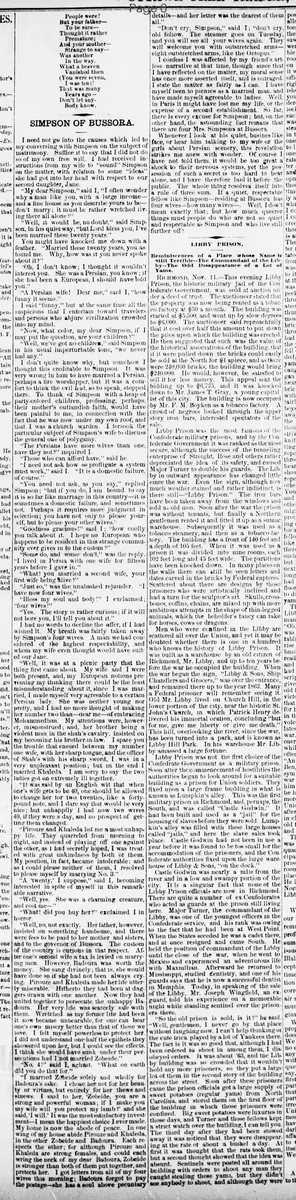
SIMPSON OF BUSSORA.
I need not go into the causes which led to my conversing with Simpson on the subject of matrimony. Suffice it to say that I did not do so of my own free will. I had received instructions from my wife to "sound" Simpson on the matter, with relation to some "ideas" she had got into her head with respect to our second daughter, Jane.
"My dear Simpson," said I, "I often wonder why a man like you, with a large income—and a fine house as you describe yours to be—don't marry; it must be rather wretched living there all alone?"
"Well, it would be, no doubt," said Simpson, in his quiet way, "but Lord bless you, I've been married these twenty years."
You might have knocked me down with a feather. "Married these twenty years, you astound me. Why, how was it you never spoke about it?"
"Oh, I don't know; I thought it wouldn't interest you. She was a Persian, you know; if she had been a European, I should have told you."
"A Persian wife! Dear me," said I, "how funny it seems."
I said "funny," but at the same time all the suspicions that I entertain toward travelers and persons who abjure civilization crowded into my mind.
"Now, what color, my dear Simpson, if I may put the question, are your children?"
"Well, we've got no children," said Simpson in his usual imperturbable tone, "we never had any."
I don't quite know why, but somehow I thought this creditable to Simpson. It was very wrong in him to have married a Persian, perhaps a fire worshipper, but it was a comfort to think the evil had, so to speak, stopped there. To think of Simpson with a heap of party-colored children, professing, perhaps, their mother's outlandish faith, would have been painful to me, in connection with the fact that he was now under my own roof, and that I was a church warden. I forsook the particular subject of Simpson's wife to discuss the general one of polygamy.
"The Persians have more wives than one, have they not?" inquired I.
"Those who can afford have," said he.
"I need not ask how so profligate a system must work," said I. "It is a domestic failure, of course."
"You need not ask, as you say," replied Simpson: "but if you do, I am bound to say it is so far like marriage in this country—it is sometimes a domestic failure, and sometimes not. Perhaps it requires more judgment in selection; you have not only to please yourself, but to please your other wives."
"Goodness gracious!" said I; "how coolly you talk about it. I hope no European who happens to be resident in this strange community ever gives in to the custom?"
"Some do, and some don't," was the reply.
"I lived in Persia with one wife for fifteen years before I gave in."
"What! you married a second wife, your first wife being alive?"
"Just so," was the unabashed rejoinder. "I have now four wives."
"Bless my soul and body!" I exclaimed, "four wives!"
"Yes. The story is rather curious: if it will not bore you, I'll tell you about it."
I had no words to decline the offer, if I had wished it. My breath was fairly taken away by Simpson's four wives. A man we had considered of the highest respectability, and whom my wife even thought would have suited our Jane.
"Well, it was at a picnic party that the thing first came about. My wife and I were both present, and, my European notions preventing my thinking there could be the least misunderstanding about it, since I was married, I made myself very agreeable to a certain Persian lady. She was neither young nor pretty, and I had no more thought of making her number two than—dear me—of embracing Mohammedanism. My attentions were, however, misconstrued; and, her brother being a violent man in the shah's cavalry, insisted on my becoming his brother-in-law. I spare you the trouble that ensued between my number one wife, with her sharp tongue, and the officer of shah's with his sharp sword. I was in a very unpleasant position; but in the end I married Khaleda."
I am sorry to say the two ladies got on extremely ill together.
"It was said by an English wit that when one's wife gets to be 40, one should be allowed to change her for two twenties, like a forty pound note, and I dare say that would be very nice; but unhappily I had now two wives 40, if they were a day, and no prospect of getting them changed.
"Pirouze and Khaleda led me a most unhappy life. They quarreled from morning to night, and instead of playing off one against the other, as I had secretly hoped, I was treated with great unkindness by both of them. My position, in fact, became intolerable: and as I could please neither of them, I resolved to please myself by marrying No. 3."
"A twenty," I suppose," said I, becoming interested in spite of myself in this remarkable narrative.
"Well, yes. She was a charming creature and cost me—"
"What! did you buy her?" exclaimed I in horror.
"Well, no, not exactly. Her father, however, insisted on something handsome, and there were fees to be paid to her mother and sisters, and to the governor of Bussora. The custom of the country is curious in that respect. After one's second wife a tax is levied on marrying men. However, Badoura was worth the money. She sang divinely; that is, she would have done so if she had not been always crying. Pirouze and Khaleda made her life utterly miserable. Hitherto they had been at daggers drawn with one another. Now they had united together to persecute the unhappy Badoura. Her very life was scarcely safe with them. Wretched as my former life had been it now became unbearable, for one can bear one's own misery better than that of those we love. I felt myself powerless to protect her. I did not understand one-half the epithets they showered upon her, but I could see the effects. I think she would have sunk under their persecutions had I not married Zobeide."
"No. 4!" said I, aghast. "What on earth did you do that for?"
"I married Zobeide solely and wholly for Badoura's sake. I chose her not for her beauty or virtues, but entirely for her thews and sinews. I said to her, Zobeide, you are a strong and powerful woman; if I make you my wife will you protect my lamb?' and she said, 'I will.' It was the most satisfactory investment—I mean the happiest choice I ever made. My home is now the abode of peace. In one wing of my house abide Pirouze and Khaleda, in the other Zobeide and Badoura. Each respects the other; for although Pirouze and Khaleda are strong females, and could each wring the neck of my dear Badoura, Zobeide is stronger than both of them put together, and protects her. I got letters from all of my four wives this morning; Badoura forgot to pay the postage—she has a soul above pecuniary details—and her letter was the dearest of them all."
"Don't cry, Simpson," said I; "don't cry old fellow. The steamer goes on Tuesday and you will see all your wives again. They will welcome you with outstretched arms—eight outstretched arms, like the Octopus."
I confess I was affected by my friend's artless narrative at that time, though since that I have reflected on the matter, my moral sense has once more asserted itself, and is outraged. I state the matter as fairly as I can. I have myself been to picnics as a married man, and have made myself agreeable to ladies. Well, in Paris it might have lost me my life, or the expense of a second establishment. So far, there is every excuse for Simpson; but, on the other hand, the astounding fact remains that there are four Mrs. Simpsons at Bussora. Whenever I look at his quiet, business-like face, or hear him talking to my wife or the girls about Persian scenery, this revelation strikes me anew with wonder. Of course I have not told them, it would be too great a shock to their nervous systems, yet the possession of such a secret is too hard to bear alone, and I have therefore laid it before the public. The whole thing resolves itself into a rule of three sum. If a quiet, respectable fellow like Simpson—residing at Bussora—has four wives—how many wives— Well, I don't mean exactly that: but how much queerer things must people do who are not so quiet and respectable as Simpson and who live still further off?
I need not go into the causes which led to my conversing with Simpson on the subject of matrimony. Suffice it to say that I did not do so of my own free will. I had received instructions from my wife to "sound" Simpson on the matter, with relation to some "ideas" she had got into her head with respect to our second daughter, Jane.
"My dear Simpson," said I, "I often wonder why a man like you, with a large income—and a fine house as you describe yours to be—don't marry; it must be rather wretched living there all alone?"
"Well, it would be, no doubt," said Simpson, in his quiet way, "but Lord bless you, I've been married these twenty years."
You might have knocked me down with a feather. "Married these twenty years, you astound me. Why, how was it you never spoke about it?"
"Oh, I don't know; I thought it wouldn't interest you. She was a Persian, you know; if she had been a European, I should have told you."
"A Persian wife! Dear me," said I, "how funny it seems."
I said "funny," but at the same time all the suspicions that I entertain toward travelers and persons who abjure civilization crowded into my mind.
"Now, what color, my dear Simpson, if I may put the question, are your children?"
"Well, we've got no children," said Simpson in his usual imperturbable tone, "we never had any."
I don't quite know why, but somehow I thought this creditable to Simpson. It was very wrong in him to have married a Persian, perhaps a fire worshipper, but it was a comfort to think the evil had, so to speak, stopped there. To think of Simpson with a heap of party-colored children, professing, perhaps, their mother's outlandish faith, would have been painful to me, in connection with the fact that he was now under my own roof, and that I was a church warden. I forsook the particular subject of Simpson's wife to discuss the general one of polygamy.
"The Persians have more wives than one, have they not?" inquired I.
"Those who can afford have," said he.
"I need not ask how so profligate a system must work," said I. "It is a domestic failure, of course."
"You need not ask, as you say," replied Simpson: "but if you do, I am bound to say it is so far like marriage in this country—it is sometimes a domestic failure, and sometimes not. Perhaps it requires more judgment in selection; you have not only to please yourself, but to please your other wives."
"Goodness gracious!" said I; "how coolly you talk about it. I hope no European who happens to be resident in this strange community ever gives in to the custom?"
"Some do, and some don't," was the reply.
"I lived in Persia with one wife for fifteen years before I gave in."
"What! you married a second wife, your first wife being alive?"
"Just so," was the unabashed rejoinder. "I have now four wives."
"Bless my soul and body!" I exclaimed, "four wives!"
"Yes. The story is rather curious: if it will not bore you, I'll tell you about it."
I had no words to decline the offer, if I had wished it. My breath was fairly taken away by Simpson's four wives. A man we had considered of the highest respectability, and whom my wife even thought would have suited our Jane.
"Well, it was at a picnic party that the thing first came about. My wife and I were both present, and, my European notions preventing my thinking there could be the least misunderstanding about it, since I was married, I made myself very agreeable to a certain Persian lady. She was neither young nor pretty, and I had no more thought of making her number two than—dear me—of embracing Mohammedanism. My attentions were, however, misconstrued; and, her brother being a violent man in the shah's cavalry, insisted on my becoming his brother-in-law. I spare you the trouble that ensued between my number one wife, with her sharp tongue, and the officer of shah's with his sharp sword. I was in a very unpleasant position; but in the end I married Khaleda."
I am sorry to say the two ladies got on extremely ill together.
"It was said by an English wit that when one's wife gets to be 40, one should be allowed to change her for two twenties, like a forty pound note, and I dare say that would be very nice; but unhappily I had now two wives 40, if they were a day, and no prospect of getting them changed.
"Pirouze and Khaleda led me a most unhappy life. They quarreled from morning to night, and instead of playing off one against the other, as I had secretly hoped, I was treated with great unkindness by both of them. My position, in fact, became intolerable: and as I could please neither of them, I resolved to please myself by marrying No. 3."
"A twenty," I suppose," said I, becoming interested in spite of myself in this remarkable narrative.
"Well, yes. She was a charming creature and cost me—"
"What! did you buy her?" exclaimed I in horror.
"Well, no, not exactly. Her father, however, insisted on something handsome, and there were fees to be paid to her mother and sisters, and to the governor of Bussora. The custom of the country is curious in that respect. After one's second wife a tax is levied on marrying men. However, Badoura was worth the money. She sang divinely; that is, she would have done so if she had not been always crying. Pirouze and Khaleda made her life utterly miserable. Hitherto they had been at daggers drawn with one another. Now they had united together to persecute the unhappy Badoura. Her very life was scarcely safe with them. Wretched as my former life had been it now became unbearable, for one can bear one's own misery better than that of those we love. I felt myself powerless to protect her. I did not understand one-half the epithets they showered upon her, but I could see the effects. I think she would have sunk under their persecutions had I not married Zobeide."
"No. 4!" said I, aghast. "What on earth did you do that for?"
"I married Zobeide solely and wholly for Badoura's sake. I chose her not for her beauty or virtues, but entirely for her thews and sinews. I said to her, Zobeide, you are a strong and powerful woman; if I make you my wife will you protect my lamb?' and she said, 'I will.' It was the most satisfactory investment—I mean the happiest choice I ever made. My home is now the abode of peace. In one wing of my house abide Pirouze and Khaleda, in the other Zobeide and Badoura. Each respects the other; for although Pirouze and Khaleda are strong females, and could each wring the neck of my dear Badoura, Zobeide is stronger than both of them put together, and protects her. I got letters from all of my four wives this morning; Badoura forgot to pay the postage—she has a soul above pecuniary details—and her letter was the dearest of them all."
"Don't cry, Simpson," said I; "don't cry old fellow. The steamer goes on Tuesday and you will see all your wives again. They will welcome you with outstretched arms—eight outstretched arms, like the Octopus."
I confess I was affected by my friend's artless narrative at that time, though since that I have reflected on the matter, my moral sense has once more asserted itself, and is outraged. I state the matter as fairly as I can. I have myself been to picnics as a married man, and have made myself agreeable to ladies. Well, in Paris it might have lost me my life, or the expense of a second establishment. So far, there is every excuse for Simpson; but, on the other hand, the astounding fact remains that there are four Mrs. Simpsons at Bussora. Whenever I look at his quiet, business-like face, or hear him talking to my wife or the girls about Persian scenery, this revelation strikes me anew with wonder. Of course I have not told them, it would be too great a shock to their nervous systems, yet the possession of such a secret is too hard to bear alone, and I have therefore laid it before the public. The whole thing resolves itself into a rule of three sum. If a quiet, respectable fellow like Simpson—residing at Bussora—has four wives—how many wives— Well, I don't mean exactly that: but how much queerer things must people do who are not so quiet and respectable as Simpson and who live still further off?
What sub-type of article is it?
Biography
Curiosity
Family Drama
What themes does it cover?
Deception
Family
Social Manners
What keywords are associated?
Polygamy
Persian Wives
Cultural Misunderstanding
Domestic Quarrels
Multiple Marriages
What entities or persons were involved?
Simpson
Pirouze
Khaleda
Badoura
Zobeide
Where did it happen?
Bussora, Persia
Story Details
Key Persons
Simpson
Pirouze
Khaleda
Badoura
Zobeide
Location
Bussora, Persia
Story Details
The narrator learns from his friend Simpson that he has been married to a Persian woman for twenty years and has since acquired three more wives due to cultural misunderstandings and domestic conflicts; the additional marriages were made to resolve quarrels and protect the newer wives, resulting in a peaceful household divided into wings.