Thank you for visiting SNEWPapers!
Sign up free
Literary
June 8, 1803
The Recorder
Richmond, Virginia
What is this article about?
A 1796 account of poor travel conditions in the US, from Frenchtown to Philadelphia by coach and boat, highlighting delays, negligence, and extortion; followed by a letter detailing similar experiences and critiques of American hospitality and infrastructure.
Clipping
OCR Quality
75%
Good
Full Text
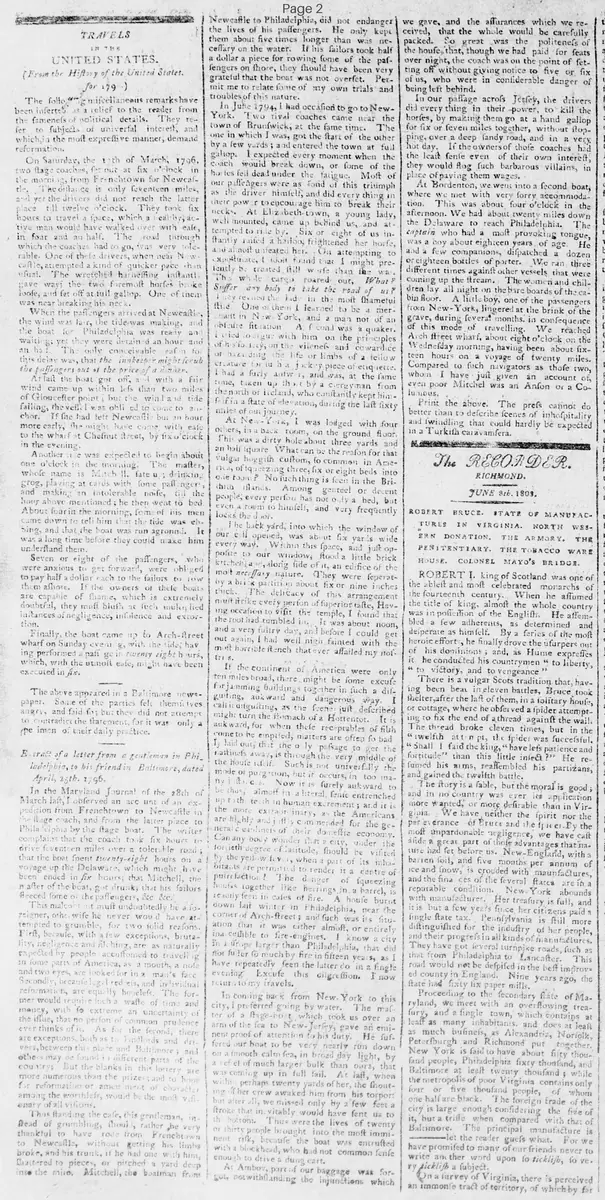
TRAVELS
IN THE
UNITED STATES.
(From the History of the United States for 1796.)
The following miscellaneous remarks have been inserted as a relief to the reader from the sameness of political details. They refer to subjects of universal interest, and which, in the most expressive manner, demand reformation.
On Saturday, the 12th of March, 1796, two stage coaches set out at six o'clock in the morning, from Frenchtown for Newcastle. The distance is only seventeen miles, and yet the drivers did not reach the latter place till twelve o'clock. They took six hours to travel a space, which a healthy, active man would have walked over with ease, in four and a half. The road through which the coaches had to go, was very tolerable. One of these drivers, when near Newcastle, attempted a kind of quicker pace than usual. The wretched harnessing instantly gave way; the two foremost horses broke loose, and set off at full gallop. One of them was near breaking his neck.
When the passengers arrived at Newcastle, the wind was fair, the tide was making, and the boat for Philadelphia was ready and waiting; yet they were detained an hour and a half. The only conceivable cause to this delay was, that the innkeeper might screw the passengers out of the price of a dinner. At last the boat got off, and with a fair wind came up within less than two miles of Gloucester point; but the wind and tide failing, the vessel was obliged to come to an anchor. If she had left Newcastle but an hour more early, she might have come with ease to the wharf at Chestnut street, by six o'clock in the evening.
Another tide was expected to begin about one o'clock in the morning. The master, whose name is Mitchell, sat up drinking grog, playing at cards with some passengers, and making an intolerable noise, till the hour above mentioned; he then went to bed. About four in the morning, some of his men came down to tell him that the tide was ebbing, and that the boat was run aground. It was a long time before they could make him understand them.
Seven or eight of the passengers, who were anxious to get forward, were obliged to pay half a dollar each to the sailors to row them ashore. If the owners of these boats are capable of shame, which is extremely doubtful, they must blush at such multiplied instances of negligence, insolence and extortion.
Finally, the boat came up to Arch-street wharf on Sunday evening, with the tide; having performed a passage in twenty-eight hours, which, with the utmost ease, might have been executed in six.
The above appeared in a Baltimore newspaper. Some of the parties felt themselves angry, and said so; but they did not attempt to contradict the statement, for it was only a specimen of their daily practice.
Extract of a letter from a gentleman in Philadelphia, to his friend in Baltimore, dated April 29th, 1796.
In the Maryland Journal of the 28th of March last, I observed an account of an expedition from Frenchtown to Newcastle in the stage coach, and from the latter place to Philadelphia by the stage boat. The writer complains that the coach took six hours to drive seventeen miles over a tolerable road; that the boat spent twenty-eight hours on a voyage up the Delaware, which might have been ended in six hours, that Mitchell, the master of the boat, got drunk, that his sailors fleeced some of the passengers, &c. &c.
This malcontent must undoubtedly be a foreigner, or else he never would have attempted to grumble, for two solid reasons. First, because, with a few exceptions, brutality, negligence and filching, are as naturally expected by people accustomed to travelling in some parts of America, as a mouth, a nose and two eyes, are looked for in man's face. Secondly, because log-rolling is, and individual reformation, are equally hopeless. The former would require such a waste of time and money, with so extreme an uncertainty of the issue, that no person of common prudence ever thinks of it. As for the second, there are exceptions, both as to landlords and drivers, between this place and Baltimore; and others may be found in different parts of the country; but the blanks in this lottery are more numerous than the prize; and to hope for reformation or amendment of character among the worthless, would be the most visionary of all visions.
Notwithstanding the case, this gentleman, instead of grumbling, should rather be very thankful to have rode from Frenchtown to Newcastle, without getting his limbs broke, and his trunk, if he had one with him, scattered to pieces, or pitched headlong deep into the mire. Mitchell, the boatman from Newcastle to Philadelphia, did not endanger the lives of his passengers. He only kept them about five times longer than was necessary on the water. If his sailors took half a dollar a piece for rowing some of the passengers on shore, they should have been very grateful that the boat was not overset. Permit me to relate some of my own trials and troubles of this nature.
In June 1794, I had occasion to go to New-York. Two rival coaches came near the town of Brunswick, at the same time. The one in which I was, got the start of the other by a few yards; and entered the town at full gallop. I expected every moment when the coach would break down, or some of the horses fell dead under the fatigue. Most of our passengers were as fond of this triumph as the driver himself, and did every thing in their power to encourage him to break their necks. At Elizabeth-town, a young lady, well mounted, came up behind us, and attempted to ride by. Six or eight of us instantly raised a halloo, frightened her horse, and almost unseated her. On attempting to expostulate, I too found that I might precisely be treated still worse than she was. The whole cargo roared out, What? Suffer anybody to take the road of us? I ever used the aid in the most shameful manner. (This was one of them I learned to be a merchant in New York, and a man not of an obscure station.) Second was a quaker. I vied o'er with him on the principles of his sect, on the vileness and cowardice of hazarding the life or limbs of a fellow creature in such a ticky piece of etiquette. I had a surly answer, and was, at the same time, taken up short by a clergyman from the north of Ireland, who constantly kept himself in a state of elevation, during the last sixty miles of our journey.
At New-York, I was lodged with four others, in a back room, on the ground floor. This was a dirty hole about three yards and an half square. What can be the reason for that vulgar hoydenish custom, so common in America, of squeezing three, six or eight beds into one room? No such thing is seen in the British islands. Among genteel or decent people; every person has not only a bed, but even a room to himself, and very frequently locks the door.
The back yard, into which the window of our room opened, was about six yards wide every way. Within this space, and just opposite to our window, stood a little brick kitchen, alongside of it, an edifice of the most necessary nature. They were separated by a brick partition about six or nine inches thick. The delicacy of this arrangement must strike every person of superior taste. Having occasion to visit the temple, I found that the roof had tumbled in. It was about noon, and a very sultry day, and before I could get out again, I had well nigh fainted with the most horrible stench that ever assailed my nostrils.
If the continent of America were only ten miles broad, there might be some excuse for jamming buildings together in such a disgusting, awkward and dangerous way. I call it disgusting, as the scene just described might turn the stomach of a Hottentot. It is awkward, for when these receptacles of filth come to be emptied, matters are often so bad laid out, that the only passage to get the rattling away, is through the very middle of the house itself. Such is not universally the mode of purgation, but it occurs, in too many instances. Now it is surely awkward to be thus, almost in a literal, sense entrenched up to the teeth in human excrement; and it is the more extraordinary, as the Americans are highly, and I commend for the general cleanliness of their domestic economy.
Can anybody wonder that a city, under the fortieth degree of latitude, should be visited by the yellow fever, when a part of its inhabitants are permitted to render it a centre of putrefaction? The danger of squeezing houses together like herrings in a barrel, is recently seen in cases of fire. A house burnt down last winter in Philadelphia, near the corner of Arch-street; and such was its situation that it was either almost, or entirely inaccessible to fire-engines. I know a city in Europe larger than Philadelphia, that did not suffer so much by fire in fifteen years, as I have repeatedly seen the latter do in a single evening. Excuse this digression. I now return to my travels.
In coming back from New-York to this city, I preferred going by water. The master of a stage-boat which took us over an arm of the sea to New-Jersey, gave an eminent proof of attention to his duty. He suffered our boat to be very nearly run down on a smooth calm sea, in broad day light, by a vessel of much larger bulk than ours, that was coming up in full sail. At last, when with perhaps twenty yards of her, the shouting her crew awaked him from his torpor; but after all, we missed only by a few feet a stroke that inevitably would have sent us to the bottom. Thus were the lives of twenty or thirty people brought into the most imminent risk, because the boat was entrusted with a blockhead, who had not common sense enough to drive a dung cart.
At Amboy, part of our baggage was forgot, notwithstanding the injunctions which we gave, and the assurances which we received, that the whole would be carefully packed. So great was the politeness of the house, that, though we had paid for seats over night, the coach was on the point of setting off without giving notice to five or six of us, who were in considerable danger of being left behind.
In our passage across Jersey, the drivers did every thing in their power, to kill the horses, by making them go at a hand gallop for six or seven miles together, without stopping, over a deep sandy road, and in a very hot day. If the owners of those coaches had the least sense even of their own interest, they would flog such barbarous villains, in place of paying them wages.
At Bordentown, we went into a second boat, where we met with very sorry accommodation. This was about four o'clock in the afternoon. We had about twenty miles down the Delaware to reach Philadelphia. The captain who had a most provoking tongue, was a boy about eighteen years of age. He and a few companions, dispatched a dozen or eighteen bottles of porter. We ran three different times against other vessels that were coming up the stream. The women and children lay all night on the bare boards of the cabin floor. A little boy, one of the passengers from New-York, lingered at the brink of the grave, during several months, in consequence of this mode of travelling. We reached Arch street wharf, about eight o'clock on the Wednesday morning, having been about sixteen hours on a voyage of twenty miles.
Compared to such navigators as those two, whom I have just given an account of, even poor Mitchell was an Anson or a Columbus.
Print the above. The press cannot do better than to describe scenes of inhospitality and swindling that could hardly be expected in a Turkish caravansera.
IN THE
UNITED STATES.
(From the History of the United States for 1796.)
The following miscellaneous remarks have been inserted as a relief to the reader from the sameness of political details. They refer to subjects of universal interest, and which, in the most expressive manner, demand reformation.
On Saturday, the 12th of March, 1796, two stage coaches set out at six o'clock in the morning, from Frenchtown for Newcastle. The distance is only seventeen miles, and yet the drivers did not reach the latter place till twelve o'clock. They took six hours to travel a space, which a healthy, active man would have walked over with ease, in four and a half. The road through which the coaches had to go, was very tolerable. One of these drivers, when near Newcastle, attempted a kind of quicker pace than usual. The wretched harnessing instantly gave way; the two foremost horses broke loose, and set off at full gallop. One of them was near breaking his neck.
When the passengers arrived at Newcastle, the wind was fair, the tide was making, and the boat for Philadelphia was ready and waiting; yet they were detained an hour and a half. The only conceivable cause to this delay was, that the innkeeper might screw the passengers out of the price of a dinner. At last the boat got off, and with a fair wind came up within less than two miles of Gloucester point; but the wind and tide failing, the vessel was obliged to come to an anchor. If she had left Newcastle but an hour more early, she might have come with ease to the wharf at Chestnut street, by six o'clock in the evening.
Another tide was expected to begin about one o'clock in the morning. The master, whose name is Mitchell, sat up drinking grog, playing at cards with some passengers, and making an intolerable noise, till the hour above mentioned; he then went to bed. About four in the morning, some of his men came down to tell him that the tide was ebbing, and that the boat was run aground. It was a long time before they could make him understand them.
Seven or eight of the passengers, who were anxious to get forward, were obliged to pay half a dollar each to the sailors to row them ashore. If the owners of these boats are capable of shame, which is extremely doubtful, they must blush at such multiplied instances of negligence, insolence and extortion.
Finally, the boat came up to Arch-street wharf on Sunday evening, with the tide; having performed a passage in twenty-eight hours, which, with the utmost ease, might have been executed in six.
The above appeared in a Baltimore newspaper. Some of the parties felt themselves angry, and said so; but they did not attempt to contradict the statement, for it was only a specimen of their daily practice.
Extract of a letter from a gentleman in Philadelphia, to his friend in Baltimore, dated April 29th, 1796.
In the Maryland Journal of the 28th of March last, I observed an account of an expedition from Frenchtown to Newcastle in the stage coach, and from the latter place to Philadelphia by the stage boat. The writer complains that the coach took six hours to drive seventeen miles over a tolerable road; that the boat spent twenty-eight hours on a voyage up the Delaware, which might have been ended in six hours, that Mitchell, the master of the boat, got drunk, that his sailors fleeced some of the passengers, &c. &c.
This malcontent must undoubtedly be a foreigner, or else he never would have attempted to grumble, for two solid reasons. First, because, with a few exceptions, brutality, negligence and filching, are as naturally expected by people accustomed to travelling in some parts of America, as a mouth, a nose and two eyes, are looked for in man's face. Secondly, because log-rolling is, and individual reformation, are equally hopeless. The former would require such a waste of time and money, with so extreme an uncertainty of the issue, that no person of common prudence ever thinks of it. As for the second, there are exceptions, both as to landlords and drivers, between this place and Baltimore; and others may be found in different parts of the country; but the blanks in this lottery are more numerous than the prize; and to hope for reformation or amendment of character among the worthless, would be the most visionary of all visions.
Notwithstanding the case, this gentleman, instead of grumbling, should rather be very thankful to have rode from Frenchtown to Newcastle, without getting his limbs broke, and his trunk, if he had one with him, scattered to pieces, or pitched headlong deep into the mire. Mitchell, the boatman from Newcastle to Philadelphia, did not endanger the lives of his passengers. He only kept them about five times longer than was necessary on the water. If his sailors took half a dollar a piece for rowing some of the passengers on shore, they should have been very grateful that the boat was not overset. Permit me to relate some of my own trials and troubles of this nature.
In June 1794, I had occasion to go to New-York. Two rival coaches came near the town of Brunswick, at the same time. The one in which I was, got the start of the other by a few yards; and entered the town at full gallop. I expected every moment when the coach would break down, or some of the horses fell dead under the fatigue. Most of our passengers were as fond of this triumph as the driver himself, and did every thing in their power to encourage him to break their necks. At Elizabeth-town, a young lady, well mounted, came up behind us, and attempted to ride by. Six or eight of us instantly raised a halloo, frightened her horse, and almost unseated her. On attempting to expostulate, I too found that I might precisely be treated still worse than she was. The whole cargo roared out, What? Suffer anybody to take the road of us? I ever used the aid in the most shameful manner. (This was one of them I learned to be a merchant in New York, and a man not of an obscure station.) Second was a quaker. I vied o'er with him on the principles of his sect, on the vileness and cowardice of hazarding the life or limbs of a fellow creature in such a ticky piece of etiquette. I had a surly answer, and was, at the same time, taken up short by a clergyman from the north of Ireland, who constantly kept himself in a state of elevation, during the last sixty miles of our journey.
At New-York, I was lodged with four others, in a back room, on the ground floor. This was a dirty hole about three yards and an half square. What can be the reason for that vulgar hoydenish custom, so common in America, of squeezing three, six or eight beds into one room? No such thing is seen in the British islands. Among genteel or decent people; every person has not only a bed, but even a room to himself, and very frequently locks the door.
The back yard, into which the window of our room opened, was about six yards wide every way. Within this space, and just opposite to our window, stood a little brick kitchen, alongside of it, an edifice of the most necessary nature. They were separated by a brick partition about six or nine inches thick. The delicacy of this arrangement must strike every person of superior taste. Having occasion to visit the temple, I found that the roof had tumbled in. It was about noon, and a very sultry day, and before I could get out again, I had well nigh fainted with the most horrible stench that ever assailed my nostrils.
If the continent of America were only ten miles broad, there might be some excuse for jamming buildings together in such a disgusting, awkward and dangerous way. I call it disgusting, as the scene just described might turn the stomach of a Hottentot. It is awkward, for when these receptacles of filth come to be emptied, matters are often so bad laid out, that the only passage to get the rattling away, is through the very middle of the house itself. Such is not universally the mode of purgation, but it occurs, in too many instances. Now it is surely awkward to be thus, almost in a literal, sense entrenched up to the teeth in human excrement; and it is the more extraordinary, as the Americans are highly, and I commend for the general cleanliness of their domestic economy.
Can anybody wonder that a city, under the fortieth degree of latitude, should be visited by the yellow fever, when a part of its inhabitants are permitted to render it a centre of putrefaction? The danger of squeezing houses together like herrings in a barrel, is recently seen in cases of fire. A house burnt down last winter in Philadelphia, near the corner of Arch-street; and such was its situation that it was either almost, or entirely inaccessible to fire-engines. I know a city in Europe larger than Philadelphia, that did not suffer so much by fire in fifteen years, as I have repeatedly seen the latter do in a single evening. Excuse this digression. I now return to my travels.
In coming back from New-York to this city, I preferred going by water. The master of a stage-boat which took us over an arm of the sea to New-Jersey, gave an eminent proof of attention to his duty. He suffered our boat to be very nearly run down on a smooth calm sea, in broad day light, by a vessel of much larger bulk than ours, that was coming up in full sail. At last, when with perhaps twenty yards of her, the shouting her crew awaked him from his torpor; but after all, we missed only by a few feet a stroke that inevitably would have sent us to the bottom. Thus were the lives of twenty or thirty people brought into the most imminent risk, because the boat was entrusted with a blockhead, who had not common sense enough to drive a dung cart.
At Amboy, part of our baggage was forgot, notwithstanding the injunctions which we gave, and the assurances which we received, that the whole would be carefully packed. So great was the politeness of the house, that, though we had paid for seats over night, the coach was on the point of setting off without giving notice to five or six of us, who were in considerable danger of being left behind.
In our passage across Jersey, the drivers did every thing in their power, to kill the horses, by making them go at a hand gallop for six or seven miles together, without stopping, over a deep sandy road, and in a very hot day. If the owners of those coaches had the least sense even of their own interest, they would flog such barbarous villains, in place of paying them wages.
At Bordentown, we went into a second boat, where we met with very sorry accommodation. This was about four o'clock in the afternoon. We had about twenty miles down the Delaware to reach Philadelphia. The captain who had a most provoking tongue, was a boy about eighteen years of age. He and a few companions, dispatched a dozen or eighteen bottles of porter. We ran three different times against other vessels that were coming up the stream. The women and children lay all night on the bare boards of the cabin floor. A little boy, one of the passengers from New-York, lingered at the brink of the grave, during several months, in consequence of this mode of travelling. We reached Arch street wharf, about eight o'clock on the Wednesday morning, having been about sixteen hours on a voyage of twenty miles.
Compared to such navigators as those two, whom I have just given an account of, even poor Mitchell was an Anson or a Columbus.
Print the above. The press cannot do better than to describe scenes of inhospitality and swindling that could hardly be expected in a Turkish caravansera.
What sub-type of article is it?
Essay
Satire
What themes does it cover?
Social Manners
Commerce Trade
What keywords are associated?
Travel Conditions
United States
1796
Negligence
Hospitality
Transportation
Extortion
Yellow Fever
Literary Details
Title
Travels In The United States.
Subject
Miscellaneous Remarks On Travel Conditions And Hospitality In The United States In 1796
Form / Style
Prose Essay With Personal Anecdotes And Critique
Key Lines
The Following Miscellaneous Remarks Have Been Inserted As A Relief To The Reader From The Sameness Of Political Details. They Refer To Subjects Of Universal Interest, And Which, In The Most Expressive Manner, Demand Reformation.
If The Owners Of These Boats Are Capable Of Shame, Which Is Extremely Doubtful, They Must Blush At Such Multiplied Instances Of Negligence, Insolence And Extortion.
Brutality, Negligence And Filching, Are As Naturally Expected By People Accustomed To Travelling In Some Parts Of America, As A Mouth, A Nose And Two Eyes, Are Looked For In Man's Face.
Can Anybody Wonder That A City, Under The Fortieth Degree Of Latitude, Should Be Visited By The Yellow Fever, When A Part Of Its Inhabitants Are Permitted To Render It A Centre Of Putrefaction?
The Press Cannot Do Better Than To Describe Scenes Of Inhospitality And Swindling That Could Hardly Be Expected In A Turkish Caravansera.