Thank you for visiting SNEWPapers!
Sign up free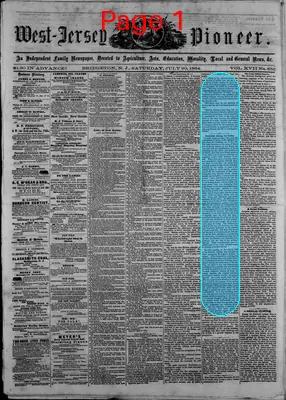
Story
July 30, 1864
West Jersey Pioneer
Bridgeton, Cumberland County, New Jersey
What is this article about?
Article praises Northern women's patriotism during Civil War through nursing, aid contributions, and a movement to boycott foreign luxuries for economy and war support, urging widespread adoption.
Clipping

OCR Quality
95%
Excellent
Full Text
Patriotism Among the Ladies.
" I wish I were a man," has been the exclamation of many a noble spirited woman, since the breaking out of the war.
The rabid devotion to the cause of Secession shown by females at the South, has been met with the manifestation of fervid patriotism by the wives and mothers of the North, and they have found means to evince their love of country, although not permitted to join their brethren in the field. Many have gone as nurses, others have contributed supplies through Sanitary Fairs, or with their own hands have prepared needed articles for the wounded.
Recently, by the action of some of the leading spirits in social society, another avenue for the expression of this noble feeling has been opened, which, though perhaps less attractive, is scarcely less important. As is well known, the war has given to many, unprecedented opportunities of making money, and thousands suddenly grown rich, are displaying their good fortune in the most extravagant style of living and dress. Dealers in costly fabrics and jewelry state they have never before had so large a trade, and the streets of our cities are fairly ablaze with the silks, laces, and diamonds, and showy equipage of this class. As might be expected, the influence of their example has been felt throughout society, and there has been an increase of fashionable display, little befitting the terrible realities of the struggle which convulses the nation.
It is no time for festivity and folly when thousands of our brave brothers are lying in anguish upon the field, and many a household is shrouded in gloom by the loss of loved ones sacrificed to their country.
Neither can we as a people afford such a Costly style of living. The burdens imposed by the war can be borne, but they may be greatly lightened by the exercise of proper economy; and those who do not feel the need of retrenchment can find ample use for their abundance, in promoting the benevolent enterprises growing out of the war, the Sanitary and Christian Commissions, and the care of the soldiers' families. These considerations have impelled some of our noble minded women to attempt a needed reform.
The first meeting on the subject, held at the National Capital, was attended by those occupying the highest position in society. After consultation, a pledge was adopted, binding those who subscribed to it, to purchase no articles of foreign manufacture during the continuance of the war.
This, we regret to say, was subsequently modified so as to exclude only such articles as could be produced in our own country.
As most imported articles of dress are merely luxuries, the original resolution would have largely covered the ground desired. As it now stands little will be effected, except to call attention to the subject, which is the purpose of this article,
Societies to extend the movement are being formed in this and other cities, and if the spirit instead of the letter of the pledge is carried out, great good will be accomplished. It is not necessary, however, that any one wait for a society to be formed, before co-operating in the reform If a hundred thousand ladies throughout the country would individually say, we will purchase no more foreign silks, laces, gloves, ornaments, nor luxuries of any kind until the rebellion is crushed and peace restored, their noble resolution would inspire general respect for themselves and a movement of needed reform in their own neighborhoods.
We love to speak of the patriotism which excluded tea from the tables of our grandmothers; let our women show themselves not unworthy of such ancestry. We commend the subject to all our readers. Let it be discussed, at the sewing societies, quiltings, and other social meetings, and let us hear of a general response to the proposition.
" I wish I were a man," has been the exclamation of many a noble spirited woman, since the breaking out of the war.
The rabid devotion to the cause of Secession shown by females at the South, has been met with the manifestation of fervid patriotism by the wives and mothers of the North, and they have found means to evince their love of country, although not permitted to join their brethren in the field. Many have gone as nurses, others have contributed supplies through Sanitary Fairs, or with their own hands have prepared needed articles for the wounded.
Recently, by the action of some of the leading spirits in social society, another avenue for the expression of this noble feeling has been opened, which, though perhaps less attractive, is scarcely less important. As is well known, the war has given to many, unprecedented opportunities of making money, and thousands suddenly grown rich, are displaying their good fortune in the most extravagant style of living and dress. Dealers in costly fabrics and jewelry state they have never before had so large a trade, and the streets of our cities are fairly ablaze with the silks, laces, and diamonds, and showy equipage of this class. As might be expected, the influence of their example has been felt throughout society, and there has been an increase of fashionable display, little befitting the terrible realities of the struggle which convulses the nation.
It is no time for festivity and folly when thousands of our brave brothers are lying in anguish upon the field, and many a household is shrouded in gloom by the loss of loved ones sacrificed to their country.
Neither can we as a people afford such a Costly style of living. The burdens imposed by the war can be borne, but they may be greatly lightened by the exercise of proper economy; and those who do not feel the need of retrenchment can find ample use for their abundance, in promoting the benevolent enterprises growing out of the war, the Sanitary and Christian Commissions, and the care of the soldiers' families. These considerations have impelled some of our noble minded women to attempt a needed reform.
The first meeting on the subject, held at the National Capital, was attended by those occupying the highest position in society. After consultation, a pledge was adopted, binding those who subscribed to it, to purchase no articles of foreign manufacture during the continuance of the war.
This, we regret to say, was subsequently modified so as to exclude only such articles as could be produced in our own country.
As most imported articles of dress are merely luxuries, the original resolution would have largely covered the ground desired. As it now stands little will be effected, except to call attention to the subject, which is the purpose of this article,
Societies to extend the movement are being formed in this and other cities, and if the spirit instead of the letter of the pledge is carried out, great good will be accomplished. It is not necessary, however, that any one wait for a society to be formed, before co-operating in the reform If a hundred thousand ladies throughout the country would individually say, we will purchase no more foreign silks, laces, gloves, ornaments, nor luxuries of any kind until the rebellion is crushed and peace restored, their noble resolution would inspire general respect for themselves and a movement of needed reform in their own neighborhoods.
We love to speak of the patriotism which excluded tea from the tables of our grandmothers; let our women show themselves not unworthy of such ancestry. We commend the subject to all our readers. Let it be discussed, at the sewing societies, quiltings, and other social meetings, and let us hear of a general response to the proposition.
What sub-type of article is it?
Historical Event
What themes does it cover?
Bravery Heroism
Moral Virtue
Triumph
What keywords are associated?
Patriotism
Women
Civil War
Boycott Foreign Goods
Economy
Sanitary Fairs
Where did it happen?
Northern United States, National Capital
Story Details
Location
Northern United States, National Capital
Event Date
During The Civil War
Story Details
Northern women demonstrate patriotism by nursing, supplying aid, and pledging to avoid purchasing foreign luxuries to promote economy and support the war effort, contrasting Southern secessionist fervor.