Thank you for visiting SNEWPapers!
Sign up free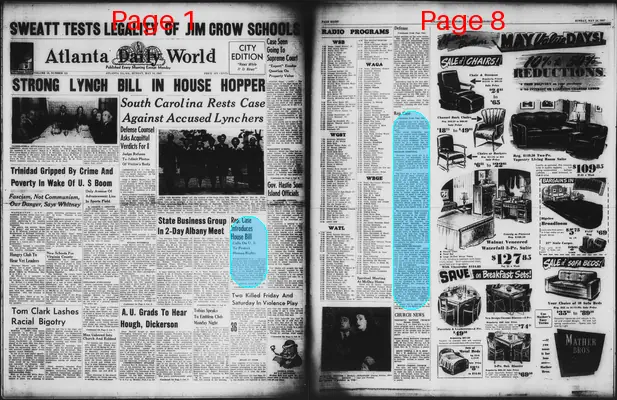
Atlanta Daily World
Atlanta, Fulton County, Georgia
What is this article about?
Congressman Clifford P. Case (R-NJ) introduced a strengthened anti-lynching bill in the U.S. House on May 16, providing federal penalties for lynch mobs, officials failing to act, and liable communities. It has support from NAACP, churches, labor, and civic groups, and was referred to the Judiciary Committee.
Merged-components note: Continuation of article across pages.
Clippings
1 of 2
OCR Quality
Full Text
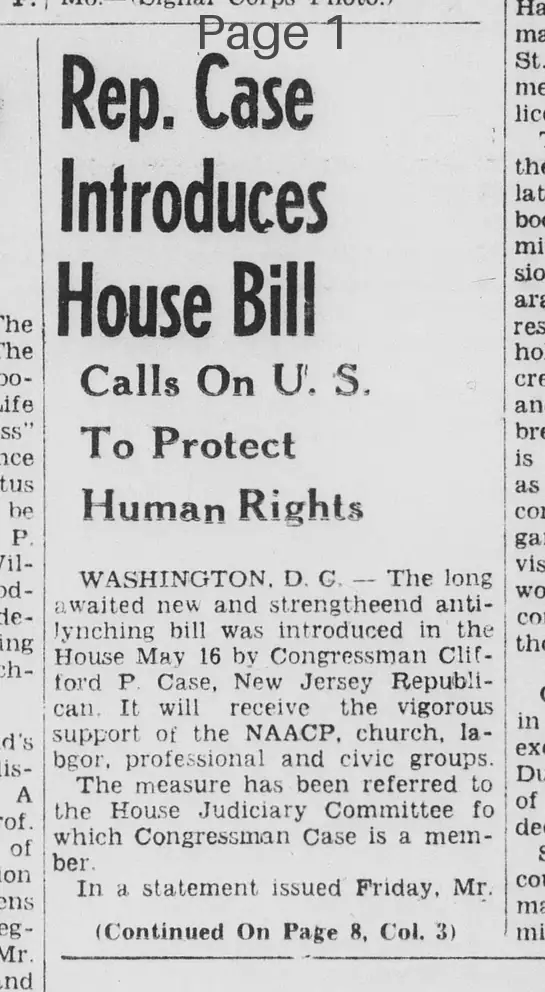
WASHINGTON, D. C. - The long awaited new and strengthened anti-lynching bill was introduced in the House May 16 by Congressman Clifford P Case, New Jersey Republican It will receive the vigorous support of the NAACP. church, labor, professional and civic groups.
The measure has been referred to the House Judiciary Committee for which Congressman Case is a member
In a statement issued Friday. Mr.
(Continued On Page 8, Col. 3)
Rep. Case
(Continued From Page One)
Case declared that "it is vital that the federal government should definitely define and use full authority to protect fundamental human rights."
"Our moral leadership, upon which the outside world depends at least as much as on our physical strength and material resources, will be greatly weakened," he said, "unless we, as a nation, take definite and effective steps to eradicate the foul crime of lynching from the fabric of our domestic life."
FREEDOM ESSENTIAL
"Freedom from lynch law is essential to the enjoyment of the fundamental human rights which the United States promised to promote when it signed the United Nations Charter. It is one of the inherent rights guaranteed by our Constitution."
The Case bill, it was pointed out, would provide heavy criminal penalties for any member of a lynch mob or any other person wilfully involved in a lynching. It would also punish any state or local official who shall have failed in the performance of his duty to prevent a lynching or to apprehend and bring to justice anyone guilty of that crime. Of equal if not greater importance, it would make the local community whose neglect makes possible a lynching, or an abduction which leads to a lynching, liable for civil damages to the victim or to his family if he is killed.
The Congressmen called attention to the fact that 1946 showed a marked increase in the number of admitted lynchings. He pointed to the fact that there has been no conviction of the lynchers who dragged Roger Malcolm, George Dorsey, a veteran and their wives Willie Mae and Dorothy, from a car and shot them to death in broad daylight down in Monroe, Georgia, last July. He said that those who lynched Leon McTatie, the 35-year old father of ten children in Lexington, Mississippi, have never paid the penalty for their heinous crime against humanity.
ASSISTANCE NECESSARY
While recognizing the efforts which certain states and communities have made and are making to deal with the problem, he insisted that the whole record, including that for 1946, clearly showed that they could not do the job alone and that the assistance of a strong federal law was necessary.
It was pointed out that following the failure to make any progress on the Monroe, Georgia lynchings, Attorney General Tom Clark asserted in several speeches and in one magazine article last year that a federal law specifically against lynching was necessary in order to give federal officials the necessary authority to act.
Representative Case said that the bill had been prepared with the co-operation of the National Association for the Advancement of Colored People and that the support of many church, labor, professional and civic organizations had been assured.
A similar bill is expected to be introduced in the Senate in the next few days.
What sub-type of article is it?
What keywords are associated?
What entities or persons were involved?
Where did it happen?
Domestic News Details
Primary Location
Washington, D. C.
Event Date
May 16
Key Persons
Outcome
bill referred to house judiciary committee; heavy criminal penalties proposed for lynch mobs and officials; civil damages for communities; no convictions in mentioned 1946 lynchings; four killed in monroe, georgia; one killed in lexington, mississippi.
Event Details
Congressman Clifford P. Case introduced a strengthened anti-lynching bill in the House, emphasizing federal protection of human rights and eradication of lynching; bill provides penalties for participants, officials failing duties, and liable communities; prepared with NAACP cooperation and supported by various groups; highlights 1946 lynchings in Georgia and Mississippi without convictions.