Thank you for visiting SNEWPapers!
Sign up free
Foreign News
August 27, 1900
Daily Inter Mountain
Butte, Silver Bow County, Montana
What is this article about?
London Express article contrasts British soldier's lighter 32-pound marching kit and poorer field rations with heavier loads (68-72 pounds) and better provisions for German, French, and Russian troops during maneuvers, highlighting continental training superiority.
Clipping
OCR Quality
95%
Excellent
Full Text
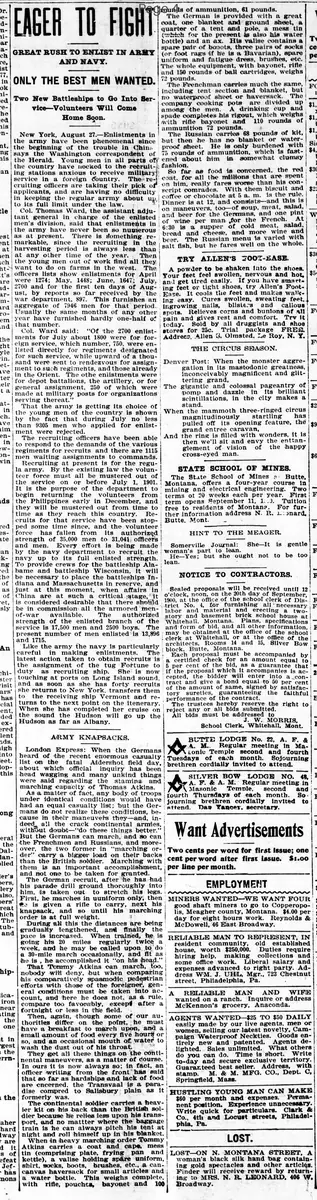
ARMY KNAPSACKS.
London Express: When the Germans heard of the recent enormous casualty list on the fatal Aldershot field day, about which official inquiry has been made wagging and many unkind things were said regarding the stamina and marching capacity of Thomas Atkins. As a matter of fact, any body of troops under identical conditions would have had an equal casualty list; but the Germans do not realize these conditions, because in their maneuvers they—and, indeed, all the crack continental armies, without doubt—do these things better. But the Germans can march, and so can the Frenchmen and Russians, and moreover, the two former in "marching order" carry a bigger load on their backs than the British soldier. Marching with them is an important accomplishment, and not one to be taken for granted.
The German recruit, after he has had his parade drill ground thoroughly into him, is taken out to stretch his legs. First, he marches in uniform only, then he is given a rifle to carry, next his knapsack, and so until his marching order is at full weight. During all this the distances are being gradually lengthened, and finally the pace is increased. When trained, he is going his 20 miles regularly twice a week, and he may be called upon to do a 30-mile march occasionally, and fit as he is, he accomplishes it "on his head."
That Tommy Atkins can march, too, nobody will deny, but when comparing his comparatively spasmodic pedestrian efforts with those of the foreigner, general conditions must be taken into account, and here he does not, as a rule, compare too favorably, except after a fortnight or less in the field.
Then, again, though some of our authorities differ on the point, he must have a breakfast to march upon, and a small amount of food every five hours or so, and an occasional mouthful of water to wash the dust out of his throat. They get all these things on the continental maneuvers, as a matter of course. In ours it is now always so; in fact, an officer writing from the front has said that so far as hardships and lack of food are concerned, the Transvaal is a paradise compared to Salisbury plain as it formerly was.
The continental soldier carries a heavier kit on his back than the British soldier because he relies less upon his transport, and no matter where the baggage train is he can always pitch his tent at night and roll himself up in his blanket.
When in heavy marching order Tommy Atkins carries a coat and cape, mess tin (comprising plate, frying pan and kettle), a valise holding spare uniform, shirt, socks, boots, brushes, etc., a canvas haversack for small articles and a water bottle. This weighs complete, with rifle, pouches, bayonet and 100 rounds of ammunition, 32 pounds.
The German is provided with a great coat, one blanket and groundsheet, a quarter of a tent and pole, a mess tin (which for the present is also his water bottle) and an ax. His valise contains a spare pair of boots, three pairs of socks (or foot rags if he is a Bavarian), spare uniform and fatigue dress, brushes, etc. The whole equipment, with bayonet, rifle and 150 rounds of ball cartridges, weighs 72 pounds.
The Frenchman carries much the same, including tent section and blanket, but no waterproof sheet or haversack. The company cooking pots are divided up among the men. A drinking cup and spade completes his rigout, which weighs with rifle bayonet and 110 rounds of ammunition 72 pounds.
The Russian carries 68 pounds of kit, but then he has no blanket or waterproof sheet. He is only burdened with 75 rounds of ammunition, which is fastened about him in somewhat clumsy fashion.
So far as food is concerned, the red coat, for all the millions that are spent on him, really fares worse than his conscript comrades. With them biscuit and coffee or chocolate at 5 a. m. is the rule. Dinner is at 12, and consists—and this is on maneuvers, too—of soup, meat, salad, and beer for the Germans, and one pint of wine per man for the French. At 6:30 is a supper of cold meat, salad, bread and cheese, and more wine and beer. The Russian menu is varied with salt fish, but he fares well on the whole.
London Express: When the Germans heard of the recent enormous casualty list on the fatal Aldershot field day, about which official inquiry has been made wagging and many unkind things were said regarding the stamina and marching capacity of Thomas Atkins. As a matter of fact, any body of troops under identical conditions would have had an equal casualty list; but the Germans do not realize these conditions, because in their maneuvers they—and, indeed, all the crack continental armies, without doubt—do these things better. But the Germans can march, and so can the Frenchmen and Russians, and moreover, the two former in "marching order" carry a bigger load on their backs than the British soldier. Marching with them is an important accomplishment, and not one to be taken for granted.
The German recruit, after he has had his parade drill ground thoroughly into him, is taken out to stretch his legs. First, he marches in uniform only, then he is given a rifle to carry, next his knapsack, and so until his marching order is at full weight. During all this the distances are being gradually lengthened, and finally the pace is increased. When trained, he is going his 20 miles regularly twice a week, and he may be called upon to do a 30-mile march occasionally, and fit as he is, he accomplishes it "on his head."
That Tommy Atkins can march, too, nobody will deny, but when comparing his comparatively spasmodic pedestrian efforts with those of the foreigner, general conditions must be taken into account, and here he does not, as a rule, compare too favorably, except after a fortnight or less in the field.
Then, again, though some of our authorities differ on the point, he must have a breakfast to march upon, and a small amount of food every five hours or so, and an occasional mouthful of water to wash the dust out of his throat. They get all these things on the continental maneuvers, as a matter of course. In ours it is now always so; in fact, an officer writing from the front has said that so far as hardships and lack of food are concerned, the Transvaal is a paradise compared to Salisbury plain as it formerly was.
The continental soldier carries a heavier kit on his back than the British soldier because he relies less upon his transport, and no matter where the baggage train is he can always pitch his tent at night and roll himself up in his blanket.
When in heavy marching order Tommy Atkins carries a coat and cape, mess tin (comprising plate, frying pan and kettle), a valise holding spare uniform, shirt, socks, boots, brushes, etc., a canvas haversack for small articles and a water bottle. This weighs complete, with rifle, pouches, bayonet and 100 rounds of ammunition, 32 pounds.
The German is provided with a great coat, one blanket and groundsheet, a quarter of a tent and pole, a mess tin (which for the present is also his water bottle) and an ax. His valise contains a spare pair of boots, three pairs of socks (or foot rags if he is a Bavarian), spare uniform and fatigue dress, brushes, etc. The whole equipment, with bayonet, rifle and 150 rounds of ball cartridges, weighs 72 pounds.
The Frenchman carries much the same, including tent section and blanket, but no waterproof sheet or haversack. The company cooking pots are divided up among the men. A drinking cup and spade completes his rigout, which weighs with rifle bayonet and 110 rounds of ammunition 72 pounds.
The Russian carries 68 pounds of kit, but then he has no blanket or waterproof sheet. He is only burdened with 75 rounds of ammunition, which is fastened about him in somewhat clumsy fashion.
So far as food is concerned, the red coat, for all the millions that are spent on him, really fares worse than his conscript comrades. With them biscuit and coffee or chocolate at 5 a. m. is the rule. Dinner is at 12, and consists—and this is on maneuvers, too—of soup, meat, salad, and beer for the Germans, and one pint of wine per man for the French. At 6:30 is a supper of cold meat, salad, bread and cheese, and more wine and beer. The Russian menu is varied with salt fish, but he fares well on the whole.
What sub-type of article is it?
Military Campaign
What keywords are associated?
Army Knapsacks
Marching Orders
Continental Armies
Equipment Loads
Military Maneuvers
Where did it happen?
Continental Europe
Foreign News Details
Primary Location
Continental Europe
Event Details
The article compares the marching capabilities and equipment loads of German, French, and Russian soldiers to British troops, noting that continental armies carry heavier knapsacks (up to 72 pounds) and receive better rations during maneuvers, while emphasizing rigorous training for long marches.