Thank you for visiting SNEWPapers!
Sign up free
Editorial
March 1, 1834
Republican Herald
Providence, Providence County, Rhode Island
What is this article about?
An anonymous contributor criticizes the banking system in their native state for charging exorbitant interest rates, especially to manufacturers, leading to bankruptcy and ruin. Uses examples of compound interest and hypothetical scenarios to argue for legislative investigation and penalties on 'shaving mills' banks.
Clipping
OCR Quality
95%
Excellent
Full Text
FOR THE HERALD.
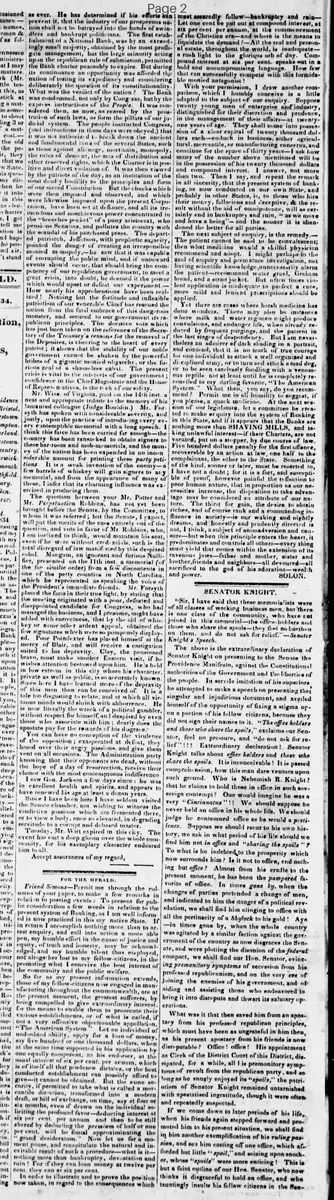
Friend Simons—Permit me through the columns of your paper, to make a few remarks in relation to passing events: To present for public consideration a few words in relation to the present system of Banking, as I am well informed is now practiced in this my native State. If in return I accomplish nothing more than to arrest enquiry, and call into action a more able pen, my humble effort in the cause of justice and equity, of truth and honesty, may be acknowledged, and my humble talent thus employed, not altogether lost to my fellow-citizens, in the promoting what I conceive the best interest of the community and the public welfare.
So far as my present information extends, those of my fellow-citizens now engaged in manufacturing throughout the commonwealth, are at the present moment, the greatest sufferers, by being compelled to give extraordinary interest, for the means to enable them to prosecute their various establishments, or of what is called, if not a very offensive objectionable appellation, 'The American System' Let an individual of undoubted ability, apply for a loan of money, say five hundred or one thousand dollars. when at the same time supported in his application by one equally competent, as his endorser, at the usual interest of six per cent. per annum, which is of itself all that prudence dictates, or the best conducted establishment can possibly afford to give—it cannot be obtained. But the same security, if permitted to take what is called a mercantile direction, transformed into a modern draft, or bill of exchange, on time, say at four or six months, even if drawn on the individuals soliciting the profound favor—deducting interest at six per cent. per annum and then to be still shaved by deducting the premium of half or one per cent. will be found approximating the grand desideratum. Now let us for a moment pause, and recapitulate the natural and inevitable result of such a procedure—what is it—nothing more than bankruptcy, devastation and ruin! For if they can loan money at twelve per cent. they can at six per cent.
In order to illustrate and to prove the position now taken, in regard to the consequences which must assuredly follow—bankruptcy and ruin—Let one cent be put out at compound interest, at six per cent. per annum, at the commencement of the Christian era—and where is the means to liquidate the demand?—All the real and personal estate, throughout the world, is inadequate—a rush light to the glorious orb of day. Compound interest at six per cent. speaks out in a bold and uncompromising language. How few that can successfully compete with this formidable monied antagonist!
With your permission, I draw another comparison, which I humbly conceive is a little adapted to the subject of our enquiry. Suppose twenty young men of enterprise and industry, distinguished for their discretion and prudence, in the management of their affairs—at twenty-one years of age. They shall come into possession of a clear capital of twenty thousand dollars each—embark in business, either agricultural, mercantile, or manufacturing concerns, and continue for the space of thirty years—I ask how many of the number above mentioned will be in the possession of his twenty thousand dollars and compound interest. I answer, not more than two. Then I say, and repeat the remark in all sincerity, that the present system of banking, as now conducted in our own State, and probably in other States, is, to those who hire their money, fallacious and deceptive, & the result without the aid of omnipotence, will as certainly end in bankruptcy and ruin, 'as we move and have a being'—and the sooner it is abandoned the better for all parties.
The next subject of enquiry, is the remedy.—The patient cannot be said to be convalescent; then what medicine would a skilful physician recommend and adopt. I might perhaps in the zeal of enquiry and premature investigation, not having scientific knowledge, unnecessarily alarm the patient—recommend water gruel, Graham bread, and a strait jacket. But often times violent application is inadequate to perfect a cure, more mild and lenient prescriptions should be applied.
Yet there are cases where harsh medicine has done wonders. There may also be instances where milk and water regimen might produce convulsions, and endanger life, when already reduced by frequent purgings, and the patient in the last stages of despondency. But I am nevertheless an admirer of dark shading in a portrait, and contend, that it is no mark of true courage for one individual to attack a well organized and disciplined army, or to turn and attack a mad dog, or to be seen carelessly fondling with a venomous reptile not at least until he is completely reconciled to my darling favorite, 'The American System.' What then, you say, do you recommend? Permit me in all humility to suggest, if you please, a quack medicine. At the next session of our legislature, let a committee be created to make enquiry into the system of Banking in this State, and if it appears that the Banks are nothing more than SHAVING MILLS, and taking unlawful interest—if their Charters, are not vacated, put on a stopper, by due course of law. Five hundred dollars penalty for the first offence, recoverable by an action at law, one half to the complainant, the other to the State. Something of the kind, sooner or later, must be resorted to, I have not a doubt; for it is a fact, and susceptible of proof, however painful the reflection to poor human nature, that in proportion as our necessities increase, the disposition to take advantage may be considered an attribute of our nature. The thirst for gain, the desire to obtain riches, and of course rank and a commanding influence in society—is our waking and nightly dreams, and honestly and prudently directed is not, I think, a subject of animadversion and censure—but when this principle enters the heart, it predominates and controls all others—every thing must yield that comes within the extension of its ravenous jaws—father and mother, sister and brother, friends and neighbors—all devoured—all sacrificed to the god of his adoration—wealth and power.
Friend Simons—Permit me through the columns of your paper, to make a few remarks in relation to passing events: To present for public consideration a few words in relation to the present system of Banking, as I am well informed is now practiced in this my native State. If in return I accomplish nothing more than to arrest enquiry, and call into action a more able pen, my humble effort in the cause of justice and equity, of truth and honesty, may be acknowledged, and my humble talent thus employed, not altogether lost to my fellow-citizens, in the promoting what I conceive the best interest of the community and the public welfare.
So far as my present information extends, those of my fellow-citizens now engaged in manufacturing throughout the commonwealth, are at the present moment, the greatest sufferers, by being compelled to give extraordinary interest, for the means to enable them to prosecute their various establishments, or of what is called, if not a very offensive objectionable appellation, 'The American System' Let an individual of undoubted ability, apply for a loan of money, say five hundred or one thousand dollars. when at the same time supported in his application by one equally competent, as his endorser, at the usual interest of six per cent. per annum, which is of itself all that prudence dictates, or the best conducted establishment can possibly afford to give—it cannot be obtained. But the same security, if permitted to take what is called a mercantile direction, transformed into a modern draft, or bill of exchange, on time, say at four or six months, even if drawn on the individuals soliciting the profound favor—deducting interest at six per cent. per annum and then to be still shaved by deducting the premium of half or one per cent. will be found approximating the grand desideratum. Now let us for a moment pause, and recapitulate the natural and inevitable result of such a procedure—what is it—nothing more than bankruptcy, devastation and ruin! For if they can loan money at twelve per cent. they can at six per cent.
In order to illustrate and to prove the position now taken, in regard to the consequences which must assuredly follow—bankruptcy and ruin—Let one cent be put out at compound interest, at six per cent. per annum, at the commencement of the Christian era—and where is the means to liquidate the demand?—All the real and personal estate, throughout the world, is inadequate—a rush light to the glorious orb of day. Compound interest at six per cent. speaks out in a bold and uncompromising language. How few that can successfully compete with this formidable monied antagonist!
With your permission, I draw another comparison, which I humbly conceive is a little adapted to the subject of our enquiry. Suppose twenty young men of enterprise and industry, distinguished for their discretion and prudence, in the management of their affairs—at twenty-one years of age. They shall come into possession of a clear capital of twenty thousand dollars each—embark in business, either agricultural, mercantile, or manufacturing concerns, and continue for the space of thirty years—I ask how many of the number above mentioned will be in the possession of his twenty thousand dollars and compound interest. I answer, not more than two. Then I say, and repeat the remark in all sincerity, that the present system of banking, as now conducted in our own State, and probably in other States, is, to those who hire their money, fallacious and deceptive, & the result without the aid of omnipotence, will as certainly end in bankruptcy and ruin, 'as we move and have a being'—and the sooner it is abandoned the better for all parties.
The next subject of enquiry, is the remedy.—The patient cannot be said to be convalescent; then what medicine would a skilful physician recommend and adopt. I might perhaps in the zeal of enquiry and premature investigation, not having scientific knowledge, unnecessarily alarm the patient—recommend water gruel, Graham bread, and a strait jacket. But often times violent application is inadequate to perfect a cure, more mild and lenient prescriptions should be applied.
Yet there are cases where harsh medicine has done wonders. There may also be instances where milk and water regimen might produce convulsions, and endanger life, when already reduced by frequent purgings, and the patient in the last stages of despondency. But I am nevertheless an admirer of dark shading in a portrait, and contend, that it is no mark of true courage for one individual to attack a well organized and disciplined army, or to turn and attack a mad dog, or to be seen carelessly fondling with a venomous reptile not at least until he is completely reconciled to my darling favorite, 'The American System.' What then, you say, do you recommend? Permit me in all humility to suggest, if you please, a quack medicine. At the next session of our legislature, let a committee be created to make enquiry into the system of Banking in this State, and if it appears that the Banks are nothing more than SHAVING MILLS, and taking unlawful interest—if their Charters, are not vacated, put on a stopper, by due course of law. Five hundred dollars penalty for the first offence, recoverable by an action at law, one half to the complainant, the other to the State. Something of the kind, sooner or later, must be resorted to, I have not a doubt; for it is a fact, and susceptible of proof, however painful the reflection to poor human nature, that in proportion as our necessities increase, the disposition to take advantage may be considered an attribute of our nature. The thirst for gain, the desire to obtain riches, and of course rank and a commanding influence in society—is our waking and nightly dreams, and honestly and prudently directed is not, I think, a subject of animadversion and censure—but when this principle enters the heart, it predominates and controls all others—every thing must yield that comes within the extension of its ravenous jaws—father and mother, sister and brother, friends and neighbors—all devoured—all sacrificed to the god of his adoration—wealth and power.
What sub-type of article is it?
Economic Policy
What keywords are associated?
Banking System
Interest Rates
Compound Interest
Manufacturers
Shaving Mills
Legislative Reform
American System
What entities or persons were involved?
Banks
Legislature
Manufacturers
The American System
Editorial Details
Primary Topic
Criticism Of State Banking System And High Interest Rates
Stance / Tone
Strongly Critical Of Banking Practices, Advocating Legislative Reform
Key Figures
Banks
Legislature
Manufacturers
The American System
Key Arguments
Manufacturers Suffer From Extraordinary Interest Rates Beyond 6% Per Annum
Loans Disguised As Bills Of Exchange Effectively Charge 12% Or More
Such Practices Lead To Bankruptcy, Devastation, And Ruin
Compound Interest At 6% Over Centuries Exceeds All World Wealth
Most Young Entrepreneurs Would Fail To Retain Capital After 30 Years Under Current System
Banking System Is Fallacious And Deceptive To Borrowers
Recommend Legislative Committee To Investigate Banks As 'Shaving Mills'
Impose Penalties Like $500 Fines For Unlawful Interest