Thank you for visiting SNEWPapers!
Sign up free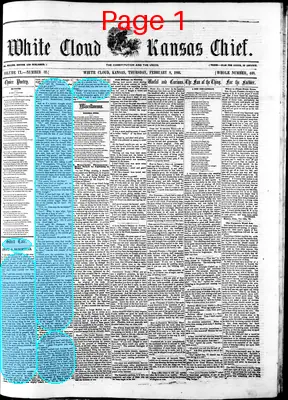
Story
February 8, 1866
White Cloud Kansas Chief
White Cloud, Doniphan County, Kansas
What is this article about?
A Yankee peddler named Joel Spry bets a plantation overseer, Mr. Simmons, that his barometer predicts weather better than blind slave Jake's aching toe. Jake wins the bet over a week, but Spry reveals the goods boxes contain fakes, tricking Simmons for free lodging and feed.
Clipping
OCR Quality
95%
Excellent
Full Text
Select Tale.
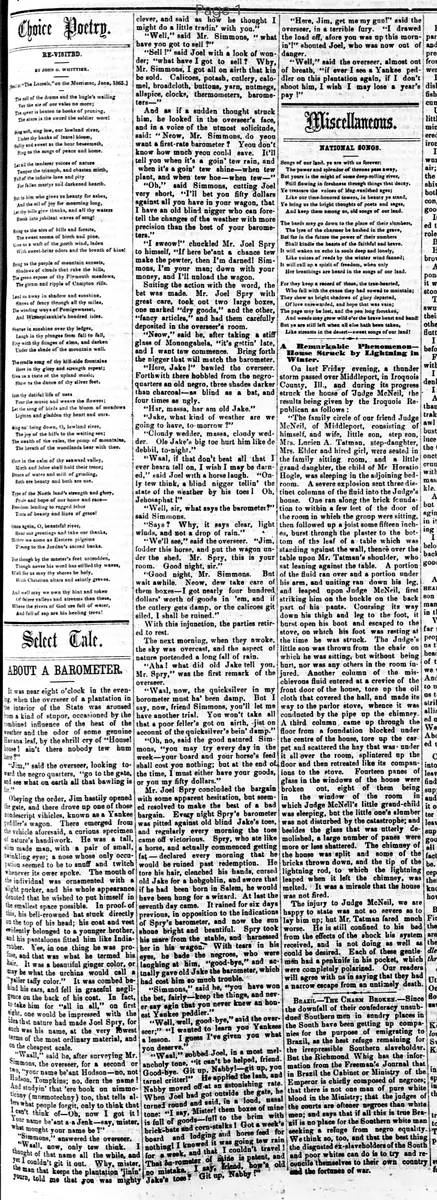
ABOUT A BAROMETER.
It was near eight o'clock in the evening, when the overseer of a plantation in the interior of the State was aroused from a kind of stupor, occasioned by the combined influence of the heat of the weather and the odor of some genuine Havana leaf, by the shrill cry of "House! house! ain't there nobody tew bum here?"
"Jim," said the overseer, looking toward the negro quarters, "go to the gate, and see what on earth all that bawling is for."
Obeying the order, Jim hastily opened the gate, and there drove up one of those nondescript vehicles, known as a Yankee peddler's wagon. There emerged from the vehicle aforesaid, a curious specimen of nature's handiwork. He was a tall, slim made man, with a pair of small, twinkling eyes; a nose whose only occupation seemed to be to snuff and twitch whenever its owner spoke. The mouth of the individual was ornamented with a slight pucker, and his whole appearance denoted that he wished to put himself in the smallest space possible. In proof of this, his bell-crowned hat stuck directly on the top of his head; his coat and vest evidently belonged to a younger brother, and his pantaloons fitted him like India-rubber. Yes, in one thing he was pro-fuse, and that was what he termed his hair. It was a beautiful ginger color, or may be what the urchins would call a "yaller taffy color."
It was combed behind his ears, and fell in graceful negligence on the back of his coat. In fact, to take him for "all in all," on first sight, one would be impressed with the idea that nature had made Joel Spry, for such was his name, at the very lowest terms of the most ordinary material, and on the cheapest scale.
"Waall," said he, after surveying Mr. Simmons, the overseer, for a second or two, "your name be'ant Hodson—no, not Hodson, Tompkins; no, dern the name! And studyin' that 'ere book on nimmonicny (mnemonics) too, that tells allers what people forgit, only to think that—now I got it. Your name be'ant a-a Jenk—say, mister, what mought your name be?"
"Simmons," answered the overseer.
"Waall, now, only tew think. I thought of that name all the while, and yet I couldn't git it out. Why, mister, the man that keeps the plantation 'jinin' yourn, told me that you was mighty clever, and said as how he thought I might do a little tradin' with you."
"Well," said Mr. Simmons, "what have you got to sell?"
"Sell!" said Joel with a look of wonder; "what have I got to sell? Why, Mr. Simmons, I got all on airth that kin be sold. Calicoes, potash, cutlery, calomel, broadcloth, buttons, yarn, nutmegs, allspice, clocks, thermometers, barometers—"
And as if a sudden thought struck him, he looked in the overseer's face, and in a voice of the utmost solicitude, said: "Neow, Mr. Simmons, do yeou want a first-rate barometer? Yeou don't know how much yeou could save. It'll tell you when it's a goin' tew rain, and when it's a goin' tew shine—when tew plant, and when tew hoe—when tew—"
"Oh," said Simmons, cutting Joel very short, "I'll bet you fifty dollars against all you have in your wagon, that I have an old blind nigger who can foretell the changes of the weather with more precision than the best of your barometers."
"I swow!" chuckled Mr. Joel Spry to himself, "If here be'ant a chance tew make the pewter, then I'm darned! Simmons, I'm your man; down with your money, and I'll unload the wagon."
Suiting the action with the word, the bet was made. Mr. Joel Spry with great care, took out two large boxes, one marked "dry goods," and the other, "fancy articles," and had them carefully deposited in the overseer's room.
"Neow," said he, after taking a stiff glass of Monongahela, "it's gettin' late, and I want tew commence. Bring forth the nigger that will match the barometer."
"Here, Jake!" bawled the overseer.
Forthwith there hobbled from the negro quarters an old negro, three shades darker than charcoal—as blind as a bat, and four times as ugly.
"Har, massa, har am old Jake."
"Jake, what kind of weather are we going to have, to-morrow?"
"Cloudy wedder, massa, cloudy wedder. Ole Jake's big toe hurt him like de debbil, to-night."
"Waal, if that don't beat all that I ever bearn tell on, I wish I may be darned," said Joel with a horse laugh. "Only tew think, a blind nigger tellin' the state of the weather by his toes! Oh, Jehosaphat!"
"Well, sir, what says the barometer?" said Simmons.
"Says? Why, it says clear, light winds, and not a drop of rain."
"We'll see," said the overseer. "Jim, fodder this horse, and put the wagon under the shed. Mr. Spry, this is your room. Good night, sir."
"Good night, Mr. Simmons. But wait awhile. Neow, dew take care of them boxes—I got nearly four hundred dollars' worth of goods in 'em, and if the cutlery gets damp, or the calicoes git siled, I shall be ruined."
With this injunction, the parties retired to rest.
The next morning, when they awoke, the sky was overcast, and the aspect of nature portended a long fall of rain.
"Aha! what did old Jake tell you, Mr. Spry," was the first remark of the overseer.
"Waal, now, the quicksilver in my barometer must ba' been damp. But I say, now, friend Simmons, you'll let me have another trial. You won't take all that a poor feller's got on airth, just on account of the quicksilver's bein' damp."
"Oh, no," said the good natured Simmons, "you may try every day in the week—your board and your horse's feed shall cost you nothing; but at the end of the time, I must either have your goods, or you my fifty dollars."
Mr. Joel Spry concluded the bargain with some apparent hesitation, but seemed resolved to make the best of a bad bargain. Every night Spry's barometer was pitted against old blind Jake's toes, and regularly every morning the toes came off victorious. Spry, who ate like a horse, and actually commenced getting fat—declared every morning that he would be ruined past redemption. He tore his hair, clenched his hands, cursed old Jake for a hobgoblin, and swore that if he had been born in Salem, he would have been hung for a wizard. At last the seventh day came. It rained for six days previous, in opposition to the indications of Spry's barometer, and now the sun shone bright and beautiful. Spry took his mare from the stable, and harnessed her in his wagon. With tears in his eyes, he bade the negroes, who were laughing at him, "good-bye," and actually gave old Jake the barometer, which had cost him so much trouble.
"Simmons," said he, "you have won the bet, fairly—keep the thing, and never say agin that you never knew an honest Yankee peddler."
"Well, well, good-bye," said the overseer; "I wanted to learn you Yankees a lesson. I guess I've given you what you deserve."
"Waal," sobbed Joel, in a most melancholy tone, "it can't be helped, friend. Good-bye. Git up, Nabby!—git up, you tarnel critter!" He applied the lash, and Nabby moved off—at an astonishing rate.
When Joel had got outside the gate, he turned round and said, in a loud, nasal tone: "I say, Mister! them boxes of mine is full of goods—full to the brim with brick-bats and corn-stalks! Got a week's board and lodging and horse feed for nothing! I knowed it was going tew rain. That ba-rometeor of mine is patent, and no mistake. I say, friend, how's old Jake's toes? Git up, Nabby!"
"Here, Jim, get me my gun!" said the overseer, in a terrible fury. "I drawed the load off, afore you was up this mornin'!" shouted Joel, who was now out of danger.
"Well," said the overseer, almost out of breath, "if ever I see a Yankee peddler on this plantation again, if I don't shoot him, I wish I may lose a year's pay!"
ABOUT A BAROMETER.
It was near eight o'clock in the evening, when the overseer of a plantation in the interior of the State was aroused from a kind of stupor, occasioned by the combined influence of the heat of the weather and the odor of some genuine Havana leaf, by the shrill cry of "House! house! ain't there nobody tew bum here?"
"Jim," said the overseer, looking toward the negro quarters, "go to the gate, and see what on earth all that bawling is for."
Obeying the order, Jim hastily opened the gate, and there drove up one of those nondescript vehicles, known as a Yankee peddler's wagon. There emerged from the vehicle aforesaid, a curious specimen of nature's handiwork. He was a tall, slim made man, with a pair of small, twinkling eyes; a nose whose only occupation seemed to be to snuff and twitch whenever its owner spoke. The mouth of the individual was ornamented with a slight pucker, and his whole appearance denoted that he wished to put himself in the smallest space possible. In proof of this, his bell-crowned hat stuck directly on the top of his head; his coat and vest evidently belonged to a younger brother, and his pantaloons fitted him like India-rubber. Yes, in one thing he was pro-fuse, and that was what he termed his hair. It was a beautiful ginger color, or may be what the urchins would call a "yaller taffy color."
It was combed behind his ears, and fell in graceful negligence on the back of his coat. In fact, to take him for "all in all," on first sight, one would be impressed with the idea that nature had made Joel Spry, for such was his name, at the very lowest terms of the most ordinary material, and on the cheapest scale.
"Waall," said he, after surveying Mr. Simmons, the overseer, for a second or two, "your name be'ant Hodson—no, not Hodson, Tompkins; no, dern the name! And studyin' that 'ere book on nimmonicny (mnemonics) too, that tells allers what people forgit, only to think that—now I got it. Your name be'ant a-a Jenk—say, mister, what mought your name be?"
"Simmons," answered the overseer.
"Waall, now, only tew think. I thought of that name all the while, and yet I couldn't git it out. Why, mister, the man that keeps the plantation 'jinin' yourn, told me that you was mighty clever, and said as how he thought I might do a little tradin' with you."
"Well," said Mr. Simmons, "what have you got to sell?"
"Sell!" said Joel with a look of wonder; "what have I got to sell? Why, Mr. Simmons, I got all on airth that kin be sold. Calicoes, potash, cutlery, calomel, broadcloth, buttons, yarn, nutmegs, allspice, clocks, thermometers, barometers—"
And as if a sudden thought struck him, he looked in the overseer's face, and in a voice of the utmost solicitude, said: "Neow, Mr. Simmons, do yeou want a first-rate barometer? Yeou don't know how much yeou could save. It'll tell you when it's a goin' tew rain, and when it's a goin' tew shine—when tew plant, and when tew hoe—when tew—"
"Oh," said Simmons, cutting Joel very short, "I'll bet you fifty dollars against all you have in your wagon, that I have an old blind nigger who can foretell the changes of the weather with more precision than the best of your barometers."
"I swow!" chuckled Mr. Joel Spry to himself, "If here be'ant a chance tew make the pewter, then I'm darned! Simmons, I'm your man; down with your money, and I'll unload the wagon."
Suiting the action with the word, the bet was made. Mr. Joel Spry with great care, took out two large boxes, one marked "dry goods," and the other, "fancy articles," and had them carefully deposited in the overseer's room.
"Neow," said he, after taking a stiff glass of Monongahela, "it's gettin' late, and I want tew commence. Bring forth the nigger that will match the barometer."
"Here, Jake!" bawled the overseer.
Forthwith there hobbled from the negro quarters an old negro, three shades darker than charcoal—as blind as a bat, and four times as ugly.
"Har, massa, har am old Jake."
"Jake, what kind of weather are we going to have, to-morrow?"
"Cloudy wedder, massa, cloudy wedder. Ole Jake's big toe hurt him like de debbil, to-night."
"Waal, if that don't beat all that I ever bearn tell on, I wish I may be darned," said Joel with a horse laugh. "Only tew think, a blind nigger tellin' the state of the weather by his toes! Oh, Jehosaphat!"
"Well, sir, what says the barometer?" said Simmons.
"Says? Why, it says clear, light winds, and not a drop of rain."
"We'll see," said the overseer. "Jim, fodder this horse, and put the wagon under the shed. Mr. Spry, this is your room. Good night, sir."
"Good night, Mr. Simmons. But wait awhile. Neow, dew take care of them boxes—I got nearly four hundred dollars' worth of goods in 'em, and if the cutlery gets damp, or the calicoes git siled, I shall be ruined."
With this injunction, the parties retired to rest.
The next morning, when they awoke, the sky was overcast, and the aspect of nature portended a long fall of rain.
"Aha! what did old Jake tell you, Mr. Spry," was the first remark of the overseer.
"Waal, now, the quicksilver in my barometer must ba' been damp. But I say, now, friend Simmons, you'll let me have another trial. You won't take all that a poor feller's got on airth, just on account of the quicksilver's bein' damp."
"Oh, no," said the good natured Simmons, "you may try every day in the week—your board and your horse's feed shall cost you nothing; but at the end of the time, I must either have your goods, or you my fifty dollars."
Mr. Joel Spry concluded the bargain with some apparent hesitation, but seemed resolved to make the best of a bad bargain. Every night Spry's barometer was pitted against old blind Jake's toes, and regularly every morning the toes came off victorious. Spry, who ate like a horse, and actually commenced getting fat—declared every morning that he would be ruined past redemption. He tore his hair, clenched his hands, cursed old Jake for a hobgoblin, and swore that if he had been born in Salem, he would have been hung for a wizard. At last the seventh day came. It rained for six days previous, in opposition to the indications of Spry's barometer, and now the sun shone bright and beautiful. Spry took his mare from the stable, and harnessed her in his wagon. With tears in his eyes, he bade the negroes, who were laughing at him, "good-bye," and actually gave old Jake the barometer, which had cost him so much trouble.
"Simmons," said he, "you have won the bet, fairly—keep the thing, and never say agin that you never knew an honest Yankee peddler."
"Well, well, good-bye," said the overseer; "I wanted to learn you Yankees a lesson. I guess I've given you what you deserve."
"Waal," sobbed Joel, in a most melancholy tone, "it can't be helped, friend. Good-bye. Git up, Nabby!—git up, you tarnel critter!" He applied the lash, and Nabby moved off—at an astonishing rate.
When Joel had got outside the gate, he turned round and said, in a loud, nasal tone: "I say, Mister! them boxes of mine is full of goods—full to the brim with brick-bats and corn-stalks! Got a week's board and lodging and horse feed for nothing! I knowed it was going tew rain. That ba-rometeor of mine is patent, and no mistake. I say, friend, how's old Jake's toes? Git up, Nabby!"
"Here, Jim, get me my gun!" said the overseer, in a terrible fury. "I drawed the load off, afore you was up this mornin'!" shouted Joel, who was now out of danger.
"Well," said the overseer, almost out of breath, "if ever I see a Yankee peddler on this plantation again, if I don't shoot him, I wish I may lose a year's pay!"
What sub-type of article is it?
Deception Fraud
What themes does it cover?
Deception
Fortune Reversal
Triumph
What keywords are associated?
Yankee Peddler
Barometer
Weather Prediction
Deception
Plantation Bet
Slave Toe
Trickery
What entities or persons were involved?
Joel Spry
Mr. Simmons
Jake
Jim
Where did it happen?
Plantation In The Interior Of The State
Story Details
Key Persons
Joel Spry
Mr. Simmons
Jake
Jim
Location
Plantation In The Interior Of The State
Story Details
Yankee peddler Joel Spry bets overseer Simmons that his barometer predicts weather better than blind slave Jake's toe; Jake wins over a week, but Spry reveals boxes contain fakes, securing free board while mocking Simmons.