Thank you for visiting SNEWPapers!
Sign up free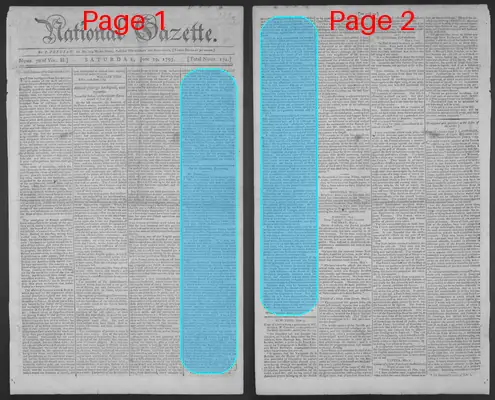
National Gazette
Philadelphia, Philadelphia County, Pennsylvania
What is this article about?
A letter to the editor of the National Gazette criticizes the federal government's protection of Cherokee Indians over Georgia settlers, questions the republican nature of the U.S. government, and laments Georgia's hasty adoption of the Constitution, warning of potential division like ancient Israel.
Merged-components note: Continuation of the letter to Mr. Freneau about political issues in Georgia across pages; the starting text in the first component includes a short concluding paragraph from the prior foreign news article due to parsing boundaries, but the primary content is the letter.
Clippings
1 of 2
OCR Quality
Full Text
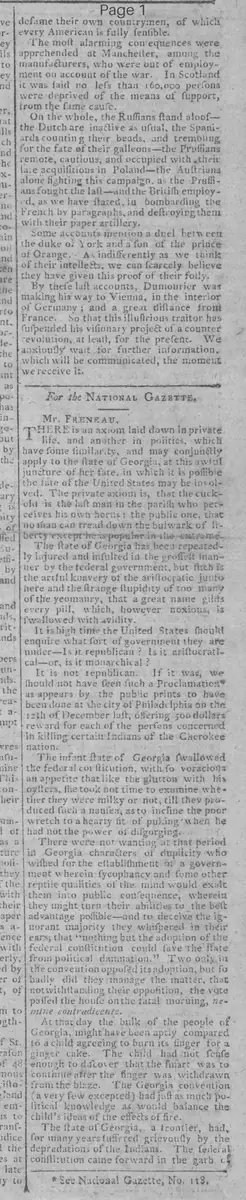
For the National Gazette.
Mr. Freneau,
There is an axiom laid down in private life, and another in politics, which have some similarity, and may conjunctly apply to the state of Georgia, at this awful juncture of her fate, in which it is possible the fate of the United States may be involved. The private axiom is, that the cuckold is the last man in the parish who perceives his own horns: the public one, that no man can tread down the bulwark of liberty except he is popular in the extreme. The state of Georgia has been repeatedly injured and insulted in the grossest manner by the federal government, but such is the artful knavery of the aristocratic junto here and the strange stupidity of too many of the yeomanry, that a great name gilds every pill, which, however noxious, is swallowed with avidity.
It is high time the United States should enquire what sort of government they are under—Is it republican? Is it aristocratical—or, is it monarchical? It is not republican. If it was, we should not have seen such a Proclamation as appears by the public prints to have been done at the city of Philadelphia on the 12th of December last, offering fifty dollars reward for each of the persons concerned in killing certain Indians of the Cherokee nation.
The infant state of Georgia swallowed the federal constitution, with so voracious an appetite that like the glutton with his oysters, she took not time to examine whether they were milky or not, till they produced such a nausea, as to incline the poor wretch to a hearty fit of puking when he had not the power of disgorging.
There were not wanting at that period in Georgia characters of duplicity who wished for the establishment of a government wherein sycophancy and some other reptile qualities of the mind would exalt them into public consequence, wherein they might turn their abilities to the best advantage possible—and to deceive the ignorant majority they whispered in their ears, that "nothing but the adoption of the federal constitution could save the state from political damnation." Two only in the convention opposed its adoption, but so badly did they manage the matter, that notwithstanding their opposition, the vote passed the house on the fatal morning, nine contra ten.
At that day the bulk of the people of Georgia, might have been aptly compared to a child agreeing to burn its finger for a ginger cake. The child had not sense enough to discover that the smart was to continue after the finger was withdrawn from the blaze. The Georgia convention (a very few excepted) had just as much political knowledge as would balance the child's ideas of the effects of fire.
The state of Georgia, a frontier, had, for many years suffered grievously by the depredations of the Indians. The federal constitution came forward in the garb of
An artful gallant addressing an innocent and unsuspecting girl, whose fortune, not her person or mental accomplishments, was the object of his affection. The deceived multitude expected it would afford them ample protection against their savage neighbours.
And it is with a vengeance we are protected!—A few federal troops are stationed on our frontiers to give protection to the Indians and punish any citizen of Georgia who shall presume to kill one of them, although of a party who had just embrued their hands in the blood of his wife and children, burnt his habitation, and carried off as much of his stock and furniture as they could lay hold of or manage.
Ye demi-gods of federalism, do not visions haunt your slumbers of the distresses endured on our frontier?—Surrounded by minions, sycophants and paralytics (the first visible marks of royalty) the glare of your borrowed plumes has so dazzled the eyes of the astonished multitude, that it has, in fact, become difficult to persuade them that you are not infallible!
Is it possible you can really conceive or suppose the Creek Indians to be at amity with the United States, when a very slight exertion might have procured you authentic information that the Cherokees, as well as the other great and respectable allies of the United States, the Creeks, helped to defeat the two generals Harmar and St. Clair?
Behold the salutary effects of a royal mandate appearing in form of a proclamation! The prefatory part of it is sufficient to condemn the residue. Authentic information could not have been received, because to be authentic it was necessary it should be true. Hearken then to the voice of truth:
A militia officer, living on the western frontier of Georgia, had some horses carried off by a party of Cherokee Indians. A few of his neighbours were killed, several houses burnt, and a considerable quantity of stock carried off from various people by those respectable aborigines of this ill-fated country. He collected a few of his militia, pursued the murderers, passed several Indian towns without molesting any of the inhabitants, and finally arrived at that in which the hostile savages had taken refuge. This hostile town he laid in ashes, as any other good soldier would have done under like circumstances, killed as many of the red men as he could come at there, and then returned home, passing again in the most peaceable manner through their towns, when he had it in his power to annihilate them and their inhabitants.
This officer had been generally active in suppressing the violent attempts of the Indians, which thwarting the views of a few of our oligarchical gentlemen, he was marked out as a proper object on which to try the validity of the proclamation. He was taken into custody by the federal marshal for the district of Georgia, when he chose to go forward to trial, conscious of his innocence, rather than yield to the solicitations of his friends; one hundred and fifty of whom presented themselves, and proffered to release him by force.
This, with the court-party, will be an additional instance of the lawless disposition of the Georgians. But they are mistaken: it was only a resuscitation of that patriotic spirit which gave birth to the two battles of Lexington and Bunker's hill, and paved the way to those exalted stations in which some now live, who seem to forget that their consequence is wholly and totally from the people, and that from the current of their breath it derives its existence only.
As an extenuation of the conduct of the federal government towards the United States generally, and the state of Georgia particularly, it cannot be denied but that the people wear the yoke so tamely, that the plain inference to be drawn is, The Almighty originally intended them for slaves, and therefore did not endue them with mental faculties to support such a government as they had been tantalized with.
Solomon slept with his fathers—Rehoboam ascended his throne he took bad counsel, which Jeroboam availing himself of, rent the kingdom in twain. It is possible, nay it is more than probable, that a duplicate of the transactions of those days may be copied into the pages of American history, when certain heads, which are now warm, are reposing in the dust.
A CITIZEN OF GEORGIA.
Wilkes County, April 15, 1793.
What sub-type of article is it?
What themes does it cover?
What keywords are associated?
What entities or persons were involved?
Letter to Editor Details
Author
A Citizen Of Georgia
Recipient
Mr. Freneau
Main Argument
the federal government is not republican but aristocratic, protecting cherokee indians over georgia citizens through a proclamation offering rewards for their killers, and georgia was deceived into adopting the constitution, leading to frontier vulnerabilities and potential national division.
Notable Details