Thank you for visiting SNEWPapers!
Sign up free
The Bismarck Tribune
Bismarck, Mandan, Burleigh County, Morton County, North Dakota
What is this article about?
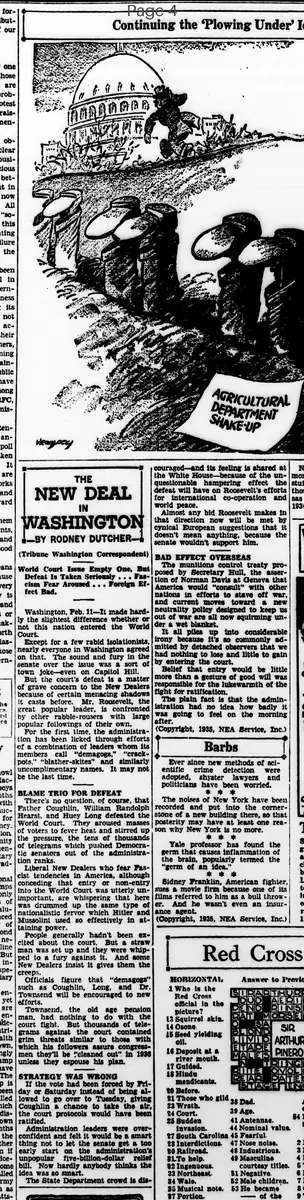
Washington correspondent Rodney Dutcher analyzes the Senate's rejection of World Court entry on Feb. 11, 1935, attributing it to demagogues Coughlin, Hearst, and Long. Though the issue was trivial, the defeat alarms New Dealers over rising nationalism akin to fascism and its harm to Roosevelt's global initiatives.
Clipping
OCR Quality
Full Text
(Tribune Washington Correspondent)
World Court Issue Empty One, But Defeat Is Taken Seriously ... Fascism Fear Aroused... Foreign Effect Bad,
Washington, Feb. 11-It made hardly the slightest difference whether or not this nation entered the World Court.
Except for a few rabid isolationists, nearly everyone in Washington agreed on that. The sound and fury in the senate over the issue was a sort of town joke-even on Capitol Hill.
But the court's defeat is a matter of grave concern to the New Dealers because of certain menacing shadows it casts before. Mr. Roosevelt, the great popular leader, is confronted by other rabble-rousers with large popular followings of their own.
For the first time, the administration has been licked through efforts of a combination of leaders whom its members call "demagogues," "crackpots," "blatherskites" and similarly uncomplimentary names. It may not be the last time.
BLAME TRIO FOR DEFEAT
There's no question, of course, that Father Coughlin, William Randolph Hearst, and Huey Long defeated the World Court. They aroused masses of voters to fever heat and stirred up the pressure, the tens of thousands of telegrams which pushed Democratic senators out of the administration ranks.
Liberal New Dealers who fear Fascist tendencies in America, although conceding that entry or non-entry into the World Court was utterly unimportant, are whispering that here was drummed up the same type of nationalistic fervor which Hitler and Mussolini used so effectively in attaining power.
People generally hadn't been excited about the court. But a straw man was set up and they were whipped to a fury against it. And some New Dealers insist it gives them the creeps.
Officials figure that "demagogues" such as Coughlin, Long, and Dr. Townsend will be encouraged to new efforts.
Townsend, the old age pension man, had nothing to do with the court fight. But thousands of telegrams against the court contained grim threats similar to those with which his followers assure congressmen they'll be "cleaned out", in 1936 unless they espouse his plan.
STRATEGY WAS WRONG
If the vote had been forced by Friday or Saturday instead of being allowed to go over to Tuesday, giving Coughlin a chance to take the air, the court protocols would have been ratified.
Administration leaders were over-confident and felt it would be a smart thing not to let the senate get a too early start on the administration's unpopular five-billion-dollar relief bill. Now hardly anybody thinks the idea was so smart.
The State Department crowd is discouraged-and its feeling is shared at the White House-because of the unquestionable hampering effect the defeat will have on Roosevelt's efforts for international co-operation and world peace.
Almost any bid Roosevelt makes in that direction now will be met by cynical European suggestions that it doesn't mean anything, because the senate wouldn't support him.
Bad Effect Overseas
The munitions control treaty proposed by Secretary Hull, the assertion of Norman Davis at Geneva that America would "consult" with other nations in efforts to stave off war, and current moves toward a new neutrality policy designed to keep us out of war are all now squirming under a wet blanket.
It all piles up into considerable irony because it's so commonly admitted by detached observers that we had nothing to lose and little to gain by entering the court.
Belief that entry would be little more than a gesture of good will was responsible for the lukewarmth of the fight for ratification.
The plain fact is that the administration had no idea how badly it was going to feel on the morning after.
(Copyright, 1935, NEA Service, Inc.)
What sub-type of article is it?
What themes does it cover?
What keywords are associated?
What entities or persons were involved?
Where did it happen?
Story Details
Key Persons
Location
Washington
Event Date
1935 02 11
Story Details
The U.S. Senate defeats the World Court protocols due to opposition from demagogues Coughlin, Hearst, and Long, who stirred public fervor via telegrams and radio. New Dealers view this as a serious setback, fearing fascist-like nationalism and damage to Roosevelt's international cooperation efforts, despite the issue's minor importance.