Thank you for visiting SNEWPapers!
Sign up free
Letter to Editor
August 29, 1881
Towanda Daily Review
Towanda, Bradford County, Pennsylvania
What is this article about?
Letter reports observing numerous worms in black bass caught in Bradford County, PA, and Onondaga Lake, NY. Describes their location, harmlessness when cooked, and theorizes origin from parasitic eggs in flies eaten by fish. Notes bass remain healthy and gamy.
Clipping
OCR Quality
98%
Excellent
Full Text
Worms in Black Bass.
To the Editor of Review:—
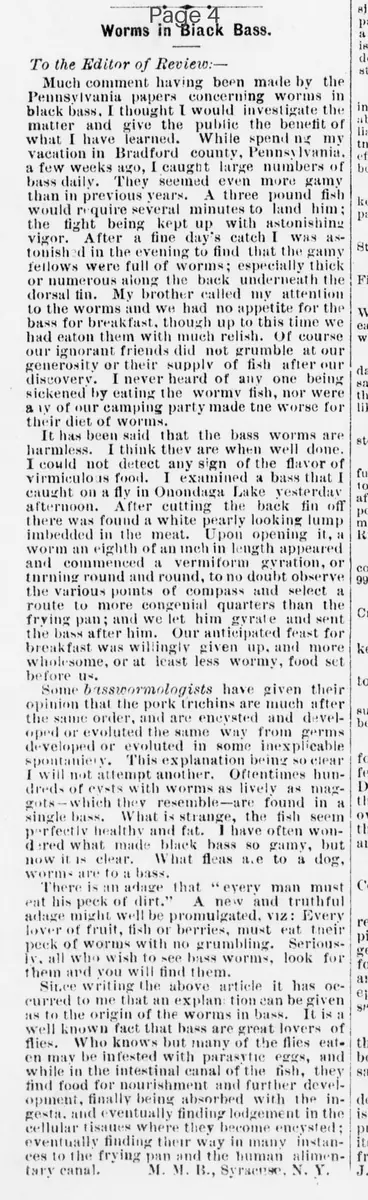
Much comment having been made by the Pennsylvania papers concerning worms in black bass, I thought I would investigate the matter and give the public the benefit of what I have learned. While spending my vacation in Bradford county, Pennsylvania, a few weeks ago, I caught large numbers of bass daily. They seemed even more gamy than in previous years. A three pound fish would require several minutes to land him; the fight being kept up with astonishing vigor. After a fine day's catch I was astonished in the evening to find that the gamy fellows were full of worms; especially thick or numerous along the back underneath the dorsal fin. My brother called my attention to the worms and we had no appetite for the bass for breakfast, though up to this time we had eaten them with much relish. Of course our ignorant friends did not grumble at our generosity or their supply of fish after our discovery. I never heard of any one being sickened by eating the wormy fish, nor were any of our camping party made the worse for their diet of worms.
It has been said that the bass worms are harmless. I think they are when well done. I could not detect any sign of the flavor of vermiculous food. I examined a bass that I caught on a fly in Onondaga Lake yesterday afternoon. After cutting the back fin there was found a white pearly looking lump imbedded in the meat. Upon opening it, a worm an eighth of an inch in length appeared and commenced a vermiform gyration, or turning round and round, to no doubt observe the various points of compass and select a route to more congenial quarters than the frying pan; and we let him gyrate and sent the bass after him. Our anticipated feast for breakfast was willingly given up, and more wholesome, or at least less wormy, food set before us.
Some basswormologists have given their opinion that the pork trichinae are much after the same order, and are encysted and developed or evoluted the same way from germs developed or evoluted in some inexplicable spontaneity. This explanation being so clear I will not attempt another. Oftentimes hundreds of cysts with worms as lively as maggots—which they resemble—are found in a single bass. What is strange, the fish seem perfectly healthy and fat. I have often wondered what made black bass so gamy, but now it is clear. What fleas are to a dog, worms are to a bass.
There is an adage that "every man must eat his peck of dirt." A new and truthful adage might well be promulgated, viz: Every lover of fruit, fish or berries, must eat their peck of worms with no grumbling. Seriously, all who wish to see bass worms, look for them and you will find them.
Since writing the above article it has occurred to me that an explanation can be given as to the origin of the worms in bass. It is a well known fact that bass are great lovers of flies. Who knows but many of the flies eaten may be infested with parasitic eggs, and while in the intestinal canal of the fish, they find food for nourishment and further development, finally being absorbed with the ingesta, and eventually finding lodgement in the cellular tissues where they become encysted; eventually finding their way in many instances to the frying pan and the human alimentary canal.
M. M. B., Syracuse, N. Y.
To the Editor of Review:—
Much comment having been made by the Pennsylvania papers concerning worms in black bass, I thought I would investigate the matter and give the public the benefit of what I have learned. While spending my vacation in Bradford county, Pennsylvania, a few weeks ago, I caught large numbers of bass daily. They seemed even more gamy than in previous years. A three pound fish would require several minutes to land him; the fight being kept up with astonishing vigor. After a fine day's catch I was astonished in the evening to find that the gamy fellows were full of worms; especially thick or numerous along the back underneath the dorsal fin. My brother called my attention to the worms and we had no appetite for the bass for breakfast, though up to this time we had eaten them with much relish. Of course our ignorant friends did not grumble at our generosity or their supply of fish after our discovery. I never heard of any one being sickened by eating the wormy fish, nor were any of our camping party made the worse for their diet of worms.
It has been said that the bass worms are harmless. I think they are when well done. I could not detect any sign of the flavor of vermiculous food. I examined a bass that I caught on a fly in Onondaga Lake yesterday afternoon. After cutting the back fin there was found a white pearly looking lump imbedded in the meat. Upon opening it, a worm an eighth of an inch in length appeared and commenced a vermiform gyration, or turning round and round, to no doubt observe the various points of compass and select a route to more congenial quarters than the frying pan; and we let him gyrate and sent the bass after him. Our anticipated feast for breakfast was willingly given up, and more wholesome, or at least less wormy, food set before us.
Some basswormologists have given their opinion that the pork trichinae are much after the same order, and are encysted and developed or evoluted the same way from germs developed or evoluted in some inexplicable spontaneity. This explanation being so clear I will not attempt another. Oftentimes hundreds of cysts with worms as lively as maggots—which they resemble—are found in a single bass. What is strange, the fish seem perfectly healthy and fat. I have often wondered what made black bass so gamy, but now it is clear. What fleas are to a dog, worms are to a bass.
There is an adage that "every man must eat his peck of dirt." A new and truthful adage might well be promulgated, viz: Every lover of fruit, fish or berries, must eat their peck of worms with no grumbling. Seriously, all who wish to see bass worms, look for them and you will find them.
Since writing the above article it has occurred to me that an explanation can be given as to the origin of the worms in bass. It is a well known fact that bass are great lovers of flies. Who knows but many of the flies eaten may be infested with parasitic eggs, and while in the intestinal canal of the fish, they find food for nourishment and further development, finally being absorbed with the ingesta, and eventually finding lodgement in the cellular tissues where they become encysted; eventually finding their way in many instances to the frying pan and the human alimentary canal.
M. M. B., Syracuse, N. Y.
What sub-type of article is it?
Informative
Comedic
What themes does it cover?
Science Nature
Health Medicine
What keywords are associated?
Black Bass Worms
Fish Parasites
Bass Fishing
Pennsylvania Bass
Onondaga Lake
Trichinae Comparison
Fly Parasites
What entities or persons were involved?
M. M. B., Syracuse, N. Y.
Editor Of Review
Letter to Editor Details
Author
M. M. B., Syracuse, N. Y.
Recipient
Editor Of Review
Main Argument
black bass commonly contain harmless worms, especially along the back, which do not affect flavor when well-cooked and likely originate from parasitic eggs in flies consumed by the fish.
Notable Details
Worms Found Thick Along The Back Underneath The Dorsal Fin
Comparison To Pork Trichinae And Their Development
Bass Remain Healthy And Gamy Despite Worms
Adage: Every Lover Of Fruit, Fish Or Berries Must Eat Their Peck Of Worms