Thank you for visiting SNEWPapers!
Sign up free
Literary
May 13, 1836
Southern Telegraph
Rodney, Jefferson County, Mississippi
What is this article about?
Humorous narrative recounting the life of Aunt Elizabeth, a beautiful and wealthy woman who receives multiple marriage proposals but breaks off each engagement due to superstitious omens prompted by her suitors' ill-timed puns and remarks, leaving her unmarried and optimistic.
Clipping
OCR Quality
95%
Excellent
Full Text
MISCELLANEOUS,
[From a late Foreign Journal.]
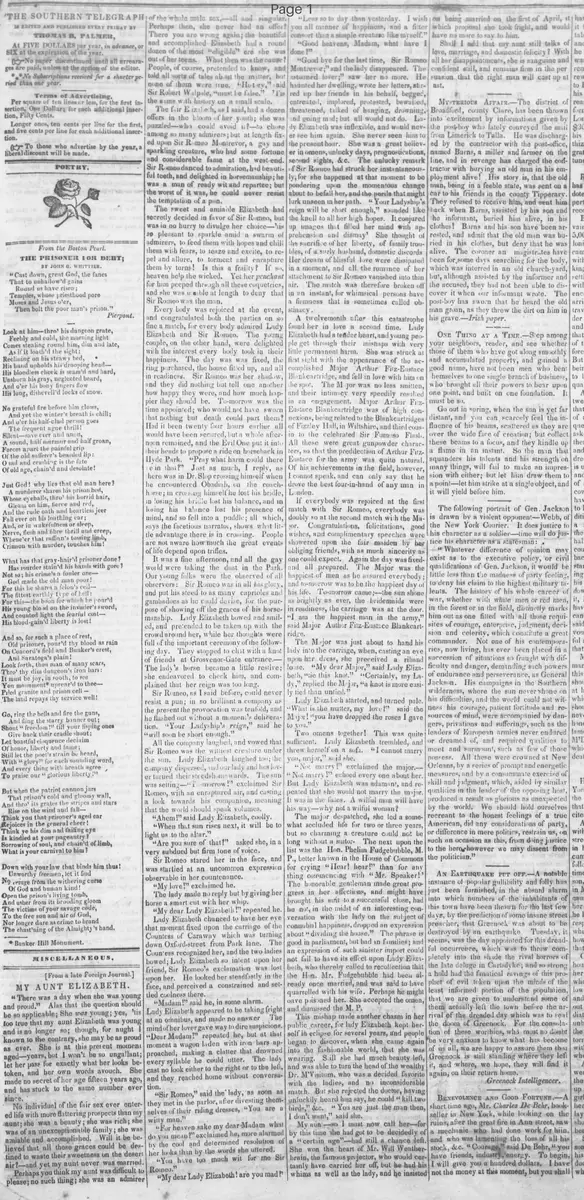
MY AUNT ELIZABETH.
"There was a day when she was young and proud." Alas that the question should be so applicable; She was young; yes, 'tis too true that my aunt Elizabeth was young and is no longer so; though, for aught I know to the contrary, she may be as proud as ever. She is at this present moment aged—years, but I won't be so ungallant; let her pass for exactly what her looks betoken, and her own words avouch. She made no secret of her age fifteen years ago, and has stuck to the same number ever since.
No individual of the fair sex ever entered life with more flattering prospects than my aunt; she was a beauty; she was rich; she was of an unexceptionable family; she was amiable and accomplished. Will it be believed that all those graces could be destined to waste their sweetness on the desert air?—and yet my aunt never was married.
Perhaps you think my aunt was difficult to please; no such thing; she was an admirer of the whole male sex,—all and singular.
Perhaps then, she never had an offer? There you are wrong again; the beautiful and accomplished Elizabeth had a round dozen of the most "eligible" ere she was out of her teens. What then was the cause?
People, of course, pretended to know, and told all sorts of tales about the matter, but none of them were true. Her story, said Sir Robert Walpole, "must be false." 'Tis the same with history on a small scale.
The fair Elizabeth, as I said, had a dozen offers in the bloom of her youth; she was puzzled—who could avoid it?—to choose among so many admirers; but at length fixed upon Sir Romeo Montrevor, a gay and sparkling creature, who had some fortune and considerable fame at the west-end.
Sir Romeo danced to admiration, had beautiful teeth, and delighted in horsemanship; he was a man of ready wit and repartee; but the worst of it was, he could never resist the temptation of a pun.
The sweet and amiable Elizabeth had secretly decided in favor of Sir Romeo, but was in no hurry to divulge her choice—'tis so pleasant to sparkle amid a swarm of admirers, to feed them with hopes and chill them with fears, to tease and excite, to repel and allure, to torment and enrapture them by turns! Is this a frailty? If so, heaven help the wicked. Yet her penchant for him peeped through all these coquetries, and she was unable at length to deny that Sir Romeo was the man.
Every body was rejoiced at the event, and congratulated both the parties on so fine a match, for every body admired Lady Elizabeth and Sir Romeo. The young couple, on the other hand, were delighted with the interest every body took in their happiness. The day was fixed, the ring purchased, the house fitted up, and all in readiness. Sir Romeo was her shadow, and they did nothing but tell one another how happy they were, and how much happier they should be. To-morrow was the time appointed; who would not have sworn that nothing but death could part them?
Had it been twenty four hours earlier all would have been secured, but a whole afternoon remained, and the Evil One put it into their heads to propose a ride on horseback in Hyde Park. "Pray what harm could there be in that?" Just as much, I reply, as there was in Dr. Slop crossing himself when he encountered Obadiah, on the coach-horse; in crossing himself he lost his bridle, in losing his bridle lost his balance, and in losing his balance lost his presence of mind, and so fell into a puddle; all which, says the facetious narrator, shows what little advantage there is in crossing. People are not aware how much the great events of life depend upon trifles.
It was a fine afternoon, and all the gay world were taking the dust in the Park. Our young folks were the observed of all observers: Sir Romeo was in all his glory, and put his steed to as many caprioles and gambadoes as he could devise, for the purpose of showing off the graces of his horsemanship. Lady Elizabeth bowed and smiled, and pretended to be taken up with the crowd around her, while her thoughts were full of the important ceremony of the following day. They stopped to chat with a knot of friends at Grosvenor-Gate entrance.—The lady's horse became a little restive: she endeavored to check him, and complained that her rein was too long.
Sir Romeo, as I said before, could never resist a pun; in so brilliant a company as the present the provocation was tenfold, and he flashed out without a moment's deliberation. "Your Ladyship's reign," said he, "will soon be short enough."
All the company laughed, and vowed that Sir Romeo was the wittiest creature under the sun. Lady Elizabeth laughed too; the company dispersed, and our lady and her lover turned their steeds homewards. The sun was setting—"To-morrow!" exclaimed Sir Romeo, with an enraptured air, and casting a look towards his companion, meaning that the world should speak volumes.
"Ahem!" said Lady Elizabeth, coolly.
"When that sun rises next, it will be to light us to the altar."
"Are you sure of that?" asked she, in a very subdued but firm tone of voice.
Sir Romeo stared her in the face, and was startled at an uncommon expression observable in her countenance.
"My love!" exclaimed he.
The lady made no reply but by giving her horse a smart cut with her whip.
"My dear Lady Elizabeth!" repeated he.
Lady Elizabeth chanced to have her eye that moment fixed upon the carriage of the Countess of Caraway which was turning down Oxford-street from Park lane. The Countess recognized her, and the two ladies bowed; Lady Elizabeth so intent upon her friend, Sir Romeo's exclamation was lost upon her. He looked her steadfastly in the face, and perceived a constrained and settled coolness there.
"Madam!" said he, in some alarm.
Lady Elizabeth appeared to be taking fright at an omnibus, and made no answer. The mind of her lover gave way to dire suspicions.
"Dear Madam!" repeated he, but at that moment a wagon laden with iron bars approached, making a clatter that drowned every syllable he could utter. The lady cast no look either to the right or to the left, and they reached home without conversation.
"Sir Romeo," said the lady, as soon as they met in the parlor, after divesting themselves of their riding dresses, "You are a witty man."
"For heaven sake my dear Madam what do you mean?" exclaimed he, more alarmed by the cool and determined resolution of her looks than by the words she uttered.
"You have too much wit for me Sir Romeo."
"My dear Lady Elizabeth! are you mad?"
"Less so to day than yesterday. I wish you all manner of happiness, and a fitter consort than a simple creature like myself."
"Good heavens, Madam, what have I done?"
"Good bye for the last time, Sir Romeo Montrevor;" and the lady disappeared. The astounded lover saw her no more. He haunted her dwelling, wrote her letters, stirred up her friends in his behalf, begged, entreated, implored, protested, bewailed, threatened, talked of hanging, drowning, and going mad; but all would not do. Lady Elizabeth was inflexible, and would never see him again. She never has seen him to the present hour. She was a great believer in omens, unlucky days, prognostications, second sights, &c. The unlucky remark of Sir Romeo had struck her instantaneously, for she happened at that moment to be pondering upon the momentous change about to befall her, and the perils that might lurk unseen in her path. "Your Ladyship's reign will be short enough," sounded like the knell to all her high hopes. It conjured up images that filled her mind with apprehension and dismay. She thought of the sacrifice of her liberty, of family troubles, of a surly husband, domestic discords. Her dream of blissful love were dissipated in a moment, and all the romance of her attachment to Sir Romeo vanished into thin air. The match was therefore broken off in an instant, for whimsical persons have a firmness that is sometimes called obstinacy.
A twelvemonth after this catastrophe found her in love a second time. Lady Elizabeth had a tender heart, and young people get through their mishaps with very little permanent harm. She was struck at first sight with the appearance of the accomplished Major Arthur Fitz-Eustace Blankcartridge, and fell in love with him on the spot. The Major was no less smitten, and their intimacy very speedily resulted in an engagement. Major Arthur Fitz-Eustace Blankcartridge was of high connexions, being related to the Blankcartridges of Fizzlev Hall, in Wiltshire, and third cousin to the celebrated Sir Fumoso Flash. All these were great gunpowder characters, so that the predilection of Arthur Fitz-Eustace for the army was quite natural.
Of his achievements in the field, however, I cannot speak, and can only say that he drove the best four-in-hand of any man in London.
If everybody was rejoiced at the first match with Sir Romeo, everybody was doubly so at the second match with the Major. Congratulations, felicitations, good wishes, and complimentary speeches were showered upon the fair maiden by her obliging friends, with as much sincerity as one could expect. Again the day was fixed—and all prepared. The Major was the happiest of men as he assured everybody; and to-morrow was to be the happiest day of his life. To-morrow came;—the sun shone as brightly as ever, the bridemaids were in readiness, the carriage was at the door.
"I am the happiest man in the army," said Major Arthur Fitz-Eustace Blankcartridge.
The Major was just about to hand his lady into the carriage, when, casting an eye upon her dress, she perceived a riband loose. "My dear Major," said Lady Elizabeth, "tie this knot." "Certainly, my Lady," replied the Major, "a knot is more easily tied than untied."
Lady Elizabeth started, and turned pale.
"What is the matter, my love?" said the Major! "you have dropped the roses I gave to you."
Two omens together! This was quite sufficient. Lady Elizabeth trembled, and threw herself on a sofa. "I cannot marry you, major," said she.
"Not marry!" exclaimed the major.—
"Not marry!" echoed every one about her.
But Lady Elizabeth was adamant, and repeated that she would not marry the major. It was in the fates. A wilful man will have his way—why not a wilful woman?
The major despatched, she led a somewhat secluded life for two or three years, but so charming a creature could not be long without a suitor. The next upon the list was the Hon. Phelim Fudgebubble, M. P., better known in the House of Commons for crying "Hear! hear!" than for any thing commencing with "Mr. Speaker!"
The honorable gentleman made great progress in her affections, and might have brought his suit to a successful close, had he not, in the midst of an interesting conversation with the lady on the subject of connubial happiness, dropped an expression about "dividing the house." The phrase is good in parliament, but bad in families; and an expression of such sinister import could not fail to have its effect upon Lady Elizabeth, who thereby called to recollection that the Hon. Mr. Fudgebubble had been already once married, and was said to have quarrelled with his wife. Perhaps he might have poisoned her. She accepted the omen, and dismissed the M. P.
This mishap made another chasm in her public career, for Lady Elizabeth kept herself in eclipse for several years, and people began to discover, when she came again into the fashionable world, that she was wearing. Still she had much beauty left and was able to turn the head of the wealthy Dr. M'Visitum, who was a decided favorite with the ladies, and no inconsiderable match. But she rejected the doctor, having unluckily heard him say, he could "kill two birds," &c. "You are just the man then, I don't want," said she.
My aunt—so I must now call her—for by this time she had got to be decidedly of a "certain age"—had still a chance left. She won the heart of Mr. Will Weatherbrain, the famous projector, who would certainly have carried her off, but he had his whims as well as the lady, and he insisted on being married on the first of April, which proposal she took fright, and would have no more to say to him.
Shall I add that my aunt still talks of love, marriage, and domestic felicity? With all her disappointments, she is sanguine and confident still, and remains firm in the persuasion that the right man will cast up at last.
[From a late Foreign Journal.]
MY AUNT ELIZABETH.
"There was a day when she was young and proud." Alas that the question should be so applicable; She was young; yes, 'tis too true that my aunt Elizabeth was young and is no longer so; though, for aught I know to the contrary, she may be as proud as ever. She is at this present moment aged—years, but I won't be so ungallant; let her pass for exactly what her looks betoken, and her own words avouch. She made no secret of her age fifteen years ago, and has stuck to the same number ever since.
No individual of the fair sex ever entered life with more flattering prospects than my aunt; she was a beauty; she was rich; she was of an unexceptionable family; she was amiable and accomplished. Will it be believed that all those graces could be destined to waste their sweetness on the desert air?—and yet my aunt never was married.
Perhaps you think my aunt was difficult to please; no such thing; she was an admirer of the whole male sex,—all and singular.
Perhaps then, she never had an offer? There you are wrong again; the beautiful and accomplished Elizabeth had a round dozen of the most "eligible" ere she was out of her teens. What then was the cause?
People, of course, pretended to know, and told all sorts of tales about the matter, but none of them were true. Her story, said Sir Robert Walpole, "must be false." 'Tis the same with history on a small scale.
The fair Elizabeth, as I said, had a dozen offers in the bloom of her youth; she was puzzled—who could avoid it?—to choose among so many admirers; but at length fixed upon Sir Romeo Montrevor, a gay and sparkling creature, who had some fortune and considerable fame at the west-end.
Sir Romeo danced to admiration, had beautiful teeth, and delighted in horsemanship; he was a man of ready wit and repartee; but the worst of it was, he could never resist the temptation of a pun.
The sweet and amiable Elizabeth had secretly decided in favor of Sir Romeo, but was in no hurry to divulge her choice—'tis so pleasant to sparkle amid a swarm of admirers, to feed them with hopes and chill them with fears, to tease and excite, to repel and allure, to torment and enrapture them by turns! Is this a frailty? If so, heaven help the wicked. Yet her penchant for him peeped through all these coquetries, and she was unable at length to deny that Sir Romeo was the man.
Every body was rejoiced at the event, and congratulated both the parties on so fine a match, for every body admired Lady Elizabeth and Sir Romeo. The young couple, on the other hand, were delighted with the interest every body took in their happiness. The day was fixed, the ring purchased, the house fitted up, and all in readiness. Sir Romeo was her shadow, and they did nothing but tell one another how happy they were, and how much happier they should be. To-morrow was the time appointed; who would not have sworn that nothing but death could part them?
Had it been twenty four hours earlier all would have been secured, but a whole afternoon remained, and the Evil One put it into their heads to propose a ride on horseback in Hyde Park. "Pray what harm could there be in that?" Just as much, I reply, as there was in Dr. Slop crossing himself when he encountered Obadiah, on the coach-horse; in crossing himself he lost his bridle, in losing his bridle lost his balance, and in losing his balance lost his presence of mind, and so fell into a puddle; all which, says the facetious narrator, shows what little advantage there is in crossing. People are not aware how much the great events of life depend upon trifles.
It was a fine afternoon, and all the gay world were taking the dust in the Park. Our young folks were the observed of all observers: Sir Romeo was in all his glory, and put his steed to as many caprioles and gambadoes as he could devise, for the purpose of showing off the graces of his horsemanship. Lady Elizabeth bowed and smiled, and pretended to be taken up with the crowd around her, while her thoughts were full of the important ceremony of the following day. They stopped to chat with a knot of friends at Grosvenor-Gate entrance.—The lady's horse became a little restive: she endeavored to check him, and complained that her rein was too long.
Sir Romeo, as I said before, could never resist a pun; in so brilliant a company as the present the provocation was tenfold, and he flashed out without a moment's deliberation. "Your Ladyship's reign," said he, "will soon be short enough."
All the company laughed, and vowed that Sir Romeo was the wittiest creature under the sun. Lady Elizabeth laughed too; the company dispersed, and our lady and her lover turned their steeds homewards. The sun was setting—"To-morrow!" exclaimed Sir Romeo, with an enraptured air, and casting a look towards his companion, meaning that the world should speak volumes.
"Ahem!" said Lady Elizabeth, coolly.
"When that sun rises next, it will be to light us to the altar."
"Are you sure of that?" asked she, in a very subdued but firm tone of voice.
Sir Romeo stared her in the face, and was startled at an uncommon expression observable in her countenance.
"My love!" exclaimed he.
The lady made no reply but by giving her horse a smart cut with her whip.
"My dear Lady Elizabeth!" repeated he.
Lady Elizabeth chanced to have her eye that moment fixed upon the carriage of the Countess of Caraway which was turning down Oxford-street from Park lane. The Countess recognized her, and the two ladies bowed; Lady Elizabeth so intent upon her friend, Sir Romeo's exclamation was lost upon her. He looked her steadfastly in the face, and perceived a constrained and settled coolness there.
"Madam!" said he, in some alarm.
Lady Elizabeth appeared to be taking fright at an omnibus, and made no answer. The mind of her lover gave way to dire suspicions.
"Dear Madam!" repeated he, but at that moment a wagon laden with iron bars approached, making a clatter that drowned every syllable he could utter. The lady cast no look either to the right or to the left, and they reached home without conversation.
"Sir Romeo," said the lady, as soon as they met in the parlor, after divesting themselves of their riding dresses, "You are a witty man."
"For heaven sake my dear Madam what do you mean?" exclaimed he, more alarmed by the cool and determined resolution of her looks than by the words she uttered.
"You have too much wit for me Sir Romeo."
"My dear Lady Elizabeth! are you mad?"
"Less so to day than yesterday. I wish you all manner of happiness, and a fitter consort than a simple creature like myself."
"Good heavens, Madam, what have I done?"
"Good bye for the last time, Sir Romeo Montrevor;" and the lady disappeared. The astounded lover saw her no more. He haunted her dwelling, wrote her letters, stirred up her friends in his behalf, begged, entreated, implored, protested, bewailed, threatened, talked of hanging, drowning, and going mad; but all would not do. Lady Elizabeth was inflexible, and would never see him again. She never has seen him to the present hour. She was a great believer in omens, unlucky days, prognostications, second sights, &c. The unlucky remark of Sir Romeo had struck her instantaneously, for she happened at that moment to be pondering upon the momentous change about to befall her, and the perils that might lurk unseen in her path. "Your Ladyship's reign will be short enough," sounded like the knell to all her high hopes. It conjured up images that filled her mind with apprehension and dismay. She thought of the sacrifice of her liberty, of family troubles, of a surly husband, domestic discords. Her dream of blissful love were dissipated in a moment, and all the romance of her attachment to Sir Romeo vanished into thin air. The match was therefore broken off in an instant, for whimsical persons have a firmness that is sometimes called obstinacy.
A twelvemonth after this catastrophe found her in love a second time. Lady Elizabeth had a tender heart, and young people get through their mishaps with very little permanent harm. She was struck at first sight with the appearance of the accomplished Major Arthur Fitz-Eustace Blankcartridge, and fell in love with him on the spot. The Major was no less smitten, and their intimacy very speedily resulted in an engagement. Major Arthur Fitz-Eustace Blankcartridge was of high connexions, being related to the Blankcartridges of Fizzlev Hall, in Wiltshire, and third cousin to the celebrated Sir Fumoso Flash. All these were great gunpowder characters, so that the predilection of Arthur Fitz-Eustace for the army was quite natural.
Of his achievements in the field, however, I cannot speak, and can only say that he drove the best four-in-hand of any man in London.
If everybody was rejoiced at the first match with Sir Romeo, everybody was doubly so at the second match with the Major. Congratulations, felicitations, good wishes, and complimentary speeches were showered upon the fair maiden by her obliging friends, with as much sincerity as one could expect. Again the day was fixed—and all prepared. The Major was the happiest of men as he assured everybody; and to-morrow was to be the happiest day of his life. To-morrow came;—the sun shone as brightly as ever, the bridemaids were in readiness, the carriage was at the door.
"I am the happiest man in the army," said Major Arthur Fitz-Eustace Blankcartridge.
The Major was just about to hand his lady into the carriage, when, casting an eye upon her dress, she perceived a riband loose. "My dear Major," said Lady Elizabeth, "tie this knot." "Certainly, my Lady," replied the Major, "a knot is more easily tied than untied."
Lady Elizabeth started, and turned pale.
"What is the matter, my love?" said the Major! "you have dropped the roses I gave to you."
Two omens together! This was quite sufficient. Lady Elizabeth trembled, and threw herself on a sofa. "I cannot marry you, major," said she.
"Not marry!" exclaimed the major.—
"Not marry!" echoed every one about her.
But Lady Elizabeth was adamant, and repeated that she would not marry the major. It was in the fates. A wilful man will have his way—why not a wilful woman?
The major despatched, she led a somewhat secluded life for two or three years, but so charming a creature could not be long without a suitor. The next upon the list was the Hon. Phelim Fudgebubble, M. P., better known in the House of Commons for crying "Hear! hear!" than for any thing commencing with "Mr. Speaker!"
The honorable gentleman made great progress in her affections, and might have brought his suit to a successful close, had he not, in the midst of an interesting conversation with the lady on the subject of connubial happiness, dropped an expression about "dividing the house." The phrase is good in parliament, but bad in families; and an expression of such sinister import could not fail to have its effect upon Lady Elizabeth, who thereby called to recollection that the Hon. Mr. Fudgebubble had been already once married, and was said to have quarrelled with his wife. Perhaps he might have poisoned her. She accepted the omen, and dismissed the M. P.
This mishap made another chasm in her public career, for Lady Elizabeth kept herself in eclipse for several years, and people began to discover, when she came again into the fashionable world, that she was wearing. Still she had much beauty left and was able to turn the head of the wealthy Dr. M'Visitum, who was a decided favorite with the ladies, and no inconsiderable match. But she rejected the doctor, having unluckily heard him say, he could "kill two birds," &c. "You are just the man then, I don't want," said she.
My aunt—so I must now call her—for by this time she had got to be decidedly of a "certain age"—had still a chance left. She won the heart of Mr. Will Weatherbrain, the famous projector, who would certainly have carried her off, but he had his whims as well as the lady, and he insisted on being married on the first of April, which proposal she took fright, and would have no more to say to him.
Shall I add that my aunt still talks of love, marriage, and domestic felicity? With all her disappointments, she is sanguine and confident still, and remains firm in the persuasion that the right man will cast up at last.
What sub-type of article is it?
Prose Fiction
Satire
What themes does it cover?
Love Romance
Social Manners
What keywords are associated?
Aunt Elizabeth
Failed Engagements
Superstitious Omens
Suitor Puns
Courtship Satire
Marriage Mishaps
Lady Elizabeth
Literary Details
Title
My Aunt Elizabeth.
Key Lines
"Your Ladyship's Reign," Said He, "Will Soon Be Short Enough."
"A Knot Is More Easily Tied Than Untied."
Dropped An Expression About "Dividing The House."
He Could "Kill Two Birds," &C.
Insisted On Being Married On The First Of April