Thank you for visiting SNEWPapers!
Sign up free
Editorial
April 17, 1815
Portland Gazette, And Maine Advertiser
Portland, Cumberland County, Maine
What is this article about?
Editorial criticizes President Madison for prolonging the War of 1812 over impressment, abandoning the issue in peace talks, and attacking the federal party to cover his errors, while defending federal views on achievable peace without dishonor.
Clipping
OCR Quality
75%
Good
Full Text
Political Miscellany.
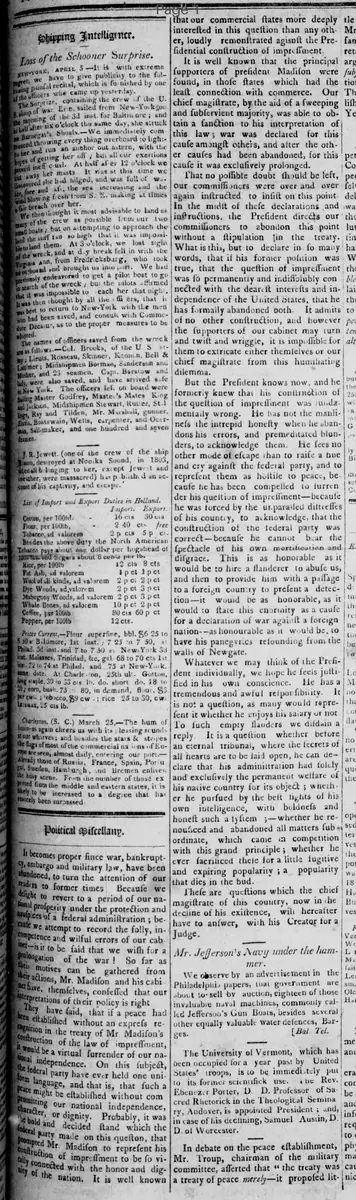
It becomes proper since war, bankruptcy, embargo and military law, have been abandoned, to turn the attention of our readers to former times. Because we delight to revert to a period of our national prosperity under the protection and auspices of a federal administration; because we attempt to record the folly, incompetence and wilful errors of our cabinet—is it to be said that we wish for a prolongation of the war! So far as their motives can be gathered from their actions, Mr. Madison and his cabinet have, themselves, confessed that our interpretations of their policy is right.
They have said, that if a peace had been established without an express recognition in the treaty of Mr Madison's construction of the law of impressment, would be a virtual surrender of our national independence. On this subject, the federal party and have ever held that a peace might be established without compromising the honor and dignity of the nation. It is well known to represent his... this question, that...
Probably, it was the federal party made on... prompted Mr. Madison construction of... tally connected with... nity of the nation. Impressment to be o vi... the honor and dig...
That our commercial states more deeply interested in this question than any other, loudly remonstrated against the Presidential construction of impressment. It is well known that the principal supporters of president Madison were found, in those states which had the least connection with commerce. Our chief magistrate, by the aid of a weeping and subservient majority, was able to obtain a sanction to his interpretation of this law; war was declared for this cause amongst others, and after the other causes had been abandoned, for this cause it was exclusively prolonged.
That no possible doubt should be left, our commissioners were over and over again instructed to insist on this point. In the midst of these declarations and instructions, the President directs our commissioners to abandon this point without a stipulation in the treaty. What is this, but to declare in so many words, that if his former position was true, that the question of impressment was so permanently and indissolubly connected with the dearest interests and independence of the United States. that he has formally abandoned both. It admits of no other construction, and however the supporters of our cabinet may turn and twist and wriggle, it is impossible for them to extricate either themselves or our chief magistrate from this humiliating dilemma.
But the President knows now, and he formerly knew that his construction of the question of impressment was fundamentally wrong. He has not the manliness the intrepid honesty when he abandons his errors, and premeditated blunders, to acknowledge them. He sees no other mode of escape than to raise a hue and cry against the federal party, and to represent them as hostile to peace, because he has been compelled to surrender his question of impressment—because he was forced by the unparalleled distresses of his country, to acknowledge, that the construction of the federal party was correct—because he cannot bear the spectacle of his own mortification and disgrace. This is as honorable as it would be to hire a slanderer to abuse us, and then to provide him with a passage to a foreign country to prevent a detection—it would be as honorable, as it would to state this enormity as a cause for a declaration of war against a foreign nation—as honourable as it would be, to have his panegyrics resounding from the walls of Newgate.
Whatever we may think of the President individually, we hope he feels justified in his own conscience. He has a tremendous and awful responsibility. It is not a question, as many would represent it whether he enjoys his salary or not. To such empty slanders we disdain a reply. It is a question whether before an eternal tribunal, where the secrets of all hearts are to be laid open, he can declare that his administration had solely and exclusively the permanent welfare of his native country for its object; whether he pursued by the best lights of his own intelligence, with boldness and honesty such a system;—whether he renounced and abandoned all matters subordinate, which came in competition with this grand principle; whether he ever sacrificed these for a little fugitive and expiring popularity; a popularity that dies in the bud.
These are questions which the chief magistrate of this country, now in the decline of his existence, will hereafter have to answer, with his Creator for a Judge.
It becomes proper since war, bankruptcy, embargo and military law, have been abandoned, to turn the attention of our readers to former times. Because we delight to revert to a period of our national prosperity under the protection and auspices of a federal administration; because we attempt to record the folly, incompetence and wilful errors of our cabinet—is it to be said that we wish for a prolongation of the war! So far as their motives can be gathered from their actions, Mr. Madison and his cabinet have, themselves, confessed that our interpretations of their policy is right.
They have said, that if a peace had been established without an express recognition in the treaty of Mr Madison's construction of the law of impressment, would be a virtual surrender of our national independence. On this subject, the federal party and have ever held that a peace might be established without compromising the honor and dignity of the nation. It is well known to represent his... this question, that...
Probably, it was the federal party made on... prompted Mr. Madison construction of... tally connected with... nity of the nation. Impressment to be o vi... the honor and dig...
That our commercial states more deeply interested in this question than any other, loudly remonstrated against the Presidential construction of impressment. It is well known that the principal supporters of president Madison were found, in those states which had the least connection with commerce. Our chief magistrate, by the aid of a weeping and subservient majority, was able to obtain a sanction to his interpretation of this law; war was declared for this cause amongst others, and after the other causes had been abandoned, for this cause it was exclusively prolonged.
That no possible doubt should be left, our commissioners were over and over again instructed to insist on this point. In the midst of these declarations and instructions, the President directs our commissioners to abandon this point without a stipulation in the treaty. What is this, but to declare in so many words, that if his former position was true, that the question of impressment was so permanently and indissolubly connected with the dearest interests and independence of the United States. that he has formally abandoned both. It admits of no other construction, and however the supporters of our cabinet may turn and twist and wriggle, it is impossible for them to extricate either themselves or our chief magistrate from this humiliating dilemma.
But the President knows now, and he formerly knew that his construction of the question of impressment was fundamentally wrong. He has not the manliness the intrepid honesty when he abandons his errors, and premeditated blunders, to acknowledge them. He sees no other mode of escape than to raise a hue and cry against the federal party, and to represent them as hostile to peace, because he has been compelled to surrender his question of impressment—because he was forced by the unparalleled distresses of his country, to acknowledge, that the construction of the federal party was correct—because he cannot bear the spectacle of his own mortification and disgrace. This is as honorable as it would be to hire a slanderer to abuse us, and then to provide him with a passage to a foreign country to prevent a detection—it would be as honorable, as it would to state this enormity as a cause for a declaration of war against a foreign nation—as honourable as it would be, to have his panegyrics resounding from the walls of Newgate.
Whatever we may think of the President individually, we hope he feels justified in his own conscience. He has a tremendous and awful responsibility. It is not a question, as many would represent it whether he enjoys his salary or not. To such empty slanders we disdain a reply. It is a question whether before an eternal tribunal, where the secrets of all hearts are to be laid open, he can declare that his administration had solely and exclusively the permanent welfare of his native country for its object; whether he pursued by the best lights of his own intelligence, with boldness and honesty such a system;—whether he renounced and abandoned all matters subordinate, which came in competition with this grand principle; whether he ever sacrificed these for a little fugitive and expiring popularity; a popularity that dies in the bud.
These are questions which the chief magistrate of this country, now in the decline of his existence, will hereafter have to answer, with his Creator for a Judge.
What sub-type of article is it?
Partisan Politics
War Or Peace
Foreign Affairs
What keywords are associated?
Madison Critique
Impressment Policy
War Prolongation
Federal Party
Peace Treaty
National Independence
What entities or persons were involved?
Mr. Madison
His Cabinet
Federal Party
Our Commissioners
President
Editorial Details
Primary Topic
Critique Of Madison's Impressment Policy And War Prolongation
Stance / Tone
Strongly Anti Madison, Pro Federal Party, Accusatory
Key Figures
Mr. Madison
His Cabinet
Federal Party
Our Commissioners
President
Key Arguments
Madison's Construction Of Impressment Law Led To War Declaration
Peace Without Recognition Of Madison's Impressment View Is Surrender Of Independence
Federal Party Held Peace Possible Without Compromising Honor
Commercial States Remonstrated Against Madison's Impressment Interpretation
Madison's Supporters Mainly From Non Commercial States
Commissioners Instructed To Insist On Impressment But Later Abandoned It
Abandonment Admits Madison's Position Was Wrong
Madison Attacks Federal Party To Deflect Blame
Madison Lacks Honesty To Acknowledge Errors
Madison Faces Moral Responsibility For Administration's Welfare Focus