Thank you for visiting SNEWPapers!
Sign up free
The Virginia Gazette
Richmond, Williamsburg, Richmond County, Virginia
What is this article about?
Extract of a June 24, 1779, letter from Philadelphia details alarming political factions in Congress, led by a minority junto obstructing proceedings on foreign loans, Silas Deane's affairs, Arthur Lee's recall, and peace negotiations with France and Spain, risking national ruin amid ongoing war.
Clipping
OCR Quality
Full Text
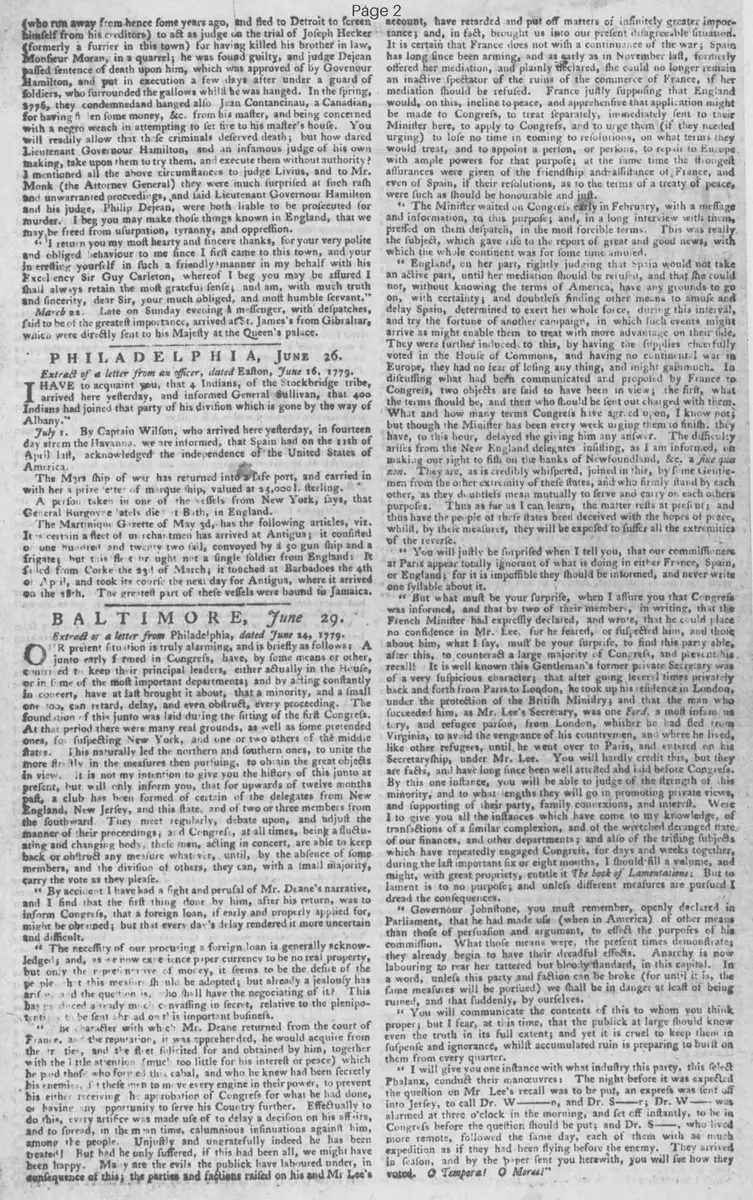
Extract of a letter from Philadelphia, dated June 24, 1779.
Our present situation is truly alarming, and is briefly as follows; A junto early formed in Congress, have, by some means or other, contrived to keep their principal leaders, either actually in the House, or in some of the most important departments; and by acting constantly in concert, have at last brought it about, that a minority, and a small one too, can retard, delay, and even obstruct, every proceeding. The foundation of this junto was laid during the sitting of the first Congress. At that period there were many real grounds, as well as some pretended ones, for suspecting New York, and one or two others of the middle states. This naturally led the northern and southern ones, to unite the more firmly in the measures then pursuing, to obtain the great objects in view. It is not my intention to give you the history of this junto at present, but will only inform you, that for upwards of twelve months past, a club has been formed of certain of the delegates from New England, New Jersey, and this state, and of two or three members from the southward. They meet regularly, debate upon, and adjust the manner of their proceedings; and Congress, at all times, being a fluctuating and changing body, these men, acting in concert, are able to keep back or obstruct any measure whatever, until, by the absence of some members, and the division of others, they can, with a small majority, carry the vote as they please.
"By accident I have had a sight and perusal of Mr. Deane's narrative, and I find that the first thing done by him, after his return, was to inform Congress, that a foreign loan, if early and properly applied for, might be obtained; but that every day's delay rendered it more uncertain and difficult.
"The necessity of our procuring a foreign loan is generally acknowledged; and, as our experience proves paper currency to be no real property, but only the representative of money, it seems to be the desire of the people that this measure should be adopted; but already a jealousy has arisen, and the question is, who shall have the negotiating of it? This has produced a steady much canvassing in secret, relative to the plenipotentiary to be sent on this important business.
"The character with which Mr. Deane returned from the court of France, and the reputation, it was apprehended, he would acquire from the treaties, and the fleet solicited for and obtained by him, together with the little attention (much too little for his interest or peace) which he paid those who formed the cabal, and who he knew had been secretly his enemies, set these men to move every engine in their power, to prevent his either receiving the approbation of Congress for what he had done, or having any opportunity to serve his Country further. Effectually to do this, every artifice was made use of to delay a decision on his affairs, and to spread, in the mean time, calumnious insinuations against him, among the people. Unjustly and ungratefully indeed he has been treated! But had he only suffered, if this had been all, we might have been happy. Many are the evils the publick have laboured under, in consequence of this; the parties and factions raised on his and Mr Lee's account, have retarded and put off matters of infinitely greater importance; and, in fact, brought us into our present disagreeable situation.
It is certain that France does not wish a continuance of the war; Spain has long since been arming, and as early as in November last, formerly offered her mediation, and plainly declared, she could no longer remain an inactive spectator of the ruins of the commerce of France, if her mediation should be refused. France justly supposing that England would, on this, incline to peace, and apprehensive that application might be made to Congress, to treat separately, immediately sent to their Minister here, to apply to Congress, and to urge them (if they needed urging) to lose no time in coming to resolutions, on what terms they would treat, and to appoint a person, or persons, to repair to Europe with ample powers for that purpose; at the same time the strongest assurances were given of the friendship and alliance of France, and even of Spain, if their resolutions, as to the terms of a treaty of peace, were such as should be honourable and just.
The Minister waited on Congress early in February, with a message and information, to this purpose; and, in a long interview with them, pressed on them dispatch, in the most forcible terms. This was really the subject, which gave rise to the report of great and good news, with which the whole continent was for some time amused.
England, on her part, rightly judging that Spain would not take an active part, until her mediation should be refused, and that he could not, without knowing the terms of America, have any grounds to go on, with certainty; and doubtless finding other means to amuse and delay Spain, determined to exert her whole force, during this interval, and try the fortune of another campaign, in which such events might arrive as might enable them to treat with more advantage on their side. They were further induced to this, by having the supplies cheerfully voted in the House of Commons, and having no continental war in Europe, they had no fear of losing any thing, and might gain much. In discussing what had been communicated and proposed by France to Congress, two objects are said to have been in view; the first, what the terms should be, and then who should be sent out charged with them. What and how many terms Congress have agreed upon, I know not; but though the Minister has been every week urging them to finish, they have, to this hour, delayed the giving him any answer. The difficulty arises from the New England delegates insisting, as I am informed, on making our right to fish on the banks of Newfoundland, &c. a sine qua non. They are, as is credibly whispered, joined in this, by some Gentlemen from the other extremity of these states, and who firmly stand by each other, as they doubtless mean mutually to serve and carry on each others purposes. Thus far as I can learn, the matter rests at present; and thus have the people of these states been deceived with the hopes of peace, whilst, by these measures, they will be exposed to suffer all the extremities of the reverse.
You will justly be surprised when I tell you, that our commissioners at Paris appear totally ignorant of what is doing in either France, Spain, or England; for it is impossible they should be informed, and never write one syllable about it.
But what must be your surprise, when I assure you that Congress was informed, and that by two of their members, in writing, that the French Minister had expressly declared, and wrote, that he could place no confidence in Mr. Lee, for he feared, or suspected him, and those about him, what I say, must be your surprise, to find this party able, after this, to counteract a large majority of Congress, and prevent his recall! It is well known this Gentleman's former private Secretary was of a very suspicious character; that after going several times privately back and forth from Paris to London, he took up his residence in London, under the protection of the British Ministry; and that the man who succeeded him, as Mr. Lee's Secretary, was one Ford, a most infamous tory, and refugee parson, from London, whither he had fled from Virginia, to avoid the vengeance of his countrymen, and where he lived, like other refugees, until he went over to Paris, and entered on his Secretaryship, under Mr. Lee. You will hardly credit this, but they are facts, and have long since been well attested and laid before Congress. By this one instance, you will be able to judge of the strength of this minority, and to what lengths they will go in promoting private views, and supporting of their party, family connections, and interest. Were I to give you all the instances which have come to my knowledge, of transactions of a similar complexion, and of the wretched deranged state of our finances, and other departments; and also of the trifling subjects which have repeatedly engaged Congress, for days and weeks together, during the last important six or eight months, I should fill a volume, and might, with great propriety, entitle it The book of Lamentations: But to lament is to no purpose; and unless different measures are pursued I dread the consequences.
Governor Johnstone, you must remember, openly declared in Parliament, that he had made use (when in America) of other means than those of persuasion and argument, to effect the purposes of his commission. What those means were, the present times demonstrate; they already begin to have their dreadful effects. Anarchy is now labouring to rear her tattered but bloody standard, in this capital. In a word, unless this party and faction can be broke (for until it is, the same measures will be pursued) we shall be in danger at least of being ruined, and that suddenly, by ourselves.
You will communicate the contents of this to whom you think proper; but I fear, at this time, that the publick at large should know even the truth in its fullest extent; and yet it is cruel to keep them in suspense and ignorance, whilst accumulated ruin is preparing to burst on them from every quarter.
I will give you one instance with what industry this party, this select Phalanx, conduct their manoeuvres: The night before it was expected the question on Mr Lee's recall was to be put, an express was sent off into Jersey, to call Dr. W-n, and Dr. S-r; Dr. W-- was alarmed at three o'clock in the morning, and set off instantly, to be in Congress before the question should be put; and Dr. S-, who lived more remote, followed the same day, each of them with as much expedition as if they had been flying before the enemy. They arrived in season, and by the proper sent you herewith, you will see how they voted. O Tempora! O Mores!"
What sub-type of article is it?
What keywords are associated?
What entities or persons were involved?
Where did it happen?
Domestic News Details
Primary Location
Philadelphia
Event Date
June 24, 1779
Key Persons
Outcome
delays in foreign loan negotiations, peace terms, and mr. lee's recall; risk of national ruin, anarchy, and continued war due to congressional factions.
Event Details
A letter describes a minority faction in Congress obstructing key decisions on foreign loans urged by Silas Deane, peace negotiations with France and Spain, and Arthur Lee's recall amid suspicions of his loyalty; factions from New England, New Jersey, Pennsylvania, and southern states meet secretly to control votes, leading to public deception and financial distress.