Thank you for visiting SNEWPapers!
Sign up free
The Worthington Advance
Worthington, Nobles County, Minnesota
What is this article about?
In 1880, J.K. from Bigelow inquires about homestead laws for single men, asking if they must reside continuously, can leave for winter work, and if claims can be jumped. The editor explains strict enforcement requires residence after six months, but temporary winter absences are allowed if improvements continue in good faith.
Clipping
OCR Quality
Full Text
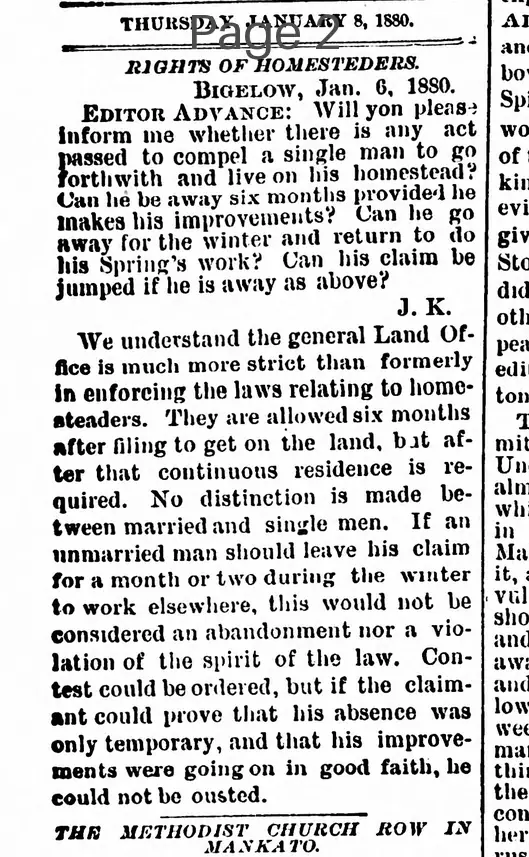
BIGELOW, Jan. 6, 1880,
EDITOR ADVANCE: Will you please
inform me whether there is any act
passed to compel a single man to go
forthwith and live on his homestead?
Can he be away six months provided he
[is] away for the winter and return to it
[to] make his improvements? Can he go
[do] his Spring's work? Can his claim be
jumped if he is away as above?
J. K.
We understand the general Land Office is much more strict than formerly
in enforcing the laws relating to home-
steaders. They are allowed six months
after filing to get on the land, but af-
ter that continuous residence is re-
quired. No distinction is made be-
tween married and single men. If an
unmarried man should leave his claim
for a month or two during the winter
to work elsewhere, this would not be
considered an abandonment nor a vio-
lation of the spirit of the law. Con-
test could be ordered, but if the claim-
ant could prove that his absence was
only temporary, and that his improve-
ments were going on in good faith, he
could not be ousted.
What sub-type of article is it?
What themes does it cover?
What keywords are associated?
What entities or persons were involved?
Where did it happen?
Story Details
Key Persons
Location
Bigelow
Event Date
Jan. 6, 1880
Story Details
J.K. asks if single homesteaders must live on their claim immediately, can leave for six months or winter work while making improvements, and if their claim can be jumped during absence. Response: Land Office requires continuous residence after initial six months, no difference for marital status; temporary winter absences for work are permissible if improvements continue in good faith, preventing ousting via contest.