Thank you for visiting SNEWPapers!
Sign up free
Story
September 3, 1900
Daily Inter Mountain
Butte, Silver Bow County, Montana
What is this article about?
William Jennings Bryan speaks in Chicago on September 3, addressing labor issues, advocating for workers' rights, reforms like eight-hour day and direct senator elections, opposing trusts and injunctions, and warning against Oriental immigration.
Clipping
OCR Quality
98%
Excellent
Full Text
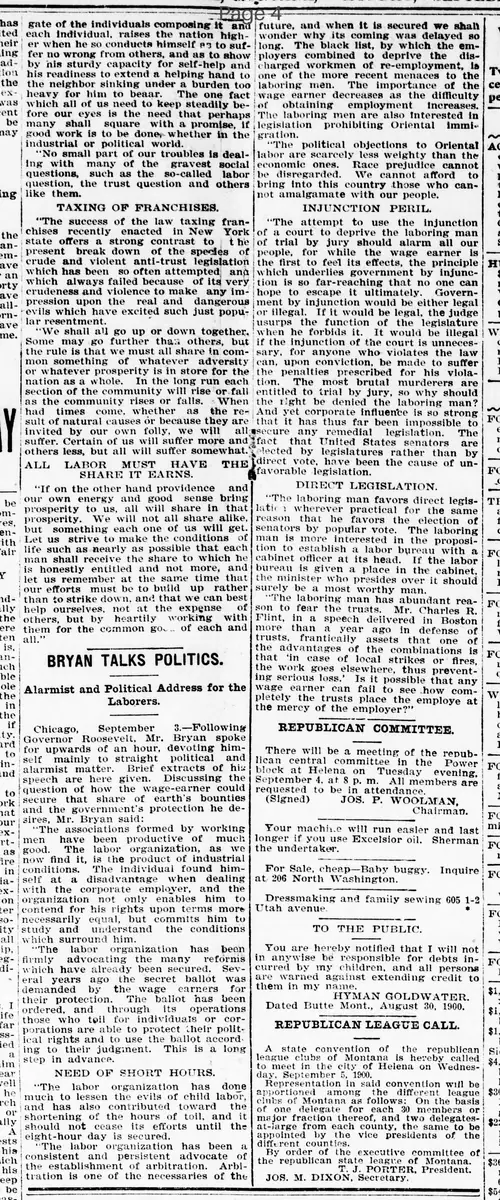
BRYAN TALKS POLITICS.
Alarmist and Political Address for the Laborers.
Chicago, September 3.-Following Governor Roosevelt, Mr. Bryan spoke for upwards of an hour, devoting himself mainly to straight political and alarmist matter. Brief extracts of his speech are here given. Discussing the question of how the wage-earner could secure that share of earth's bounties and the government's protection he desires, Mr. Bryan said:
"The associations formed by working men have been productive of much good. The labor organization, as we now find it, is the product of industrial conditions. The individual found himself at a disadvantage when dealing with the corporate employer, and the organization not only enables him to contend for his rights upon terms more nearly equal, but commits him to study and understand the conditions which surround him.
"The labor organization has been firmly advocating the many reforms which have already been secured. Several years ago the secret ballot was demanded by the wage earners for their protection. The ballot has been ordered, and through its operations those who toil for individuals or corporations are able to protect their political rights and to use the ballot according to their judgment. This is a long step in advance.
NEED OF SHORT HOURS.
"The labor organization has done much to lessen the evils of child labor, and has also contributed toward the shortening of the hours of toil, and it should not cease its efforts until the eight-hour day is secured.
"The labor organization has been a consistent and persistent advocate of the establishment of arbitration. Arbitration is one of the necessaries of the future, and when it is secured we shall wonder why its coming was delayed so long. The black list, by which the employers combined to deprive the discharged workmen of re-employment, is one of the more recent menaces to the laboring men. The importance of the wage earner decreases as the difficulty of obtaining employment increases.
The laboring men are also interested in legislation prohibiting Oriental immigration.
"The political objections to Oriental labor are scarcely less weighty than the economic ones. Race prejudice cannot be disregarded. We cannot afford to bring into this country those who cannot amalgamate with our people.
INJUNCTION PERIL.
"The attempt to use the injunction of a court to deprive the laboring man of trial by jury should alarm all our people, for while the wage earner is the first to feel its effects, the principle which underlies government by injunction is so far-reaching that no one can hope to escape it ultimately. Government by injunction would be either legal or illegal. If it would be legal, the judge usurps the function of the legislature when he forbids it. It would be illegal if the injunction of the court is unnecessary, for anyone who violates the law can, upon conviction, be made to suffer the penalties prescribed for his violation. The most brutal murderers are entitled to trial by jury, so why should the right be denied the laboring man? And yet corporate influence is so strong that it has thus far been impossible to secure any remedial legislation.
The fact that United States senators are elected by legislatures rather than by direct vote, have been the cause of unfavorable legislation.
DIRECT LEGISLATION.
"The laboring man favors direct legislation wherever practical for the same reason that he favors the election of senators by popular vote. The laboring man is more interested in the proposition to establish a labor bureau with a cabinet officer at its head. If the labor bureau is given a place in the cabinet, the minister who presides over it should surely be a most worthy man.
"The laboring man has abundant reason to fear the trusts. Mr. Charles R. Flint, in a speech delivered in Boston more than a year ago in defense of trusts, frantically asserts that one of the advantages of the combinations is that in case of local strikes or fires, the work goes elsewhere, thus preventing serious loss.' Is it possible that any wage earner can fail to see how completely the trusts place the employe at the mercy of the employer?"
Alarmist and Political Address for the Laborers.
Chicago, September 3.-Following Governor Roosevelt, Mr. Bryan spoke for upwards of an hour, devoting himself mainly to straight political and alarmist matter. Brief extracts of his speech are here given. Discussing the question of how the wage-earner could secure that share of earth's bounties and the government's protection he desires, Mr. Bryan said:
"The associations formed by working men have been productive of much good. The labor organization, as we now find it, is the product of industrial conditions. The individual found himself at a disadvantage when dealing with the corporate employer, and the organization not only enables him to contend for his rights upon terms more nearly equal, but commits him to study and understand the conditions which surround him.
"The labor organization has been firmly advocating the many reforms which have already been secured. Several years ago the secret ballot was demanded by the wage earners for their protection. The ballot has been ordered, and through its operations those who toil for individuals or corporations are able to protect their political rights and to use the ballot according to their judgment. This is a long step in advance.
NEED OF SHORT HOURS.
"The labor organization has done much to lessen the evils of child labor, and has also contributed toward the shortening of the hours of toil, and it should not cease its efforts until the eight-hour day is secured.
"The labor organization has been a consistent and persistent advocate of the establishment of arbitration. Arbitration is one of the necessaries of the future, and when it is secured we shall wonder why its coming was delayed so long. The black list, by which the employers combined to deprive the discharged workmen of re-employment, is one of the more recent menaces to the laboring men. The importance of the wage earner decreases as the difficulty of obtaining employment increases.
The laboring men are also interested in legislation prohibiting Oriental immigration.
"The political objections to Oriental labor are scarcely less weighty than the economic ones. Race prejudice cannot be disregarded. We cannot afford to bring into this country those who cannot amalgamate with our people.
INJUNCTION PERIL.
"The attempt to use the injunction of a court to deprive the laboring man of trial by jury should alarm all our people, for while the wage earner is the first to feel its effects, the principle which underlies government by injunction is so far-reaching that no one can hope to escape it ultimately. Government by injunction would be either legal or illegal. If it would be legal, the judge usurps the function of the legislature when he forbids it. It would be illegal if the injunction of the court is unnecessary, for anyone who violates the law can, upon conviction, be made to suffer the penalties prescribed for his violation. The most brutal murderers are entitled to trial by jury, so why should the right be denied the laboring man? And yet corporate influence is so strong that it has thus far been impossible to secure any remedial legislation.
The fact that United States senators are elected by legislatures rather than by direct vote, have been the cause of unfavorable legislation.
DIRECT LEGISLATION.
"The laboring man favors direct legislation wherever practical for the same reason that he favors the election of senators by popular vote. The laboring man is more interested in the proposition to establish a labor bureau with a cabinet officer at its head. If the labor bureau is given a place in the cabinet, the minister who presides over it should surely be a most worthy man.
"The laboring man has abundant reason to fear the trusts. Mr. Charles R. Flint, in a speech delivered in Boston more than a year ago in defense of trusts, frantically asserts that one of the advantages of the combinations is that in case of local strikes or fires, the work goes elsewhere, thus preventing serious loss.' Is it possible that any wage earner can fail to see how completely the trusts place the employe at the mercy of the employer?"
What sub-type of article is it?
Historical Event
Biography
What themes does it cover?
Justice
Moral Virtue
Social Manners
What keywords are associated?
Labor Organizations
Political Reforms
Wage Earners
Trusts
Injunctions
Oriental Immigration
What entities or persons were involved?
Mr. Bryan
Governor Roosevelt
Mr. Charles R. Flint
Where did it happen?
Chicago
Story Details
Key Persons
Mr. Bryan
Governor Roosevelt
Mr. Charles R. Flint
Location
Chicago
Event Date
September 3
Story Details
Mr. Bryan delivers a political speech advocating for labor organizations, reforms like secret ballot, eight-hour day, arbitration, anti-child labor, prohibition of Oriental immigration, opposition to injunctions denying jury trials, direct election of senators, labor bureau in cabinet, and criticism of trusts.