Thank you for visiting SNEWPapers!
Sign up free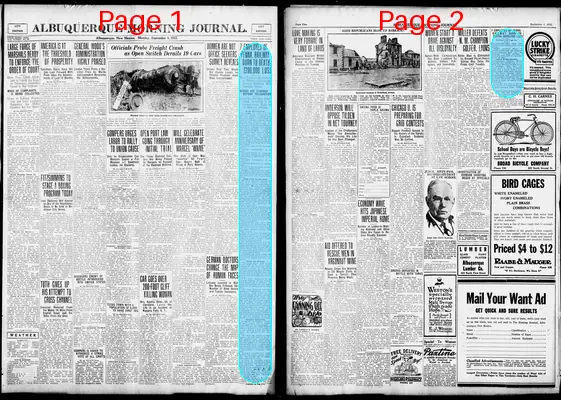
Albuquerque Morning Journal
Albuquerque, Bernalillo County, New Mexico
What is this article about?
A dawn fire in the Pennsylvania Railroad's bunkhouse in Pittsburgh's Thirteenth Street yards killed seven car repairmen, injured ten others, and caused $220,000 in damage on Sept. 3. The blaze spread rapidly from waste materials, charring bodies beyond recognition. Investigations probe possible arson amid a shopmen's strike.
Merged-components note: This is a continuation of the Pennsylvania railway bunkhouse fire story from page 1 to page 2, as explicitly indicated by 'Continued from Page One.' The components are merged to form a single logical article.
Clippings

1 of 2
OCR Quality
Full Text
Blaze Starts in Bunk House at Pittsburgh and Sweeps Through Buildings With Incredible Speed,
BODIES ARE CHARRED BEYOND RECOGNITION
Cause Has Not Been Determined, According to an Announcement Made by the Railroad Officials.
By the Associated Press.
Pittsburgh, Pa., Sept. 3 (by the Associated Press)—Seven car repair men, recently employed, were burned to death, ten more were injured severely and property loss of $220,000 was wrought by fire which started at dawn today in a bunk house in the Thirteenth street yards of the Pennsylvania railroad and spread through the building with incredible speed. Nearly all the bodies were charred beyond recognition. The body of J. F. Carr, Baltimore, was positively identified, however. Railway officials made a check of all employees living in the bunk house and gave out the following list of missing tonight:
ALVIN L. BRUCE, 21, Kewanee, Illinois.
FRANK CUSTODINO, 28, laborer.
EDGERT DUNN, 35, repairman.
DAVID L. DAVIS, 46, repairman.
WALTER L. PARSONS, 23, repairman.
ERNEST INOZATINO, 38, repairman.
GERALD HARPER, 24, machine helper.
Search of the wreckage failed to reveal an eighth body. Railway representatives said it was possible that one of the above listed men failed to report after he had fled from the blazing bunkhouse.
Jump From Second Story.
The most seriously injured employee is J. Mineru Tajuma of Tokio, Japan, an air brake inspector's helper. Tajuma and the other employees who sustained injuries were hurt when they jumped from the second story of the bunkhouse.
Investigations immediately were started by the railroad, the police and fire departments and by the department of justice. They were in progress tonight, with announcements by the railroad that it had been unable "to determine the cause of the fire."
E. K. Kennedy, a watchman, saw smoke coming from a section of the building, which, in addition to housing workmen, was in part used as a store house and a commissary. Running to the place he saw the interior of a room filled with waste and it was a mass of flames. He turned in an alarm.
Knowing that sixty men were sleeping on the second floor, Kennedy dashed up the stairway. He was driven back by dense smoke but made another attempt with better success.
Many of the men sleeping near windows tumbled out on the tracks and those who were uninjured ran from the yards. Others, trapped in their bunks, perished.
The building was set in a network of railroad tracks, and fire companies lost time in reaching it. When they finally arrived the oil soaked floors had fallen in, and the sheet iron sides had been twisted into a pile of junk.
Exploring the ruins taxed the resources of the firemen but by 10 o'clock the bodies had been removed.
Trains Are Delayed.
The bunk house was almost within sight of the union station, adjacent to the main east bound passenger tracks. A number of fast through trains were due when the fire started, but they were held in the yards until the fire was out and the warped tracks had been repaired.
N. P. Good, chairman of the striking shopmen on the Pennsylvania system, in a statement tonight deplored the fire and said it could not be charged to the shopmen.
"The shop destroyed was under guard, as I understand it," said Mr. Good, "and could not be reached except by some one having free access to the yards. I understand that part of this shop was used for the storage and repair of coach storage batteries which, from my knowledge are subject to spontaneous combustion from the acids they contain. I am willing to stand upon the record established by our membership for the peaceful and orderly manner in which this strike has been conducted, and will continue to be conducted to a successful conclusion."
Shopmen Questioned.
George W. McCandless director of public safety, who is working with agents of the department of justice, announced tonight that two railroad shopmen were questioned in his office at length this afternoon.
He authorized this statement:
"We have only begun our investigation into the cause of the fire. Two shopmen were questioned in my office in the presence of government agents and officials of the Pennsylvania road. I cannot make any announcement tonight regarding the cause of the fire but I think I can promise a statement tomorrow."
An eighth charred form, removed from the debris, proved to be a dog. The carcass, like the corpses, was burned to a cinder.
A score of shopmen who escaped from the blazing bunk house told essentially the same story to newspaper men. Awakened by the shouts of the watchmen, or by the clamor which resulted, they leaped from their cots. Those who grasped the situation, jumped from the building and fled. Those who did not do so died.
Residents living in the vicinity declared the fire flashed from the building with such force that people were awakened by the light.
Continued from Page One.
People living two miles away were telephoning for details within three minutes.
District Attorney Harry H. Rowand, conducting an independent investigation, gave out this statement:
"If facts warrant, a grand jury will make an investigation of the fire."
Started Within Building.
Pennsylvania railroad officials reiterated the statements of employees that the fire started within the building. This, they said, caused them to ignore a possible theory that a spark from a locomotive might have been responsible.
The same officials declare the bunkhouse cook corroborated the watchman's statement that the fire when discovered was roaring through a mass of greasy waste and rubbish.
"I was the last man to get out alive," said N. L. Davis, a tall, middle aged carpenter from Corbin, Ky.
"I heard a yell and I jumped for the door.
The fire followed me out. I won't call it a fire. It was greased lightning."
What sub-type of article is it?
What themes does it cover?
What keywords are associated?
What entities or persons were involved?
Where did it happen?
Story Details
Key Persons
Location
Thirteenth Street Yards, Pittsburgh, Pa.
Event Date
Sept. 3
Story Details
Fire starts at dawn in bunkhouse waste room, rapidly engulfs building housing 60 sleeping railroad workers. Seven die, including listed missing men; ten injured from jumps. Watchman Kennedy alerts but some trapped perish. Investigations by officials suspect possible arson amid strike; batteries may have spontaneously combusted. Trains delayed; dog also burned.