Thank you for visiting SNEWPapers!
Sign up free
Editorial
May 27, 1789
Gazette Of The United States
New York, New York County, New York
What is this article about?
An editorial reprint from The Tablet No. XIII condemns smuggling as dishonest and urges citizens in the new United States to form voluntary associations to support revenue laws morally, emphasizing public opinion, habit, and legislative penalties that shame offenders to ensure compliance and national prosperity.
Clipping
OCR Quality
95%
Excellent
Full Text
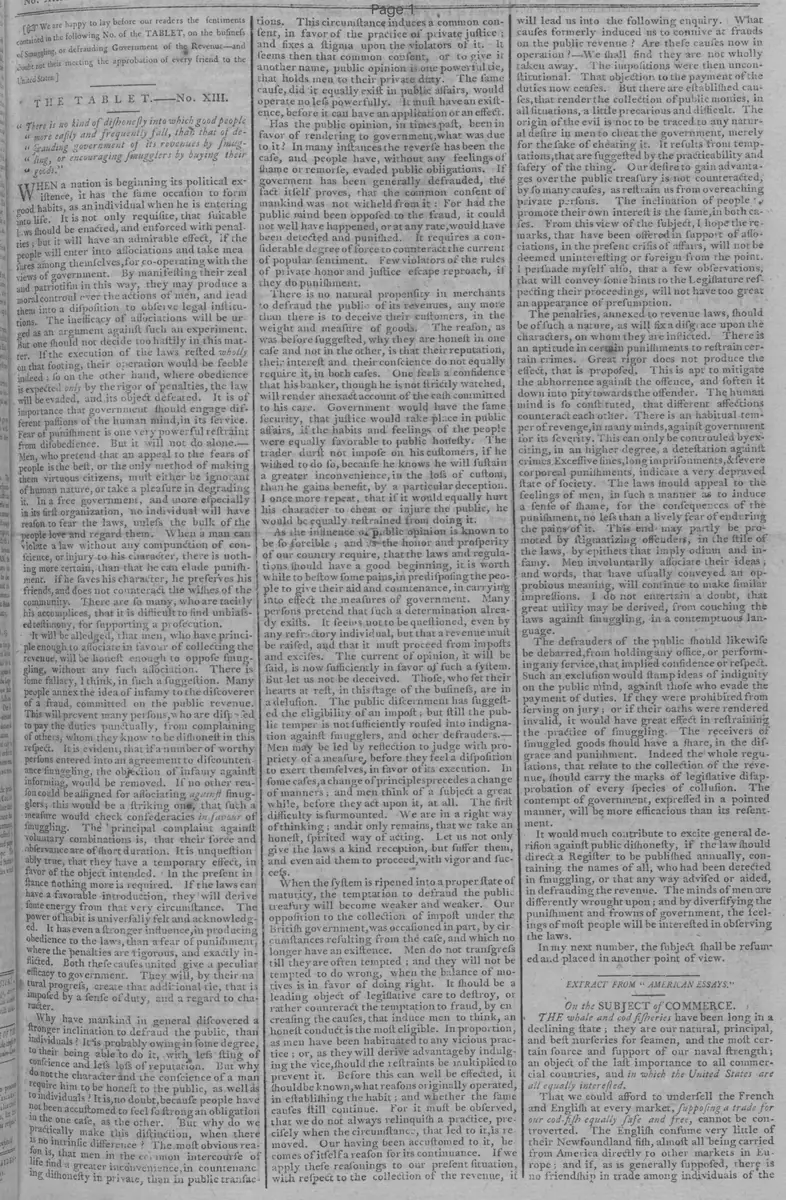
We are happy to lay before our readers the sentiments contained in the following No. of the TABLET, on the business of Smuggling, or defrauding Government of the Revenue—and [sentiments] doubt not their meeting the approbation of every friend to the United States.]
THE TABLET.—NO. XIII.
"There is no kind of dishonesty into which good people more easily and frequently fall, than that of defrauding government of its revenues by smuggling, or encouraging smugglers by buying their goods."
When a nation is beginning its political existence, it has the same occasion to form good habits, as an individual when he is entering into life. It is not only requisite, that suitable laws should be enacted, and enforced with penalties; but it will have an admirable effect, if the laws should be enacted, and enforced with penalties among themselves, for co-operating with the people will enter into associations and take measures views of government. By manifesting their zeal and patriotism in this way, they may produce a moral control over the actions of men, and lead them into a disposition to observe legal institutions. The inefficacy of associations will be urged as an argument against such an experiment. But one should not decide too hastily in this matter. If the execution of the laws rested wholly on that footing, their operation would be feeble indeed; so on the other hand, where obedience is expected only by the rigor of penalties, the law will be evaded, and its object defeated. It is of importance that government should engage different passions of the human mind, in its service. Fear of punishment is one very powerful restraint from disobedience. But it will not do alone.— Men, who pretend that an appeal to the fears of people is the best, or the only method of making them virtuous citizens, must either be ignorant of human nature, or take a pleasure in degrading it. In a free government, and more especially in its first organization, no individual will have reason to fear the laws, unless the bulk of the people love and regard them. When a man can violate a law without any compunction of conscience, or injury to his character, there is nothing more certain, than that he can elude punishment. If he saves his character, he preserves his friends, and does not counteract the wishes of the community. There are so many, who are tacitly his accomplices, that it is difficult to find unbiased testimony, for supporting a prosecution. 'It will be alleged, that men, who have principle enough to associate in favour of collecting the revenue, will be honest enough to oppose smuggling, without any such association. There is some fallacy, I think, in such a suggestion. Many people annex the idea of infamy to the discoverer of a fraud, committed on the public revenue. This will prevent many persons, who are disposed to pay the duties punctually, from complaining of others, whom they know to be dishonest in this respect. It is evident, that if a number of worthy persons entered into an agreement to discountenance smuggling, the objection of infamy against informing, would be removed. If no other reason could be alleged for associating against smugglers; this would be a striking one, that such a measure would check confederacies in favour of smuggling. The principal complaint against voluntary combinations is, that their force and observance are of short duration. It is unquestionably true, that they have a temporary effect, in favor of the object intended. In the present instance nothing more is required. If the laws can have a favorable introduction, they will derive some energy from that very circumstance. The power of habit is universally felt and acknowledged. It has even a stronger influence, in producing obedience to the laws, than a fear of punishment, where the penalties are rigorous, and exactly inflicted. Both these causes united give a peculiar efficacy to government. They will, by their natural progress, create that additional tie, that is imposed by a sense of duty, and a regard to character.
Why have mankind in general discovered a stronger inclination to defraud the public, than individuals? It is probably owing in some degree, to their being able to do it, with less sting of conscience and less loss of reputation. But why do not the character and the conscience of a man require him to be honest to the public, as well as to individuals? It is, no doubt, because people have not been accustomed to feel so strong an obligation in the one case, as the other. 'But why do we practically make this distinction, when there is no intrinsic difference? The most obvious reason is, that men in the common intercourse of life find a greater inconvenience, in countenancing dishonesty in private, than in public transactions. This circumstance induces a common consent, in favor of the practice of private justice; and fixes a stigma upon the violators of it. It seems then that common consent, or to give it another name, public opinion is one powerful tie, that holds men to their private duty. The same cause, did it equally exist in public affairs, would operate no less powerfully. It must have an existence, before it can have an application or an effect. Has the public opinion, in times past, been in favor of rendering to government, what was due to it? In many instances the reverse has been the case, and people have, without any feelings of shame or remorse, evaded public obligations. If government has been generally defrauded, the fact itself proves, that the common consent of mankind was not withheld from it: For had the public mind been opposed to the fraud, it could not well have happened, or at any rate, would have been detected and punished. It requires a considerable degree of force to counteract the current of popular sentiment. Few violators of the rules of private honor and justice escape reproach, if they do punishment. There is no natural propensity in merchants to defraud the public of its revenues, any more than there is to deceive their customers, in the weight and measure of goods. The reason, as was before suggested, why they are honest in one case and not in the other, is that their reputation, their interest and their conscience do not equally require it, in both cases. One feels a confidence that his banker, though he is not strictly watched, will render an exact account of the cash committed to his care. Government would have the same security, that justice would take place in public affairs, if the habits and feelings of the people were equally favorable to public honesty. The trader durst not impose on his customers, if he wished to do so, because he knows he will sustain a greater inconvenience, in the loss of custom, than he gains benefit, by a particular deception. I once more repeat, that if it would equally hurt his character to cheat or injure the public, he would be equally restrained from doing it. As the influence of public opinion is known to be so forcible; and as the honor and prosperity of our country require, that the laws and regulations should have a good beginning, it is worth while to bestow some pains, in predisposing the people to give their aid and countenance, in carrying into effect the measures of government. Many persons pretend that such a determination already exists. It seems not to be questioned, even by any refractory individual, but that a revenue must be raised, and that it must proceed from imposts and excises. The current of opinion, it will be said, is now sufficiently in favor of such a system. But let us not be deceived. Those, who set their hearts at rest, in this stage of the business, are in a delusion. The public discernment has suggested the eligibility of an impost; but till the public temper is not sufficiently roused into indignation against smugglers, and other defrauders.— Men may be led by reflection to judge with propriety of a measure, before they feel a disposition to exert themselves, in favor of its execution. In some cases, a change of principles precedes a change of manners; and men think of a subject a great while, before they act upon it, at all. The first difficulty is surmounted. We are in a right way of thinking; and it only remains, that we take an honest, spirited way of acting. Let us not only give the laws a kind reception, but suffer them, and even aid them to proceed, with vigor and success.
When the system is ripened into a proper state of maturity, the temptation to defraud the public treasury will become weaker and weaker. Our opposition to the collection of impost under the British government, was occasioned in part, by circumstances resulting from the case, and which no longer have an existence. Men do not transgress till they are often tempted; and they will not be tempted to do wrong, when the balance of motives is in favor of doing right. It should be a leading object of legislative care to destroy, or rather counteract the temptation to fraud, by increasing the causes, that induce men to think, an honest conduct is the most eligible. In proportion, as men have been habituated to any vicious practice; or, as they will derive advantage by indulging the vice, should the restraints be multiplied to prevent it. Before this can well be effected, it should be known, what reasons originally operated, in establishing the habit; and whether the same causes still continue. For it must be observed, that we do not always relinquish a practice, precisely when the circumstances, that led to it, is removed. Our having been accustomed to it, becomes of itself a reason for its continuance. If we apply these reasonings to our present situation, with respect to the collection of the revenue, it will lead us into the following enquiry. What causes formerly induced us to connive at frauds on the public revenue? Are these causes now in operation? We shall find they are not wholly taken away. The impositions were then unconstitutional. That objection to the payment of the duties now ceases. But there are established causes, that render the collection of public monies, in all situations, a little precarious and difficult. The origin of the evil is not to be traced to any natural desire in men to cheat the government, merely for the sake of cheating it. It results from temptations, that are suggested by the practicability and safety of the thing. Our desire to gain advantages over the public treasury is not counteracted, by so many causes, as restrain us from overreaching private persons. The inclination of people to promote their own interest is the same, in both cases. From this view of the subject, I hope the remarks, that have been offered in support of associations, in the present crisis of affairs, will not be deemed uninteresting or foreign from the point. I persuade myself also, that a few observations, that will convey some hints to the Legislature respecting their proceedings, will not have too great an appearance of presumption.
The penalties, annexed to revenue laws, should be of such a nature, as will fix a disgrace upon the characters, on whom they are inflicted. There is an aptitude in certain punishments to restrain certain crimes. Great rigor does not produce the effect, that is proposed. This is apt to mitigate the abhorrence against the offence, and often it down into pity towards the offender. The human mind is so constituted, that different affections counteract each other. There is an habitual temper of revenge, in many minds, against government for its severity. This can only be controlled by exciting, in an higher degree, a detestation against crimes. Excessive fines, long imprisonments, & severe corporeal punishments, indicate a very depraved state of society. The laws should appeal to the feelings of men, in such a manner as to induce a sense of shame, for the consequences of the punishment, no less than a lively fear of enduring the pains of it. This end may partly be promoted by stigmatizing offenders, in the title of the laws, by epithets that imply odium and infamy. Men involuntarily associate their ideas; and words, that have usually conveyed an opprobrious meaning, will continue to make similar impressions. I do not entertain a doubt, that great utility may be derived, from couching the laws against smuggling, in a contemptuous language.
The defrauders of the public should likewise be debarred, from holding any office, or performing any service, that implied confidence or respect. Such an exclusion would stamp ideas of indignity on the public mind, against those who evade the payment of duties. If they were prohibited from serving on jury; or if their oaths were rendered invalid, it would have great effect in restraining the practice of smuggling. The receivers of smuggled goods should have a share, in the disgrace and punishment. Indeed the whole regulations, that relate to the collection of the revenue, should carry the marks of legislative disapprobation of every species of collusion. The contempt of government, expressed in a pointed manner, will be more efficacious than its resentment.
It would much contribute to excite general derision against public dishonesty, if the law should direct a Register to be published annually, containing the names of all, who had been detected in smuggling, or that any way advised or aided, in defrauding the revenue. The minds of men are differently wrought upon; and by diversifying the punishment and frowns of government, the feelings of most people will be interested in observing the laws.
In my next number, the subject shall be resumed and placed in another point of view.
THE TABLET.—NO. XIII.
"There is no kind of dishonesty into which good people more easily and frequently fall, than that of defrauding government of its revenues by smuggling, or encouraging smugglers by buying their goods."
When a nation is beginning its political existence, it has the same occasion to form good habits, as an individual when he is entering into life. It is not only requisite, that suitable laws should be enacted, and enforced with penalties; but it will have an admirable effect, if the laws should be enacted, and enforced with penalties among themselves, for co-operating with the people will enter into associations and take measures views of government. By manifesting their zeal and patriotism in this way, they may produce a moral control over the actions of men, and lead them into a disposition to observe legal institutions. The inefficacy of associations will be urged as an argument against such an experiment. But one should not decide too hastily in this matter. If the execution of the laws rested wholly on that footing, their operation would be feeble indeed; so on the other hand, where obedience is expected only by the rigor of penalties, the law will be evaded, and its object defeated. It is of importance that government should engage different passions of the human mind, in its service. Fear of punishment is one very powerful restraint from disobedience. But it will not do alone.— Men, who pretend that an appeal to the fears of people is the best, or the only method of making them virtuous citizens, must either be ignorant of human nature, or take a pleasure in degrading it. In a free government, and more especially in its first organization, no individual will have reason to fear the laws, unless the bulk of the people love and regard them. When a man can violate a law without any compunction of conscience, or injury to his character, there is nothing more certain, than that he can elude punishment. If he saves his character, he preserves his friends, and does not counteract the wishes of the community. There are so many, who are tacitly his accomplices, that it is difficult to find unbiased testimony, for supporting a prosecution. 'It will be alleged, that men, who have principle enough to associate in favour of collecting the revenue, will be honest enough to oppose smuggling, without any such association. There is some fallacy, I think, in such a suggestion. Many people annex the idea of infamy to the discoverer of a fraud, committed on the public revenue. This will prevent many persons, who are disposed to pay the duties punctually, from complaining of others, whom they know to be dishonest in this respect. It is evident, that if a number of worthy persons entered into an agreement to discountenance smuggling, the objection of infamy against informing, would be removed. If no other reason could be alleged for associating against smugglers; this would be a striking one, that such a measure would check confederacies in favour of smuggling. The principal complaint against voluntary combinations is, that their force and observance are of short duration. It is unquestionably true, that they have a temporary effect, in favor of the object intended. In the present instance nothing more is required. If the laws can have a favorable introduction, they will derive some energy from that very circumstance. The power of habit is universally felt and acknowledged. It has even a stronger influence, in producing obedience to the laws, than a fear of punishment, where the penalties are rigorous, and exactly inflicted. Both these causes united give a peculiar efficacy to government. They will, by their natural progress, create that additional tie, that is imposed by a sense of duty, and a regard to character.
Why have mankind in general discovered a stronger inclination to defraud the public, than individuals? It is probably owing in some degree, to their being able to do it, with less sting of conscience and less loss of reputation. But why do not the character and the conscience of a man require him to be honest to the public, as well as to individuals? It is, no doubt, because people have not been accustomed to feel so strong an obligation in the one case, as the other. 'But why do we practically make this distinction, when there is no intrinsic difference? The most obvious reason is, that men in the common intercourse of life find a greater inconvenience, in countenancing dishonesty in private, than in public transactions. This circumstance induces a common consent, in favor of the practice of private justice; and fixes a stigma upon the violators of it. It seems then that common consent, or to give it another name, public opinion is one powerful tie, that holds men to their private duty. The same cause, did it equally exist in public affairs, would operate no less powerfully. It must have an existence, before it can have an application or an effect. Has the public opinion, in times past, been in favor of rendering to government, what was due to it? In many instances the reverse has been the case, and people have, without any feelings of shame or remorse, evaded public obligations. If government has been generally defrauded, the fact itself proves, that the common consent of mankind was not withheld from it: For had the public mind been opposed to the fraud, it could not well have happened, or at any rate, would have been detected and punished. It requires a considerable degree of force to counteract the current of popular sentiment. Few violators of the rules of private honor and justice escape reproach, if they do punishment. There is no natural propensity in merchants to defraud the public of its revenues, any more than there is to deceive their customers, in the weight and measure of goods. The reason, as was before suggested, why they are honest in one case and not in the other, is that their reputation, their interest and their conscience do not equally require it, in both cases. One feels a confidence that his banker, though he is not strictly watched, will render an exact account of the cash committed to his care. Government would have the same security, that justice would take place in public affairs, if the habits and feelings of the people were equally favorable to public honesty. The trader durst not impose on his customers, if he wished to do so, because he knows he will sustain a greater inconvenience, in the loss of custom, than he gains benefit, by a particular deception. I once more repeat, that if it would equally hurt his character to cheat or injure the public, he would be equally restrained from doing it. As the influence of public opinion is known to be so forcible; and as the honor and prosperity of our country require, that the laws and regulations should have a good beginning, it is worth while to bestow some pains, in predisposing the people to give their aid and countenance, in carrying into effect the measures of government. Many persons pretend that such a determination already exists. It seems not to be questioned, even by any refractory individual, but that a revenue must be raised, and that it must proceed from imposts and excises. The current of opinion, it will be said, is now sufficiently in favor of such a system. But let us not be deceived. Those, who set their hearts at rest, in this stage of the business, are in a delusion. The public discernment has suggested the eligibility of an impost; but till the public temper is not sufficiently roused into indignation against smugglers, and other defrauders.— Men may be led by reflection to judge with propriety of a measure, before they feel a disposition to exert themselves, in favor of its execution. In some cases, a change of principles precedes a change of manners; and men think of a subject a great while, before they act upon it, at all. The first difficulty is surmounted. We are in a right way of thinking; and it only remains, that we take an honest, spirited way of acting. Let us not only give the laws a kind reception, but suffer them, and even aid them to proceed, with vigor and success.
When the system is ripened into a proper state of maturity, the temptation to defraud the public treasury will become weaker and weaker. Our opposition to the collection of impost under the British government, was occasioned in part, by circumstances resulting from the case, and which no longer have an existence. Men do not transgress till they are often tempted; and they will not be tempted to do wrong, when the balance of motives is in favor of doing right. It should be a leading object of legislative care to destroy, or rather counteract the temptation to fraud, by increasing the causes, that induce men to think, an honest conduct is the most eligible. In proportion, as men have been habituated to any vicious practice; or, as they will derive advantage by indulging the vice, should the restraints be multiplied to prevent it. Before this can well be effected, it should be known, what reasons originally operated, in establishing the habit; and whether the same causes still continue. For it must be observed, that we do not always relinquish a practice, precisely when the circumstances, that led to it, is removed. Our having been accustomed to it, becomes of itself a reason for its continuance. If we apply these reasonings to our present situation, with respect to the collection of the revenue, it will lead us into the following enquiry. What causes formerly induced us to connive at frauds on the public revenue? Are these causes now in operation? We shall find they are not wholly taken away. The impositions were then unconstitutional. That objection to the payment of the duties now ceases. But there are established causes, that render the collection of public monies, in all situations, a little precarious and difficult. The origin of the evil is not to be traced to any natural desire in men to cheat the government, merely for the sake of cheating it. It results from temptations, that are suggested by the practicability and safety of the thing. Our desire to gain advantages over the public treasury is not counteracted, by so many causes, as restrain us from overreaching private persons. The inclination of people to promote their own interest is the same, in both cases. From this view of the subject, I hope the remarks, that have been offered in support of associations, in the present crisis of affairs, will not be deemed uninteresting or foreign from the point. I persuade myself also, that a few observations, that will convey some hints to the Legislature respecting their proceedings, will not have too great an appearance of presumption.
The penalties, annexed to revenue laws, should be of such a nature, as will fix a disgrace upon the characters, on whom they are inflicted. There is an aptitude in certain punishments to restrain certain crimes. Great rigor does not produce the effect, that is proposed. This is apt to mitigate the abhorrence against the offence, and often it down into pity towards the offender. The human mind is so constituted, that different affections counteract each other. There is an habitual temper of revenge, in many minds, against government for its severity. This can only be controlled by exciting, in an higher degree, a detestation against crimes. Excessive fines, long imprisonments, & severe corporeal punishments, indicate a very depraved state of society. The laws should appeal to the feelings of men, in such a manner as to induce a sense of shame, for the consequences of the punishment, no less than a lively fear of enduring the pains of it. This end may partly be promoted by stigmatizing offenders, in the title of the laws, by epithets that imply odium and infamy. Men involuntarily associate their ideas; and words, that have usually conveyed an opprobrious meaning, will continue to make similar impressions. I do not entertain a doubt, that great utility may be derived, from couching the laws against smuggling, in a contemptuous language.
The defrauders of the public should likewise be debarred, from holding any office, or performing any service, that implied confidence or respect. Such an exclusion would stamp ideas of indignity on the public mind, against those who evade the payment of duties. If they were prohibited from serving on jury; or if their oaths were rendered invalid, it would have great effect in restraining the practice of smuggling. The receivers of smuggled goods should have a share, in the disgrace and punishment. Indeed the whole regulations, that relate to the collection of the revenue, should carry the marks of legislative disapprobation of every species of collusion. The contempt of government, expressed in a pointed manner, will be more efficacious than its resentment.
It would much contribute to excite general derision against public dishonesty, if the law should direct a Register to be published annually, containing the names of all, who had been detected in smuggling, or that any way advised or aided, in defrauding the revenue. The minds of men are differently wrought upon; and by diversifying the punishment and frowns of government, the feelings of most people will be interested in observing the laws.
In my next number, the subject shall be resumed and placed in another point of view.
What sub-type of article is it?
Taxation
Economic Policy
Moral Or Religious
What keywords are associated?
Smuggling
Revenue Fraud
Voluntary Associations
Public Opinion
Revenue Laws
Moral Obedience
Legislative Penalties
National Habits
What entities or persons were involved?
United States Government
Smugglers
Legislature
British Government
Editorial Details
Primary Topic
Opposition To Smuggling And Promotion Of Voluntary Associations For Revenue Compliance
Stance / Tone
Advocacy For Moral Support Of Laws Against Defrauding Government Revenue
Key Figures
United States Government
Smugglers
Legislature
British Government
Key Arguments
Smuggling Is A Common Dishonesty That Undermines Government Revenue.
Nations Need Good Habits Like Individuals; Voluntary Associations Can Foster Moral Obedience To Laws.
Fear Of Punishment Alone Is Insufficient; Public Opinion And Habit Are Stronger Restraints.
Public Opinion Stigmatizes Private Dishonesty More Than Public; Associations Can Extend This To Revenue Evasion.
Legislative Penalties Should Shame Offenders, E.G., Infamy In Language, Barring From Office, Public Registers.
Past Opposition To British Imposts Was Constitutional; Now Citizens Must Support New Revenue Systems Actively.
Temptations To Fraud Persist; Laws Must Counteract Them By Making Honesty More Advantageous.