Thank you for visiting SNEWPapers!
Sign up free
National Gazette
Philadelphia, Philadelphia County, Pennsylvania
What is this article about?
The French National Assembly addresses the suspension of King Louis XVI's powers after the August 10, 1792, events, citing suspicions of treason amid foreign invasions by Prussian and emigrant forces. They call for a National Convention to exercise popular sovereignty and defend liberty.
Clipping
OCR Quality
Full Text
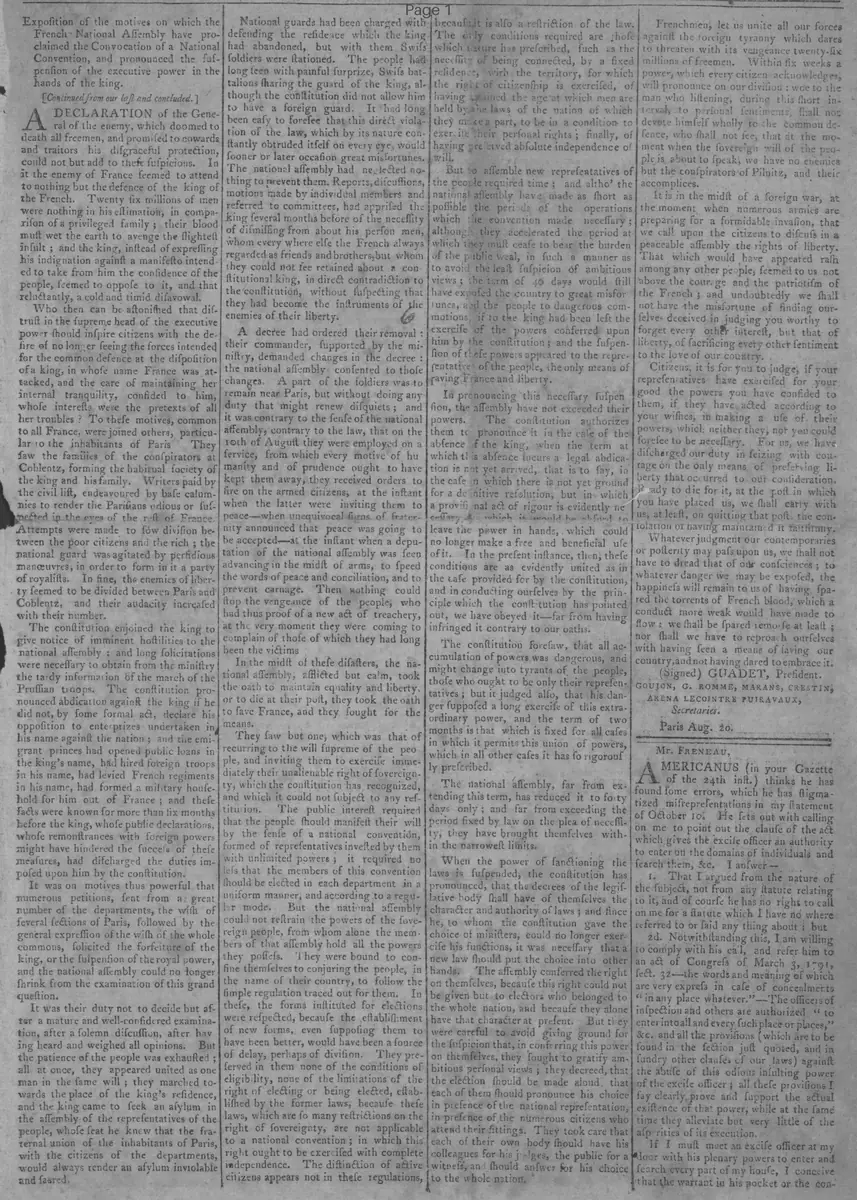
DECLARATION of the General of the enemy, which doomed to death all freemen, and promised to cowards and traitors his disgraceful protection, could not but add to these suspicions. In it the enemy of France seemed to attend to nothing but the defence of the king of the French. Twenty six millions of men were nothing in his estimation, in comparison of a privileged family; their blood must wet the earth to avenge the slightest insult; and the king, instead of expressing his indignation against a manifesto intended to take from him the confidence of the people, seemed to oppose to it, and that reluctantly, a cold and timid disavowal. Who then can be astonished that distrust in the supreme head of the executive power should inspire citizens with the desire of no longer seeing the forces intended for the common defence at the disposition of a king, in whose name France was attacked, and the care of maintaining her internal tranquility, confided to him, whose interests were the pretexts of all her troubles? To these motives, common to all France, were joined others, particular to the inhabitants of Paris. They saw the families of the conspirators at Coblentz, forming the habitual society of the king and his family. Writers paid by the civil list, endeavoured by base calumnies to render the Parisians odious or suspected in the eyes of the rest of France. Attempts were made to sow division between the poor citizens and the rich; the national guard was agitated by perfidious manoeuvres, in order to form in it a party of royalists. In fine, the enemies of liberty seemed to be divided between Paris and Coblentz, and their audacity increased with their number.
The constitution enjoined the king to give notice of imminent hostilities to the national assembly: and long solicitations were necessary to obtain from the ministry the tardy information of the march of the Prussian troops. The constitution pronounced abdication against the king if he did not, by some formal act, declare his opposition to enterprises undertaken in his name against the nation; and the emigrant princes had opened public loans in the king's name, had hired foreign troops in his name, had levied French regiments in his name, had formed a military household for him out of France; and these facts were known for more than six months before the king, whose public declarations, whose remonstrances with foreign powers might have hindered the success of these measures, had discharged the duties imposed upon him by the constitution.
It was on motives thus powerful that numerous petitions, sent from a great number of the departments, the wish of several sections of Paris, followed by the general expression of the wish of the whole commons, solicited the forfeiture of the king, or the suspension of the royal power, and the national assembly could no longer shrink from the examination of this grand question.
It was their duty not to decide but after a mature and well-considered examination, after a solemn discussion, after having heard and weighed all opinions. But the patience of the people was exhausted; all at once, they appeared united as one man in the same will; they marched towards the place of the king's residence, and the king came to seek an asylum in the assembly of the representatives of the people, whose seat he knew that the fraternal union of the inhabitants of Paris, with the citizens of the departments, would always render an asylum inviolable and sacred.
National guards had been charged with defending the residence which the king had abandoned, but with them Swiss soldiers were stationed. The people had long seen with painful surprise, Swiss battalions sharing the guard of the king, although the constitution did not allow him to have a foreign guard. It had long been easy to foresee that this direct violation of the law, which by its nature constantly obtruded itself on every eye, would sooner or later occasion great misfortunes. The national assembly had neglected nothing to prevent them. Reports, discussions, motions made by individual members and referred to committees, had apprised the king several months before of the necessity of dismissing from about his person men, whom every where else the French always regarded as friends and brothers, but whom they could not see retained about a constitutional king, in direct contradiction to the constitution, without suspecting that they had become the instruments of the enemies of their liberty.
A decree had ordered their removal: their commander, supported by the ministry, demanded changes in the decree: the national assembly consented to those changes. A part of the soldiers was to remain near Paris, but without doing any duty that might renew disquiets; and it was contrary to the sense of the national assembly, contrary to the law, that on the 10th of August they were employed on a service, from which every motive of humanity and of prudence ought to have kept them away, they received orders to fire on the armed citizens, at the instant when the latter were inviting them to peace—when unequivocal signs of fraternity announced that peace was going to be accepted—at the instant when a deputation of the national assembly was seen advancing in the midst of arms, to spread the words of peace and conciliation, and to prevent carnage. Then nothing could stop the vengeance of the people, who had thus proof of a new act of treachery, at the very moment they were coming to complain of those of which they had long been the victims.
In the midst of these disasters, the national assembly, afflicted but calm, took the oath to maintain equality and liberty, or to die at their post, they took the oath to save France, and they sought for the means.
They saw but one, which was that of recurring to the supreme will of the people, and inviting them to exercise immediately their unalienable right of sovereignty, which the constitution has recognized, and which it could not subject to any restriction. The public interest required that the people should manifest their will by the sense of a national convention, formed of representatives invested by them with unlimited powers; it required no less that the members of this convention should be elected in each department in a uniform manner, and according to a regular mode. But the national assembly could not restrain the powers of the sovereign people, from whom alone the members of that assembly hold all the powers they possess. They were bound to confine themselves to conjuring the people, in the name of their country, to follow the simple regulation traced out for them. In these, the forms instituted for elections were respected, because the establishment of new forms, even supposing them to have been better, would have been a source of delay, perhaps of division. They preserved in them none of the conditions of eligibility, none of the limitations of the right of electing or being elected, established by the former laws, because these laws, which are so many restrictions on the right of sovereignty, are not applicable to a national convention; in which this right ought to be exercised with complete independence. The distinction of active citizens appears not in these regulations, because it is also a restriction of the law. The only conditions required are those which nature has prescribed, such as the necessity of being connected, by a fixed residence, with the territory, for which the right of citizenship is exercised, of having used the age at which men are held by civil laws of the nation of which they make a part, to be in a condition to exercise their personal rights; finally, of having received absolute independence of will.
But to assemble new representatives of the people required time; and although the national assembly have made as short as possible the periods of the operations which the convention made necessary; although they accelerated the period at which they must cease to bear the burden of the public weal, in such a manner as to avoid the least suspicion of ambitious views; the term of 40 days would still have exposed the country to great misfortunes, and the people to dangerous commotions if to the king had been left the exercise of the powers conferred upon him by the constitution; and the suspension of these powers appeared to the representatives of the people, the only means of saving France and liberty.
In pronouncing this necessary suspension, the assembly have not exceeded their powers. The constitution authorizes them to pronounce it in the case of the absence of the king, when the term at which this absence incurs a legal abdication is not yet arrived, that is to say, in the case in which there is not yet ground for a definitive resolution, but in which a provisional act of rigour is evidently necessary, which it would be absurd to leave the power in hands, which could no longer make a free and beneficial use of it. In the present instance, then, these conditions are as evidently united as in the case provided for by the constitution, and in conducting ourselves by the principle which the constitution has pointed out, we have obeyed it—far from having infringed it contrary to our oaths.
The constitution foresaw, that all accumulation of powers was dangerous, and might change into tyrants of the people, those who ought to be only their representatives; but it judged also, that this danger supposed a long exercise of this extraordinary power, and the term of two months is that which is fixed for all cases in which it permits this union of powers, which in all other cases it has so rigorously prescribed.
The national assembly, far from extending this term, has reduced it to forty days only; and far from exceeding the period fixed by law on the plea of necessity, they have brought themselves within the narrowest limits.
When the power of sanctioning the laws is suspended, the constitution has pronounced, that the decrees of the legislative body shall have of themselves the character and authority of laws: and since he, to whom the constitution gave the choice of ministers, could no longer exercise his functions, it was necessary that a new law should put the choice into other hands. The assembly conferred the right on themselves, because this right could not be given but to electors who belonged to the whole nation, and because they alone have that character at present. But they were careful to avoid giving ground for the suspicion that, in conferring this power on themselves, they sought to gratify ambitious personal views; they decreed, that the election should be made aloud, that each of them should pronounce his choice in presence of the national representation, in presence of the numerous citizens who attend their sittings. They took care that each of their own body should have his colleagues for his judges, the public for a witness, and should answer for his choice to the whole nation.
Frenchmen, let us unite all our forces against the foreign tyranny which dares to threaten with its vengeance twenty-six millions of freemen. Within six weeks a power, which every citizen acknowledges, will pronounce on our division: woe to the man who listening, during this short interval, to personal sentiments, shall not devote himself wholly to the common defence, who shall not see, that at the moment when the sovereign will of the people is about to speak, we have no enemies but the conspirators of Pilnitz, and their accomplices.
It is in the midst of a foreign war, at the moment when numerous armies are preparing for a formidable invasion, that we call upon the citizens to discuss in a peaceable assembly the rights of liberty. That which would have appeared rash among any other people, seemed to us not above the courage and the patriotism of the French: and undoubtedly we shall not have the misfortune of finding ourselves deceived in judging you worthy to forget every other interest, but that of liberty, of sacrificing every other sentiment to the love of our country.
Citizens, it is for you to judge, if your representatives have exercised for your good the powers you have confided to them, if they have acted according to your wishes, in making a use of their powers, which neither they, nor you could foresee to be necessary. For us, we have discharged our duty in seizing with courage on the only means of preserving liberty that occurred to our consideration. Ready to die for it, at the post in which you have placed us, we shall carry with us, at least, on quitting that post, the consolation of having maintained it faithfully. Whatever judgment our contemporaries or posterity may pass upon us, we shall not have to dread that of our consciences; to whatever danger we may be exposed, the happiness will remain to us of having spared the torrents of French blood, which a conduct more weak would have made to flow: we shall be spared remorse at least; nor shall we have to reproach ourselves with having seen a means of saving our country, and not having dared to embrace it.
(Signed) GUIADET, President.
GOUJON, G. ROMME, MARANS, CRESTIN, ARENA LECOINTRE PUIRAVAUX, Secretaries.
Paris Aug. 20.
What sub-type of article is it?
What keywords are associated?
What entities or persons were involved?
Where did it happen?
Foreign News Details
Primary Location
Paris
Event Date
Aug. 20
Key Persons
Outcome
suspension of the royal power; call for election of a national convention within 40 days; decrees to have force of law without royal sanction; swiss guards ordered to fire on citizens, leading to popular vengeance.
Event Details
The National Assembly justifies suspending the king's powers due to suspicions of treason linked to foreign enemies and emigrants at Coblentz. Following the king's flight to the Assembly on August 10 amid attacks by Swiss guards on citizens, the Assembly oaths to defend liberty and invokes popular sovereignty via a National Convention. They address foreign threats from Prussian troops and Pilnitz conspirators.