Thank you for visiting SNEWPapers!
Sign up free
Literary
October 2, 1869
Springfield Weekly Republican
Springfield, Hampden County, Massachusetts
What is this article about?
Review of the Journal of Speculative Philosophy, introducing German philosophers like Hegel and Kant to America, with an excerpt from editor Mr. Harris's essay on the rational basis of elementary education through rudiments like reading, arithmetic, geography, history, and grammar, emphasizing social and self-knowledge.
Merged-components note: Continuous book reviews and literary content across sequential reading orders on page 3; merge into single literary component.
Clipping
OCR Quality
95%
Excellent
Full Text
BOOKS, AUTHORS AND ART.
The Journal of Speculative Philosophy
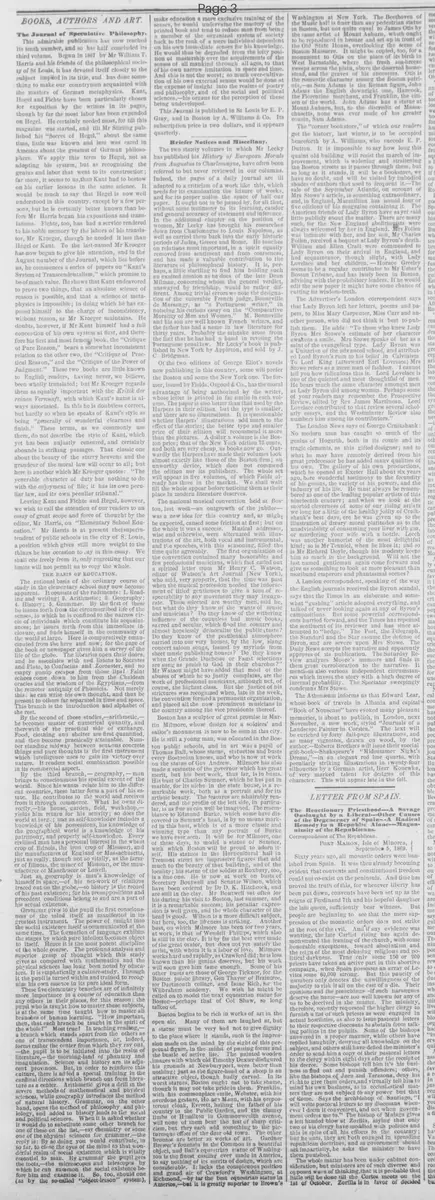
This admirable publication has now reached its tenth number, and so has half concluded its third volume. Begun in 1867 by Mr. William T. Harris and his friends of the philosophical society of St. Louis, it has devoted itself closely to the subject implied in its title, and has done something to make our countrymen acquainted with the masters of German metaphysics. Kant, Hegel and Fichte have been particularly chosen for exposition by the writers in its pages, though by far the most labor has been expended on Hegel. It certainly needed most, for till this magazine was started, and till Mr. Stirling published his "Secret of Hegel," about the same time, little was known and less was cared in America about the greatest of German philosophers. We apply this term to Hegel, not as adopting his system, but as recognizing the genius and labor that went to its construction; far more, it seems to us, than Kant had to bestow on his earlier lessons in the same science. It would be much to say that Hegel is now well understood in this country, except by a few persons, but he is certainly better known than before Mr. Harris began his expositions and translations. Fichte, too, has had a service rendered to his noble memory by the labors of his translator, Mr. Kroeger, though he needed it less than Hegel or Kant. To the last-named Mr. Kroeger has now begun to give his attention, and in the August number of the Journal, which lies before us, he commences a series of papers on "Kant's System of Transcendentalism," which promise to be of much value. He shows that Kant endeavored to prove two things, that an absolute science of reason is possible, and that a science of metaphysics is impossible; in doing which he has exposed himself to the charge of inconsistency, without reason, as Mr. Kroeger maintains. He doubts, however, if Mr. Kant himself had a full conception of his own system at first, and therefore his first and most famous book, the "Critique of Pure Reason," bears a somewhat inconsistent relation to the other two, the "Critique of Practical Reason," and the "Critique of the Power of Judgment." These two books are little known to English readers, having never, we believe, been wholly translated; but Mr. Kroeger regards them as equally important with the Kritik der reinen Vernunft, with which Kant's name is always associated. In this he is doubtless correct, but hardly so when he speaks of Kant's style as being "generally of wonderful clearness and finish." These terms, as we commonly use them, do not describe the style of Kant, which yet has been unjustly censured, and certainly abounds in striking passages. That classic one about the beauty of the starry heavens and the grandeur of the moral law will occur to all; but here is another which Mr. Kroeger quotes: "The venerable character of duty has nothing to do with the enjoyment of life; it has its own peculiar law, and its own peculiar tribunal."
Leaving Kant and Fichte and Hegel, however, we wish to call the attention of our readers to an essay of great scope and force of thought by the editor, Mr. Harris, on "Elementary School Education." Mr. Harris is at present the superintendent of public schools in the city of St. Louis, a position which gives still more weight to the things he has occasion to say in this essay. We shall cite freely from it, only regretting that our limits will not permit us to copy the whole.
THE BASIS OF EDUCATION.
The rational basis of the ordinary course of study in the elementary school may now become apparent. It consists of the rudiments: 1. Reading and writing; 2. Arithmetic; 3. Geography; 4. History; 5. Grammar. By the first of these he issues forth from the circumscribed life of the senses, in which he is confined to the narrow circle of individuals which constitute his acquaintances; he issues forth from this immediate inclosure, and finds himself in the community of the world at large. Here he is comparatively emancipated from the here and now; for the page of the book or newspaper gives him a survey of the life of the globe. The libraries open their doors, and he associates with and listens to Socrates and Plato, to Confucius and Zoroaster, and no empty gossip escapes from those lips! Faint echoes come down to him from the Chaldean oracles and the wisdom of the Egyptians,—from the remoter antiquity of Phænicia. Not merely this: he can write his own thought, and thus be present to others far separated in time and space. This branch is the introduction and alphabet of the rest.
By the second of these studies,—arithmetic,—he becomes master of numerical quantity, and therewith of the practical side of exchange. Food, clothing and shelter are first quantified, and then become practically attainable. Number standing midway between sensuous concrete things and pure thoughts is the first instrument which intelligence uses to gain its victory over nature. It renders social combination possible in its commercial aspect.
By the third branch,—geography,—man brings to consciousness his spatial extent of the world. Since his wants relate him to the different countries, these latter form a part of his estate. He contributes to the world and receives from it through commerce. What he owns directly,—his house, garden, field, workshop,—yields him return for his activity: so does the world at large; and as self-knowledge includes a knowledge of his possessions, his knowledge of the geographical world is a knowledge of his patrimony, and properly self-knowledge. Every civilized man has a personal interest in the wheat crop of Illinois, the iron crop of Missouri, and the manufactures of England or Massachusetts, just as really, though not so vitally, as the farmer of Illinois, the miner of Missouri, or the manufacturer of Manchester or Lowell.
Just as geography is man's knowledge of himself in space,—of his net-work of relations traced out on the globe,—so history is the record of his past existence; for his presuppositions and precedent conditions belong to and are a part of his actual existence.
Grammar gives to the pupil the first consciousness of the mind itself as manifested in its greatest instrument. The power of insight into the social existence itself is communicated at the same time. The formation of language exhibits the stages by which pure intellect becomes object to itself. Hence it is the most potent discipline of the whole course. The profound analysis and superior grasp of thought which this study gives as compared with mathematics and the physical sciences has long been noted by educators. It is emphatically a culture-study. Through it the pupil is turned within and trained to recognize his own essence in its pure ideal form.
These five elementary branches are of infinitely more importance in a course of education than any others in their places, for this reason: the pupil who is taught how to master these subjects, is at the same time taught how to master all branches of human learning. "How important, then, that each branch be taught in the spirit of the whole!" Most true! In teaching reading,—a branch which stands apart from the others as one of transcendent importance, or, indeed, forms rather the center from which they ray out,—the pupil is to be initiated into the realm of literature,—the morning-land of phantasy and imagination. Science and history are its adjacent provinces. But, in order to reinforce this culture, there is added a special training in the cardinal directions which branch out from literature as a center. Arithmetic gives a drill in the severe methods of mathematical and physical sciences, while geography introduces the method of natural history. Grammar, on the other hand, opens the method of philosophy and philology, and added to history leads to the social and political sciences. When it is asked whether it would do to substitute some other branch for one of these on the list,—say chemistry or some one of the physical sciences for grammar,—the reply is: By so doing you would contribute, in so far, to close the eyes of the mind to that wonderful realm of social existence which is vitally essential to man. By grammar the pupil gets the tools, the microscopes and telescopes by which he can summon the social existence before him and examine it. So, too, should one (as by the so-called "object-lesson" system),
make education a more exclusive training of the senses, he would undervalue the mastery of the printed book and tend to reduce man from being a member of the organized system of society back to the rank of a mere individual dependent on his own immediate senses for his knowledge. He would thus be degraded from the lofty position of mastership over the acquirement of the senses of all mankind through all ages, to that of his own narrow limitation in space and time. And this is not the worst; so much over-cultivation of his own external senses would be done at the expense of insight into the realms of poetry and philosophy, and of the social and political sciences, his organs for the perception of these being undeveloped.
This Journal is published in St. Louis by E. P. Gray, and in Boston by A. Williams & Co. Its subscription price is two dollars, and it appears quarterly.
Briefer Notices and Miscellany.
The two stately volumes in which Mr. Lecky has published his History of European Morals from Augustus to Charlemagne, have often been referred to but never reviewed in our columns. Indeed, the pages of a daily journal are ill adapted to a criticism of a work like this, which needs for its examination the leisure of weeks, and for its proper notice the space of half our paper. It ought not to be passed by, for all that, without some testimony to its learning, candor and general accuracy of statement and inference. In the additional chapter on the position of women, Mr. Lecky has brought his researches down from Charlemagne to Louis Napoleon, as well as carried them back into the early historic periods of Judea, Greece and Rome. He touches on relations most important, in a spirit equally removed from sentiment and from coarseness, and has made a valuable contribution to the literature of philosophical history. It is, perhaps, a little startling to find him holding such an exalted opinion as he does of the late Dean Milman, concerning whom the general verdict, unswayed by friendship, would be rather different. Among trivial errors we note the designation of the venerable French judge, Bonneville de Marsangy, as "a Portuguese writer," in noticing his curious essay on the "Comparative Morality of Men and Women." M. Bonneville and his son are well known French writers, and the father has had a name in law literature for thirty years. Probably the mistake arose from the fact that he has had a hand in revising the Portuguese penal law. Mr. Lecky's book is published in New York by Appleton, and sold by J. C. Bridgman.
Of the two editions of George Eliot's novels now publishing in this country, some will prefer the Boston and some the New York one. The former, issued by Fields, Osgood & Co., has the moral advantage of being authorized by the writer, whose letter is printed in fac simile in each volume. The paper is also better than that used by the Harpers in their edition, but the type is smaller, and there are no illustrations. It is questionable whether Harpers' illustrations add much to the effect of the stories; the better type and smaller price of their edition will recommend it more than the pictures. A dollar a volume is the Boston price; that of the New York edition 75 cents, and both are very cheap, as books now go. Outwardly the Harpers have made their volumes look almost exactly like those of the Boston firm; an unworthy device, which does not commend the edition nor its publishers. The whole set will appear in five volumes, of which Fields already has three in the market. We shall wait till the whole appear before noticing them as their place in modern literature deserves.
The national musical convention held at Boston, last week—an outgrowth of the jubilee—was a new idea for this country and, as might be expected, caused some friction at first; but on the whole it was a success. Musical addresses, wise and otherwise, were alternated with illustrations of the art, both vocal and instrumental, and the speeches, with this seasoning, filled the time quite agreeably. The first organization of the convention contained many honorables and few professional musicians, which fact called out a spirited letter from Mr. Henry C. Watson, editor of Watson's Art Journal (New York), who said, very properly, that the time was past when the musical profession needed the indorsement of titled gentlemen to give a tone of respectability to any movement they may inaugurate. Those selected are worthy men, said he, but what do they know of the wants of music and musicians? Do they know of the withering influence of the countless bad music books, sacred and secular, which flood the country and almost hopelessly demoralize the public taste? Do they know of the pestilential atmosphere carried into our very homes, by the low, slang concert saloon songs, issued by myriads from sheet music publishing houses? Do they know when the Grande Duchesse or Faust selections are sung as praise to God in their churches? Mr. Watson might have added that most of the abuses of which he so justly complains, are the work of professional musicians, although not, of course, the highest class. But the justice of his strictures was recognized when, late in the week, the convention formed a permanent organization, and placed all the now prominent musicians in the country among the vice presidents thereof.
Boston has a sculptor of great promise in Martin Milmore, whose design for a soldiers' and sailors' monument is now to be seen in this city. He is still a young man, was educated in the Boston public schools, and in art was a pupil of Thomas Ball, whose statue, statuettes and busts every Bostonian knows, and who is now at work on the statue of Gov. Andrew. Milmore has also made a statuette of the governor which has great merit, but his best work, thus far, is in busts. His bust of Charles Sumner, which he has put in marble, for its niche in the state house, is a remarkable work, both as a portrait and for its artistic beauty. The features are admirably rendered, and the profile of the left side, in particular, is as fine as can well be imagined. The resemblance to Edmund Burke, which some have discovered in Sumner's head, is by no means marked in this bust, which is of a more classic and winning type than any portrait of Burke we have ever seen. It will be for Milmore, one of these days, to model a statue of Sumner, with which Boston will be proud to adorn itself. His statues in the Horticultural hall in Tremont street are impressive figures that add much to the beauty of that building, and of the locality: his statue of the soldier at Roxbury, too, is a fine one. He is now at work on busts of Secretary Boutwell and Senator Wilson, which have been ordered by Dr. D. K. Hitchcock, and are still in the clay. Mr. Boutwell sat often for his during his visit to Boston, last summer, and it is a remarkable success; his peculiar expression is well given, and the whole character of the head is good. Wilson is a more difficult subject, but here, too, the likeness is striking. Another bust, on which Milmore has been at work for two years, is that of Wendell Phillips, which also is still in the clay. It is by far the best ever made of the great orator, but does not yet satisfy the artist, with whom it is a labor of love. Milmore works hard and rapidly, as Crawford did; he is less known than his genius deserves, but his work will soon give him fame enough. Some of his other busts are those of George Ticknor, for the Boston public library, Gen. Thayer of Braintree, for Dartmouth college, and Isaac Rich, for the Wilbraham academy. We wish he might be called on to model the next equestrian statue for Boston—perhaps that of Col. Shaw, so long talked of.
Boston begins to be rich in works of art in the open air. Many of them are laughed at, but a statue must be very bad not to give dignity to the place where it stands, such is the impression made on the mind by the sight of this perpetual figure, in the midst of passing forms and the bustle of active life. The painted wooden images with which old Timothy Dexter disfigured his grounds at Newburyport, were better than nothing; just as the figure-head of a sheep is an attractive object, though badly carved. In its worst statues, Boston ought not to take shame, though it may not take pride in them. Franklin, with his commonplace smile, Webster, with his overdone gesture, Horace Mann, with his preposterous cloak, Everett, hailing the father of his country in the Public Garden, and the clumsy limbs of Hamilton in Commonwealth avenue, will none of them bear the test of sharp criticism, but they each add something to the picturesque effect of the dear old town. The other bronzes are better as works of art. Gardner Brewer's fountain in the Common is a beautiful object, and Ball's equestrian statue of Washington is the finest casting ever made in America, to say nothing of its merits of design, which are considerable. It lacks the conspicuous position and grand air of Crawford's Washington, at Richmond,—by far the best equestrian statue in America,—but it is greatly superior to Brown's Washington at New York.
The Beethoven of the Music Hall is finer than any pedestrian statue in Boston, but not quite equal to James Otis by the same artist at Mount Auburn, which ought to be reproduced in bronze and set up in front of the Old State House, overlooking the scene of Boston Massacre. It might be copied, too, for a monument to Otis on the place of its birth in West Barnstable, where the fresh sea-breeze sweeps across the plain, above the deserted homestead, and the graves of his ancestors. Otis is the romantic character among the Boston patriots, as Sam Adams is the Roman figure, John Adams the English downright one, Hancock, the Florentine merchant, and Franklin, the citizen of the world. John Adams has a statue at Mount Auburn, but, to the discredit of Massachusetts, none was ever made of his greater cousin, Sam Adams.
The "corner bookstore," of which our readers got the history, last winter, is to be occupied henceforth by A. Williams, who succeeds E. P. Dutton. It is impossible to say how long this quaint old building will resist the march of improvement, which is widening and straightening the Boston streets as it passes through them, but so long as it stands, it will be a bookstore, we have no doubt, and will be visited by embodied shades of authors that used to frequent it. The sale of the September Atlantic, on account of Mrs. Stowe's article, is something extraordinary, and, in England, Macmillan has issued four or five editions of his magazine containing it. The American friends of Lady Byron have as yet said little publicly about the matter. There are many such, for the New England abolitionists were always welcomed by her in England. Mrs. Follen was intimate with her, and her son, Mr. Charles Follen, received a bequest at Lady Byron's death. William and Ellen Craft were commended to Lady Byron on their arrival in England, and had acquaintance, though slight, with Lady Lovelace and her children. Horace Greeley seems to be a regular contributor to Mr. Usher's Boston Tribune, and has lately been in Boston advising with the prohibitory leaders. If he would edit the new paper it might have some chance of cutting its wisdom-teeth.
The Advertiser's London correspondent says that Lady Byron left her letters, poems and papers, to Miss Mary Carpenter, Miss Carr and another person, who did not think it best to publish them. He adds: "To those who knew Lady Byron Mrs. Stowe's estimate of her character awakens a smile. Mrs. Stowe speaks of her as a saint of the evangelical type. Lady Byron was a Unitarian of the advanced school, and attributed Lord Byron's ruin to his belief in Calvinism. To Lord King (afterward Earl Lovelace) Mrs. Stowe refers as a mere man of fashion. I cannot tell you how ridiculous this is. Lord Lovelace is one of the quietest and most thoughtful of men. He bears much the same character amongst men as Lady Byron did among women. Perhaps some of your readers may remember the Prospective Review, edited by Rev. James Martineau. Lord Lovelace contributed to that review several scholarly essays, and the Westminster Review also numbers him among its contributors."
The London News says of George Cruikshank: No modern man has caught so much of the genius of Hogarth, both in its comic and its tragic elements, as this gifted designer; and to what he may have remotely derived from his great predecessor he has added many qualities of his own. The gallery of his own productions, which he opened at Exeter Hall about six years ago, bore wonderful testimony to the fecundity of his genius, the variety of his powers, and the industry of his life. He must always be remembered as one of the leading popular artists of this nineteenth century; and when we look at the morbid cleverness of some of our rising artists we long for a little of the healthy jollity of Cruikshank's best days, ere he was given up to the illustration of dreary moral platitudes as to the unadvisability of consuming your liver with gin, or murdering your wife with a bottle. Leech was another humorist of the most delightful kind; so is Mr. Tenniel, when he likes it; and so is Mr. Richard Doyle, though his modesty keeps him so much in the background. Will not the last named gentleman again come forward and give us something to look at more pleasant than moribund emperors and phantasmal scenes?
A London correspondent, speaking of the way the English journals received the Byron scandal, says that the Times in an elaborate and somewhat "gushing" article adopted everything, and talked of never looking again at any of Byron's compositions. But some powerful correspondents hurried forward, and the Times has repented the sentiment of its reviewer and has since attempted to "hedge." The Post, the Telegraph, the Standard and the Star assume the defense of Byron, and are severe upon Mrs. Stowe. The Daily News accepts the narrative and apparently approves of its publication. The Saturday Review analyzes Moore's memoirs and finds in them great corroboration to the narrative. It mentions also various independent circumstances which invest the story with a high degree of internal probability. The Spectator sweepingly condemns Mrs. Stowe.
The Athenaeum informs us that Edward Lear, whose book of travels in Albania and capital "Book of Nonsense" have evoked many pleasant memories, is about to publish, in London, next November, a new work, styled "Journals of a Landscape Painter in Corsica." The text will be enriched by forty full-page illustrations, and as many vignettes, drawn on wood, by the author.—Roberts Brothers will issue their special gift-book—Shakspeare's "Midsummer Night's Dream,"—in an elegant red line quarto, with peculiarly striking illustrations in twenty-four silhouettes by a German artist, Herr Konewka, of very marked talent for designs of this character. This will appear late in the fall.
The Journal of Speculative Philosophy
This admirable publication has now reached its tenth number, and so has half concluded its third volume. Begun in 1867 by Mr. William T. Harris and his friends of the philosophical society of St. Louis, it has devoted itself closely to the subject implied in its title, and has done something to make our countrymen acquainted with the masters of German metaphysics. Kant, Hegel and Fichte have been particularly chosen for exposition by the writers in its pages, though by far the most labor has been expended on Hegel. It certainly needed most, for till this magazine was started, and till Mr. Stirling published his "Secret of Hegel," about the same time, little was known and less was cared in America about the greatest of German philosophers. We apply this term to Hegel, not as adopting his system, but as recognizing the genius and labor that went to its construction; far more, it seems to us, than Kant had to bestow on his earlier lessons in the same science. It would be much to say that Hegel is now well understood in this country, except by a few persons, but he is certainly better known than before Mr. Harris began his expositions and translations. Fichte, too, has had a service rendered to his noble memory by the labors of his translator, Mr. Kroeger, though he needed it less than Hegel or Kant. To the last-named Mr. Kroeger has now begun to give his attention, and in the August number of the Journal, which lies before us, he commences a series of papers on "Kant's System of Transcendentalism," which promise to be of much value. He shows that Kant endeavored to prove two things, that an absolute science of reason is possible, and that a science of metaphysics is impossible; in doing which he has exposed himself to the charge of inconsistency, without reason, as Mr. Kroeger maintains. He doubts, however, if Mr. Kant himself had a full conception of his own system at first, and therefore his first and most famous book, the "Critique of Pure Reason," bears a somewhat inconsistent relation to the other two, the "Critique of Practical Reason," and the "Critique of the Power of Judgment." These two books are little known to English readers, having never, we believe, been wholly translated; but Mr. Kroeger regards them as equally important with the Kritik der reinen Vernunft, with which Kant's name is always associated. In this he is doubtless correct, but hardly so when he speaks of Kant's style as being "generally of wonderful clearness and finish." These terms, as we commonly use them, do not describe the style of Kant, which yet has been unjustly censured, and certainly abounds in striking passages. That classic one about the beauty of the starry heavens and the grandeur of the moral law will occur to all; but here is another which Mr. Kroeger quotes: "The venerable character of duty has nothing to do with the enjoyment of life; it has its own peculiar law, and its own peculiar tribunal."
Leaving Kant and Fichte and Hegel, however, we wish to call the attention of our readers to an essay of great scope and force of thought by the editor, Mr. Harris, on "Elementary School Education." Mr. Harris is at present the superintendent of public schools in the city of St. Louis, a position which gives still more weight to the things he has occasion to say in this essay. We shall cite freely from it, only regretting that our limits will not permit us to copy the whole.
THE BASIS OF EDUCATION.
The rational basis of the ordinary course of study in the elementary school may now become apparent. It consists of the rudiments: 1. Reading and writing; 2. Arithmetic; 3. Geography; 4. History; 5. Grammar. By the first of these he issues forth from the circumscribed life of the senses, in which he is confined to the narrow circle of individuals which constitute his acquaintances; he issues forth from this immediate inclosure, and finds himself in the community of the world at large. Here he is comparatively emancipated from the here and now; for the page of the book or newspaper gives him a survey of the life of the globe. The libraries open their doors, and he associates with and listens to Socrates and Plato, to Confucius and Zoroaster, and no empty gossip escapes from those lips! Faint echoes come down to him from the Chaldean oracles and the wisdom of the Egyptians,—from the remoter antiquity of Phænicia. Not merely this: he can write his own thought, and thus be present to others far separated in time and space. This branch is the introduction and alphabet of the rest.
By the second of these studies,—arithmetic,—he becomes master of numerical quantity, and therewith of the practical side of exchange. Food, clothing and shelter are first quantified, and then become practically attainable. Number standing midway between sensuous concrete things and pure thoughts is the first instrument which intelligence uses to gain its victory over nature. It renders social combination possible in its commercial aspect.
By the third branch,—geography,—man brings to consciousness his spatial extent of the world. Since his wants relate him to the different countries, these latter form a part of his estate. He contributes to the world and receives from it through commerce. What he owns directly,—his house, garden, field, workshop,—yields him return for his activity: so does the world at large; and as self-knowledge includes a knowledge of his possessions, his knowledge of the geographical world is a knowledge of his patrimony, and properly self-knowledge. Every civilized man has a personal interest in the wheat crop of Illinois, the iron crop of Missouri, and the manufactures of England or Massachusetts, just as really, though not so vitally, as the farmer of Illinois, the miner of Missouri, or the manufacturer of Manchester or Lowell.
Just as geography is man's knowledge of himself in space,—of his net-work of relations traced out on the globe,—so history is the record of his past existence; for his presuppositions and precedent conditions belong to and are a part of his actual existence.
Grammar gives to the pupil the first consciousness of the mind itself as manifested in its greatest instrument. The power of insight into the social existence itself is communicated at the same time. The formation of language exhibits the stages by which pure intellect becomes object to itself. Hence it is the most potent discipline of the whole course. The profound analysis and superior grasp of thought which this study gives as compared with mathematics and the physical sciences has long been noted by educators. It is emphatically a culture-study. Through it the pupil is turned within and trained to recognize his own essence in its pure ideal form.
These five elementary branches are of infinitely more importance in a course of education than any others in their places, for this reason: the pupil who is taught how to master these subjects, is at the same time taught how to master all branches of human learning. "How important, then, that each branch be taught in the spirit of the whole!" Most true! In teaching reading,—a branch which stands apart from the others as one of transcendent importance, or, indeed, forms rather the center from which they ray out,—the pupil is to be initiated into the realm of literature,—the morning-land of phantasy and imagination. Science and history are its adjacent provinces. But, in order to reinforce this culture, there is added a special training in the cardinal directions which branch out from literature as a center. Arithmetic gives a drill in the severe methods of mathematical and physical sciences, while geography introduces the method of natural history. Grammar, on the other hand, opens the method of philosophy and philology, and added to history leads to the social and political sciences. When it is asked whether it would do to substitute some other branch for one of these on the list,—say chemistry or some one of the physical sciences for grammar,—the reply is: By so doing you would contribute, in so far, to close the eyes of the mind to that wonderful realm of social existence which is vitally essential to man. By grammar the pupil gets the tools, the microscopes and telescopes by which he can summon the social existence before him and examine it. So, too, should one (as by the so-called "object-lesson" system),
make education a more exclusive training of the senses, he would undervalue the mastery of the printed book and tend to reduce man from being a member of the organized system of society back to the rank of a mere individual dependent on his own immediate senses for his knowledge. He would thus be degraded from the lofty position of mastership over the acquirement of the senses of all mankind through all ages, to that of his own narrow limitation in space and time. And this is not the worst; so much over-cultivation of his own external senses would be done at the expense of insight into the realms of poetry and philosophy, and of the social and political sciences, his organs for the perception of these being undeveloped.
This Journal is published in St. Louis by E. P. Gray, and in Boston by A. Williams & Co. Its subscription price is two dollars, and it appears quarterly.
Briefer Notices and Miscellany.
The two stately volumes in which Mr. Lecky has published his History of European Morals from Augustus to Charlemagne, have often been referred to but never reviewed in our columns. Indeed, the pages of a daily journal are ill adapted to a criticism of a work like this, which needs for its examination the leisure of weeks, and for its proper notice the space of half our paper. It ought not to be passed by, for all that, without some testimony to its learning, candor and general accuracy of statement and inference. In the additional chapter on the position of women, Mr. Lecky has brought his researches down from Charlemagne to Louis Napoleon, as well as carried them back into the early historic periods of Judea, Greece and Rome. He touches on relations most important, in a spirit equally removed from sentiment and from coarseness, and has made a valuable contribution to the literature of philosophical history. It is, perhaps, a little startling to find him holding such an exalted opinion as he does of the late Dean Milman, concerning whom the general verdict, unswayed by friendship, would be rather different. Among trivial errors we note the designation of the venerable French judge, Bonneville de Marsangy, as "a Portuguese writer," in noticing his curious essay on the "Comparative Morality of Men and Women." M. Bonneville and his son are well known French writers, and the father has had a name in law literature for thirty years. Probably the mistake arose from the fact that he has had a hand in revising the Portuguese penal law. Mr. Lecky's book is published in New York by Appleton, and sold by J. C. Bridgman.
Of the two editions of George Eliot's novels now publishing in this country, some will prefer the Boston and some the New York one. The former, issued by Fields, Osgood & Co., has the moral advantage of being authorized by the writer, whose letter is printed in fac simile in each volume. The paper is also better than that used by the Harpers in their edition, but the type is smaller, and there are no illustrations. It is questionable whether Harpers' illustrations add much to the effect of the stories; the better type and smaller price of their edition will recommend it more than the pictures. A dollar a volume is the Boston price; that of the New York edition 75 cents, and both are very cheap, as books now go. Outwardly the Harpers have made their volumes look almost exactly like those of the Boston firm; an unworthy device, which does not commend the edition nor its publishers. The whole set will appear in five volumes, of which Fields already has three in the market. We shall wait till the whole appear before noticing them as their place in modern literature deserves.
The national musical convention held at Boston, last week—an outgrowth of the jubilee—was a new idea for this country and, as might be expected, caused some friction at first; but on the whole it was a success. Musical addresses, wise and otherwise, were alternated with illustrations of the art, both vocal and instrumental, and the speeches, with this seasoning, filled the time quite agreeably. The first organization of the convention contained many honorables and few professional musicians, which fact called out a spirited letter from Mr. Henry C. Watson, editor of Watson's Art Journal (New York), who said, very properly, that the time was past when the musical profession needed the indorsement of titled gentlemen to give a tone of respectability to any movement they may inaugurate. Those selected are worthy men, said he, but what do they know of the wants of music and musicians? Do they know of the withering influence of the countless bad music books, sacred and secular, which flood the country and almost hopelessly demoralize the public taste? Do they know of the pestilential atmosphere carried into our very homes, by the low, slang concert saloon songs, issued by myriads from sheet music publishing houses? Do they know when the Grande Duchesse or Faust selections are sung as praise to God in their churches? Mr. Watson might have added that most of the abuses of which he so justly complains, are the work of professional musicians, although not, of course, the highest class. But the justice of his strictures was recognized when, late in the week, the convention formed a permanent organization, and placed all the now prominent musicians in the country among the vice presidents thereof.
Boston has a sculptor of great promise in Martin Milmore, whose design for a soldiers' and sailors' monument is now to be seen in this city. He is still a young man, was educated in the Boston public schools, and in art was a pupil of Thomas Ball, whose statue, statuettes and busts every Bostonian knows, and who is now at work on the statue of Gov. Andrew. Milmore has also made a statuette of the governor which has great merit, but his best work, thus far, is in busts. His bust of Charles Sumner, which he has put in marble, for its niche in the state house, is a remarkable work, both as a portrait and for its artistic beauty. The features are admirably rendered, and the profile of the left side, in particular, is as fine as can well be imagined. The resemblance to Edmund Burke, which some have discovered in Sumner's head, is by no means marked in this bust, which is of a more classic and winning type than any portrait of Burke we have ever seen. It will be for Milmore, one of these days, to model a statue of Sumner, with which Boston will be proud to adorn itself. His statues in the Horticultural hall in Tremont street are impressive figures that add much to the beauty of that building, and of the locality: his statue of the soldier at Roxbury, too, is a fine one. He is now at work on busts of Secretary Boutwell and Senator Wilson, which have been ordered by Dr. D. K. Hitchcock, and are still in the clay. Mr. Boutwell sat often for his during his visit to Boston, last summer, and it is a remarkable success; his peculiar expression is well given, and the whole character of the head is good. Wilson is a more difficult subject, but here, too, the likeness is striking. Another bust, on which Milmore has been at work for two years, is that of Wendell Phillips, which also is still in the clay. It is by far the best ever made of the great orator, but does not yet satisfy the artist, with whom it is a labor of love. Milmore works hard and rapidly, as Crawford did; he is less known than his genius deserves, but his work will soon give him fame enough. Some of his other busts are those of George Ticknor, for the Boston public library, Gen. Thayer of Braintree, for Dartmouth college, and Isaac Rich, for the Wilbraham academy. We wish he might be called on to model the next equestrian statue for Boston—perhaps that of Col. Shaw, so long talked of.
Boston begins to be rich in works of art in the open air. Many of them are laughed at, but a statue must be very bad not to give dignity to the place where it stands, such is the impression made on the mind by the sight of this perpetual figure, in the midst of passing forms and the bustle of active life. The painted wooden images with which old Timothy Dexter disfigured his grounds at Newburyport, were better than nothing; just as the figure-head of a sheep is an attractive object, though badly carved. In its worst statues, Boston ought not to take shame, though it may not take pride in them. Franklin, with his commonplace smile, Webster, with his overdone gesture, Horace Mann, with his preposterous cloak, Everett, hailing the father of his country in the Public Garden, and the clumsy limbs of Hamilton in Commonwealth avenue, will none of them bear the test of sharp criticism, but they each add something to the picturesque effect of the dear old town. The other bronzes are better as works of art. Gardner Brewer's fountain in the Common is a beautiful object, and Ball's equestrian statue of Washington is the finest casting ever made in America, to say nothing of its merits of design, which are considerable. It lacks the conspicuous position and grand air of Crawford's Washington, at Richmond,—by far the best equestrian statue in America,—but it is greatly superior to Brown's Washington at New York.
The Beethoven of the Music Hall is finer than any pedestrian statue in Boston, but not quite equal to James Otis by the same artist at Mount Auburn, which ought to be reproduced in bronze and set up in front of the Old State House, overlooking the scene of Boston Massacre. It might be copied, too, for a monument to Otis on the place of its birth in West Barnstable, where the fresh sea-breeze sweeps across the plain, above the deserted homestead, and the graves of his ancestors. Otis is the romantic character among the Boston patriots, as Sam Adams is the Roman figure, John Adams the English downright one, Hancock, the Florentine merchant, and Franklin, the citizen of the world. John Adams has a statue at Mount Auburn, but, to the discredit of Massachusetts, none was ever made of his greater cousin, Sam Adams.
The "corner bookstore," of which our readers got the history, last winter, is to be occupied henceforth by A. Williams, who succeeds E. P. Dutton. It is impossible to say how long this quaint old building will resist the march of improvement, which is widening and straightening the Boston streets as it passes through them, but so long as it stands, it will be a bookstore, we have no doubt, and will be visited by embodied shades of authors that used to frequent it. The sale of the September Atlantic, on account of Mrs. Stowe's article, is something extraordinary, and, in England, Macmillan has issued four or five editions of his magazine containing it. The American friends of Lady Byron have as yet said little publicly about the matter. There are many such, for the New England abolitionists were always welcomed by her in England. Mrs. Follen was intimate with her, and her son, Mr. Charles Follen, received a bequest at Lady Byron's death. William and Ellen Craft were commended to Lady Byron on their arrival in England, and had acquaintance, though slight, with Lady Lovelace and her children. Horace Greeley seems to be a regular contributor to Mr. Usher's Boston Tribune, and has lately been in Boston advising with the prohibitory leaders. If he would edit the new paper it might have some chance of cutting its wisdom-teeth.
The Advertiser's London correspondent says that Lady Byron left her letters, poems and papers, to Miss Mary Carpenter, Miss Carr and another person, who did not think it best to publish them. He adds: "To those who knew Lady Byron Mrs. Stowe's estimate of her character awakens a smile. Mrs. Stowe speaks of her as a saint of the evangelical type. Lady Byron was a Unitarian of the advanced school, and attributed Lord Byron's ruin to his belief in Calvinism. To Lord King (afterward Earl Lovelace) Mrs. Stowe refers as a mere man of fashion. I cannot tell you how ridiculous this is. Lord Lovelace is one of the quietest and most thoughtful of men. He bears much the same character amongst men as Lady Byron did among women. Perhaps some of your readers may remember the Prospective Review, edited by Rev. James Martineau. Lord Lovelace contributed to that review several scholarly essays, and the Westminster Review also numbers him among its contributors."
The London News says of George Cruikshank: No modern man has caught so much of the genius of Hogarth, both in its comic and its tragic elements, as this gifted designer; and to what he may have remotely derived from his great predecessor he has added many qualities of his own. The gallery of his own productions, which he opened at Exeter Hall about six years ago, bore wonderful testimony to the fecundity of his genius, the variety of his powers, and the industry of his life. He must always be remembered as one of the leading popular artists of this nineteenth century; and when we look at the morbid cleverness of some of our rising artists we long for a little of the healthy jollity of Cruikshank's best days, ere he was given up to the illustration of dreary moral platitudes as to the unadvisability of consuming your liver with gin, or murdering your wife with a bottle. Leech was another humorist of the most delightful kind; so is Mr. Tenniel, when he likes it; and so is Mr. Richard Doyle, though his modesty keeps him so much in the background. Will not the last named gentleman again come forward and give us something to look at more pleasant than moribund emperors and phantasmal scenes?
A London correspondent, speaking of the way the English journals received the Byron scandal, says that the Times in an elaborate and somewhat "gushing" article adopted everything, and talked of never looking again at any of Byron's compositions. But some powerful correspondents hurried forward, and the Times has repented the sentiment of its reviewer and has since attempted to "hedge." The Post, the Telegraph, the Standard and the Star assume the defense of Byron, and are severe upon Mrs. Stowe. The Daily News accepts the narrative and apparently approves of its publication. The Saturday Review analyzes Moore's memoirs and finds in them great corroboration to the narrative. It mentions also various independent circumstances which invest the story with a high degree of internal probability. The Spectator sweepingly condemns Mrs. Stowe.
The Athenaeum informs us that Edward Lear, whose book of travels in Albania and capital "Book of Nonsense" have evoked many pleasant memories, is about to publish, in London, next November, a new work, styled "Journals of a Landscape Painter in Corsica." The text will be enriched by forty full-page illustrations, and as many vignettes, drawn on wood, by the author.—Roberts Brothers will issue their special gift-book—Shakspeare's "Midsummer Night's Dream,"—in an elegant red line quarto, with peculiarly striking illustrations in twenty-four silhouettes by a German artist, Herr Konewka, of very marked talent for designs of this character. This will appear late in the fall.
What sub-type of article is it?
Essay
What themes does it cover?
Political
Moral Virtue
Social Manners
What keywords are associated?
Elementary Education
Reading Writing
Arithmetic
Geography
History
Grammar
Social Existence
Self Knowledge
What entities or persons were involved?
Mr. Harris
Literary Details
Title
The Basis Of Education
Author
Mr. Harris
Subject
Elementary School Education
Form / Style
Philosophical Prose On The Rudiments Of Education
Key Lines
The Rational Basis Of The Ordinary Course Of Study In The Elementary School May Now Become Apparent. It Consists Of The Rudiments: 1. Reading And Writing; 2. Arithmetic; 3. Geography; 4. History; 5. Grammar.
By The First Of These He Issues Forth From The Circumscribed Life Of The Senses... This Branch Is The Introduction And Alphabet Of The Rest.
Grammar Gives To The Pupil The First Consciousness Of The Mind Itself As Manifested In Its Greatest Instrument... It Is Emphatically A Culture Study.