Thank you for visiting SNEWPapers!
Sign up free
Editorial
October 7, 1814
Daily National Intelligencer
Washington, District Of Columbia
What is this article about?
This editorial criticizes British violations of the Law of Nations during the War of 1812, citing atrocities like burning Washington and using Native allies, contrasts with civilized warfare under figures like Bonaparte, and urges American retaliation, military preparation, and predicts Britain's decline.
Clipping
OCR Quality
95%
Excellent
Full Text
FOR THE NATIONAL INTELLIGENCER.
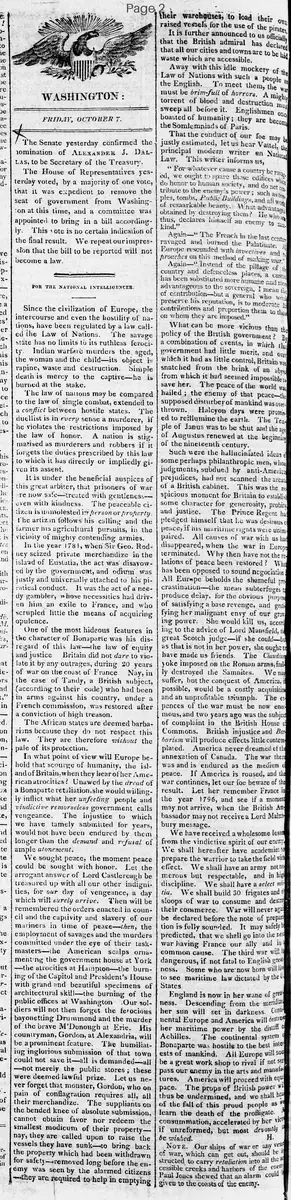
Since the civilization of Europe, the intercourse and even the hostility of nations, have been regulated by a law called the Law of Nations. The savage state has no limits to its ruthless ferocity. Indian warfare murders the aged, the woman and the child--its object is rapine, waste and destruction. Simple death is mercy to the captive-he is burned at the stake.
The law of nations may be compared to the law of single combat, extended to a conflict between hostile states. The duellist is in every sense a murderer, if he violates the restrictions imposed by the law of honor. A nation is stigmatised as murderers and robbers if it forgets the duties prescribed by this law to which it has directly or impliedly given its assent.
It is under the beneficial auspices of this great arbiter, that prisoners of war are now safe--treated with gentleness-- even with kindness. The peaceable citizen is unmolested in person or property. The artizan follows his calling and the farmer his agricultural pursuits, in the vicinity of mighty contending armies.
In the year 1781, when Sir Geo. Rodney seized private merchandize in the island of Eustatia, the act was disavowed by the government, and odium was justly and universally attached to his piratical conduct. It was the act of a needy gambler, whose necessities had driven him an exile to France, and who scrupled little the means of acquiring opulence.
One of the most hideous features in the character of Bonaparte was his disregard of this law-the law of equity and justice. Britain did not dare to violate it by any outrages, during 20 years of war on the coast of France. Nay, in the case of Tandy, a British subject, (according to their code) who had been in arms against his country, under a French commission, was restored after a conviction of high treason.
The African states are deemed barbarians because they do not respect this law. They are therefore without the pale of its protection.
In what point of view will Europe behold that scourge of humanity, the island of Britain, when they hear of her American atrocities? Unawed by the dread of a Bonaparte retaliation, she would willingly inflict what her unfeeling people and vindictive remorseless government calls vengeance. The injustice to which we have tamely submitted for years, would not have been endured by them longer than the demand and refusal of ample atonement.
We sought peace, the moment peace could be sought with honor. Let the arrogant answer of Lord Castlereagh be treasured up with all our other indignities, for our day of vengeance, a day which will surely arrive. Then will be remembered the orders enacted in council and the captivity and slavery of our mariners in time of peace--then, the employment of savages and the murders committed under the eye of their task-masters--the American scalps ornamenting the government house at York --the atrocities at Hampton--the burning of the Capitol and President's House with grand and beautiful specimens of architectural skill--the burning of the public offices at Washington Our soldiers will not then forget the ferocious bayonetting Drummond and the murder of the brave M'Donough at Erie. His countryman, Gordon, at Alexandria, will be a prominent feature. The humiliating inglorious submission of that town could not save it---all is demanded--all --not merely the public stores; these were deemed lawful prize. Let us never forget that monster, Gordon, who on pain of conflagration requires all, all their merchandize. The suppliants on the bended knee of absolute submission, cannot obtain favor nor redeem the smallest modicum of their property-- nay, they are called upon to raise the vessels they have sunk to bring back the property which had been withdrawn for safety-+removed long before the enemy was seen by the alarmed citizens they are required to help in emptying their warehouses, to load their own raised vessels for the use of the pirates
It is further announced to us officially that the British admiral has declared that all our cities and towns are to be laid waste which are accessible.
Away with this idle mockery of the Law of Nations with such a people as the English. To meet them, the war must be brim-full of horrors. A mighty torrent of blood and destruction must sweep all before it. Englishmen once boasted of humanity; they are become the Solemnniads of Paris.
That the conduct of our foe may be justly estimated, let us hear Vattel, the principal modern writer on National Law. This writer informs us, "For whatever cause a country be ravaged. we ought to spare those edifices which do honor to human society, and do not contribute to the enemy's power; such as temples, tombs, Public Buildings, and all works of remarkable beauty. What advantage obtained by destroying them? He who acts thus, declares himself an enemy to mankind."
Again-" The French in the last century ravaged and burned the Palatinate. All Europe resounded with invectives and reproaches on this method of making war."
Again--" Instead of the pillage of the country and defenceless places, a custom has been substituted more humane and more advantageous to the sovereign, I mean that of contribution-but a general who would preserve his reputation, is to moderate his contributions and proportion them to those on whom they are imposed."
What can be more vicious than the policy of the British government? By a combination of events, in which that government had little merit, and over which it had as little control, Britain was snatched from the brink of an abyss from which it had seemed impossible to save her. The peace of the world was hailed; the enemy of that peace-the supposed disturber of mankind was overthrown. Halcyon days were promised to reillumine the earth. The Temple of Janus was to be shut and the age of Augustus renewed at the beginning of the nineteenth century.
Such were the hallucinated ideas some perhaps philanthropic men, whose judgments, subdued by anti-American prejudices, had not scanned the arcana of a British cabinet. This was the auspicious moment for Britain to establish some character for generosity, probity and justice. The Prince Regent had pledged himself that he was desirous of peace, if his maritime rights were unimpaired. All causes of war with us had disappeared, when the war in Europe terminated. Why then have not the relations of peace been restored? What has been opposed to sound negotiation All Europe beholds the shameful procrastination--the mean subterfuges to produce delay, for the obvious purpose of satisfying a base revenge, and gratifying her malignant envy of our growing power. She would kill us, according to the advice of Lord Mansfield, the great Scotch judge--if she could but as that is not in her power, she ought to have made us friends. The Claudian yoke imposed on the Roman arms, finally destroyed the Samnites. We may suffer, but the conquest of America, if possible, would be a costly acquisition and an unprofitable triumph. The expenses of the war must be now enormous, and two years ago was the subject of complaint in the British House of Commons. British injustice and Barbarism will produce effects little contemplated. America never dreamed of the annexation of Canada. The war then was and is endured as the medium of peace. If America is roused, and the war continues, let our foe beware of the result. Let her remember France in the year 1793, and see if a moment may not arrive, when the British Ambassador may not receive a Lord Malmesbury message.
We have received a wholesome lesson from the vindictive spirit of our enemy We shall hereafter have academies to prepare the warrior to take the field with effect. We shall have an army not numerous but respectable, and in high discipline. We shall have a select militia. We shall build 30 frigates and 6 sloops of war to consume and destroy their commerce. War will never again be declared before the note of preparation is fully sounded. It may safely be predicted, that we shall go into the next war having France our ally and in common cause. The third war will be dangerous, if not fatal to English greatness. Some who are now born will live to see maritime law dictated by the United States
England is now in her wane of greatness. Descending from the meridian her sun will set in darkness. Continental Europe and America will destroy her maritime power by the distaff of Achilles. The continental system Bonaparte was hostile to the best interests of mankind. All Europe will soon be a great work shop to rival if not surpass our enemy in the arts and manufactures. America will proceed with equal pace. The props of British power will thus be undermined, and we shall hear of the fall of this proud people as we learn the death of the profligate. consummation, accelerated by her vices if unreformed, but most devoutly be wished.
H.
Note. Our ships of war or any vessels of war, which can get out, should be instructed to carry retaliation into all the accessible creeks and harbors of the enemy. Paul Jones shewed that an alarm could given to the coasts of the enemy.
Since the civilization of Europe, the intercourse and even the hostility of nations, have been regulated by a law called the Law of Nations. The savage state has no limits to its ruthless ferocity. Indian warfare murders the aged, the woman and the child--its object is rapine, waste and destruction. Simple death is mercy to the captive-he is burned at the stake.
The law of nations may be compared to the law of single combat, extended to a conflict between hostile states. The duellist is in every sense a murderer, if he violates the restrictions imposed by the law of honor. A nation is stigmatised as murderers and robbers if it forgets the duties prescribed by this law to which it has directly or impliedly given its assent.
It is under the beneficial auspices of this great arbiter, that prisoners of war are now safe--treated with gentleness-- even with kindness. The peaceable citizen is unmolested in person or property. The artizan follows his calling and the farmer his agricultural pursuits, in the vicinity of mighty contending armies.
In the year 1781, when Sir Geo. Rodney seized private merchandize in the island of Eustatia, the act was disavowed by the government, and odium was justly and universally attached to his piratical conduct. It was the act of a needy gambler, whose necessities had driven him an exile to France, and who scrupled little the means of acquiring opulence.
One of the most hideous features in the character of Bonaparte was his disregard of this law-the law of equity and justice. Britain did not dare to violate it by any outrages, during 20 years of war on the coast of France. Nay, in the case of Tandy, a British subject, (according to their code) who had been in arms against his country, under a French commission, was restored after a conviction of high treason.
The African states are deemed barbarians because they do not respect this law. They are therefore without the pale of its protection.
In what point of view will Europe behold that scourge of humanity, the island of Britain, when they hear of her American atrocities? Unawed by the dread of a Bonaparte retaliation, she would willingly inflict what her unfeeling people and vindictive remorseless government calls vengeance. The injustice to which we have tamely submitted for years, would not have been endured by them longer than the demand and refusal of ample atonement.
We sought peace, the moment peace could be sought with honor. Let the arrogant answer of Lord Castlereagh be treasured up with all our other indignities, for our day of vengeance, a day which will surely arrive. Then will be remembered the orders enacted in council and the captivity and slavery of our mariners in time of peace--then, the employment of savages and the murders committed under the eye of their task-masters--the American scalps ornamenting the government house at York --the atrocities at Hampton--the burning of the Capitol and President's House with grand and beautiful specimens of architectural skill--the burning of the public offices at Washington Our soldiers will not then forget the ferocious bayonetting Drummond and the murder of the brave M'Donough at Erie. His countryman, Gordon, at Alexandria, will be a prominent feature. The humiliating inglorious submission of that town could not save it---all is demanded--all --not merely the public stores; these were deemed lawful prize. Let us never forget that monster, Gordon, who on pain of conflagration requires all, all their merchandize. The suppliants on the bended knee of absolute submission, cannot obtain favor nor redeem the smallest modicum of their property-- nay, they are called upon to raise the vessels they have sunk to bring back the property which had been withdrawn for safety-+removed long before the enemy was seen by the alarmed citizens they are required to help in emptying their warehouses, to load their own raised vessels for the use of the pirates
It is further announced to us officially that the British admiral has declared that all our cities and towns are to be laid waste which are accessible.
Away with this idle mockery of the Law of Nations with such a people as the English. To meet them, the war must be brim-full of horrors. A mighty torrent of blood and destruction must sweep all before it. Englishmen once boasted of humanity; they are become the Solemnniads of Paris.
That the conduct of our foe may be justly estimated, let us hear Vattel, the principal modern writer on National Law. This writer informs us, "For whatever cause a country be ravaged. we ought to spare those edifices which do honor to human society, and do not contribute to the enemy's power; such as temples, tombs, Public Buildings, and all works of remarkable beauty. What advantage obtained by destroying them? He who acts thus, declares himself an enemy to mankind."
Again-" The French in the last century ravaged and burned the Palatinate. All Europe resounded with invectives and reproaches on this method of making war."
Again--" Instead of the pillage of the country and defenceless places, a custom has been substituted more humane and more advantageous to the sovereign, I mean that of contribution-but a general who would preserve his reputation, is to moderate his contributions and proportion them to those on whom they are imposed."
What can be more vicious than the policy of the British government? By a combination of events, in which that government had little merit, and over which it had as little control, Britain was snatched from the brink of an abyss from which it had seemed impossible to save her. The peace of the world was hailed; the enemy of that peace-the supposed disturber of mankind was overthrown. Halcyon days were promised to reillumine the earth. The Temple of Janus was to be shut and the age of Augustus renewed at the beginning of the nineteenth century.
Such were the hallucinated ideas some perhaps philanthropic men, whose judgments, subdued by anti-American prejudices, had not scanned the arcana of a British cabinet. This was the auspicious moment for Britain to establish some character for generosity, probity and justice. The Prince Regent had pledged himself that he was desirous of peace, if his maritime rights were unimpaired. All causes of war with us had disappeared, when the war in Europe terminated. Why then have not the relations of peace been restored? What has been opposed to sound negotiation All Europe beholds the shameful procrastination--the mean subterfuges to produce delay, for the obvious purpose of satisfying a base revenge, and gratifying her malignant envy of our growing power. She would kill us, according to the advice of Lord Mansfield, the great Scotch judge--if she could but as that is not in her power, she ought to have made us friends. The Claudian yoke imposed on the Roman arms, finally destroyed the Samnites. We may suffer, but the conquest of America, if possible, would be a costly acquisition and an unprofitable triumph. The expenses of the war must be now enormous, and two years ago was the subject of complaint in the British House of Commons. British injustice and Barbarism will produce effects little contemplated. America never dreamed of the annexation of Canada. The war then was and is endured as the medium of peace. If America is roused, and the war continues, let our foe beware of the result. Let her remember France in the year 1793, and see if a moment may not arrive, when the British Ambassador may not receive a Lord Malmesbury message.
We have received a wholesome lesson from the vindictive spirit of our enemy We shall hereafter have academies to prepare the warrior to take the field with effect. We shall have an army not numerous but respectable, and in high discipline. We shall have a select militia. We shall build 30 frigates and 6 sloops of war to consume and destroy their commerce. War will never again be declared before the note of preparation is fully sounded. It may safely be predicted, that we shall go into the next war having France our ally and in common cause. The third war will be dangerous, if not fatal to English greatness. Some who are now born will live to see maritime law dictated by the United States
England is now in her wane of greatness. Descending from the meridian her sun will set in darkness. Continental Europe and America will destroy her maritime power by the distaff of Achilles. The continental system Bonaparte was hostile to the best interests of mankind. All Europe will soon be a great work shop to rival if not surpass our enemy in the arts and manufactures. America will proceed with equal pace. The props of British power will thus be undermined, and we shall hear of the fall of this proud people as we learn the death of the profligate. consummation, accelerated by her vices if unreformed, but most devoutly be wished.
H.
Note. Our ships of war or any vessels of war, which can get out, should be instructed to carry retaliation into all the accessible creeks and harbors of the enemy. Paul Jones shewed that an alarm could given to the coasts of the enemy.
What sub-type of article is it?
War Or Peace
Foreign Affairs
Military Affairs
What keywords are associated?
Law Of Nations
British Atrocities
War Of 1812
American Retaliation
Military Preparation
British Decline
What entities or persons were involved?
Britain
Bonaparte
Sir Geo. Rodney
Lord Castlereagh
Drummond
M'donough
Gordon
Vattel
Lord Mansfield
Prince Regent
Editorial Details
Primary Topic
British Violations Of The Law Of Nations In The War Of 1812
Stance / Tone
Strongly Anti British, Calling For Retaliation And Military Preparation
Key Figures
Britain
Bonaparte
Sir Geo. Rodney
Lord Castlereagh
Drummond
M'donough
Gordon
Vattel
Lord Mansfield
Prince Regent
Key Arguments
British Atrocities Violate The Law Of Nations, Contrasting With Civilized Warfare
Examples Include Burning Of Washington, Hampton Atrocities, Use Of Native Allies
America Sought Peace Honorably But Faced British Procrastination And Revenge
Predicts Britain's Decline And America's Rise With Future Alliances
Urges Building Military Strength And Retaliation Against British Ports