Thank you for visiting SNEWPapers!
Sign up free
The Hillsborough Recorder
Hillsboro, Orange County, North Carolina
What is this article about?
Detailed report of U.S. Congress sessions from June 14 to 20, 1860, in the Senate and House of Representatives, covering debates, amendments, and passage of appropriation bills for legislative, executive, judicial, naval, civil, and post-office expenses; the homestead bill; treasury notes redemption; tariff; mail routes; and other legislation, with key votes and committee reports.
Clipping
OCR Quality
Full Text
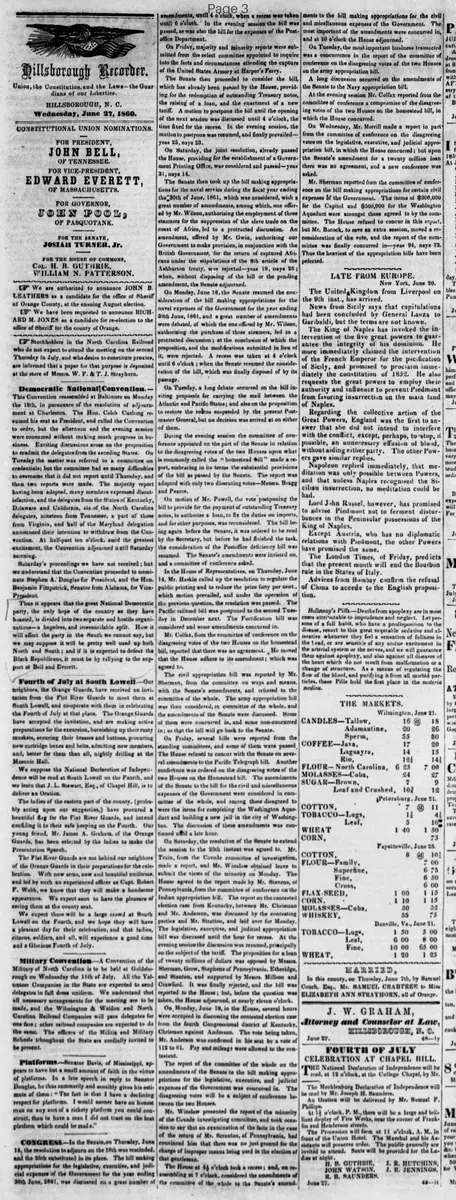
On Friday, majority and minority reports were submitted from the select committee appointed to inquire into the facts and circumstances attending the capture of the United States Armory at Harper's Ferry. The Senate then proceeded to consider the bill, which has already been passed by the House, providing for the redemption of outstanding Treasury notes, the raising of a loan, and the enactment of a new tariff. A motion to postpone the bill until the opening of the next session was discussed until 4 o'clock, the time fixed for the recess. In the evening session, the motion to postpone was resumed, and finally prevailed—yeas 25, nays 23.
On Saturday, the joint resolution, already passed the House, providing for the establishment of a Government Printing Office, was considered and passed—yeas 31, nays 14. The Senate then took up the bill making appropriations for the naval service during the fiscal year ending the 30th of June, 1861, which was considered, with a great number of amendments, among which, one offered by Mr. Wilson, authorizing the employment of three steamers for the suppression of the slave trade on the coast of Africa, led to a protracted discussion. An amendment, offered by Mr. Gwin, authorizing our Government to make provision, in conjunction with the British Government, for the return of captured Africans under the stipulations of the 8th article of the Ashburton treaty, was rejected—yeas 19, nays 26; when, without disposing of the bill or the pending amendment, the Senate adjourned.
On Monday, June 18, the Senate resumed the consideration of the bill making appropriations for the naval expenses of the Government for the year ending 30th June, 1861, and a great number of amendments were debated, of which the one offered by Mr. Wilson, authorizing the purchase of three steamers, led to a protracted discussion; at the conclusion of which the proposition, and the modifications submitted in lieu of it, were rejected. A recess was taken at 4 o'clock until 6 o'clock; when the Senate resumed the consideration of the bill, which was finally disposed of by its passage.
On Tuesday, a long debate occurred on the bill inviting proposals for carrying the mail between the Atlantic and Pacific States; and also on the proposition to restore the routes suspended by the present Postmaster General, but no decision was arrived at on either of them.
During the evening session the committee of conference appointed on the part of the Senate in relation to the disagreeing votes of the two Houses upon what is commonly called the "homestead bill" made a report, embracing in its terms the substantial provisions of the bill as passed by the Senate. The report was adopted with only two dissenting votes—Messrs. Bragg and Pearce.
On motion of Mr. Powell, the vote postponing the bill to provide for the payment of outstanding Treasury notes, to authorize a loan, to fix the duties on imports and for other purposes, was reconsidered. The bill being again before the Senate, it was ordered to be read by the Secretary, but before he had finished the task, the consideration of the Postoffice deficiency bill was resumed. The Senate's amendments were insisted on, and a committee of conference asked.
In the House of Representatives, on Thursday, June 14, Mr. Haskin called up the resolution to regulate the public printing and to reduce the price forty per cent., which motion prevailed, and under the operation of the previous question, the resolution was passed. The Pacific railroad bill was postponed to the second Tuesday in December next. The Fortification bill was considered and some amendments concurred in.
Mr. Colfax, from the committee of conference on the disagreeing votes of the two Houses on the homestead bill, reported that there was no agreement. He moved that the House adhere to its amendment; which was agreed to.
The civil appropriation bill was reported by Mr. Sherman, from the committee on ways and means, with the Senate's amendments, and referred to the committee of the whole. The army appropriation bill was then considered, in committee of the whole, and the amendments of the Senate were discussed. Some of them were concurred in, and some non-concurred in; so that the bill will go back to the Senate.
On Friday, several bills were reported from the standing committees, and some of them were passed. The House refused to concur with the Senate on several amendments to the Pacific Telegraph bill. Another conference was ordered on the disagreeing votes of the two Houses on the Homestead bill. The amendments of the Senate to the bill for the civil and miscellaneous expenses of the Government were considered in committee of the whole, and among those disagreed to were the items for completing the Washington Aqueduct and building a new jail in the city of Washington. The discussion of these amendments was continued until a late hour.
On Saturday, the resolution of the Senate to extend the session to the 25th instant was agreed to. Mr. Train, from the Covode committee of investigation, made a report, and Mr. Winslow obtained leave to submit the views of the minority on Monday. The House agreed to the report made by Mr. Stevens, of Pennsylvania, from the committee of conference on the Indian appropriation bill. The report on the contested election case from Kentucky, between Mr. Chrisman and Mr. Anderson, was discussed by the contesting parties and Mr. Stratton, and laid over for Monday. The legislative, executive, and judicial appropriation bill was discussed until the hour for recess. At the evening session the discussion was resumed, principally on the subject of the tariff. The proposition for a loan of twenty millions of dollars was opposed by Messrs. Sherman, Grow, Stephens of Pennsylvania, Etheridge, and Stanton, and supported by Messrs. Millson and Crawford. It was finally rejected, and the bill was reported to the House: but, before the question was taken, the House adjourned, at nearly eleven o'clock.
On Monday, June 18, in the House, several hours were occupied in discussing the contested election case from the fourth Congressional district of Kentucky, Chrisman against Anderson. The vote being taken, Mr. Anderson was confirmed in his seat by a vote of 112 to 61. Pay and mileage were allowed to the contestant.
The report of the committee of the whole on the amendments of the Senate to the bill making appropriations for the legislative, executive, and judicial expenses of the Government was concurred in. The disagreeing votes will be a subject of conference between the two Houses.
Mr. Winslow presented the report of the minority of the Covode investigating committee, and took occasion to say that an examination of the facts in the case of the return of Mr. Scranton, of Pennsylvania, had convinced him that there was no just ground for the charge of improper means being used in the election of that gentleman.
The House at 4 o'clock took a recess; and, on reassembling at 7 o'clock, considered the amendments of the committee of the whole to the Senate's amendments to the bill making appropriations for the civil and miscellaneous expenses of the Government. The most important of the amendments were concurred in, and at 10 o'clock the House adjourned.
On Tuesday, the most important business transacted was a concurrence in the report of the committee of conference on the disagreeing votes of the two Houses on the army appropriation bill.
A long discussion occurred on the amendments of the Senate to the Navy appropriation bill.
At the evening session Mr. Colfax reported from the committee of conference a compromise of the disagreeing votes of the two Houses on the homestead bill, in which the House concurred.
On Wednesday, Mr. Morrill made a report in part from the committee of conference on the disagreeing votes on the legislative, executive, and judicial appropriation bill, in which the House concurred; but upon the Senate's amendment for a twenty million loan there was no agreement, and a new conference was asked.
Mr. Sherman reported from the committee of conference on the bill making appropriations for certain civil expenses of the Government. The items of $300,000 for the Capitol and $500,000 for the Washington Aqueduct were amongst those agreed to by the committee. The House refused to concur in this report, but Mr. Bocock, to save an extra session, moved a reconsideration of the vote, and the report of the committee was finally concurred in—yeas 94, nays 72.
Thus the heaviest of the appropriation bills have been perfected.
What sub-type of article is it?
What keywords are associated?
What entities or persons were involved?
Where did it happen?
Domestic News Details
Primary Location
Washington
Event Date
June 14 20, 1860
Key Persons
Outcome
passage of appropriation bills for legislative, executive, judicial, post-office, naval, civil, army, and indian expenses; homestead bill compromise and passage; rejection of slave trade suppression amendments and african return provision; postponement of treasury notes, loan, and tariff bill; confirmation of mr. anderson's seat; extension of session to june 25; rejection of $20 million loan; concurrence on various amendments and conferences.
Event Details
The Senate and House of Representatives held sessions from June 14 to 20, 1860, debating and passing multiple appropriation bills with amendments, discussing the homestead bill through conferences leading to compromise, handling reports on Harper's Ferry capture and investigations, considering mail routes, Pacific railroad, telegraph, fortifications, printing office, and contested elections, with votes on postponements, rejections, and adoptions as detailed in daily proceedings.