Thank you for visiting SNEWPapers!
Sign up free
The Virginia Gazette
Richmond, Williamsburg, Richmond County, Virginia
What is this article about?
An anonymous letter from an Independent Whig criticizes British policies, particularly stamp duties and trade restrictions on North American colonies, arguing they impoverish both colonies and Britain, violate charters, and risk alienating the colonies. It advocates supporting colonial prosperity for mutual economic benefit and using fishery restrictions to enforce the peace treaty with France.
Clipping
OCR Quality
Full Text
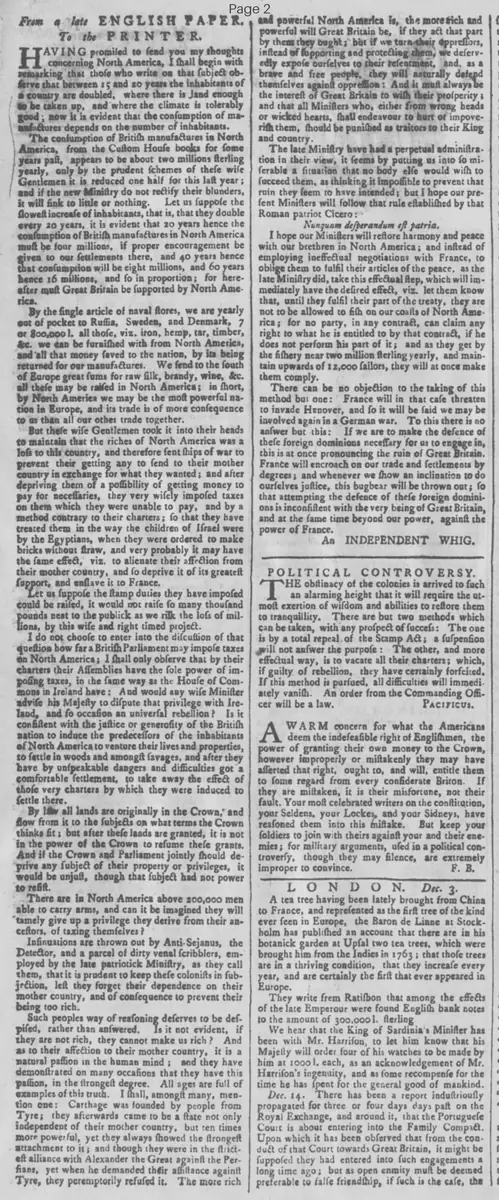
To the PRINTER.
HAVING promised to send you my thoughts concerning North America, I shall begin with remarking that those who write on that subject observe that between 15 and 20 years the inhabitants of a country are doubled, where there is land enough to be taken up, and where the climate is tolerably good; now it is evident that the consumption of manufactures depends on the number of inhabitants.
The consumption of British manufactures in North America, from the Custom House books for some years past, appears to be about two millions sterling yearly, only by the prudent schemes of these wise Gentlemen it is reduced one half for this last year; and if the new Ministry do not rectify their blunders, it will sink to little or nothing. Let us suppose the slowest increase of inhabitants, that is, that they double every 20 years, it is evident that 20 years hence the consumption of British manufactures in North America must be four millions, if proper encouragement be given to our settlements there, and 40 years hence that consumption will be eight millions, and 60 years hence 16 millions, and so in proportion; for hereafter must Great Britain be supported by North America.
By the single article of naval stores, we are yearly out of pocket to Russia, Sweden, and Denmark, 700 or 800,000l. all those, viz. iron, hemp, tar, timber, &c. we can be furnished with from North America, and all that money saved to the nation, by its being returned for our manufactures. We send to the south of Europe great sums for raw silk, brandy, wine, &c. all these may be raised in North America; in short, by North America we may be the most powerful nation in Europe, and its trade is of more consequence to us than all our other trade together.
But these wise Gentlemen took it into their heads to maintain that the riches of North America was a loss to this country, and therefore sent ships of war to prevent their getting any to send to their mother country in exchange for what they wanted; and after depriving them of a possibility of getting money to pay for necessaries, they very wisely imposed taxes on them which they were unable to pay, and by a method contrary to their charters; so that they have treated them in the way the children of Israel were by the Egyptians, when they were ordered to make bricks without straw, and very probably it may have the same effect, viz. to alienate their affection from their mother country, and so deprive it of its greatest support, and enslave it to France.
Let us suppose the stamp duties they have imposed could be raised, it would not raise so many thousand pounds neat to the public as we risk the loss of millions, by this wise and right timed project.
I do not choose to enter into the discussion of that question how far a British Parliament may impose taxes on North America; I shall only observe that by their charters their Assemblies have the sole power of imposing taxes, in the same way as the House of Commons in Ireland have: And would any wise Minister advise his Majesty to dispute that privilege with Ireland, and so occasion an universal rebellion? Is it consistent with the justice or generosity of the British nation to induce the predecessors of the inhabitants of North America to venture their lives and properties, to settle in woods and amongst savages, and after they have by unspeakable dangers and difficulties got a comfortable settlement, to take away the effect of those very charters by which they were induced to settle there.
By law all lands are originally in the Crown, and come from it to the subjects on what terms the Crown thinks fit; but after these lands are granted, it is not in the power of the Crown to resume these grants. And if the Crown and Parliament jointly should deprive any subject of their property or privileges, it would be unjust, though that subject had not power to resist.
There are in North America above 200,000 men able to carry arms, and can it be imagined they will tamely give up a privilege they derive from their ancestors, of taxing themselves?
Insinuations are thrown out by Anti-Sejanus, the Detector, and a parcel of dirty venal scribblers, employed by the late patriotick Ministry, as they call themselves, that it is prudent to keep these colonies in subjection, lest they forget their dependence on their mother country, and of consequence to prevent their being too rich.
Such people's way of reasoning deserves to be despised, rather than answered. Is it not evident, if they are not rich, they cannot make us rich? And as to their affection to their mother country, it is a natural passion in the human mind; and they have demonstrated on many occasions that they have this passion, in the strongest degree. All ages are full of examples of this truth. I shall, amongst many, mention one: Carthage was founded by people from Tyre; they afterwards came to be a state not only independent of their mother country, but ten times more powerful, yet they always showed the strongest attachment to it; and though they were in the strictest alliance with Alexander the Great against the Persians, yet when he demanded their assistance against Tyre, they peremptorily refused it. The more rich and powerful North America is, the more rich and powerful will Great Britain be, if they act that part by them they ought; but if we turn their oppressors, instead of supporting and protecting them, we deservedly expose ourselves to their resentment, and, as a brave and free people, they will naturally defend themselves against oppression: And it must always be the interest of Great Britain to wish their prosperity and that all Ministers who, either from wrong heads or wicked hearts, shall endeavour to hurt or impoverish them, should be punished as traitors to their King and country.
The late Ministry have had a perpetual administration in their view, it seems by putting us into so miserable a situation that no body else would wish to succeed them, as thinking it impossible to prevent that ruin they seem to have intended; but I hope our present Ministers will follow that rule established by that Roman patriot Cicero:
Nunquam desperandum et patria.
I hope our Ministers will restore harmony and peace with our brethren in North America; and instead of employing ineffectual negotiations with France, to oblige them to fulfil their articles of the peace, as the late Ministry did, take this effectual step, which will immediately have the desired effect, viz. let them know that, until they fulfil their part of the treaty, they are not to be allowed to fish on our coasts of North America; for no party, in any contract, can claim any right to what he is entitled to by that contract, if he does not perform his part of it; and as they get by the fishery near two million sterling yearly, and maintain upwards of 12,000 sailors, they will at once make them comply.
There can be no objection to the taking of this method but one: France will in that case threaten to invade Hanover, and so it will be said we may be involved again in a German war. To this there is no answer but this: If we are to make the defence of these foreign dominions necessary for us to engage in, this is at once pronouncing the ruin of Great Britain. France will encroach on our trade and settlements by degrees; and whenever we show an inclination to do ourselves justice, this bugbear will be thrown out; so that attempting the defence of these foreign dominions is inconsistent with the very being of Great Britain, and at the same time beyond our power, against the power of France.
An INDEPENDENT WHIG.
What sub-type of article is it?
What themes does it cover?
What keywords are associated?
What entities or persons were involved?
Letter to Editor Details
Author
An Independent Whig
Recipient
To The Printer
Main Argument
british policies like stamp duties and trade restrictions on north american colonies violate charters, impoverish both sides, and risk alienating the colonies; britain should support colonial growth for economic benefits and mutual prosperity instead.
Notable Details