Thank you for visiting SNEWPapers!
Sign up free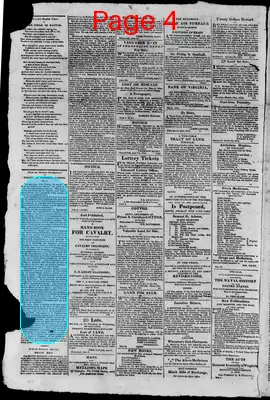
Editorial
June 15, 1814
Virginia Argus
Richmond, Virginia
What is this article about?
This editorial analyzes the fall of Napoleon Bonaparte, crediting Russian Emperor Alexander as the key figure in the coalition against him. It expresses hope that this will curb British maritime dominance and benefit U.S. interests by restoring balance in Europe and challenging England's commercial encroachments.
Clipping
OCR Quality
98%
Excellent
Full Text
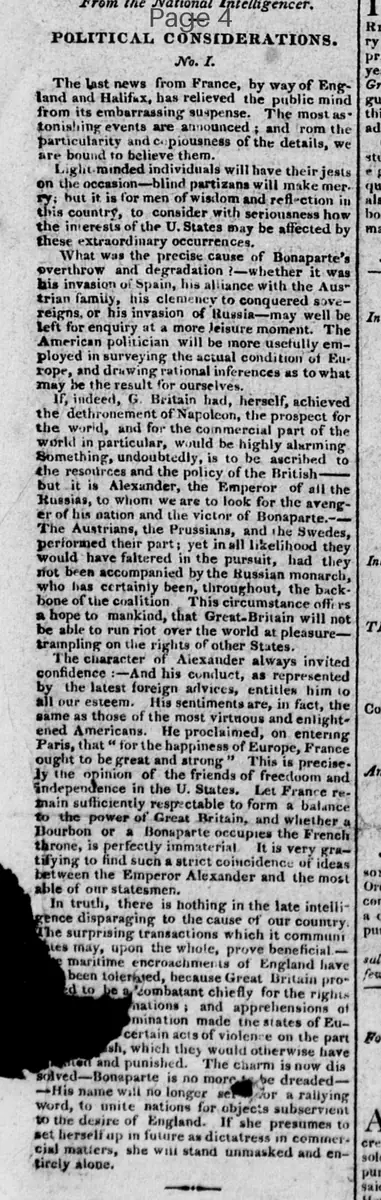
POLITICAL CONSIDERATIONS.
No. I.
The last news from France, by way of England and Halifax, has relieved the public mind from its embarrassing suspense. The most astonishing events are announced; and from the particularity and copiousness of the details, we are bound to believe them.
Light minded individuals will have their jests on the occasion—blind partizans will make merry: but it is for men of wisdom and reflection in this country, to consider with seriousness how the interests of the U. States may be affected by these extraordinary occurrences.
What was the precise cause of Bonaparte's overthrow and degradation?—whether it was his invasion of Spain, his alliance with the Austrian family, his clemency to conquered sovereigns, or his invasion of Russia—may well be left for enquiry at a more leisure moment. The American politician will be more usefully employed in surveying the actual condition of Europe, and drawing rational inferences as to what may be the result for ourselves.
If, indeed, G. Britain had, herself, achieved the dethronement of Napoleon, the prospect for the world, and for the commercial part of the world in particular, would be highly alarming. Something, undoubtedly, is to be ascribed to the resources and the policy of the British—but it is Alexander, the Emperor of all the Russias, to whom we are to look for the avenger of his nation and the victor of Bonaparte.—The Austrians, the Prussians, and the Swedes, performed their part; yet in all likelihood they would have faltered in the pursuit, had they not been accompanied by the Russian monarch, who has certainly been, throughout, the back-bone of the coalition. This circumstance offers a hope to mankind, that Great-Britain will not be able to run riot over the world at pleasure—trampling on the rights of other States.
The character of Alexander always invited confidence:—And his conduct, as represented by the latest foreign advices, entitles him to all our esteem. His sentiments are, in fact, the same as those of the most virtuous and enlightened Americans. He proclaimed, on entering Paris, that "for the happiness of Europe, France ought to be great and strong." This is precisely the opinion of the friends of freedom and independence in the U. States. Let France remain sufficiently respectable to form a balance to the power of Great Britain, and whether a Bourbon or a Bonaparte occupies the French throne, is perfectly immaterial. It is very gratifying to find such a strict coincidence of ideas between the Emperor Alexander and the most able of our statesmen.
In truth, there is nothing in the late intelligence disparaging to the cause of our country. The surprising transactions which it communicates may, upon the whole, prove beneficial.—The maritime encroachments of England have been tolerated, because Great Britain professed to be a combatant chiefly for the rights of nations; and apprehensions of Bonaparte's domination made the states of Europe wink at certain acts of violence on the part of the British, which they would otherwise have condemned and punished. The charm is now dissolved—Bonaparte is no more to be dreaded—His name will no longer serve as a rallying word, to unite nations for objects subservient to the desire of England. If she presumes to set herself up in future as dictatress in commercial matters, she will stand unmasked and entirely alone.
No. I.
The last news from France, by way of England and Halifax, has relieved the public mind from its embarrassing suspense. The most astonishing events are announced; and from the particularity and copiousness of the details, we are bound to believe them.
Light minded individuals will have their jests on the occasion—blind partizans will make merry: but it is for men of wisdom and reflection in this country, to consider with seriousness how the interests of the U. States may be affected by these extraordinary occurrences.
What was the precise cause of Bonaparte's overthrow and degradation?—whether it was his invasion of Spain, his alliance with the Austrian family, his clemency to conquered sovereigns, or his invasion of Russia—may well be left for enquiry at a more leisure moment. The American politician will be more usefully employed in surveying the actual condition of Europe, and drawing rational inferences as to what may be the result for ourselves.
If, indeed, G. Britain had, herself, achieved the dethronement of Napoleon, the prospect for the world, and for the commercial part of the world in particular, would be highly alarming. Something, undoubtedly, is to be ascribed to the resources and the policy of the British—but it is Alexander, the Emperor of all the Russias, to whom we are to look for the avenger of his nation and the victor of Bonaparte.—The Austrians, the Prussians, and the Swedes, performed their part; yet in all likelihood they would have faltered in the pursuit, had they not been accompanied by the Russian monarch, who has certainly been, throughout, the back-bone of the coalition. This circumstance offers a hope to mankind, that Great-Britain will not be able to run riot over the world at pleasure—trampling on the rights of other States.
The character of Alexander always invited confidence:—And his conduct, as represented by the latest foreign advices, entitles him to all our esteem. His sentiments are, in fact, the same as those of the most virtuous and enlightened Americans. He proclaimed, on entering Paris, that "for the happiness of Europe, France ought to be great and strong." This is precisely the opinion of the friends of freedom and independence in the U. States. Let France remain sufficiently respectable to form a balance to the power of Great Britain, and whether a Bourbon or a Bonaparte occupies the French throne, is perfectly immaterial. It is very gratifying to find such a strict coincidence of ideas between the Emperor Alexander and the most able of our statesmen.
In truth, there is nothing in the late intelligence disparaging to the cause of our country. The surprising transactions which it communicates may, upon the whole, prove beneficial.—The maritime encroachments of England have been tolerated, because Great Britain professed to be a combatant chiefly for the rights of nations; and apprehensions of Bonaparte's domination made the states of Europe wink at certain acts of violence on the part of the British, which they would otherwise have condemned and punished. The charm is now dissolved—Bonaparte is no more to be dreaded—His name will no longer serve as a rallying word, to unite nations for objects subservient to the desire of England. If she presumes to set herself up in future as dictatress in commercial matters, she will stand unmasked and entirely alone.
What sub-type of article is it?
Foreign Affairs
War Or Peace
Trade Or Commerce
What keywords are associated?
Napoleon Overthrow
Russian Emperor Alexander
British Dominance
European Balance
Us Foreign Policy
Maritime Encroachments
Coalition Against France
What entities or persons were involved?
Bonaparte
Alexander
G. Britain
France
Austrians
Prussians
Swedes
Editorial Details
Primary Topic
Implications Of Napoleon's Overthrow For U.S. Interests And European Balance
Stance / Tone
Hopeful And Supportive Of Russian Led Coalition Against British Dominance
Key Figures
Bonaparte
Alexander
G. Britain
France
Austrians
Prussians
Swedes
Key Arguments
Napoleon's Fall Relieves Suspense And Requires Serious U.S. Consideration Of Impacts
Alexander Is The Primary Victor And Backbone Of The Coalition
Hope That Britain Cannot Dominate Unchecked
Alexander's Views Align With American Ideals Of Balanced European Powers
Fall Of Napoleon Dissolves Tolerance For British Maritime Encroachments
Britain Will Face Opposition Without Napoleon As A Pretext