Thank you for visiting SNEWPapers!
Sign up free
Editorial
February 4, 1841
Edgefield Advertiser
Edgefield, Edgefield County, South Carolina
What is this article about?
Editorial opposes proposals to abolish debt collection laws, viewing them as radical agrarian ideas that would foster fraud, erode trust and trade, and ultimately increase litigation. Advocates maintaining legal protections for creditors to support honest industry.
Merged-components note: continuation of editorial on The Abolition of Debt across pages, sequential content flow
Clippings
1 of 2
OCR Quality
92%
Excellent
Full Text
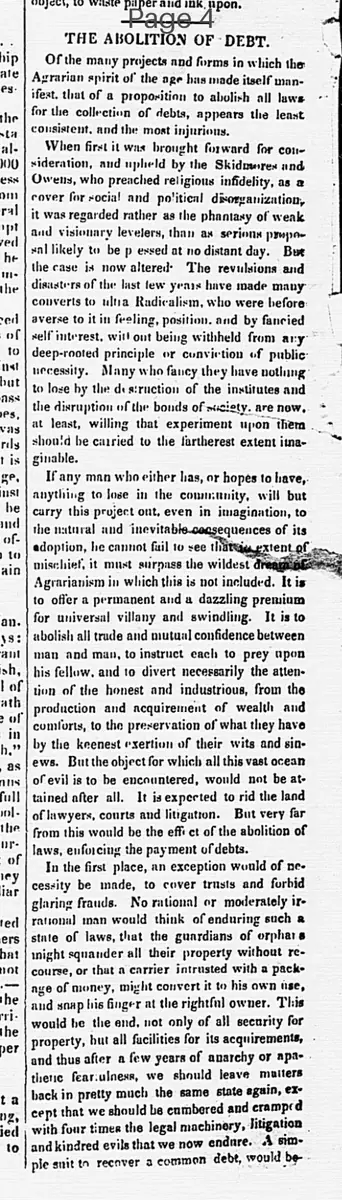
THE ABOLITION OF DEBT.
Of the many projects and forms in which the Agrarian spirit of the age has made itself manifest, that of a proposition to abolish all laws for the collection of debts, appears the least consistent, and the most injurious.
When first it was brought forward for consideration, and upheld by the Skidmores and Owels, who preached religious infidelity, as a cover for social and political disorganization, it was regarded rather as the phantasy of weak and visionary levelers, than as a serious proposal likely to be pressed at no distant day. But the case is now altered. The revulsions and disasters of the last few years have made many converts to ultra Radicalism, who were before averse to it in feeling, position, and by fancied self interest. Will not being withheld from any deep-rooted principle or conviction of public necessity. Many who fancy they have nothing to lose by the destruction of the institutes and the disruption of the bonds of society, are now, at least, willing that experiment upon them should be carried to the farthest extent imaginable.
If any man who either has, or hopes to have, anything to lose in the community, will but carry this project out, even in imagination, to the natural and inevitable consequences of its adoption, he cannot fail to see that in extent of mischief, it must surpass the wildest dream Agrarianism in which this is not included. It is to offer a permanent and a dazzling premium for universal villany and swindling. It is to abolish all trade and mutual confidence between man and man, to instruct each to prey upon his fellow, and to divert necessarily the attention of the honest and industrious, from the production and acquirement of wealth and comforts, to the preservation of what they have by the keenest exertion of their wits and sinews. But the object for which all this vast ocean of evil is to be encountered, would not be attained after all. It is expected to rid the land of lawyers, courts and litigation. But very far from this would be the effect of the abolition of laws, enforcing the payment of debts.
In the first place, an exception would of necessity be made, to cover trusts and forbid glaring frauds. No rational or moderately irrational man would think of enduring such a state of laws, that the guardians of orphans might squander all their property without recourse, or that a carrier intrusted with a package of money, might convert it to his own use, and snap his finger at the rightful owner. This would be the end, not only of all security for property, but all facilities for its acquirement, and thus after a few years of anarchy or apathetic dullness, we should leave matters back in pretty much the same state again, except that we should be cumbered and cramped with four times the legal machinery, litigation and kindred evils that we now endure. A simple suit to recover a common debt, would be—
Let us away then, with all hair-brained innovations in a matter of such vital consequence to every man's property, industry and bread. Leave to honest industry and thrift, the strongest possible assurances of realizing the reward of fair exertions, and let the restless energies of mankind be expended on constitutions and creeds, of which the destruction or remodelling, forms their natural aim. But let the Landlord rent his houses, the Merchant sell his merchandise, and the Laborer his services, with the certainty that if the buyer of either shall dishonestly withhold the pay, the law is on his side, ready to aid or the delinquent.
Of the many projects and forms in which the Agrarian spirit of the age has made itself manifest, that of a proposition to abolish all laws for the collection of debts, appears the least consistent, and the most injurious.
When first it was brought forward for consideration, and upheld by the Skidmores and Owels, who preached religious infidelity, as a cover for social and political disorganization, it was regarded rather as the phantasy of weak and visionary levelers, than as a serious proposal likely to be pressed at no distant day. But the case is now altered. The revulsions and disasters of the last few years have made many converts to ultra Radicalism, who were before averse to it in feeling, position, and by fancied self interest. Will not being withheld from any deep-rooted principle or conviction of public necessity. Many who fancy they have nothing to lose by the destruction of the institutes and the disruption of the bonds of society, are now, at least, willing that experiment upon them should be carried to the farthest extent imaginable.
If any man who either has, or hopes to have, anything to lose in the community, will but carry this project out, even in imagination, to the natural and inevitable consequences of its adoption, he cannot fail to see that in extent of mischief, it must surpass the wildest dream Agrarianism in which this is not included. It is to offer a permanent and a dazzling premium for universal villany and swindling. It is to abolish all trade and mutual confidence between man and man, to instruct each to prey upon his fellow, and to divert necessarily the attention of the honest and industrious, from the production and acquirement of wealth and comforts, to the preservation of what they have by the keenest exertion of their wits and sinews. But the object for which all this vast ocean of evil is to be encountered, would not be attained after all. It is expected to rid the land of lawyers, courts and litigation. But very far from this would be the effect of the abolition of laws, enforcing the payment of debts.
In the first place, an exception would of necessity be made, to cover trusts and forbid glaring frauds. No rational or moderately irrational man would think of enduring such a state of laws, that the guardians of orphans might squander all their property without recourse, or that a carrier intrusted with a package of money, might convert it to his own use, and snap his finger at the rightful owner. This would be the end, not only of all security for property, but all facilities for its acquirement, and thus after a few years of anarchy or apathetic dullness, we should leave matters back in pretty much the same state again, except that we should be cumbered and cramped with four times the legal machinery, litigation and kindred evils that we now endure. A simple suit to recover a common debt, would be—
Let us away then, with all hair-brained innovations in a matter of such vital consequence to every man's property, industry and bread. Leave to honest industry and thrift, the strongest possible assurances of realizing the reward of fair exertions, and let the restless energies of mankind be expended on constitutions and creeds, of which the destruction or remodelling, forms their natural aim. But let the Landlord rent his houses, the Merchant sell his merchandise, and the Laborer his services, with the certainty that if the buyer of either shall dishonestly withhold the pay, the law is on his side, ready to aid or the delinquent.
What sub-type of article is it?
Economic Policy
Social Reform
What keywords are associated?
Debt Abolition
Agrarian Radicalism
Economic Disruption
Debt Collection Laws
Social Anarchy
What entities or persons were involved?
Skidmores
Owels
Editorial Details
Primary Topic
Opposition To Abolishing Debt Collection Laws
Stance / Tone
Strongly Critical Of Radical Agrarian Proposals
Key Figures
Skidmores
Owels
Key Arguments
Abolishing Debt Collection Laws Is Inconsistent And Injurious
It Promotes Universal Villany And Swindling
Destroys Trade And Mutual Confidence Between Individuals
Diverts Honest People From Production To Self Preservation
Would Not Eliminate Lawyers, Courts, Or Litigation But Increase Them
Exceptions For Trusts And Frauds Would Lead To More Legal Machinery
Urges Preserving Legal Assurances For Honest Industry And Thrift