Thank you for visiting SNEWPapers!
Sign up free
Winchester Virginia Republican
Winchester, Virginia
What is this article about?
Rev. Mr. Kurtz's 1826 letter details stage coach journey from Liverpool to London via Birmingham, describing vehicles, excellent roads, staff roles, quick meal stops, tipping expectations, and persistent inn servants seeking gratuities; includes Lubeck anecdote on over-tipping a porter.
Merged-components note: Continuation of the article on travelling in England from page 2 to page 3, based on sequential reading order and matching narrative content.
Clippings
1 of 2
OCR Quality
Full Text
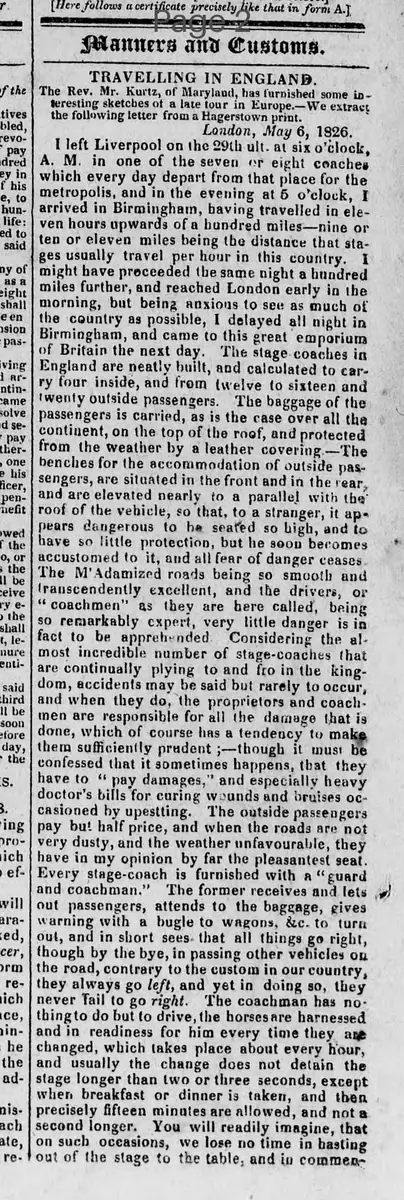
TRAVELLING IN ENGLAND
The Rev. Mr. Kurtz, of Maryland, has furnished some interesting sketches of a late tour in Europe.—We extract the following letter from a Hagerstown print.
London, May 6, 1826.
I left Liverpool on the 29th ult. at six o'clock A. M. in one of the seven or eight coaches which every day depart from that place for the metropolis, and in the evening at 5 o'clock, I arrived in Birmingham, having travelled in eleven hours upwards of a hundred miles—nine or ten or eleven miles being the distance that stages usually travel per hour in this country. I might have proceeded the same night a hundred miles further, and reached London early in the morning, but being anxious to see as much of the country as possible, I delayed all night in Birmingham, and came to this great emporium of Britain the next day. The stage coaches in England are neatly built, and calculated to carry four inside, and from twelve to sixteen and twenty outside passengers. The baggage of the passengers is carried, as is the case over all the continent, on the top of the roof, and protected from the weather by a leather covering.—The benches for the accommodation of outside passengers, are situated in the front and in the rear, and are elevated nearly to a parallel with the roof of the vehicle, so that, to a stranger, it appears dangerous to be seated so high, and to have so little protection, but he soon becomes accustomed to it, and all fear of danger ceases. The M'Adamized roads being so smooth and transcendently excellent, and the drivers, or "coachmen" as they are here called, being so remarkably expert, very little danger is in fact to be apprehended Considering the almost incredible number of stage-coaches that are continually plying to and fro in the kingdom, accidents may be said but rarely to occur and when they do, the proprietors and coachmen are responsible for all the damage that is done, which of course has a tendency to make them sufficiently prudent;—though it must be confessed that it sometimes happens, that they have to "pay damages," and especially heavy doctor's bills for curing wounds and bruises occasioned by upsetting. The outside passengers pay but half price, and when the roads are not very dusty, and the weather unfavourable, they have in my opinion by far the pleasantest seat Every stage-coach is furnished with a "guard and coachman." The former receives and lets out passengers, attends to the baggage, gives warning with a bugle to wagons, &c. to turn out, and in short sees that all things go right, though by the bye, in passing other vehicles on the road, contrary to the custom in our country, they always go left, and yet in doing so, they never fail to go right. The coachman has nothing to do but to drive, the horses are harnessed and in readiness for him every time they are changed, which takes place about every hour, and usually the change does not detain the stage longer than two or three seconds, except when breakfast or dinner is taken, and then precisely fifteen minutes are allowed, and not a second longer. You will readily imagine, that on such occasions, we lose no time in hasting out of the stage to the table, and in commencing to eat, and in finishing our meal. The outside passengers have in my opinion by far the pleasantest seat.
commencing our dental operations on any thing most conveniently within our reach. But with all our expedition, the sound of the horn hurries us off before we are ready, and the only way in which we can possibly succeed in getting any thing like the worth of our money, and in meeting the importunate solicitations of a craving appetite, is, to carry with us in our hands as much bread and meat as decency will admit which we eat on the road. When the coach man and guard are changed, which is every thirty, forty, or fifty miles, each expects a fee from every passenger, and if not immediately given to them, they hesitate not to demand, saying, "Please remember the coachman—Please remember the guard," and less than a shilling they are not willing to accept.—An American friend of mine, who travelled in England, told me that he once offered a coachman six pence, (about 11 cents,) and the coachman threw it away in his presence, saying, "Sir, you are no gentleman."
In fact, one of the most disagreeable circumstances attending a tour through Europe, is that of paying and settling with the servants. Receiving nothing from their employers, and even often paying for their places, they are altogether dependent upon travellers for their subsistence, and as they themselves are sometimes imposed upon by travellers, so they in their turn, make no conscience to take advantage of them, and to extort as much money from them for their trivial services as they possibly can. When a person, particularly if he be a stranger or foreigner, (and the domestics possess a wonderful facility in discovering whether this is the case or not,) takes lodging in an inn, as many as can will engage in his service: no one, if he can avoid it, will perform more than one act for him, and when he is about to depart, he is beleaguered by an obsequious, hungry, clamorous tribe, whom it is almost impossible to satisfy.
Thus, when I left Birmingham, some 6 or 8 came around me, and said "Please remember the boots," another, "Please remember the chambermaid," a third, "Please remember me;" and what, said I, must I remember you for? "I lifted your trunk from the coach last night, sir," was the reply. A fourth said, he carried it into the house, a fifth transported it up stairs into my chamber, a sixth brought it down again, a seventh took it out and lifted it on the coach. an eighth waited on me at the tea-table, &c. I paid about one half of the greedy swarm, and then departed, leaving the rest to vent their unreasonable murmurs to the heedless wind. In making these remarks, I am reminded of an anecdote which perhaps might be more suitably given in a subsequent letter, but as I have reserved the privilege of occasionally going ahead of my narrative when I may feel disposed, and as it is not irrelevant to the subject in question, I cannot forbear availing myself of this opportunity to relate it. When in the city of Lubeck the difficulty of satisfying the domestics, became the subject of conversation at the dining table in the hotel in which I had put up. In reply to the complaints that were made, a gentleman observed, that the servants were often treated badly, and no wonder if they were sometimes a little troublesome; that he had a small trunk which he intended to have brought from the stage office, and he had no doubt he would be able to satisfy the porter, nay, he was willing, he said, to lay a wager of a dozen of Rhenish wine, that when the porter delivered the trunk, he should be so satisfied as not to say a single word. The wager was accepted, and a porter was despatched. In a quarter of an hour he returned, and the gentleman, having in his own mind determined to win the bet, gave him a Ducat! (between 2 and 3 dollars of our currency.) The poor fellow looked at the money with astonishment and delight, hardly knowing whether he should believe his senses or not; he, however, put it into his pocket, and altogether ignorant of the wager that was pending, raised his head, and most submissively addressing the gentleman, said,— "Wollen nicht der gnadige herr mir noch einen Schnapps geben?"—(Will not the good gentleman give me a dram yet?) A loud peal of laughter ensued among the guests, and it was unanimously decided that the gentleman lost the wager. He immediately ordered 12 bottles of prime old hock, pro bono publico, which was forthwith consumed not a little to the gratification of all who witnessed the scene.
What sub-type of article is it?
What themes does it cover?
What keywords are associated?
What entities or persons were involved?
Where did it happen?
Story Details
Key Persons
Location
England, From Liverpool To Birmingham To London
Event Date
1826 05 06
Story Details
Rev. Mr. Kurtz describes stage coach travel in England from Liverpool to Birmingham and London, including coach design, McAdamized roads, driver expertise, passenger accommodations, meal stops, tipping for coachmen and guards, and demanding inn servants; includes anecdote of a wager in Lubeck where over-tipping a porter leads to a request for more.