Thank you for visiting SNEWPapers!
Sign up free
Editorial
April 17, 1934
The Daily Worker
Chicago, Cook County, Illinois
What is this article about?
This editorial critiques the New York Times for redirecting student anti-war strikes toward support for the ineffective League of Nations and World Court, citing their failure during Japan's invasion of Manchuria. It condemns pacifism as futile, arguing that real resistance against imperialist war requires proletarian revolution to overthrow capitalism.
Clipping
OCR Quality
95%
Excellent
Full Text
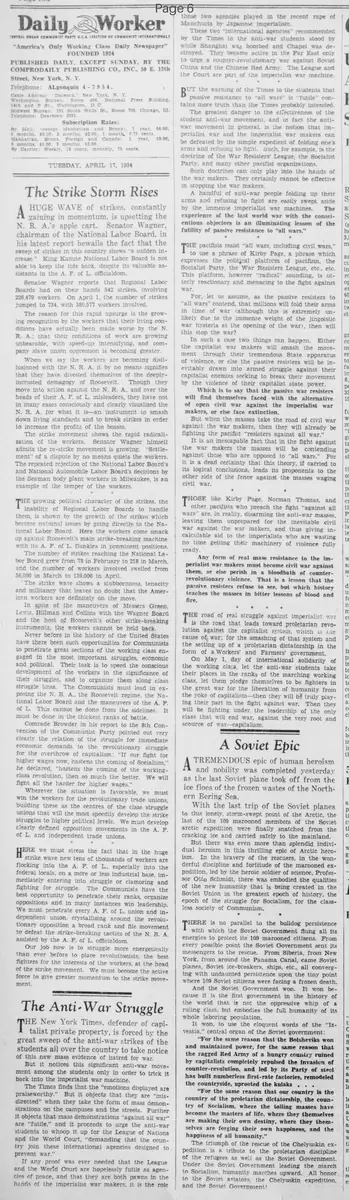
The Anti-War Struggle
THE New York Times, defender of capitalist private property, is forced by the great sweep of the anti-war strikes of the students all over the country to take notice of this new mass evidence of hatred for war.
But it notices this significant anti-war movement among the students only in order to trick it back into the imperialist war machine.
The Times finds that the "emotions displayed are praiseworthy." But it objects that they are "misdirected" when they take the form of mass demonstrations on the campuses and the streets. Further it objects that mass demonstrations "against all war" are futile," and it proceeds to urge the anti-war students to whoop it up for the League of Nations and the World Court, "demanding that the country join these international agencies designed to prevent war."
If any proof was ever needed that the League and the World Court are hopelessly futile as agencies of peace, and that they are both pawns in the hands of the imperialist war makers, it is the role these two agencies played in the recent rape of Manchuria by Japanese imperialism.
These two "international agencies" recommended by the Times to the anti-war students stood by while Shanghai was bombed and Chapei was destroyed. They became active in the Far East only to urge a counter-revolutionary war against Soviet China and the Chinese Red Army. The League and the Court are part of the imperialist war machine.
BUT the warning of the Times to the students that passive resistance to "all wars" is "futile" contains more truth than the Times probably intended.
The greatest danger to the effectiveness of the student anti-war movement, and in fact the anti-war movement in general, is the notion that imperialist war and the imperialist war makers can be defeated by the simple expedient of folding one's arms and refusing to fight. Such, for example, is the doctrine of the War Resisters' League, the Socialist Party, and many other pacifist organizations.
Such doctrines can only play into the hands of the war makers. They certainly cannot be effective in stopping the war makers.
A handful of anti-war people folding up their arms and refusing to fight are easily swept aside by the immense imperialist war machines.
The experience of the last world war with the conscientious objectors is an illuminating lesson of the futility of passive resistance to "all wars."
THE pacifists resist "all wars, including civil wars," to use a phrase of Kirby Page, a phrase which expresses the political platform of pacifism, the Socialist Party, the War Resisters League, etc., etc.
This platform, however "radical" sounding, is utterly reactionary and menacing to the fight against war.
For, let us assume, as the passive resisters to "all wars" contend, that millions will fold their arms in time of war (although this is extremely unlikely due to the immense weight of the jingoistic war hysteria at the opening of the war), then will this stop the war?
In such a case two things can happen. Either the capitalist war makers will smash the movement through their tremendous State apparatus of violence, or else the passive resisters will be inevitable drawn into armed struggle against their capitalist enemies seeking to break their movement by the violence of their capitalist state power.
Which is to say that the passive war resisters will find themselves faced with the alternative of open civil war against the imperialist war makers, or else face extinction.
But when the masses take the road of civil war against the war makers, then they will already be fighting the pacifist "resisters against all war."
It is an inescapable fact that in the fight against the war makers the masses will be contending against those who are opposed to "all wars." For it is a dead certainty that this theory, if carried to its logical conclusions, leads its proponents to the other side of the fence against the masses waging civil war.
THOSE like Kirby Page, Norman Thomas, and other pacifists who preach the fight "against all wars" are, in reality, disarming the anti-war masses, leaving them unprepared for the inevitable civil war against the war makers, and thus giving incalculable aid to the imperialists who are wasting no time getting their machinery of violence fully ready.
Any form of real mass resistance to the imperialist war makers must become civil war against them, or else perish in a bloodbath of counter-revolutionary violence. That is a lesson that the passive resisters refuse to see, but which history teaches the masses in bitter lessons of blood and fire.
THE road of real struggle against imperialist war is the road that leads toward proletarian revolution against the capitalist system, which is the cause of war; for the smashing of that system and the setting up of a proletarian dictatorship in the form of a Workers' and Farmers' government.
On May 1, day of international solidarity of the working class, let the anti-war students take their places in the ranks of the marching working class, let them pledge themselves to be fighters in the great war for the liberation of humanity from the yoke of capitalism--then they will be truly playing their part in the fight against war. Then they will be fighting under the leadership of the only class that will end war, against the very root and source of war--capitalism.
THE New York Times, defender of capitalist private property, is forced by the great sweep of the anti-war strikes of the students all over the country to take notice of this new mass evidence of hatred for war.
But it notices this significant anti-war movement among the students only in order to trick it back into the imperialist war machine.
The Times finds that the "emotions displayed are praiseworthy." But it objects that they are "misdirected" when they take the form of mass demonstrations on the campuses and the streets. Further it objects that mass demonstrations "against all war" are futile," and it proceeds to urge the anti-war students to whoop it up for the League of Nations and the World Court, "demanding that the country join these international agencies designed to prevent war."
If any proof was ever needed that the League and the World Court are hopelessly futile as agencies of peace, and that they are both pawns in the hands of the imperialist war makers, it is the role these two agencies played in the recent rape of Manchuria by Japanese imperialism.
These two "international agencies" recommended by the Times to the anti-war students stood by while Shanghai was bombed and Chapei was destroyed. They became active in the Far East only to urge a counter-revolutionary war against Soviet China and the Chinese Red Army. The League and the Court are part of the imperialist war machine.
BUT the warning of the Times to the students that passive resistance to "all wars" is "futile" contains more truth than the Times probably intended.
The greatest danger to the effectiveness of the student anti-war movement, and in fact the anti-war movement in general, is the notion that imperialist war and the imperialist war makers can be defeated by the simple expedient of folding one's arms and refusing to fight. Such, for example, is the doctrine of the War Resisters' League, the Socialist Party, and many other pacifist organizations.
Such doctrines can only play into the hands of the war makers. They certainly cannot be effective in stopping the war makers.
A handful of anti-war people folding up their arms and refusing to fight are easily swept aside by the immense imperialist war machines.
The experience of the last world war with the conscientious objectors is an illuminating lesson of the futility of passive resistance to "all wars."
THE pacifists resist "all wars, including civil wars," to use a phrase of Kirby Page, a phrase which expresses the political platform of pacifism, the Socialist Party, the War Resisters League, etc., etc.
This platform, however "radical" sounding, is utterly reactionary and menacing to the fight against war.
For, let us assume, as the passive resisters to "all wars" contend, that millions will fold their arms in time of war (although this is extremely unlikely due to the immense weight of the jingoistic war hysteria at the opening of the war), then will this stop the war?
In such a case two things can happen. Either the capitalist war makers will smash the movement through their tremendous State apparatus of violence, or else the passive resisters will be inevitable drawn into armed struggle against their capitalist enemies seeking to break their movement by the violence of their capitalist state power.
Which is to say that the passive war resisters will find themselves faced with the alternative of open civil war against the imperialist war makers, or else face extinction.
But when the masses take the road of civil war against the war makers, then they will already be fighting the pacifist "resisters against all war."
It is an inescapable fact that in the fight against the war makers the masses will be contending against those who are opposed to "all wars." For it is a dead certainty that this theory, if carried to its logical conclusions, leads its proponents to the other side of the fence against the masses waging civil war.
THOSE like Kirby Page, Norman Thomas, and other pacifists who preach the fight "against all wars" are, in reality, disarming the anti-war masses, leaving them unprepared for the inevitable civil war against the war makers, and thus giving incalculable aid to the imperialists who are wasting no time getting their machinery of violence fully ready.
Any form of real mass resistance to the imperialist war makers must become civil war against them, or else perish in a bloodbath of counter-revolutionary violence. That is a lesson that the passive resisters refuse to see, but which history teaches the masses in bitter lessons of blood and fire.
THE road of real struggle against imperialist war is the road that leads toward proletarian revolution against the capitalist system, which is the cause of war; for the smashing of that system and the setting up of a proletarian dictatorship in the form of a Workers' and Farmers' government.
On May 1, day of international solidarity of the working class, let the anti-war students take their places in the ranks of the marching working class, let them pledge themselves to be fighters in the great war for the liberation of humanity from the yoke of capitalism--then they will be truly playing their part in the fight against war. Then they will be fighting under the leadership of the only class that will end war, against the very root and source of war--capitalism.
What sub-type of article is it?
War Or Peace
Foreign Affairs
Imperialism
What keywords are associated?
Anti War Strikes
Student Movement
Pacifism Critique
League Of Nations
World Court
Manchuria Invasion
Proletarian Revolution
Imperialist War
What entities or persons were involved?
New York Times
League Of Nations
World Court
Japanese Imperialism
Soviet China
Chinese Red Army
Kirby Page
Norman Thomas
War Resisters' League
Socialist Party
Editorial Details
Primary Topic
Critique Of Pacifism And Advocacy For Revolutionary Anti War Struggle
Stance / Tone
Strongly Anti Pacifist And Pro Proletarian Revolution
Key Figures
New York Times
League Of Nations
World Court
Japanese Imperialism
Soviet China
Chinese Red Army
Kirby Page
Norman Thomas
War Resisters' League
Socialist Party
Key Arguments
The New York Times Seeks To Redirect Student Anti War Strikes Toward Futile Support For The League Of Nations And World Court.
The League And World Court Failed To Prevent Japan's Invasion Of Manchuria And Supported Counter Revolutionary Actions Against Soviet China.
Pacifist Passive Resistance To All Wars Is Ineffective And Aids Imperialist War Makers.
True Resistance Against War Requires Civil War And Proletarian Revolution To Overthrow Capitalism.
Anti War Students Should Join The Working Class On May 1 For Revolutionary Struggle.