Thank you for visiting SNEWPapers!
Sign up free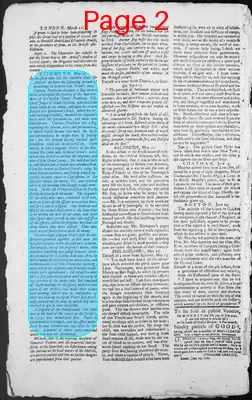
The New Hampshire Gazette And General Advertiser
Portsmouth, Exeter, Rockingham County, New Hampshire
What is this article about?
An attempted conspiracy to surprise General Greene's camp in the southern army was uncovered after sergeants were bribed by the British near Charleston. The plot involved seizing officers and marching the army to the enemy, but a sergeant's wife alerted Greene, leading to arrests and executions.
Clipping
OCR Quality
Full Text
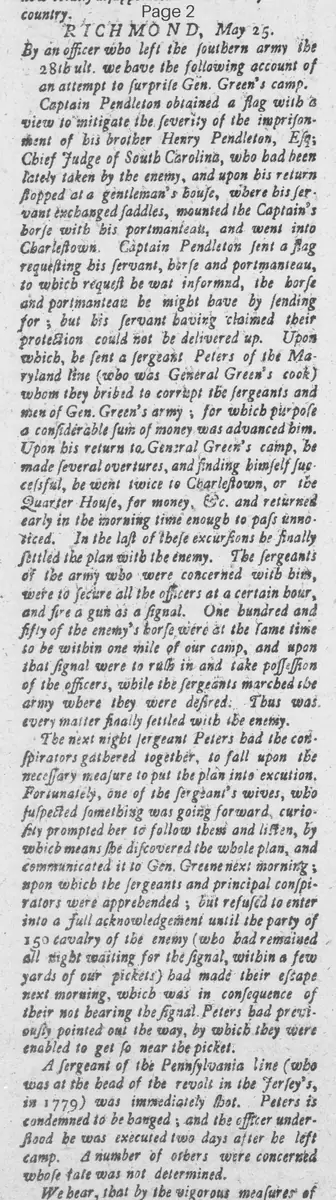
By an officer who left the southern army the 28th ult. we have the following account of an attempt to surprise Gen. Greene's camp.
Captain Pendleton obtained a flag with a view to mitigate the severity of the imprisonment of his brother Henry Pendleton, Esq: Chief Judge of South Carolina, who had been lately taken by the enemy, and upon his return stopped at a gentleman's house, where his servant exchanged saddles, mounted the Captain's horse with his portmanteau, and went into Charlestown. Captain Pendleton sent a flag requesting his servant, horse and portmanteau, to which request he was informed, the horse and portmanteau he might have by sending for; but his servant having claimed their protection could not be delivered up. Upon which, he sent a sergeant Peters of the Maryland line (who was General Greene's cook) whom they bribed to corrupt the sergeants and men of Gen. Greene's army: for which purpose a considerable sum of money was advanced him. Upon his return to General Greene's camp, he made several overtures, and finding himself successful, he went twice to Charlestown, or the Quarter House, for money, &c. and returned early in the morning time enough to pass unnoticed. In the last of these excursions he finally settled the plan with the enemy. The sergeants of the army who were concerned with him, were to seize all the officers at a certain hour, and fire a gun as a signal. One hundred and fifty of the enemy's horse were at the same time to be within one mile of our camp, and upon that signal were to rush in and take possession of the officers, while the sergeants marched the army where they were desired: Thus was every matter finally settled with the enemy.
The next night sergeant Peters had the conspirators gathered together, to fall upon the necessary measures to put the plan into execution. Fortunately, one of the sergeant's wives, who suspected something was going forward, curiously prompted her so follow them and listen, by which means she discovered the whole plan, and communicated it to Gen. Greene next morning: Upon which the sergeants and principal conspirators were apprehended; but refused to enter into a full acknowledgment until the party of 150 cavalry of the enemy (who had remained all night waiting for the signal, within a few yards of our pickets) had made their escape next morning, which was in consequence of their not hearing the signal. Peters had previously pointed out the way, by which they were enabled to get so near the picket.
A sergeant of the Pennsylvania line (who was at the head of the revolt in the Jerseys, in 1779) was immediately shot. Peters is condemned to be hanged; and the officer under whose command he was executed two days after he left camp. A number of others were concerned whose fate was not determined.
What sub-type of article is it?
What keywords are associated?
What entities or persons were involved?
Where did it happen?
Domestic News Details
Primary Location
Gen. Greene's Camp Near Charlestown
Event Date
28th Ult.
Key Persons
Outcome
a sergeant of the pennsylvania line was immediately shot. peters is condemned to be hanged; and the officer under whose command he was executed two days after he left camp. a number of others were concerned whose fate was not determined.
Event Details
Captain Pendleton's servant defected, leading to the bribing of sergeant Peters to corrupt sergeants in Gen. Greene's army. Peters organized a plot to seize officers, signal enemy cavalry, and march the army to the enemy. The plan was discovered by a sergeant's wife who informed Greene, resulting in apprehensions after the enemy cavalry escaped without the signal.