Thank you for visiting SNEWPapers!
Sign up free
Norfolk Gazette And Publick Ledger
Norfolk, Virginia
What is this article about?
American forces under Maj. Gen. Dearborn and Com. Chauncey captured York, Upper Canada, on April 27, 1813, after landing troops amid heavy fire, assaulting batteries, and suffering losses from an enemy magazine explosion that killed Brig. Gen. Pike. British Gen. Sheaffe retreated, leading to capitulation.
Clipping
OCR Quality
Full Text
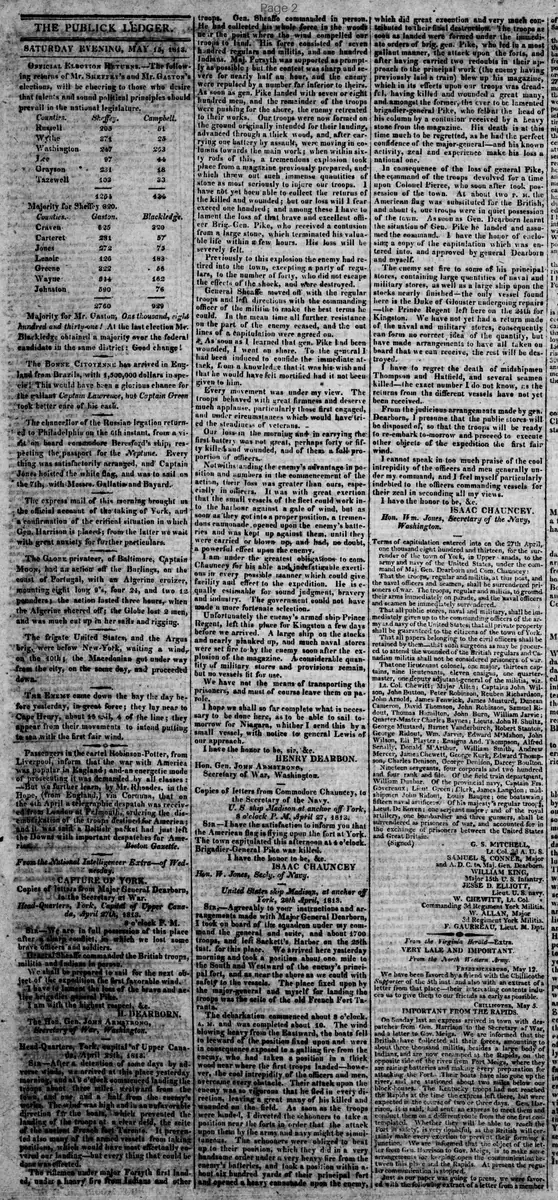
CAPTURE OF YORK!
Copies of letters from Major General Dearborn to the Secretary at War,
Head-Quarters, York, Capital of Upper Canada, April 27th, 1813.
Sir—We are in full possession of this place 8 o'clock P.M. after a sharp contest, in which we lost some brave officers and soldiers. As Gen. Sheaffe commanded the British troops militia and Indians in person: We shall be prepared to sail for the next object of this expedition the first favorable wind.
I have to lament the loss of the brave and active Brigadier General Pike,
With the highest respect,
DEARBORN
To Gen. John Armstrong,
Washington.
Head-Quarters, York, capital of Upper Canada,
April 29th, 1813.
Sir—After a detention of some days by adverse wind, we arrived at this place yesterday morning, and at 8 o'clock commenced landing the troops about three miles eastward from the town and one and a half from the enemy.
The wind was high and in an unfavorable direction for the boats which prevented the landing of the troops at a clear distance therefore of the ancient French fort Toronto. It prevented also many of the armed vessels from taking positions which would have most effectually covered our landing but every thing that could be done was effected.
The riflemen under Major Forsyth first landed under a heavy fire from Indians and other troops. Gen. Sheaffe commanded in person. He had collected his whole force in the woods near the point where the wind compelled our troops to land. His force consisted of seven hundred regulars and militia, and one hundred Indians. Maj. Forsyth was supported as promptly as possible; but the contest was sharp and severe for nearly half an hour, and the enemy were repulsed by a number far inferior to theirs.
As soon as gen. Pike landed with seven or eight hundred men, and the remainder of the troops were pushing for the shore, the enemy retreated to their works. Our troops were now formed on the ground originally intended for their landing. advanced through a thick wood, and after carrying one battery by assault, were moving in columns towards the main work; when within sixty rods of this, a tremendous explosion took place from a magazine previously prepared, and which threw out such immense quantities of stone as most seriously to injure our troops. I have not yet been able to collect the returns of the killed and wounded: but our loss will I fear exceed one hundred; and among these I have to lament the loss of that brave and excellent officer Brig. Gen. Pike, who received a contusion from a large stone, which terminated his valuable life within a few hours. His loss will be severely felt.
Previously to this explosion the enemy had retired into the town, excepting a party of regulars, to the number of forty, who did not escape the effects of the shock, and were destroyed.
General Sheaffe moved off with the regular troops and left directions with the commanding officer of the militia to make the best terms he could. In the mean time all farther resistance on the part of the enemy ceased, and the outlines of a capitulation were agreed on.
As soon as I learned that gen. Pike had been wounded, I went on shore. To the general I had been induced to confide the immediate attack, from a knowledge that it was his wish and that he would have felt mortified had it not been given to him.
Every movement was under my view. The troops behaved with great firmness and deserve much applause, particularly those first engaged, and under circumstances which would have tried the steadiness of veterans.
Our loss in the morning and in carrying the first battery was not great, perhaps forty or fifty killed and wounded, and of them a full proportion of officers.
Notwithstanding the enemy's advantage in position and numbers in the commencement of the action, their loss was greater than ours, especially in officers. It was with great exertion that the small vessels of the fleet could work into the harbour against a gale of wind, but as soon as they got into a proper position, a tremendous cannonade opened upon the enemy's batteries and was kept up against them, until they were carried or blown up and had no doubt a powerful effect upon the enemy.
I am under the greatest obligations to Com. Chauncey for his able and indefatigable exertions in every possible manner which could give facility and effect to the expedition. He is equally estimable for sound judgment, bravery and industry. The government could not have made a more fortunate selection.
Unfortunately the enemy's armed ship Prince Regent, left this place for Kingston a few days before we arrived. A large ship on the stocks and nearly planked up, and much naval stores were set fire to by the enemy soon after the explosion of the magazine. A considerable quantity of military stores and provisions remain, but no vessels fit for use.
We have not the means of transporting the prisoners, and must of course leave them on parole.
I hope we shall so far complete what is necessary to be done here, as to be able to sail tomorrow for Niagara, whither I send this by a small vessel, with notice to general Lewis of our approach.
I have the honor to be, sir, &c.
HENRY DEARBORN.
Hon. Gen. John Armstrong,
Secretary of War, Washington.
Copies of letters from Commodore Chauncey, to the Secretary of the Navy.
U. S. ship Madison at anchor off York,
9 o'clock P. M. April 27, 1813.
Sir—I have the satisfaction to inform you that the American flag is flying upon the fort at York. The town capitulated this afternoon at 4 o'clock.
Brigadier-General Pike was killed.
I have the honor to be, &c.
ISAAC CHAUNCEY
Hon. W. Jones, Sec'y. of Navy.
United States ship Madison, at anchor off
York. 28th April 1813.
Sir—Agreeably to your instructions and arrangements made with Major General Dearborn,
I took on board of the squadron under my command the general and suite, and about 1700 troops, and left Sackett's Harbor on the 25th inst. for this place. We arrived here yesterday morning and took a position about one mile to the South and Westward of the enemy's principal fort, and as near the shore as we could with safety to the vessels. The place fixed upon by the major-general and myself for landing the troops was the site of the old French Fort Toronto.
The debarkation commenced about 8 o'clock A. M. and was completed about 10. The wind blowing heavy from the Eastward, the boats fell to leeward of the position fixed upon and were in consequence exposed to a galling fire from the enemy, who had taken a position in a thick wood near where the first troops landed—however, the cool intrepidity of the officers and men, overcame every obstacle. Their attack upon the enemy was so vigorous that he fled in every direction, leaving a great many of his killed and wounded on the field. As soon as the troops were landed, I directed the schooners to take a position near the forts in order that the attack upon them by the army and navy might be simultaneous. The schooners were obliged to beat up to their position, which they did in a very handsome order under a very heavy fire from the enemy's batteries, and took a position within about six hundred yards of their principal fort and opened a heavy cannonade upon the enemy, which did great execution and very much contributed to their final destruction. The troops as soon as landed were formed under the immediate orders of brig. gen. Pike, who led in a most gallant manner, the attack upon the forts, and after having carried two redoubts in their approach to the principal work (the enemy having previously laid a train) blew up his magazine, which in its effects upon our troops was dreadful, having killed and wounded a great many, and amongst the former, the ever to be lamented brigadier-general Pike, who fell at the head of his column by a contusion received by a heavy stone from the magazine. His death is at this time much to be regretted, as he had the perfect confidence of the major-general and his known activity, zeal and experience make his loss a national one.
In consequence of the loss of general Pike, the command of the troops devolved for a time upon Colonel Pierce, who soon after took possession of the town. At about two p. m. the American flag was substituted for the British, and about one o'clock troops were in quiet possession of the town. As soon as Gen. Dearborn learnt the situation of Gen. Pike he landed and assumed the command. I have the honor of enclosing a copy of the capitulation which was entered into and approved by general Dearborn and myself.
The enemy set fire to some of his principal stores, containing large quantities of naval and military stores, as well as a large ship upon the stocks nearly finished—the only vessel found here is the Duke of Gloucester undergoing repairs—the Prince Regent left here on the 24th for Kingston. We have not yet had a return made of the naval and military stores, consequently can form no correct idea of the quantity, but have made arrangements to have all taken on board that we can receive, the rest will be destroyed.
I have to regret the death of midshipmen Thompson and Hatfield, and several seamen killed—the exact number I do not know, as the returns from the different vessels have not yet been received.
From the judicious arrangements made by gen. Dearborn, I presume that the public stores will be disposed of, so that the troops will be ready to re-embark to-morrow and proceed to execute other objects of the expedition the first fair wind.
I cannot speak in too much praise of the cool intrepidity of the officers and men generally under my command, and I feel myself particularly indebted to the officers commanding vessels for their zeal in seconding all my views.
I have the honor to be, &c.
ISAAC CHAUNCEY.
Hon. Wm. Jones, Secretary of the Navy,
Washington.
Terms of capitulation entered into on the 27th April, one thousand eight hundred and thirteen, for the surrender of the town of York, in Upper Canada, to the army and navy of the United States, under the command of Maj. Gen. Dearborn and Com. Chauncey:
That the troops, regular and militia, at this post, and the naval officers and seamen, shall be surrendered prisoners of war. The troops, regular and militia, to ground their arms immediately on parade, and the Naval officers and seamen be immediately surrendered.
That all public stores, naval and military, shall be immediately given up to the commanding officers of the army and navy of the United States; that all private property shall be guaranteed to the citizens of the town of York.
That all papers belonging to the civil officers shall be retained by them that such surgeons as may be procured to attend the wounded of the British regulars and Canadian militia shall not be considered prisoners of war.
That one lieutenant colonel, one major, thirteen captains, nine lieutenants, eleven ensigns, one quarter master, one deputy adjutant-general of the militia, viz. Lt. Col. Chewitt; Major Allen; Captains John Wilson, John Button, Peter Robinson, Reuben Richardson, John Arnold, James Fenwick, James Mustard, Duncan Cameron, David Thomson, John Robinson, Samuel Ridout, Thomas Hamilton, John Burn, William Jarvie; Quarter-Master Charles Baynes; Lieuts. John H. Shultz, George Mustard, Barnet Vanderburch, Robert Stanton, George Ridout, Wm. Jarvis, Edward M'Mahon, John Wilson, Eli Playter; Ensigns And. Thompson, Alfred Small, Donald M'Arthur, William Smith, Andrew Mercer, James Chewett, George Kirk, Edward Thompson, Charles Denison, George Denison, Darcy Boulton. Nineteen sergeants, four corporals and two hundred and four rank and file. Of the field train department. William Dunbar. Of the provincial navy, Captain Frs. Gaurreau; Lieut. Green; Clerk, James Langdon; midshipmen John Ridout, Louis Baupre; one boatswain; fifteen naval artificers. Of his majesty's regular troop Lieut, De Koven; one sergeant major; and of the royal artillery, one bombardier and three gunners, shall be surrendered as prisoners of war, and accounted for in the exchange of prisoners between the United States and Great Britain.
(Signed)
G. S. MITCHELL,
Lt. Col. 2d A. U. S.
SAMUEL S. CONNER, Major
and A. D. C. to Maj. Gen. Dearborn.
WILLIAM KING,
Major 15th U. S. Infantry.
JESSE D. ELLIOTT,
Lieut. U. S. navy.
W. CHEWITT. Lt. Col.
Commanding 3d Regiment York Militia
W. ALLAN, Major
3d Regiment York Militia.
F. GAURREAUX, Lieut M. Dept.
What sub-type of article is it?
What themes does it cover?
What keywords are associated?
What entities or persons were involved?
Where did it happen?
Story Details
Key Persons
Location
York, Upper Canada
Event Date
April 27, 1813
Story Details
American expedition under Dearborn and Chauncey landed troops near York despite adverse winds, engaged British forces led by Sheaffe, repulsed the enemy, assaulted batteries, suffered heavy losses from a magazine explosion killing Pike, captured the town, and secured capitulation terms including surrender of troops and stores.