Thank you for visiting SNEWPapers!
Sign up free
The New Dominion
Morgantown, Monongalia County, West Virginia
What is this article about?
Editorial in New Dominion discusses Judge Black's letter arguing railroads are public property subject to state and federal legislative control on rates and operations. George T. Curtis rebuts, viewing them as private property with limited regulation. Author mostly agrees with Curtis but supports moderate state regulation of maximum rates for public good, akin to ferries or interest rates.
Clipping
OCR Quality
Full Text
MORGANTOWN, W. VA.
Saturday January 1, 1881.
JUDGE BLACK'S LETTER AGAIN.
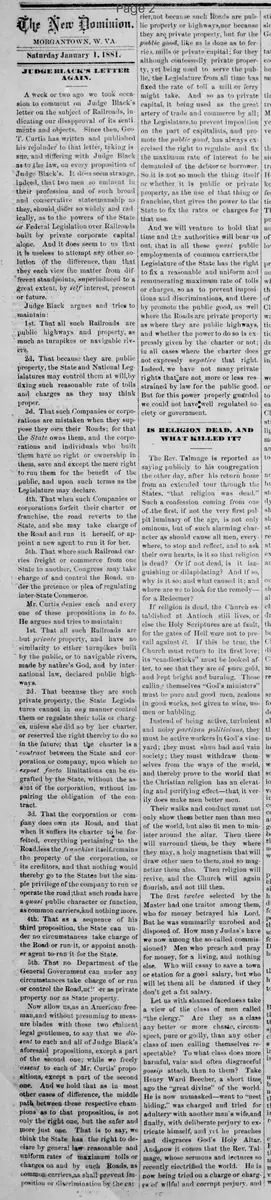
A week or two ago we took occasion to comment on Judge Black's letter on the subject of Railroads, indicating our disapproval of its sentiments and objects. Since then Geo T. Curtis has written and published his rejoinder to that letter, taking issue, and differing with Judge Black as to the law, on every proposition of Judge Black's. It does seem strange, indeed, that two men so eminent in their profession and of such broad and conservative statesmanship as they, should differ so widely and radically, as to the powers of the State or Federal Legislation over Railroads built by private corporate capital alone. And it does seem to us that it is useless to attempt any other solution of the difference, than that they each view the matter from different standpoints, superinduced to a great extent, by self interest, present or future.
Judge Black argues and tries to maintain:
1st. That all such Railroads are public highways and property, as much as turnpikes or navigable rivers.
2d. That because they are public property, the State and National Legislatures may control them at will, by fixing such reasonable rate of tolls and charges as they may think proper.
3d. That such Companies or corporations are mistaken when they suppose they own their Roads; for that the State owns them, and the corporations and individuals who built them have no right or ownership in them, save and except the mere right to run them for the benefit of the public, and upon such terms as the Legislature may declare
4th. That when such Companies or corporations forfeit their charter or franchise, the road reverts to the State, and she may take charge of the Road and run it herself, or appoint a new agent to run it for her.
5th. That where such Railroad carries freight or commerce from one State to another, Congress may take charge of and control the Road, under the pretence or plea of regulating inter-State Commerce.
Mr. Curtis denies each and every one of these propositions in toto.
He argues and tries to maintain:
1st. That all such Railroads are but private property, and have no similarity to either turnpikes built by the public, or to navigable rivers made by nature's God, and by international law declared public highways.
2d. That because they are such private property, the State Legislatures cannot in any manner control them or regulate their tolls or charges, unless she did so by her charter, or reserved the right thereby to do so in the future, that the charter is a contract between the State and corporation or company, upon which no ex post facto limitations can be engrafted by the State, without the assent of the corporation, without impairing the obligation of the contract.
3d. That the corporation or company does own its Road, and that when it suffers its charter to be forfeited, everything pertaining to the Road less the franchise itself, remains the property of the corporation, or its creditors, and that nothing would thereby go to the State but the simple privilege of the company to run or operate the road; that such roads have a quasi public character or function, as common carriers, and nothing more.
4th. That as a sequence of his third proposition, the State can under no circumstances take charge of the Road: or run it, or appoint another agent to run it for the State.
5th. That no Department of the General Government can under any circumstances take charge of or run, or control the Road, neither as private property nor as State property.
Now allow us, as an American freeman, and without presuming to measure blades with these two eminent legal gentlemen, to say that we dissent to each and all of Judge Black's aforesaid propositions, except a part of the second one; while we freely assent to each of Mr. Curtis' propositions, except a part of the second one. And we hold that as in most other cases of difference, the middle path between these respective champions as to that proposition, is not only the right one, but the safer and more just one. That is to say, we think the State has the right to declare by general law reasonable and uniform rates of maximum tolls or charges on and by such Roads, as common carriers, as shall prevent imposition or discrimination by the carrier, not because such Roads are public property or highways, nor because they are private property, but for the public good, like as is done as to ferries, mills or private capital; for they although confessedly private property, yet being used to serve the public, the Legislature from all time has fixed the rate of toll a mill or ferry might take. And so as to private capital, it being used as the great artery of trade and commerce by all: the Legislature, to prevent imposition on the part of capitalists, and promote the public good, has always exercised the right to regulate and fix the maximum rate of interest to be demanded of the debtor or borrower.
So it is not so much the thing itself or whether it is public or private property, as the use of that thing or franchise, that gives the power to the State to fix the rates or charges for that use.
And we will venture to hold that time and the authorities will bear us out, that in all these quasi public employments of common carriers, the Legislature of the State has the right to fix a reasonable and uniform and remunerating maximum rate of tolls or charges, so as to prevent impositions and discriminations, and thereby promote the public good, as well where the Roads are private property as where they are public highways and whether the power to do so is expressly given by the charter or not: in all cases where the charter does not expressly negative that right.
Indeed, we have not many private rights that are not more or less restrained by law for the public good. But for this power properly guarded we could not have well regulated society or government.
What sub-type of article is it?
What keywords are associated?
What entities or persons were involved?
Editorial Details
Primary Topic
Regulation Of Private Railroads By State And Federal Governments
Stance / Tone
Disagreement With Judge Black's Expansive State Control, Agreement With Curtis's Private Property View, Advocacy For Moderate State Regulation Of Rates For Public Good
Key Figures
Key Arguments