Thank you for visiting SNEWPapers!
Sign up free
The Virginia Gazette
Richmond, Williamsburg, Richmond County, Virginia
What is this article about?
In the House of Lords on December 19, debate on the American prohibiting bill included opposition from the Duke of Manchester and Marquis of Rockingham, citing alarming reports of losses in Canada and merchant concerns. Ministers defended the bill's urgency. The postponement motion failed, amendments were made in committee, and a protest was entered against prior proceedings.
Merged-components note: Continuation of the House of Lords debate on the American prohibiting bill across pages.
Clippings
1 of 2
OCR Quality
Full Text
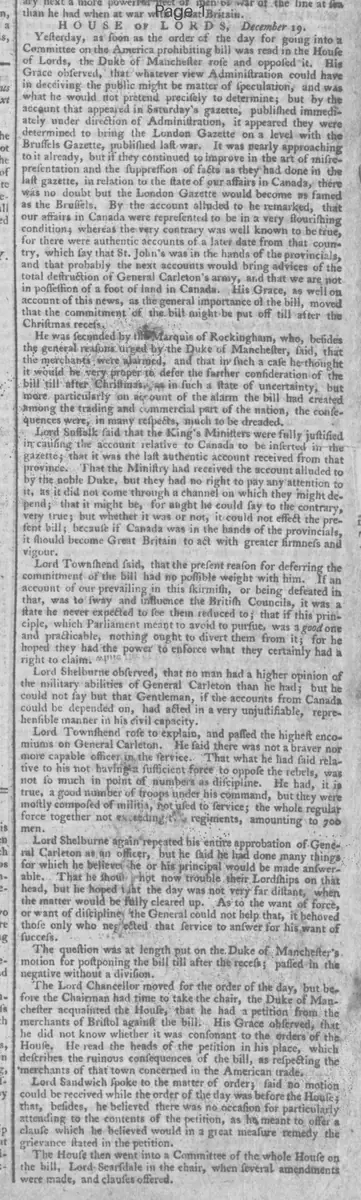
Yesterday, as soon as the order of the day for going into a Committee on the America prohibiting bill was read in the House of Lords, the Duke of Manchester rose and opposed it. His Grace observed, that whatever view Administration could have in deceiving the public might be matter of speculation, and was what he would not pretend precisely to determine; but by the account that appeared in Saturday's gazette, published immediately under direction of Administration, it appeared they were determined to bring the London Gazette on a level with the Brussels Gazette, published last war. It was nearly approaching to it already, but if they continued to improve in the art of misrepresentation and the suppression of facts as they had done in the last gazette, in relation to the state of our affairs in Canada, there was no doubt but the London Gazette would become as famed as the Brussels. By the account alluded to he remarked, that our affairs in Canada were represented to be in a very flourishing condition; whereas the very contrary was well known to be true, for there were authentic accounts of a later date from that country, which say that St. John's was in the hands of the provincials, and that probably the next accounts would bring advices of the total destruction of General Carleton's army, and that we are not in possession of a foot of land in Canada. His Grace, as well on account of this news, as the general importance of the bill, moved that the commitment of the bill might be put off till after the Christmas recess.
He was seconded by the Marquis of Rockingham, who, besides the general reasons urged by the Duke of Manchester, said, that the merchants were alarmed, and that in such a case he thought it would be very proper to defer the farther consideration of the bill till after Christmas, as in such a state of uncertainty, but more particularly on account of the alarm the bill had created among the trading and commercial part of the nation, the consequences were, in many respects, much to be dreaded.
Lord Suffolk said that the King's Ministers were fully justified in causing the account relative to Canada to be inserted in the gazette; that it was the last authentic account received from that province. That the Ministry had received the account alluded to by the noble Duke, but they had no right to pay any attention to it, as it did not come through a channel on which they might depend; that it might be, for aught he could say to the contrary, very true; but whether it was or not, it could not affect the present bill; because if Canada was in the hands of the provincials, it should become Great Britain to act with greater firmness and vigour.
Lord Townshend said, that the present reason for deferring the commitment of the bill had no possible weight with him. If an account of our prevailing in this skirmish, or being defeated in that, was to sway and influence the British Councils, it was a state he never expected to see them reduced to; that if this principle, which Parliament meant to avoid to pursue, was a good one and practicable, nothing ought to divert them from it; for he hoped they had the power to enforce what they certainly had a right to claim.
Lord Shelburne observed, that no man had a higher opinion of the military abilities of General Carleton than he had; but he could not say but that Gentleman, if the accounts from Canada could be depended on, had acted in a very unjustifiable, reprehensible manner in his civil capacity.
Lord Townshend rose to explain, and passed the highest encomiums on General Carleton. He said there was not a braver nor more capable officer in the service. That what he had said relative to his not having a sufficient force to oppose the rebels, was not so much in point of numbers as discipline. He had, it is true, a good number of troops under his command, but they were mostly composed of militia, not used to service; the whole regular force together not exceeding two regiments, amounting to 800 men.
Lord Shelburne again repeated his entire approbation of General Carleton as an officer, but he said he had done many things for which he believed he or his principal would be made answerable. That he would not now trouble their Lordships on that head, but he hoped that at the day was not very far distant, when the matter would be fully cleared up. As to the want of force, or want of discipline, the General could not help that, it behoved those only who selected that service to answer for his want of success.
The question was at length put on the Duke of Manchester's motion for postponing the bill till after the recess; passed in the negative without a division.
The Lord Chancellor moved for the order of the day, but before the Chairman had time to take the chair, the Duke of Manchester acquainted the House, that he had a petition from the merchants of Bristol against the bill. His Grace observed, that he did not know whether it was consonant to the orders of the House. He read the heads of the petition in his place, which describes the ruinous consequences of the bill, as respecting the merchants of that town concerned in the American trade.
Lord Sandwich spoke to the matter of order; said no motion could be received while the order of the day was before the House; that, besides, he believed there was no occasion for particularly attending to the contents of the petition, as he meant to offer a clause which he believed would in a great measure remedy the grievance stated in the petition.
The House then went into a Committee of the whole House on the bill, Lord Scarsdale in the chair, when several amendments were made, and clauses offered.
Lord Sandwich offered a clause to protect all vessels and their cargoes, if two thirds of which should appear to belong to British subjects.
Lord Dartmouth offered an amendment to the preamble and the concluding clause, to ascertain and show that the power of pardoning vested in his Majesty by the bill was inherent in him, and only given here to answer a particular purpose.
Lord Sandwich offered another clause in favour of the West India islands.
The bill being gone through, Lord Scarsdale left the chair, and a motion was made that the clauses and amendments be reported this day, which was agreed to.
A protest was yesterday entered against the proceedings of Friday last, upon the second reading of the American bill, and signed by the following Lords, viz. Abergavenny, Richmond, Rockingham, Ponsonby, Manchester, Fitzwilliam, Abingdon, Chedworth.
What sub-type of article is it?
What keywords are associated?
What entities or persons were involved?
Where did it happen?
Foreign News Details
Primary Location
Canada
Event Date
December 19
Key Persons
Outcome
motion to postpone bill until after christmas recess passed in the negative without division. bill went into committee with amendments offered to protect british-owned vessels, clarify royal pardon powers, and favor west india islands. protest entered against second reading by listed lords. reports indicated st. john's in hands of provincials and potential destruction of general carleton's army in canada.
Event Details
Duke of Manchester opposed committing the American prohibiting bill to committee, citing misleading Gazette accounts of Canada affairs and recent reports of provincial control over St. John's and likely defeat of Carleton's forces; moved postponement until after Christmas. Seconded by Marquis of Rockingham due to merchant alarm. Lord Suffolk defended Gazette insertion as latest authentic account and urged firmness if Canada lost. Lord Townshend dismissed military news as irrelevant to bill's principle. Lord Shelburne criticized Carleton's civil actions despite praising his military skills; Townshend defended Carleton's capabilities and force composition. Shelburne reiterated concerns. Petition from Bristol merchants read but not formally received due to order of day. Committee proceeded under Lord Scarsdale with amendments by Sandwich, Dartmouth, and another by Sandwich. Clauses and amendments reported same day.