Thank you for visiting SNEWPapers!
Sign up free
Literary
April 20, 1791
Gazette Of The United States
New York, New York County, New York
What is this article about?
In 'Discourses on Davila No. 31,' the author recounts French religious wars culminating in the 1572 St. Bartholomew's Day Massacre, driven by court intrigues and rivalries among nobles. It critiques the absence of constitutional balance leading to violence and despotism, advocating for equilibrated governments to mitigate emulations and parties.
Clipping
OCR Quality
95%
Excellent
Full Text
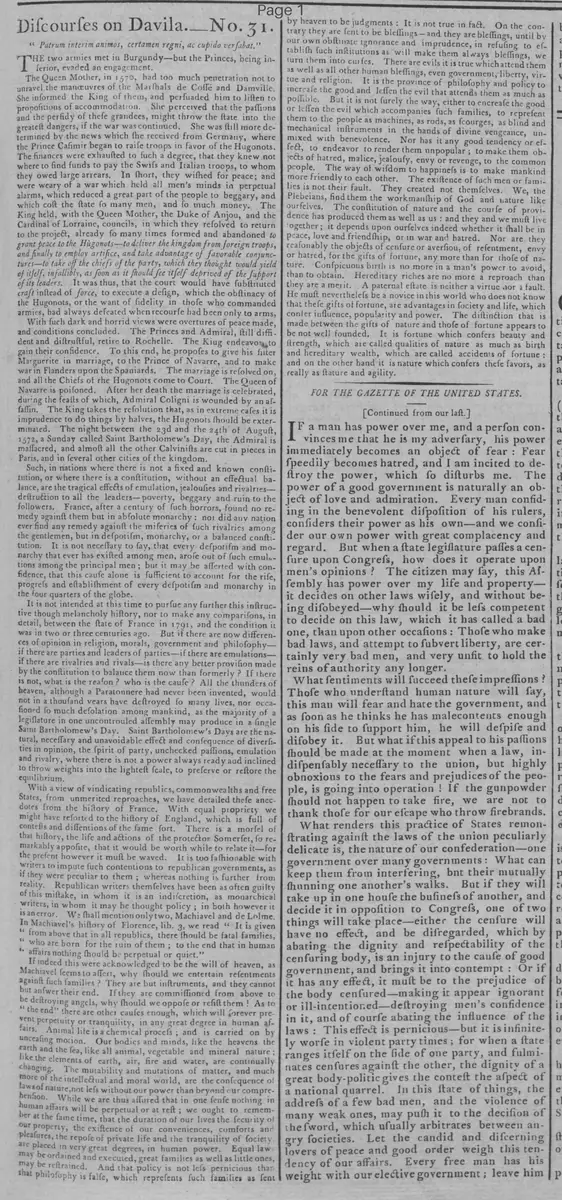
Discourses on Davila. No. 31.
"Patrum interim animos, certamen regni, ac cupido verabat."
THE two armies met in Burgundy—but the Princes, being inferior, evaded an engagement.
The Queen Mother, in 1570, had too much penetration not to unravel the manoeuvres of the Marshals de Cossé and Damville.
She informed the King of them, and persuaded him to listen to propositions of accommodation. She perceived that the passions and the perfidy of these grandees, might throw the state into the greatest dangers, if the war was continued. She was still more determined by the news which she received from Germany, where the Prince Casimir began to raise troops in favor of the Hugonots.
The finances were exhausted to such a degree, that they knew not where to find funds to pay the Swiss and Italian troops, to whom they owed large arrears. In short, they wished for peace; and were weary of a war which held all men's minds in perpetual alarms, which reduced a great part of the people to beggary, and which cost the state so many men, and so much money. The King held, with the Queen Mother, the Duke of Anjou, and the Cardinal of Lorraine, councils, in which they resolved to return to the project, already so many times formed and abandoned to grant peace to the Hugonots—to deliver the kingdom from foreign troops, and finally to employ artifice, and take advantage of favorable conjunctures—to take off the chiefs of the party, which they thought would yield of itself, infallibly, as soon as it should see itself deprived of the support of its leaders. It was thus, that the court would have substituted craft instead of force, to execute a design, which the obstinacy of the Hugonots, or the want of fidelity in those who commanded armies, had always defeated when recourse had been only to arms.
With such dark and horrid views were overtures of peace made, and conditions concluded. The Princes and Admiral, still diffident and distrustful, retire to Rochelle. The King endeavors to gain their confidence. To this end, he proposes to give his sister Marguerite in marriage, to the Prince of Navarre, and to make war in Flanders upon the Spaniards. The marriage is resolved on, and all the Chiefs of the Hugonots come to Court. The Queen of Navarre is poisoned. After her death the marriage is celebrated, during the feasts of which, Admiral Coligni is wounded by an assassin. The King takes the resolution that, as in extreme cases it is imprudence to do things by halves, the Hugonots should be exterminated. The night between the 23d and the 24th of August, 1572, a Sunday called Saint Bartholomew's Day, the Admiral is massacred, and almost all the other Calvinists are cut in pieces in Paris, and in several other cities of the kingdom.
Such, in nations where there is not a fixed and known constitution, or where there is a constitution, without an effectual balance, are the tragical effects of emulation, jealousies and rivalries—destruction to all the leaders—poverty, beggary and ruin to the followers. France, after a century of such horrors, found no remedy against them but in absolute monarchy: nor did any nation ever find any remedy against the miseries of such rivalries among the gentlemen, but in despotism, monarchy, or a balanced constitution. It is not necessary to say, that every despotism and monarchy that ever has existed among men, arose out of such emulations among the principal men; but it may be asserted with confidence, that this cause alone is sufficient to account for the rise, progress and establishment of every despotism and monarchy in the four quarters of the globe.
It is not intended at this time to pursue any further this instructive though melancholy history, nor to make any comparisons, in detail, between the state of France in 1791, and the condition it was in two or three centuries ago. But if there are now differences of opinion in religion, morals, government and philosophy—if there are parties and leaders of parties—if there are emulations—if there are rivalries and rivals—is there any better provision made by the constitution to balance them now than formerly? If there is not, what is the reason? who is the cause? All the thunders of heaven, although a Paratonnere had never been invented, would not in a thousand years have destroyed so many lives, nor occasioned so much desolation among mankind, as the majority of a legislature in one uncontrouled assembly may produce in a single Saint Bartholomew's Day. Saint Bartholomew's Days are the natural, necessary and unavoidable effect and consequence of diversities in opinion, the spirit of party, unchecked passions, emulation and rivalry, where there is not a power always ready and inclined to throw weights into the lightest scale, to preserve or restore the equilibrium.
With a view of vindicating republics, commonwealths and free States, from unmerited reproaches, we have detailed these anecdotes from the history of France. With equal propriety we might have resorted to the history of England, which is full of contests and dissensions of the same sort. There is a morsel of that history, the life and actions of the Protector Somerset, so remarkably apposite, that it would be worth while to relate it—for the present however it must be waived. It is too fashionable with writers to impute such contentions to republican governments, as if they were peculiar to them; whereas nothing is further from reality. Republican writers themselves have been as often guilty of this mistake, in whom it is an indiscretion, as monarchical writers, in whom it may be thought policy; in both however it is an error. We shall mention only two, Machiavel and de Lolme.
In Machiavel's history of Florence, lib. 3, we read "It is given from above that in all republics, there should be fatal families, who are born for the ruin of them; to the end that in human affairs nothing should be perpetual or quiet."
If indeed this were acknowledged to be the will of heaven, as Machiavel seems to assert, why should we entertain resentments against such families? They are but instruments, and they cannot but answer their end. If they are commissioned from above to be destroying angels, why should we oppose or resist them! As to "the end" there are other causes enough, which will forever prevent perpetuity or tranquility, in any great degree in human affairs. Animal life is a chemical process; and is carried on by unceasing motion.
Our bodies and minds, like the heavens the earth and the sea, like all animal, vegetable and mineral nature; like the elements of earth, air, fire and water, are continually changing. The mutability and mutations of matter, and much more of the intellectual and moral world, are the consequence of laws of nature, not less without our power than beyond our comprehension. While we are thus assured that in one sense nothing in human affairs will be perpetual or at rest; we ought to remember at the same time, that the duration of our lives the security of our property, the existence of our conveniences, comforts and pleasures, the repose of private life and the tranquility of society are placed in very great degrees, in human power. Equal law may be ordained and executed, great families as well as little ones, may be restrained. And that policy is not less pernicious than that philosophy is false, which represents such families as sent
"Patrum interim animos, certamen regni, ac cupido verabat."
THE two armies met in Burgundy—but the Princes, being inferior, evaded an engagement.
The Queen Mother, in 1570, had too much penetration not to unravel the manoeuvres of the Marshals de Cossé and Damville.
She informed the King of them, and persuaded him to listen to propositions of accommodation. She perceived that the passions and the perfidy of these grandees, might throw the state into the greatest dangers, if the war was continued. She was still more determined by the news which she received from Germany, where the Prince Casimir began to raise troops in favor of the Hugonots.
The finances were exhausted to such a degree, that they knew not where to find funds to pay the Swiss and Italian troops, to whom they owed large arrears. In short, they wished for peace; and were weary of a war which held all men's minds in perpetual alarms, which reduced a great part of the people to beggary, and which cost the state so many men, and so much money. The King held, with the Queen Mother, the Duke of Anjou, and the Cardinal of Lorraine, councils, in which they resolved to return to the project, already so many times formed and abandoned to grant peace to the Hugonots—to deliver the kingdom from foreign troops, and finally to employ artifice, and take advantage of favorable conjunctures—to take off the chiefs of the party, which they thought would yield of itself, infallibly, as soon as it should see itself deprived of the support of its leaders. It was thus, that the court would have substituted craft instead of force, to execute a design, which the obstinacy of the Hugonots, or the want of fidelity in those who commanded armies, had always defeated when recourse had been only to arms.
With such dark and horrid views were overtures of peace made, and conditions concluded. The Princes and Admiral, still diffident and distrustful, retire to Rochelle. The King endeavors to gain their confidence. To this end, he proposes to give his sister Marguerite in marriage, to the Prince of Navarre, and to make war in Flanders upon the Spaniards. The marriage is resolved on, and all the Chiefs of the Hugonots come to Court. The Queen of Navarre is poisoned. After her death the marriage is celebrated, during the feasts of which, Admiral Coligni is wounded by an assassin. The King takes the resolution that, as in extreme cases it is imprudence to do things by halves, the Hugonots should be exterminated. The night between the 23d and the 24th of August, 1572, a Sunday called Saint Bartholomew's Day, the Admiral is massacred, and almost all the other Calvinists are cut in pieces in Paris, and in several other cities of the kingdom.
Such, in nations where there is not a fixed and known constitution, or where there is a constitution, without an effectual balance, are the tragical effects of emulation, jealousies and rivalries—destruction to all the leaders—poverty, beggary and ruin to the followers. France, after a century of such horrors, found no remedy against them but in absolute monarchy: nor did any nation ever find any remedy against the miseries of such rivalries among the gentlemen, but in despotism, monarchy, or a balanced constitution. It is not necessary to say, that every despotism and monarchy that ever has existed among men, arose out of such emulations among the principal men; but it may be asserted with confidence, that this cause alone is sufficient to account for the rise, progress and establishment of every despotism and monarchy in the four quarters of the globe.
It is not intended at this time to pursue any further this instructive though melancholy history, nor to make any comparisons, in detail, between the state of France in 1791, and the condition it was in two or three centuries ago. But if there are now differences of opinion in religion, morals, government and philosophy—if there are parties and leaders of parties—if there are emulations—if there are rivalries and rivals—is there any better provision made by the constitution to balance them now than formerly? If there is not, what is the reason? who is the cause? All the thunders of heaven, although a Paratonnere had never been invented, would not in a thousand years have destroyed so many lives, nor occasioned so much desolation among mankind, as the majority of a legislature in one uncontrouled assembly may produce in a single Saint Bartholomew's Day. Saint Bartholomew's Days are the natural, necessary and unavoidable effect and consequence of diversities in opinion, the spirit of party, unchecked passions, emulation and rivalry, where there is not a power always ready and inclined to throw weights into the lightest scale, to preserve or restore the equilibrium.
With a view of vindicating republics, commonwealths and free States, from unmerited reproaches, we have detailed these anecdotes from the history of France. With equal propriety we might have resorted to the history of England, which is full of contests and dissensions of the same sort. There is a morsel of that history, the life and actions of the Protector Somerset, so remarkably apposite, that it would be worth while to relate it—for the present however it must be waived. It is too fashionable with writers to impute such contentions to republican governments, as if they were peculiar to them; whereas nothing is further from reality. Republican writers themselves have been as often guilty of this mistake, in whom it is an indiscretion, as monarchical writers, in whom it may be thought policy; in both however it is an error. We shall mention only two, Machiavel and de Lolme.
In Machiavel's history of Florence, lib. 3, we read "It is given from above that in all republics, there should be fatal families, who are born for the ruin of them; to the end that in human affairs nothing should be perpetual or quiet."
If indeed this were acknowledged to be the will of heaven, as Machiavel seems to assert, why should we entertain resentments against such families? They are but instruments, and they cannot but answer their end. If they are commissioned from above to be destroying angels, why should we oppose or resist them! As to "the end" there are other causes enough, which will forever prevent perpetuity or tranquility, in any great degree in human affairs. Animal life is a chemical process; and is carried on by unceasing motion.
Our bodies and minds, like the heavens the earth and the sea, like all animal, vegetable and mineral nature; like the elements of earth, air, fire and water, are continually changing. The mutability and mutations of matter, and much more of the intellectual and moral world, are the consequence of laws of nature, not less without our power than beyond our comprehension. While we are thus assured that in one sense nothing in human affairs will be perpetual or at rest; we ought to remember at the same time, that the duration of our lives the security of our property, the existence of our conveniences, comforts and pleasures, the repose of private life and the tranquility of society are placed in very great degrees, in human power. Equal law may be ordained and executed, great families as well as little ones, may be restrained. And that policy is not less pernicious than that philosophy is false, which represents such families as sent
What sub-type of article is it?
Essay
What themes does it cover?
Political
Liberty Freedom
War Peace
What keywords are associated?
French Religious Wars
St Bartholomews Massacre
Political Rivalries
Constitutional Balance
Huguenots
Despotism
Republican Government
Literary Details
Title
Discourses On Davila. No. 31.
Key Lines
Such, In Nations Where There Is Not A Fixed And Known Constitution, Or Where There Is A Constitution, Without An Effectual Balance, Are The Tragical Effects Of Emulation, Jealousies And Rivalries—Destruction To All The Leaders—Poverty, Beggary And Ruin To The Followers.
Saint Bartholomew's Days Are The Natural, Necessary And Unavoidable Effect And Consequence Of Diversities In Opinion, The Spirit Of Party, Unchecked Passions, Emulation And Rivalry, Where There Is Not A Power Always Ready And Inclined To Throw Weights Into The Lightest Scale, To Preserve Or Restore The Equilibrium.
It Is Not Necessary To Say, That Every Despotism And Monarchy That Ever Has Existed Among Men, Arose Out Of Such Emulations Among The Principal Men; But It May Be Asserted With Confidence, That This Cause Alone Is Sufficient To Account For The Rise, Progress And Establishment Of Every Despotism And Monarchy In The Four Quarters Of The Globe.
In Machiavel's History Of Florence, Lib. 3, We Read "It Is Given From Above That In All Republics, There Should Be Fatal Families, Who Are Born For The Ruin Of Them; To The End That In Human Affairs Nothing Should Be Perpetual Or Quiet."