Thank you for visiting SNEWPapers!
Sign up free
Editorial
June 24, 1803
The National Intelligencer And Washington Advertiser
Washington, District Of Columbia
What is this article about?
An anonymous Whig critiques modern Federalism as seeking war-driven aggrandizement, oppression, debt, and British-style government, contrasting it with Republican peace and economy. References Adams-Hamilton rift during XYZ affair and recent provocations.
Merged-components note: These components are a continuation of the same editorial piece from the Albany Register critiquing federalism, Adams, and Hamilton.
Clipping
OCR Quality
95%
Excellent
Full Text
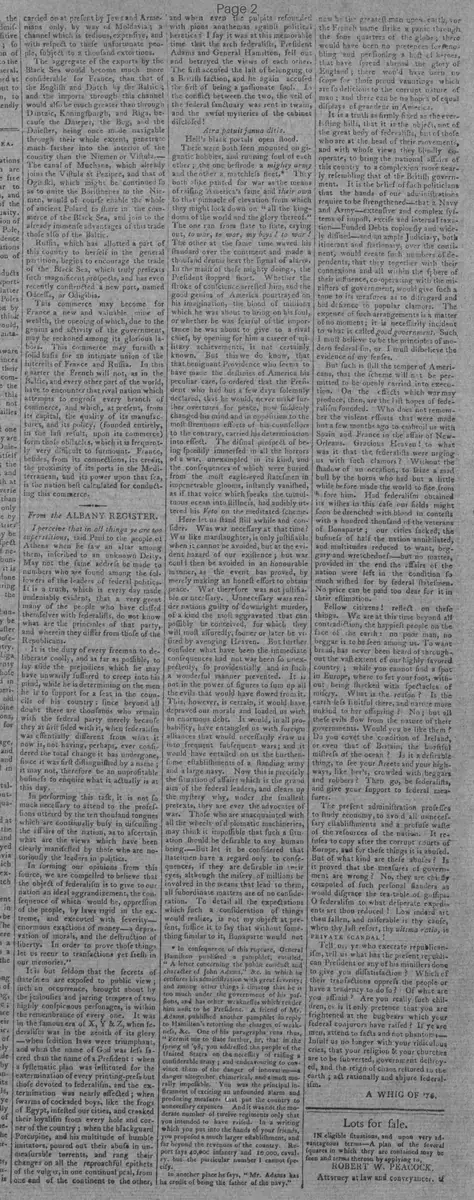
From the ALBANY REGISTER.
I perceive that in all things ye are too superstitious, said Paul to the people of Athens when he saw an altar among them, inscribed to an unknown Deity. May not the same address be made to numbers who are found among the followers of the leaders of federal politics.
It is a truth, which is every day made undeniably evident, that a very great many of the people who have classed themselves with federalists, do not know what are the principles of that party, and wherein they differ from those of the Republicans.
It is the duty of every freeman to deliberate coolly, and as far as possible, to lay aside the prejudices which he may have unwarily suffered to creep into his mind, while he is determining on the men he is to support for a seat in the councils of his country: since beyond all doubt there are thousands who remain with the federal party merely because they at first sided with it, when federalism was essentially different from what it now is, not having, perhaps, ever considered the total change it has undergone, since it was first distinguished by a name; it may not, therefore be an unprofitable business to enquire what it actually is at this day.
In performing this task, it is not so much necessary to attend to the professions uttered by the ten thousand tongues which are continually busy in discussing the affairs of the nation, as to ascertain what are the views which have been clearly manifested by those who are notoriously the leaders in politics.
In forming our opinions from this source, we are compelled to believe that the object of federalism is to give to our nation an ideal aggrandizement, the consequence of which would be, oppression of the people, by laws rigid in the extreme, and executed with severity—enormous exactions of money—a depravation of morals, and the destruction of liberty. In order to prove these things let us recur to transactions yet fresh in our memories.
It is but seldom that the secrets of statesmen are exposed to public view; such an occurrence, brought about by the jealousies and jarring tempers of two highly conspicuous personages, is within the remembrance of every one. It was in the famous era of X, Y & Z, when federalism was in the zenith of its glory—when sedition laws were triumphant, and when the name of God was less sacred than the name of a President: when a systematic plan was instituted for the extermination of every printing-press but those devoted to federalism, and the extermination was nearly effected; when swarms of cockaded boys, like the frogs of Egypt, infested our cities, and croaked their loyalty from every hole and corner of the country; when the blackguard Porcupine, and his multitude of humble imitators, poured out their abuse in unmeasurable torrents, and rang their changes on all the reproachful epithets of the vulgar, in one continual peal, from one end of the continent to the other, and when even the pulpits reechoed with pious anathemas against political heretics: I say it was at this memorable time that the arch federalists, President Adams and General Hamilton, fell out and betrayed the views of each other.
The first accused the last of belonging to a British faction, and he again accused the first of being a passionate fool. In the conflict between the two, the veil of the federal sanctuary was rent in twain, and the awful mysteries of the cabinet disclosed!
Atra patuit janua Ditis.
Hell's black portals open stood.
These were both seen mounted on gigantic hobbies, and running foul of each other; the one bestrode a mighty army and the other a matchless fleet. * They both alike panted for war as the means of raising America's fame and their own to that pinnacle of elevation from which they might look down on "all the kingdoms of the world and the glory thereof."
The one ran from state to state, crying out, to war, to war, my boys! to war! The other at the same time waved his standard over the continent and made a thousand drums beat the signal of alarms.
In the midst of these mighty doings, the President stopped short. Whether the stroke of conscience arrested him, and the good genius of America portrayed on his imagination, the blood of millions which he was about to bring on his soul, or whether he was fearful of the importance he was about to give to a rival chief, by opening for him a career of military achievements, is not certainly known. But this we do know, that that benignant Providence who seems to have made the destinies of America his peculiar care, so ordered that the President who had but a few days solemnly declared, that he would, never make further overtures for peace, now suddenly changed his mind and in opposition to the most strenuous efforts of his counsellors to the contrary, carried his determination into effect. The dismal prospect of being speedily immersed in all the horrors of a war, unexampled in its kind, and the consequences of which were buried from the most eagle-eyed statesmen in impenetrable glooms, instantly vanished, as if that voice which breaks the tumultuous ocean into stillness, had audibly uttered his Veto on the meditated scheme.
Here let us stand still awhile and consider. Was war necessary at that time? War like manslaughter, is only justifiable when it cannot be avoided, but at the evident hazard of our existence; but war could then be avoided in an honourable manner, as the event has proved, by merely making an honest effort to obtain peace. War therefore was not justifiable or necessary. Unnecessary wars render nations guilty of downright murder, of a kind the most aggravated that can possibly be conceived, for which they will most assuredly, sooner or later be visited by avenging Heaven. But further consider what have been the immediate consequences had not war been so unexpectedly, so providentially and in such a wonderful manner prevented. It is not in the power of figures to sum up all the evils that would have flowed from it. This, however, is certain, it would have depraved our morals and loaded us with an enormous debt. It would, in all probability, have entangled us with foreign alliances that would necessarily draw us into frequent subsequent wars; and it would have entailed on us the burthensome establishments of a standing army and a large navy. Now this is precisely the situation of affairs which is the grand aim of the federal leaders, and clears up the mystery why, under the smallest pretexts, they are ever the advocates of war. Those who are unacquainted with all the wheels of diplomatic machineries, may think it impossible that such a situation should be desirable to any human being.—But let it be considered that statesmen have a regard only to consequences, if they are desirable in their eyes, although the misery of millions be involved in the means that lead to them, all subordinate matters are of no consideration. To detail all the expectations which such a consideration of things would realize, is not my object at present, suffice it to say that without something similar to it, Bonaparte would not
In consequence of this rupture, General Hamilton published a pamphlet, entitled. "A letter concerning the public conduct and character of John Adams," &c. in which he censures his administration with great severity; and among other things intimates that he is too much under the government of his passions, and has other weaknesses which render him unfit to be President. A friend of Mr. Adams, published another pamphlet in reply to Hamilton's retorting the charges of weakness, &c. One of his paragraphs runs thus,
"Permit me to state further, sir, that in the spring of '98, you addressed the people of the United States on the necessity of raising a considerable army; and endeavouring to convince them of the danger of invasion—a danger altogether chimerical, and almost morally impossible, 'You was the principal instrument of exciting an unfounded alarm and producing measures that put the country to unnecessary expenses And it was not the moderate number of twelve regiments only that you intended to have raised. In a writing which you put into the hands of your friends, you proposed a much larger establishment, and far beyond the revenues of the country. Report says 40,000 infantry and 10,000, cavalry, but the particular number I cannot specify."
In another place he says, "Mr. Adams has the credit of being the father of the navy."
now be the great man upon earth, nor the French name strike a panic through the four quarters of the globe; there would have been no pretences for enlisting and pensioning a host of heroes, that have spread abroad the glory of England; there would have been no scope for those proud vauntings which are so delicious to the corrupt nature of man; and there can be no hopes of equal displays of grandeur in America.
It is a truth as firmly fixed as the everlasting hills, that it is the object, not of the great body of federalists, but of those who are at the head of their movements, and with whose views they blindly co-operate, to bring the national affairs of this country to a complexion more nearly resembling that of the British government. It is the belief of such politicians that the hands of our administrations require to be strengthened that a Navy and Army—extensive and complex systems of impost, excise and internal taxation—Funded Debts copiously and widely diffused—and an ample Judiciary, both itinerant and stationary. over the continent, would create such numbers of dependents, that they together with their Connections and all within the sphere of their influence, co-operating with the ministers of government, would give such a tone to its measures as to disregard and bid defiance to popular clamors. The expense of such arrangements is a matter of no moment; it is necessarily incident to what is called good government. Such I must believe to be the principles of modern federalism, or I must disbelieve the evidence of my senses.
But such is still the temper of Americans, that the scheme will not be permitted to be openly carried into execution. On the effects which war may produce, then, are the last hopes of federalism founded. Who does not remember the violent efforts that were made but a few months ago to embroil us with Spain and France in the affair of New-Orleans. Gracious Heaven! to what was it that the federalists were urging us with such clamors? Without the shadow of an occasion, to seize a mad bull by the horns who had but a little while before made the world to flee from before him. Had federalism obtained its wishes in this case our fields might soon be drenched with blood in contests with a hundred thousand of the veterans of Bonaparte; our cities sacked, the business of half the nation annihilated, and multitudes reduced to want, beggary and wretchedness—but no matter, provided in the end the affairs of the nation were left in the condition so much wished for by federal statesmen.
No price can be paid too dear for it in their estimation.
Fellow citizens! reflect on these things. We are at this time beyond all contradiction, the happiest people on the face of the earth: no poor man, no beggar is to be seen among us. To want bread, has never been heard of throughout the vast extent of our highly favored country; while you cannot find a spot in Europe, where to set your foot, without being shocked with spectacles of misery. What is the reason? Is the earth less fruitful here, and nature more unkind to her offspring? No; but all these evils flow from the nature of their governments. Would you be like them? Do you covet the condition of Ireland. or even that of Britain, the boastful mistress of the ocean? Is it a desirable thing, to see your streets and your highways, like hers, crowded with beggars and robbers? Then go, be federalists, and give your support to federal measures.
The present administration professes to study economy, to avoid all unnecessary establishments and a profuse waste of the resources of the nation. It refuses to copy after the corrupt courts of Europe, and for these things it is abused. But of what kind are these abuses? Is it proved that the measures of government are wrong? No, they are chiefly composed of such personal slanders as would disgrace the tea-table of gossips. O federalism to what desperate expedients art thou reduced! Low indeed art thou fallen, and miserable is thy cause, when thy last resort, thy ultima ratio, is PRIVATE SCANDAL!
Tell us, ye who execrate republicanism, tell us what has the present republican President or any of his ministers done to give you dissatisfaction? Which of their transactions oppress the people or have a tendency to do so? Of what are you afraid? Are you really such children, or is it only pretence that you are frightened at the bugbears which your federal conjurors have raised? If ye are men, attend to facts and not phantoms—Insult us no longer with your ridiculous cries, that your religion & your churches are to be subverted, government destroyed, and the reign of chaos restored to the earth; act rationally and abjure federalism.
A WHIG OF 76.
I perceive that in all things ye are too superstitious, said Paul to the people of Athens when he saw an altar among them, inscribed to an unknown Deity. May not the same address be made to numbers who are found among the followers of the leaders of federal politics.
It is a truth, which is every day made undeniably evident, that a very great many of the people who have classed themselves with federalists, do not know what are the principles of that party, and wherein they differ from those of the Republicans.
It is the duty of every freeman to deliberate coolly, and as far as possible, to lay aside the prejudices which he may have unwarily suffered to creep into his mind, while he is determining on the men he is to support for a seat in the councils of his country: since beyond all doubt there are thousands who remain with the federal party merely because they at first sided with it, when federalism was essentially different from what it now is, not having, perhaps, ever considered the total change it has undergone, since it was first distinguished by a name; it may not, therefore be an unprofitable business to enquire what it actually is at this day.
In performing this task, it is not so much necessary to attend to the professions uttered by the ten thousand tongues which are continually busy in discussing the affairs of the nation, as to ascertain what are the views which have been clearly manifested by those who are notoriously the leaders in politics.
In forming our opinions from this source, we are compelled to believe that the object of federalism is to give to our nation an ideal aggrandizement, the consequence of which would be, oppression of the people, by laws rigid in the extreme, and executed with severity—enormous exactions of money—a depravation of morals, and the destruction of liberty. In order to prove these things let us recur to transactions yet fresh in our memories.
It is but seldom that the secrets of statesmen are exposed to public view; such an occurrence, brought about by the jealousies and jarring tempers of two highly conspicuous personages, is within the remembrance of every one. It was in the famous era of X, Y & Z, when federalism was in the zenith of its glory—when sedition laws were triumphant, and when the name of God was less sacred than the name of a President: when a systematic plan was instituted for the extermination of every printing-press but those devoted to federalism, and the extermination was nearly effected; when swarms of cockaded boys, like the frogs of Egypt, infested our cities, and croaked their loyalty from every hole and corner of the country; when the blackguard Porcupine, and his multitude of humble imitators, poured out their abuse in unmeasurable torrents, and rang their changes on all the reproachful epithets of the vulgar, in one continual peal, from one end of the continent to the other, and when even the pulpits reechoed with pious anathemas against political heretics: I say it was at this memorable time that the arch federalists, President Adams and General Hamilton, fell out and betrayed the views of each other.
The first accused the last of belonging to a British faction, and he again accused the first of being a passionate fool. In the conflict between the two, the veil of the federal sanctuary was rent in twain, and the awful mysteries of the cabinet disclosed!
Atra patuit janua Ditis.
Hell's black portals open stood.
These were both seen mounted on gigantic hobbies, and running foul of each other; the one bestrode a mighty army and the other a matchless fleet. * They both alike panted for war as the means of raising America's fame and their own to that pinnacle of elevation from which they might look down on "all the kingdoms of the world and the glory thereof."
The one ran from state to state, crying out, to war, to war, my boys! to war! The other at the same time waved his standard over the continent and made a thousand drums beat the signal of alarms.
In the midst of these mighty doings, the President stopped short. Whether the stroke of conscience arrested him, and the good genius of America portrayed on his imagination, the blood of millions which he was about to bring on his soul, or whether he was fearful of the importance he was about to give to a rival chief, by opening for him a career of military achievements, is not certainly known. But this we do know, that that benignant Providence who seems to have made the destinies of America his peculiar care, so ordered that the President who had but a few days solemnly declared, that he would, never make further overtures for peace, now suddenly changed his mind and in opposition to the most strenuous efforts of his counsellors to the contrary, carried his determination into effect. The dismal prospect of being speedily immersed in all the horrors of a war, unexampled in its kind, and the consequences of which were buried from the most eagle-eyed statesmen in impenetrable glooms, instantly vanished, as if that voice which breaks the tumultuous ocean into stillness, had audibly uttered his Veto on the meditated scheme.
Here let us stand still awhile and consider. Was war necessary at that time? War like manslaughter, is only justifiable when it cannot be avoided, but at the evident hazard of our existence; but war could then be avoided in an honourable manner, as the event has proved, by merely making an honest effort to obtain peace. War therefore was not justifiable or necessary. Unnecessary wars render nations guilty of downright murder, of a kind the most aggravated that can possibly be conceived, for which they will most assuredly, sooner or later be visited by avenging Heaven. But further consider what have been the immediate consequences had not war been so unexpectedly, so providentially and in such a wonderful manner prevented. It is not in the power of figures to sum up all the evils that would have flowed from it. This, however, is certain, it would have depraved our morals and loaded us with an enormous debt. It would, in all probability, have entangled us with foreign alliances that would necessarily draw us into frequent subsequent wars; and it would have entailed on us the burthensome establishments of a standing army and a large navy. Now this is precisely the situation of affairs which is the grand aim of the federal leaders, and clears up the mystery why, under the smallest pretexts, they are ever the advocates of war. Those who are unacquainted with all the wheels of diplomatic machineries, may think it impossible that such a situation should be desirable to any human being.—But let it be considered that statesmen have a regard only to consequences, if they are desirable in their eyes, although the misery of millions be involved in the means that lead to them, all subordinate matters are of no consideration. To detail all the expectations which such a consideration of things would realize, is not my object at present, suffice it to say that without something similar to it, Bonaparte would not
In consequence of this rupture, General Hamilton published a pamphlet, entitled. "A letter concerning the public conduct and character of John Adams," &c. in which he censures his administration with great severity; and among other things intimates that he is too much under the government of his passions, and has other weaknesses which render him unfit to be President. A friend of Mr. Adams, published another pamphlet in reply to Hamilton's retorting the charges of weakness, &c. One of his paragraphs runs thus,
"Permit me to state further, sir, that in the spring of '98, you addressed the people of the United States on the necessity of raising a considerable army; and endeavouring to convince them of the danger of invasion—a danger altogether chimerical, and almost morally impossible, 'You was the principal instrument of exciting an unfounded alarm and producing measures that put the country to unnecessary expenses And it was not the moderate number of twelve regiments only that you intended to have raised. In a writing which you put into the hands of your friends, you proposed a much larger establishment, and far beyond the revenues of the country. Report says 40,000 infantry and 10,000, cavalry, but the particular number I cannot specify."
In another place he says, "Mr. Adams has the credit of being the father of the navy."
now be the great man upon earth, nor the French name strike a panic through the four quarters of the globe; there would have been no pretences for enlisting and pensioning a host of heroes, that have spread abroad the glory of England; there would have been no scope for those proud vauntings which are so delicious to the corrupt nature of man; and there can be no hopes of equal displays of grandeur in America.
It is a truth as firmly fixed as the everlasting hills, that it is the object, not of the great body of federalists, but of those who are at the head of their movements, and with whose views they blindly co-operate, to bring the national affairs of this country to a complexion more nearly resembling that of the British government. It is the belief of such politicians that the hands of our administrations require to be strengthened that a Navy and Army—extensive and complex systems of impost, excise and internal taxation—Funded Debts copiously and widely diffused—and an ample Judiciary, both itinerant and stationary. over the continent, would create such numbers of dependents, that they together with their Connections and all within the sphere of their influence, co-operating with the ministers of government, would give such a tone to its measures as to disregard and bid defiance to popular clamors. The expense of such arrangements is a matter of no moment; it is necessarily incident to what is called good government. Such I must believe to be the principles of modern federalism, or I must disbelieve the evidence of my senses.
But such is still the temper of Americans, that the scheme will not be permitted to be openly carried into execution. On the effects which war may produce, then, are the last hopes of federalism founded. Who does not remember the violent efforts that were made but a few months ago to embroil us with Spain and France in the affair of New-Orleans. Gracious Heaven! to what was it that the federalists were urging us with such clamors? Without the shadow of an occasion, to seize a mad bull by the horns who had but a little while before made the world to flee from before him. Had federalism obtained its wishes in this case our fields might soon be drenched with blood in contests with a hundred thousand of the veterans of Bonaparte; our cities sacked, the business of half the nation annihilated, and multitudes reduced to want, beggary and wretchedness—but no matter, provided in the end the affairs of the nation were left in the condition so much wished for by federal statesmen.
No price can be paid too dear for it in their estimation.
Fellow citizens! reflect on these things. We are at this time beyond all contradiction, the happiest people on the face of the earth: no poor man, no beggar is to be seen among us. To want bread, has never been heard of throughout the vast extent of our highly favored country; while you cannot find a spot in Europe, where to set your foot, without being shocked with spectacles of misery. What is the reason? Is the earth less fruitful here, and nature more unkind to her offspring? No; but all these evils flow from the nature of their governments. Would you be like them? Do you covet the condition of Ireland. or even that of Britain, the boastful mistress of the ocean? Is it a desirable thing, to see your streets and your highways, like hers, crowded with beggars and robbers? Then go, be federalists, and give your support to federal measures.
The present administration professes to study economy, to avoid all unnecessary establishments and a profuse waste of the resources of the nation. It refuses to copy after the corrupt courts of Europe, and for these things it is abused. But of what kind are these abuses? Is it proved that the measures of government are wrong? No, they are chiefly composed of such personal slanders as would disgrace the tea-table of gossips. O federalism to what desperate expedients art thou reduced! Low indeed art thou fallen, and miserable is thy cause, when thy last resort, thy ultima ratio, is PRIVATE SCANDAL!
Tell us, ye who execrate republicanism, tell us what has the present republican President or any of his ministers done to give you dissatisfaction? Which of their transactions oppress the people or have a tendency to do so? Of what are you afraid? Are you really such children, or is it only pretence that you are frightened at the bugbears which your federal conjurors have raised? If ye are men, attend to facts and not phantoms—Insult us no longer with your ridiculous cries, that your religion & your churches are to be subverted, government destroyed, and the reign of chaos restored to the earth; act rationally and abjure federalism.
A WHIG OF 76.
What sub-type of article is it?
Partisan Politics
War Or Peace
Economic Policy
What keywords are associated?
Federalism Critique
Xyz Affair
Unnecessary War
Political Parties
American Liberty
Standing Army
Public Debt
Republican Economy
What entities or persons were involved?
Federalists
President Adams
General Hamilton
Republicans
Bonaparte
Editorial Details
Primary Topic
Critique Of Federalist Principles And Advocacy For Republican Economy And Peace
Stance / Tone
Strongly Anti Federalist, Pro Republican Exhortation
Key Figures
Federalists
President Adams
General Hamilton
Republicans
Bonaparte
Key Arguments
Federalism Aims For National Aggrandizement Through Oppressive Laws, Heavy Taxation, Moral Depravation, And Destruction Of Liberty
Adams Hamilton Rift During Xyz Affair Revealed Desires For War, Army, And Navy
Unnecessary War Would Lead To Debt, Alliances, Standing Army, And Navy
Federal Leaders Seek British Like Government With Strengthened Administration, Taxes, Funded Debts, And Judiciary To Control Populace
Recent Attempts To Provoke War With Spain And France Over New Orleans For Similar Ends
Republican Administration Promotes Economy, Avoids Unnecessary Establishments, And Faces Only Personal Slanders
Americans Are Happiest Under Current Peace; Federalism Would Bring European Miseries