Thank you for visiting SNEWPapers!
Sign up free
Editorial
June 25, 1854
The Weekly Comet
Baton Rouge, East Baton Rouge County, Louisiana
What is this article about?
An editorial endorses a Crescent article criticizing the Supreme Court's lengthy, verbose opinions and delays in justice. It calls for simpler, briefer legal decisions, abolishing unnecessary forms and Latin verbosity, to expedite equity in an age of rapid communication.
Clipping
OCR Quality
98%
Excellent
Full Text
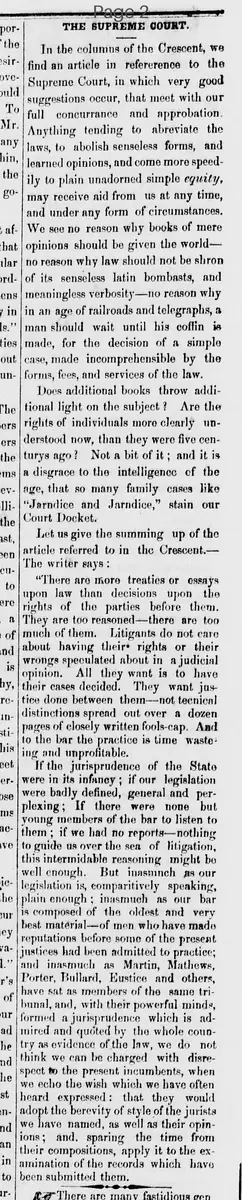
THE SUPREME COURT.
In the columns of the Crescent, we find an article in reference to the Supreme Court, in which very good suggestions occur, that meet with our full concurrence and approbation. Anything tending to abbreviate the laws, to abolish senseless forms, and learned opinions, and come more speedily to plain unadorned simple equity, may receive aid from us at any time, and under any form of circumstances.
We see no reason why books of mere opinions should be given the world—no reason why law should not be shorn of its senseless latin bombasts, and meaningless verbosity—no reason why in an age of railroads and telegraphs, a man should wait until his coffin is made, for the decision of a simple case, made incomprehensible by the forms, fees, and services of the law.
Does additional books throw additional light on the subject? Are the rights of individuals more clearly understood now, than they were five centuries ago? Not a bit of it; and it is a disgrace to the intelligence of the age, that so many family cases like "Jarndyce and Jarndyce," stain our Court Docket.
Let us give the summing up of the article referred to in the Crescent.—The writer says:
"There are more treatises or essays upon law than decisions upon the rights of the parties before them. They are too reasoned—there are too much of them. Litigants do not care about having their rights or their wrongs speculated about in a judicial opinion. All they want is to have their cases decided. They want justice done between them—not technical distinctions spread out over a dozen pages of closely written fools-cap. And to the bar the practice is time wasting and unprofitable.
If the jurisprudence of the State were in its infancy; if our legislation were badly defined, general and perplexing; If there were none but young members of the bar to listen to them: if we had no reports—nothing to guide us over the sea of litigation, this interminable reasoning might be well enough. But inasmuch as our legislation is, comparatively speaking, plain enough; inasmuch as our bar is composed of the oldest and very best material—of men who have made reputations before some of the present justices had been admitted to practice; and inasmuch as Martin, Mathews, Porter, Bullard, Eustice and others, have sat as members of the same tribunal, and, with their powerful minds, formed a jurisprudence which is admired and quoted by the whole country as evidence of the law, we do not think we can be charged with disrespect to the present incumbents, when we echo the wish which we have often heard expressed: that they would adopt the brevity of style of the jurists we have named, as well as their opinions; and, sparing the time from their compositions, apply it to the examination of the records which have been submitted them."
In the columns of the Crescent, we find an article in reference to the Supreme Court, in which very good suggestions occur, that meet with our full concurrence and approbation. Anything tending to abbreviate the laws, to abolish senseless forms, and learned opinions, and come more speedily to plain unadorned simple equity, may receive aid from us at any time, and under any form of circumstances.
We see no reason why books of mere opinions should be given the world—no reason why law should not be shorn of its senseless latin bombasts, and meaningless verbosity—no reason why in an age of railroads and telegraphs, a man should wait until his coffin is made, for the decision of a simple case, made incomprehensible by the forms, fees, and services of the law.
Does additional books throw additional light on the subject? Are the rights of individuals more clearly understood now, than they were five centuries ago? Not a bit of it; and it is a disgrace to the intelligence of the age, that so many family cases like "Jarndyce and Jarndyce," stain our Court Docket.
Let us give the summing up of the article referred to in the Crescent.—The writer says:
"There are more treatises or essays upon law than decisions upon the rights of the parties before them. They are too reasoned—there are too much of them. Litigants do not care about having their rights or their wrongs speculated about in a judicial opinion. All they want is to have their cases decided. They want justice done between them—not technical distinctions spread out over a dozen pages of closely written fools-cap. And to the bar the practice is time wasting and unprofitable.
If the jurisprudence of the State were in its infancy; if our legislation were badly defined, general and perplexing; If there were none but young members of the bar to listen to them: if we had no reports—nothing to guide us over the sea of litigation, this interminable reasoning might be well enough. But inasmuch as our legislation is, comparatively speaking, plain enough; inasmuch as our bar is composed of the oldest and very best material—of men who have made reputations before some of the present justices had been admitted to practice; and inasmuch as Martin, Mathews, Porter, Bullard, Eustice and others, have sat as members of the same tribunal, and, with their powerful minds, formed a jurisprudence which is admired and quoted by the whole country as evidence of the law, we do not think we can be charged with disrespect to the present incumbents, when we echo the wish which we have often heard expressed: that they would adopt the brevity of style of the jurists we have named, as well as their opinions; and, sparing the time from their compositions, apply it to the examination of the records which have been submitted them."
What sub-type of article is it?
Legal Reform
What keywords are associated?
Supreme Court
Legal Reform
Judicial Brevity
Law Simplification
Court Delays
Verbal Verbosity
What entities or persons were involved?
Supreme Court
Crescent
Martin
Mathews
Porter
Bullard
Eustice
Editorial Details
Primary Topic
Reform Of Verbose Supreme Court Opinions For Brevity And Efficiency
Stance / Tone
Critical Of Judicial Verbosity And Delays, Supportive Of Simpler Equity
Key Figures
Supreme Court
Crescent
Martin
Mathews
Porter
Bullard
Eustice
Key Arguments
Abbreviate Laws And Abolish Senseless Forms For Simple Equity
Eliminate Books Of Mere Opinions And Latin Bombasts
In Modern Age, Justice Should Not Be Delayed By Legal Forms And Fees
Additional Legal Books Do Not Clarify Rights Better Than Centuries Ago
Litigants Want Decisions, Not Lengthy Speculations
Current Jurisprudence Is Mature, No Need For Interminable Reasoning
Adopt Brevity Of Past Jurists Like Martin And Others