Thank you for visiting SNEWPapers!
Sign up free
Story
April 11, 1833
The National Republican And Cincinnati Daily Mercantile Advertiser
Cincinnati, Hamilton County, Ohio
What is this article about?
In 1830, a traveler visits American black settlers near Anachye, Hayti, who overcame initial farming failures and destitution through cooperative effort, achieving modest prosperity on leased land while lamenting lack of education and religion.
Clipping
OCR Quality
95%
Excellent
Full Text
LOCATION OF
AMERICAN BLACKS IN
HAYTI.
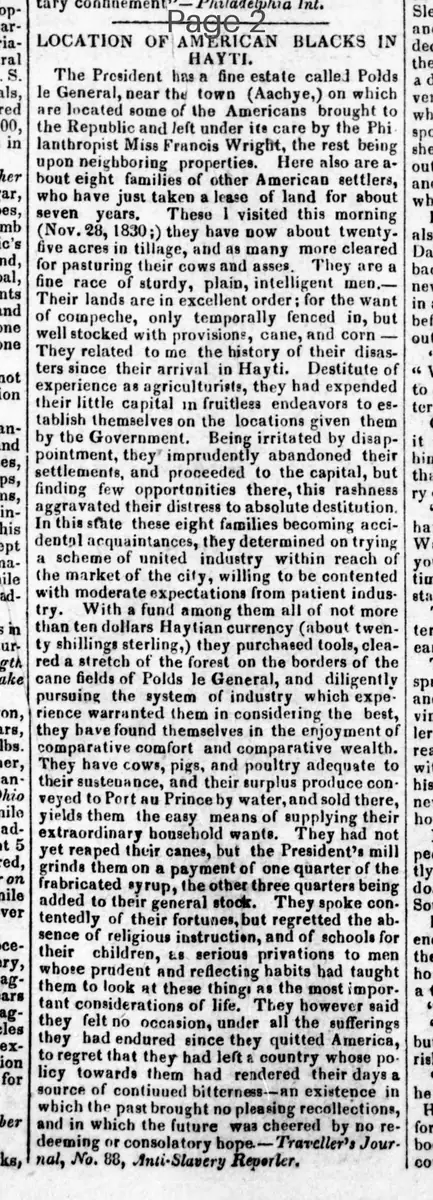
The President has a fine estate called Poids le General, near the town (Anachye,) on which are located some of the Americans brought to the Republic and left under its care by the Philanthropist Miss Frances Wright, the rest being upon neighboring properties. Here also are about eight families of other American settlers, who have just taken a lease of land for about seven years. These I visited this morning (Nov. 28, 1830;) they have now about twenty-five acres in tillage, and as many more cleared for pasturing their cows and asses. They are a fine race of sturdy, plain, intelligent men.—Their lands are in excellent order; for the want of compeche, only temporarily fenced in, but well stocked with provisions, cane, and corn—They related to me the history of their disasters since their arrival in Hayti. Destitute of experience as agriculturists, they had expended their little capital in fruitless endeavors to establish themselves on the locations given them by the Government. Being irritated by disappointment, they imprudently abandoned their settlements, and proceeded to the capital, but finding few opportunities there, this rashness aggravated their distress to absolute destitution. In this state these eight families becoming accidental acquaintances, they determined on trying a scheme of united industry within reach of the market of the city, willing to be contented with moderate expectations from patient industry. With a fund among them all of not more than ten dollars Haytian currency (about twenty shillings sterling,) they purchased tools, cleared a stretch of the forest on the borders of the cane fields of Poids le General, and diligently pursuing the system of industry which experience warranted them in considering the best, they have found themselves in the enjoyment of comparative comfort and comparative wealth. They have cows, pigs, and poultry adequate to their sustenance, and their surplus produce conveyed to Port au Prince by water, and sold there, yields them the easy means of supplying their extraordinary household wants. They had not yet reaped their canes, but the President's mill grinds them on a payment of one quarter of the fabricated syrup, the other three quarters being added to their general stock. They spoke contentedly of their fortunes, but regretted the absence of religious instruction, and of schools for their children, as serious privations to men whose prudent and reflecting habits had taught them to look at these things as the most important considerations of life. They however said they felt no occasion, under all the sufferings they had endured since they quitted America, to regret that they had left a country whose policy towards them had rendered their days a source of continued bitterness—an existence in which the past brought no pleasing recollections, and in which the future was cheered by no redeeming or consolatory hope.—Traveller's Journal, No. 88. Anti-Slavery Reporter.
AMERICAN BLACKS IN
HAYTI.
The President has a fine estate called Poids le General, near the town (Anachye,) on which are located some of the Americans brought to the Republic and left under its care by the Philanthropist Miss Frances Wright, the rest being upon neighboring properties. Here also are about eight families of other American settlers, who have just taken a lease of land for about seven years. These I visited this morning (Nov. 28, 1830;) they have now about twenty-five acres in tillage, and as many more cleared for pasturing their cows and asses. They are a fine race of sturdy, plain, intelligent men.—Their lands are in excellent order; for the want of compeche, only temporarily fenced in, but well stocked with provisions, cane, and corn—They related to me the history of their disasters since their arrival in Hayti. Destitute of experience as agriculturists, they had expended their little capital in fruitless endeavors to establish themselves on the locations given them by the Government. Being irritated by disappointment, they imprudently abandoned their settlements, and proceeded to the capital, but finding few opportunities there, this rashness aggravated their distress to absolute destitution. In this state these eight families becoming accidental acquaintances, they determined on trying a scheme of united industry within reach of the market of the city, willing to be contented with moderate expectations from patient industry. With a fund among them all of not more than ten dollars Haytian currency (about twenty shillings sterling,) they purchased tools, cleared a stretch of the forest on the borders of the cane fields of Poids le General, and diligently pursuing the system of industry which experience warranted them in considering the best, they have found themselves in the enjoyment of comparative comfort and comparative wealth. They have cows, pigs, and poultry adequate to their sustenance, and their surplus produce conveyed to Port au Prince by water, and sold there, yields them the easy means of supplying their extraordinary household wants. They had not yet reaped their canes, but the President's mill grinds them on a payment of one quarter of the fabricated syrup, the other three quarters being added to their general stock. They spoke contentedly of their fortunes, but regretted the absence of religious instruction, and of schools for their children, as serious privations to men whose prudent and reflecting habits had taught them to look at these things as the most important considerations of life. They however said they felt no occasion, under all the sufferings they had endured since they quitted America, to regret that they had left a country whose policy towards them had rendered their days a source of continued bitterness—an existence in which the past brought no pleasing recollections, and in which the future was cheered by no redeeming or consolatory hope.—Traveller's Journal, No. 88. Anti-Slavery Reporter.
What sub-type of article is it?
Historical Event
Biography
Personal Triumph
What themes does it cover?
Misfortune
Survival
Triumph
What keywords are associated?
American Settlers
Hayti
Black Migration
Agricultural Settlement
United Industry
Overcoming Destitution
What entities or persons were involved?
Miss Frances Wright
The President
American Settlers
Where did it happen?
Near The Town (Anachye,) On Poids Le General, Hayti
Story Details
Key Persons
Miss Frances Wright
The President
American Settlers
Location
Near The Town (Anachye,) On Poids Le General, Hayti
Event Date
Nov. 28, 1830
Story Details
American black settlers in Hayti, initially destitute after failed attempts to farm government lands, unite to clear forest, cultivate 25 acres, raise livestock, and sell produce in Port au Prince, achieving comfort and regretting only lack of religious instruction and schools while not regretting leaving America.