Thank you for visiting SNEWPapers!
Sign up free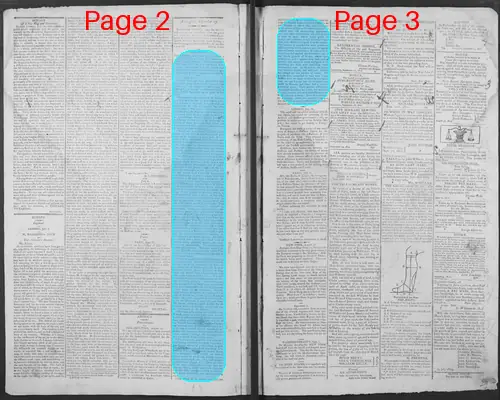
The Kentucky Gazette
Lexington, Fayette County, Kentucky
What is this article about?
A published letter from a citizen of Vincennes, Indiana Territory, describes the town's location on the Wabash River, its fertile prairies yielding high crop outputs, navigable waterways facilitating commerce, abundant natural resources, and advantages for agriculture and settlement.
Merged-components note: Continuation of the letter describing Vincennes across pages 2 and 3.
Clippings

1 of 2
OCR Quality
Full Text
The following is a letter received from a friend, who is a citizen of Vincennes, in the Indiana Territory. His correspondent has taken the liberty of publishing it for public information, with the request that the several editors into whose hands it may come, will give it a place in their papers.
"Dear Sir,
"I have some time since promised to give you a description of this place, especially the agricultural and commercial advantages attending it; as you are an intimate friend of mine, I shall use candor as my guide in this letter.
"Vincennes is the capital of the Territory: it is here the seat of government is fixed; it stands on the bank of the Wabash, in latitude 38 N. The situation of the town is delightful. The bank on which it stands is high and dry; the water in town is excellent; it is found about 25 feet below the surface; we pass through several different stratas of sand before we find water; we then come to a strata of white gravel, through which the water flows; it there appears in abundance—It is cool, pellucid and salutary.
"Vincennes is environed by a delightful prairie of four miles in length, and will average one in breadth; a great part of it is cultivated by the inhabitants of the town, and the rest is a handsome meadow formed by Nature; and producing abundance of excellent grass, which when cured in the proper season, is nearly equal to your hay made out of tame grass—Notwithstanding the land in this prairie has been under cultivation for near fifty years, it yet produces upon an average, 60 bushels of corn & 18 of wheat to the acre & that upon a moderate cultivation; but if highly cultivated it will produce eighty of the former and twenty-five of the latter—the soil in this prairie is of a blackish hue, mixed with sand which renders it warm, loose and congenial to the most rapid and luxurious vegetation, of every kind which is common to the United States from the district of Maine to Georgia—The Wabash, which rolls its gentle current past the town, and washes the verge of the prairie for its whole length, is well replenished with a variety of fine fish: This river is navigable almost all the year as high as this place; and a good part of the year it is passable almost to its source. The current is gentle; no rapids to obstruct its navigation. Commerce centres here; the merchants bring their goods from Canada down the Wabash; from Orleans up the Mississippi, and from the Eastern states down the Ohio and up the Wabash. This water transportation makes it not only more convenient for merchants and families who wish to come here, but is considerably cheaper than land carriage—there is White river which is passable for crafts of considerable burden. It rolls through a fine fertile country. Its banks are clothed with a heavy growth of wood of different kinds, generally walnut, ash, hackberry, and sugar-maple. The under-growth is rich and luxuriant. This river empties into the Wabash about 30 miles below Vincennes. There are abundance of fine fish in it of various kinds.
"As to the quality of the lands here as far as I am acquainted, there can be none better, not even the fertile bottoms of the Nile, or the exuberance of India can surpass the productions of this place. The soil is rich, black and mixed with a brown sand, and from eight to fifteen inches deep. It is easy cultivated, because the sand prevents the violent rains from baking it. Corn, wheat, rye, oats, and all kinds of small grain is produced in as great quantities to the acre at this place, as any where on the continent. Cotton, hemp, tobacco, &c. grows here unsurpassed in point of perfection, in any of the Southern states; nay every vegetable which is necessary for the sustenance of man will grow here. The farmer will find a good market for all kinds of produce at Orleans, and an easy water conveyance at all seasons.
"Merchant mills may be constructed on the Wabash, about 25 miles below town at a riffle, which will manufacture all the wheat into flour, which can be raised in the environs of the Wabash from that to its source. The farmer will only have to embark his wheat, and on his way to market have it manufactured. Besides this there are a number of fine streams which meander through the country, very well calculated to turn water works.
"The country in general is well watered; good springs are found in almost every farm. The springs rise out of a white sand, or gush from a free-stone rock—little lime-stone is to be found here. The natural growth of the soil is diversified. Our forests are stocked with a variety of wood, oak, walnut, poplar, cherry, sugar-maple, &c. The undergrowth is spice-wood, papaw, &c. There are some of the above timber which grows here immensely large; their magnitude together with their lofty appearance, seem to proclaim their proud superiority over the surrounding wood.
"The pasture in the woods is excellent, the
Pea-vine, grass, &c. are so interwoven that during the summer season it is with difficulty we pass through it, add to this, when the inclement winter refuses to let nature keep on her verdant robe and invigorating appearance, our low lands and bottoms are clothed with a kind of grass which keeps green all winter, and resembles a well advanced wheat field, and affords very good food for stock.
The country is interspersed with prairies of different sizes, which makes it have an appearance of former cultivation: It looks as if intrepid man had applied the destructive axe to the sturdy growth of Nature where those prairies are, and it appears from their green growth, that nature is never negligent in replenishing her fields with something useful to imperious man.
In the prairies the farmer may whet his scythe, and with ease procure hay enough for any number of cattle. We are not here compelled to wait with frugal anxiety until we make meadow by art, but at once we can step out into the meadows prepared by Nature, and there find a copious growth of grass.
These prairies will furnish an everlasting pasture for cattle, for the natural grass increase instead of diminishing by the flocks grazing on them. Here then we enjoy an advantage which few countries enjoy—
The farmer is at once furnished with extensive meadow and never failing pasture.
What sub-type of article is it?
What themes does it cover?
What keywords are associated?
What entities or persons were involved?
Letter to Editor Details
Author
A Citizen Of Vincennes
Recipient
Dear Sir
Main Argument
vincennes offers superior agricultural productivity, fertile soils yielding high crop outputs, navigable rivers for commerce, and abundant natural resources, making it an ideal location for farmers and merchants seeking easy cultivation, markets, and settlement advantages.
Notable Details