Thank you for visiting SNEWPapers!
Sign up free
Literary
February 10, 1843
Burlington Free Press
Burlington, Chittenden County, Vermont
What is this article about?
Review in English periodicals praises Robert Moffat's book on his 23 years of missionary work in South Africa, highlighting thrilling anecdotes of dangers from lions, buffaloes, rhinoceroses, and other wildlife during travels and hunts in arid deserts.
Clipping
OCR Quality
88%
Good
Full Text
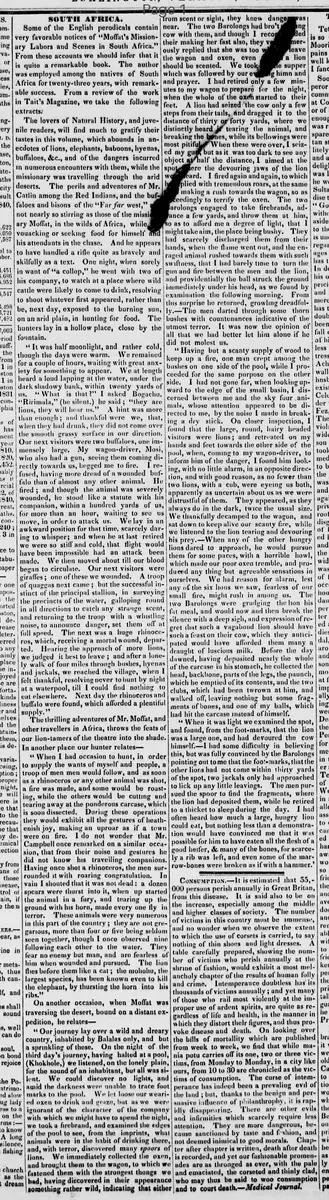
Some of the English periodicals contain very favorable notices of "Moffat's Missionary Labors and Scenes in South Africa." From these accounts we should infer that it is quite a remarkable book. The author was employed among the natives of South Africa for twenty-three years, with remarkable success. From a review of the work in Tait's Magazine, we take the following extracts:
The lovers of Natural History, and juvenile readers, will find much to gratify their tastes in this volume, which abounds in anecdotes of lions, elephants, baboons, hyenas, buffaloes, &c., and of the dangers incurred in numerous encounters with them, while the missionary was travelling through the arid deserts. The perils and adventures of Mr. Catlin among the Red Indians, and the buffaloes and bisons of the "Far far west," not nearly so stirring as those of the missionary Moffat, in the wilds of Africa, while voyaging or seeking food for himself and his attendants in the chase. And he appears to have handled a rifle quite as bravely and skilfully as a text. One night, when sorely in want of "a collop," he went with two of his company, to watch at a place where wild cattle were likely to come to drink, resolving to shoot whatever first appeared, rather than be, next day, exposed to the burning sun, on an arid plain, in hunting for food. The hunters lay in a hollow place, close by the fountain.
"It was half moonlight, and rather cold, though the days were warm. We remained for a couple of hours, waiting with great anxiety for something to appear. We at length heard a loud lapping at the water, under the dark shadowy bank, within twenty yards of us.
"What is that?" I asked Bogachu.
"Ririmala," (be silent.) he said; "they are lions, they will hear us." A hint was more than enough; and thankful were we, that, when they had drunk, they did not come over the smooth grassy surface in our direction.
Our next visitors were two buffaloes, one immensely large. My wagon-driver, Mosi, who also had a gun, seeing them coming directly towards us, begged me to fire. I refused, having more dread of a wounded buffalo than of almost any other animal. He fired; and though the animal was severely wounded, he stood like a statue with his companion, within a hundred yards of us, for more than an hour, waiting to see us move, in order to attack us. We lay in an awkward position for that time, scarcely daring to whisper; and when he at last retired we were so stiff and cold, that flight would have been impossible had an attack been made. We then moved about till our blood began to circulate. Our next visitors were giraffes; one of these we wounded. A troop of quaggas next came; but the successful instinct of the principal stallion, in surveying the precincts of the water, galloping round in all directions to catch any strange scent, and returning to the troop with a whustling noise, to announce danger, set them off at full speed. The next was a huge rhinoceros, which, receiving a mortal wound, departed. Hearing the approach of more lions, we judged it best to leave; and after a lonely walk of four miles through bushes, hyenas and jackals, we reached the village, when I felt thankful, resolving never to hunt by night at a waterpool, till I could find nothing to eat elsewhere. Next day the rhinoceros and buffalo were found, which afforded a plentiful supply."
The thrilling adventures of Mr. Moffat, and other travellers in Africa, throws the feats of our lion-tamers of the theatre into the shade. In another place our hunter relates—
"When I had occasion to hunt, in order to supply the wants of myself and people, a troop of men would follow, and as soon as a rhinoceros or any other animal was shot, a fire was made, and some would be roasting, while the others would be cutting and tearing away at the ponderous carcase, which is soon dissected. During these operations they would exhibit all the gestures of heathenish joy, making an uproar as if a town were on fire. I do not wonder that Mr. Campbell once remarked on a similar occasion, that from their noise and gestures he did not know his travelling companions.
Having once shot a rhinoceros, the men surrounded it with roaring congratulation. In vain I shouted that it was not dead : a dozen spears were thrust into it, when up started the animal in a fury, and tearing up the ground with his horn, made every one fly in terror. These animals were very numerous in this part of the country; they are not gregarious, more than four or five being seldom seen together, though I once observed nine following each other to the water. They fear no enemy but man, and are fearless of him when wounded and pursued. The lion flies before them like a cat; the mohohu, the largest species, has been known even to kill the elephant, by thrusting the horn into his ribs.
On another occasion, when Moffat was traversing the desert, bound on a distant expedition, he relates—
"Our journey lay over a wild and dreary country, inhabited by Balalas only, and but a sprinkling of these. On the night of the third day's journey, having halted at a pool, (Khokhole,) we listened, on the lonely plain, for the sound of an inhabitant, but all was silent. We could discover no lights, and amid the darkness were unable to trace foot marks to the pool. We let loose our wearied oxen to drink and graze, but as we were ignorant of the character of the company with which we might have to spend the night. we took a firebrand, and examined the edges of the pool to see, from the imprints, what animals were in the habit of drinking there, and, with terror, discovered many spoors of lions. We immediately collected the oxen, and brought them to the wagon, to which we fastened them with the strongest thongs we had, having discovered in their appearance from scent or sight, they knew danger was near. The two Barolongs had brought a cow with them, and though I recommended their making her fast also, they vehemently replied that she was too weak to leave the wagon and oxen, even a lion should be scented. We took a supper which was followed by our singing hymn and prayer. I had retired only a few minutes to my wagon to prepare for the night, when the whole of the oxen started to their feet. A lion had seized the cow only a few steps from their tails, and dragged it to the distance of thirty or forty yards, where we distinctly heard it tearing the animal, and breaking the bones, while its bellowings were most pitiful When these were over, I seized my gun but as it was too dark to see any object at half the distance, I aimed at the spot where the devouring jaws of the lion were heard. I fired again and again, to which he replied with tremendous roars, at the same time making a rush towards the wagon, so as exceedingly to terrify the oxen. The two Barolongs engaged to take firebrands, advance a few yards, and throw them at him, so as to afford me a degree of light, that I might take aim, the place being bushy. They had scarcely discharged them from their hands, when the flame went out, and the enraged animal rushed towards them with such swiftness, that I had barely time to turn the gun and fire between the men and the lion. and providentially the ball struck the ground immediately under his head, as we found by examination the following morning. From this surprise he returned, growling dreadfully.—The men darted through some thorn bushes with countenances indicative of the utmost terror. It was now the opinion of all that we had better let him alone if he did not molest us.
"Having but a scanty supply of wood to keep up a fire, one man crept among the bushes on one side of the pool, while I proceeded for the same purpose on the other side. I had not gone far, when looking upward to the edge of the small basin, I discerned between me and the sky four animals, whose attention appeared to be directed to me, by the noise I made in breaking a dry stick. On closer inspection, I found that the large, round, hairy headed visitors were lions; and retreated on my hands and feet towards the other side of the pool, when, coming to my wagon-driver, to inform him of the danger, I found him looking, with no little alarm, in an opposite direction, and with good reason, as no fewer than two lions, with a cub, were eyeing us both, apparently as uncertain about us as we were distrustful of them. They appeared, as they always do in the dark, twice the usual size.
We thankfully decamped to the wagon, and sat down to keep alive our scanty fire, while we listened to the lion tearing and devouring his prey.—When any of the other hungry lions dared to approach, he would pursue them for some paces, with a horrible howl, which made our poor oxen tremble, and produced any thing but agreeable sensations in ourselves. We had reason for alarm, lest any of the six lions we saw, fearless of our small fire, might rush in among us. The two Barolongs were grudging the lion his fat meal, and would now and then break the silence with a deep sigh, and expression of regret that such a vagabond lion should have such a feast on their cow, which they anticipated would have afforded them many a draught of luscious milk. Before the day dawned, having deposited nearly the whole of the carcase in his stomach, he collected the head, backbone, parts of the legs, the paunch, which he emptied of its contents, and the two clubs, which had been thrown at him, and walked off, leaving nothing but some fragments of bones, and one of my balls, which had hit the carcase instead of himself.
"When it was light we examined the spot, and found, from the foot-marks, that the lion was a large one, and had devoured the cow himself.—I had some difficulty in believing this, but was fully convinced by the Barolongs pointing out to me that the foot-marks, that the other lions had not come within thirty yards of the spot, two jackals only had approached to lick up any little leavings. The men pursued the spoor to find the fragments, where the lion had deposited them, while he retired to a thicket to sleep during the day. I had often heard how much a large, hungry lion could eat, but nothing less than a demonstration would have convinced me that it was possible for him to have eaten all the flesh of a good heifer, & many of the bones, for scarcely a rib was left, and even some of the marrow-bones were broken as if with a hammer.
The lovers of Natural History, and juvenile readers, will find much to gratify their tastes in this volume, which abounds in anecdotes of lions, elephants, baboons, hyenas, buffaloes, &c., and of the dangers incurred in numerous encounters with them, while the missionary was travelling through the arid deserts. The perils and adventures of Mr. Catlin among the Red Indians, and the buffaloes and bisons of the "Far far west," not nearly so stirring as those of the missionary Moffat, in the wilds of Africa, while voyaging or seeking food for himself and his attendants in the chase. And he appears to have handled a rifle quite as bravely and skilfully as a text. One night, when sorely in want of "a collop," he went with two of his company, to watch at a place where wild cattle were likely to come to drink, resolving to shoot whatever first appeared, rather than be, next day, exposed to the burning sun, on an arid plain, in hunting for food. The hunters lay in a hollow place, close by the fountain.
"It was half moonlight, and rather cold, though the days were warm. We remained for a couple of hours, waiting with great anxiety for something to appear. We at length heard a loud lapping at the water, under the dark shadowy bank, within twenty yards of us.
"What is that?" I asked Bogachu.
"Ririmala," (be silent.) he said; "they are lions, they will hear us." A hint was more than enough; and thankful were we, that, when they had drunk, they did not come over the smooth grassy surface in our direction.
Our next visitors were two buffaloes, one immensely large. My wagon-driver, Mosi, who also had a gun, seeing them coming directly towards us, begged me to fire. I refused, having more dread of a wounded buffalo than of almost any other animal. He fired; and though the animal was severely wounded, he stood like a statue with his companion, within a hundred yards of us, for more than an hour, waiting to see us move, in order to attack us. We lay in an awkward position for that time, scarcely daring to whisper; and when he at last retired we were so stiff and cold, that flight would have been impossible had an attack been made. We then moved about till our blood began to circulate. Our next visitors were giraffes; one of these we wounded. A troop of quaggas next came; but the successful instinct of the principal stallion, in surveying the precincts of the water, galloping round in all directions to catch any strange scent, and returning to the troop with a whustling noise, to announce danger, set them off at full speed. The next was a huge rhinoceros, which, receiving a mortal wound, departed. Hearing the approach of more lions, we judged it best to leave; and after a lonely walk of four miles through bushes, hyenas and jackals, we reached the village, when I felt thankful, resolving never to hunt by night at a waterpool, till I could find nothing to eat elsewhere. Next day the rhinoceros and buffalo were found, which afforded a plentiful supply."
The thrilling adventures of Mr. Moffat, and other travellers in Africa, throws the feats of our lion-tamers of the theatre into the shade. In another place our hunter relates—
"When I had occasion to hunt, in order to supply the wants of myself and people, a troop of men would follow, and as soon as a rhinoceros or any other animal was shot, a fire was made, and some would be roasting, while the others would be cutting and tearing away at the ponderous carcase, which is soon dissected. During these operations they would exhibit all the gestures of heathenish joy, making an uproar as if a town were on fire. I do not wonder that Mr. Campbell once remarked on a similar occasion, that from their noise and gestures he did not know his travelling companions.
Having once shot a rhinoceros, the men surrounded it with roaring congratulation. In vain I shouted that it was not dead : a dozen spears were thrust into it, when up started the animal in a fury, and tearing up the ground with his horn, made every one fly in terror. These animals were very numerous in this part of the country; they are not gregarious, more than four or five being seldom seen together, though I once observed nine following each other to the water. They fear no enemy but man, and are fearless of him when wounded and pursued. The lion flies before them like a cat; the mohohu, the largest species, has been known even to kill the elephant, by thrusting the horn into his ribs.
On another occasion, when Moffat was traversing the desert, bound on a distant expedition, he relates—
"Our journey lay over a wild and dreary country, inhabited by Balalas only, and but a sprinkling of these. On the night of the third day's journey, having halted at a pool, (Khokhole,) we listened, on the lonely plain, for the sound of an inhabitant, but all was silent. We could discover no lights, and amid the darkness were unable to trace foot marks to the pool. We let loose our wearied oxen to drink and graze, but as we were ignorant of the character of the company with which we might have to spend the night. we took a firebrand, and examined the edges of the pool to see, from the imprints, what animals were in the habit of drinking there, and, with terror, discovered many spoors of lions. We immediately collected the oxen, and brought them to the wagon, to which we fastened them with the strongest thongs we had, having discovered in their appearance from scent or sight, they knew danger was near. The two Barolongs had brought a cow with them, and though I recommended their making her fast also, they vehemently replied that she was too weak to leave the wagon and oxen, even a lion should be scented. We took a supper which was followed by our singing hymn and prayer. I had retired only a few minutes to my wagon to prepare for the night, when the whole of the oxen started to their feet. A lion had seized the cow only a few steps from their tails, and dragged it to the distance of thirty or forty yards, where we distinctly heard it tearing the animal, and breaking the bones, while its bellowings were most pitiful When these were over, I seized my gun but as it was too dark to see any object at half the distance, I aimed at the spot where the devouring jaws of the lion were heard. I fired again and again, to which he replied with tremendous roars, at the same time making a rush towards the wagon, so as exceedingly to terrify the oxen. The two Barolongs engaged to take firebrands, advance a few yards, and throw them at him, so as to afford me a degree of light, that I might take aim, the place being bushy. They had scarcely discharged them from their hands, when the flame went out, and the enraged animal rushed towards them with such swiftness, that I had barely time to turn the gun and fire between the men and the lion. and providentially the ball struck the ground immediately under his head, as we found by examination the following morning. From this surprise he returned, growling dreadfully.—The men darted through some thorn bushes with countenances indicative of the utmost terror. It was now the opinion of all that we had better let him alone if he did not molest us.
"Having but a scanty supply of wood to keep up a fire, one man crept among the bushes on one side of the pool, while I proceeded for the same purpose on the other side. I had not gone far, when looking upward to the edge of the small basin, I discerned between me and the sky four animals, whose attention appeared to be directed to me, by the noise I made in breaking a dry stick. On closer inspection, I found that the large, round, hairy headed visitors were lions; and retreated on my hands and feet towards the other side of the pool, when, coming to my wagon-driver, to inform him of the danger, I found him looking, with no little alarm, in an opposite direction, and with good reason, as no fewer than two lions, with a cub, were eyeing us both, apparently as uncertain about us as we were distrustful of them. They appeared, as they always do in the dark, twice the usual size.
We thankfully decamped to the wagon, and sat down to keep alive our scanty fire, while we listened to the lion tearing and devouring his prey.—When any of the other hungry lions dared to approach, he would pursue them for some paces, with a horrible howl, which made our poor oxen tremble, and produced any thing but agreeable sensations in ourselves. We had reason for alarm, lest any of the six lions we saw, fearless of our small fire, might rush in among us. The two Barolongs were grudging the lion his fat meal, and would now and then break the silence with a deep sigh, and expression of regret that such a vagabond lion should have such a feast on their cow, which they anticipated would have afforded them many a draught of luscious milk. Before the day dawned, having deposited nearly the whole of the carcase in his stomach, he collected the head, backbone, parts of the legs, the paunch, which he emptied of its contents, and the two clubs, which had been thrown at him, and walked off, leaving nothing but some fragments of bones, and one of my balls, which had hit the carcase instead of himself.
"When it was light we examined the spot, and found, from the foot-marks, that the lion was a large one, and had devoured the cow himself.—I had some difficulty in believing this, but was fully convinced by the Barolongs pointing out to me that the foot-marks, that the other lions had not come within thirty yards of the spot, two jackals only had approached to lick up any little leavings. The men pursued the spoor to find the fragments, where the lion had deposited them, while he retired to a thicket to sleep during the day. I had often heard how much a large, hungry lion could eat, but nothing less than a demonstration would have convinced me that it was possible for him to have eaten all the flesh of a good heifer, & many of the bones, for scarcely a rib was left, and even some of the marrow-bones were broken as if with a hammer.
What sub-type of article is it?
Journey Narrative
Prose Fiction
What themes does it cover?
Religious
Nature
What keywords are associated?
Missionary Labors
South Africa
Wildlife Adventures
Lions
Rhinoceros
Buffaloes
African Deserts
Hunting Encounters
What entities or persons were involved?
Robert Moffat
Literary Details
Title
Moffat's Missionary Labors And Scenes In South Africa
Author
Robert Moffat
Subject
Missionary Labors And Adventures In South Africa
Form / Style
Narrative Excerpts From Travel Memoir
Key Lines
"What Is That?" I Asked Bogachu. "Ririmala," (Be Silent.) He Said; "They Are Lions, They Will Hear Us."
"Having Once Shot A Rhinoceros, The Men Surrounded It With Roaring Congratulation. In Vain I Shouted That It Was Not Dead : A Dozen Spears Were Thrust Into It, When Up Started The Animal In A Fury, And Tearing Up The Ground With His Horn, Made Every One Fly In Terror."
A Lion Had Seized The Cow Only A Few Steps From Their Tails, And Dragged It To The Distance Of Thirty Or Forty Yards, Where We Distinctly Heard It Tearing The Animal, And Breaking The Bones, While Its Bellowings Were Most Pitiful
"I Had Often Heard How Much A Large, Hungry Lion Could Eat, But Nothing Less Than A Demonstration Would Have Convinced Me That It Was Possible For Him To Have Eaten All The Flesh Of A Good Heifer, & Many Of The Bones, For Scarcely A Rib Was Left, And Even Some Of The Marrow Bones Were Broken As If With A Hammer."