Thank you for visiting SNEWPapers!
Sign up free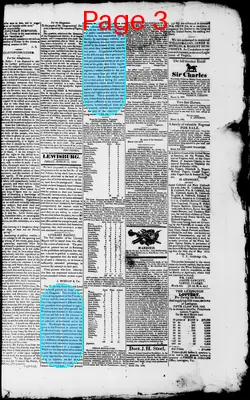
The Alleghanian
Lewisburg, Greenbrier County, West Virginia
What is this article about?
Congress passed the Tariff, Force, and Land bills by large majorities. The President signed the first two into law but vetoed the Land bill, an action criticized as arbitrary and influenced by personal feelings rather than constitutional grounds.
Clipping
OCR Quality
Full Text
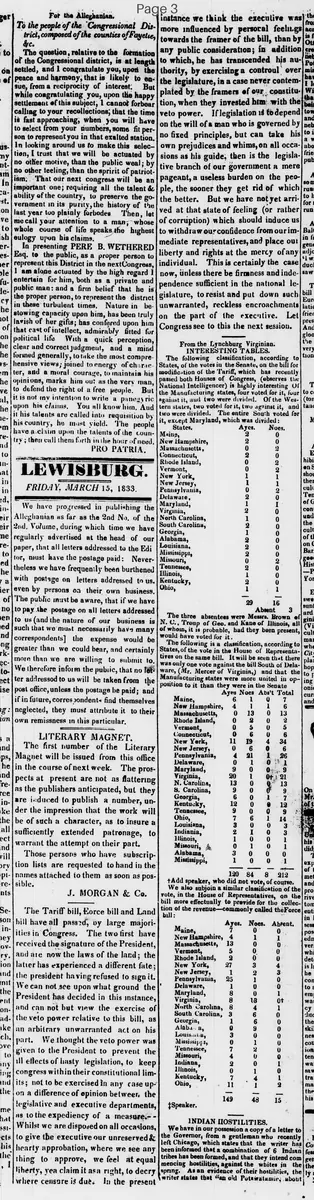
We can not see upon what ground the President has decided in this instance, and can not but view the exercise of the veto power relative to this bill, as an arbitrary unwarranted act on his part. We thought the veto power was given to the President to prevent the ill effects of hasty legislation, to keep congress within their constitutional limits; not to be exercised in any case upon a difference of opinion between the legislative and executive departments, as to the expediency of a measure.— Whilst we are disposed on all occasions, to give the executive our unreserved & hearty approbation, where we see any thing to approve, we feel at equal liberty, yea claim it as a right, to decry where censure is due. In the present instance we think the executive was more influenced by personal feelings towards the framer of the bill, than by any public consideration; in addition to which, he has transcended his authority, by exercising a controul over the legislature, in a case never contemplated by the framers of our constitution, when they invested him with the veto power. If legislation is to depend on the will of a man who is governed by no fixed principles, but can take his own prejudices and whims, on all occasions as his guide, then is the legislative branch of our government a mere pageant, a useless burden on the people, the sooner they get rid of which the better. But we have not yet arrived at that state of feeling (or rather of corruption) which should induce us to withdraw our confidence from our immediate representatives, and place our liberty and rights at the mercy of any individual. This is certainly the case now, unless there be firmness and independence sufficient in the national legislature, to resist and put down such unwarranted, reckless encroachments on the part of the executive. Let Congress see to this the next session.
What sub-type of article is it?
What keywords are associated?
What entities or persons were involved?
Domestic News Details
Key Persons
Outcome
tariff bill and force bill signed into law; land bill vetoed by president.
Event Details
Congress passed the Tariff bill, Force bill, and Land bill by large majorities. The President signed the Tariff and Force bills, making them laws, but refused to sign the Land bill, exercising the veto power. The action is criticized as arbitrary, influenced by personal feelings toward the bill's framer, and beyond constitutional intent, potentially undermining legislative independence.