Thank you for visiting SNEWPapers!
Sign up free
Literary
June 11, 1829
Martinsburg Gazette And Public Advertiser
Martinsburg, Berkeley County, West Virginia
What is this article about?
A collection of anecdotes from the Library of Useful Knowledge illustrating the sagacity, loyalty, and intelligence of dogs, including their use in London carts, swimming to save a ship, sense of time, understanding language, and guarding graves.
Clipping
OCR Quality
95%
Excellent
Full Text
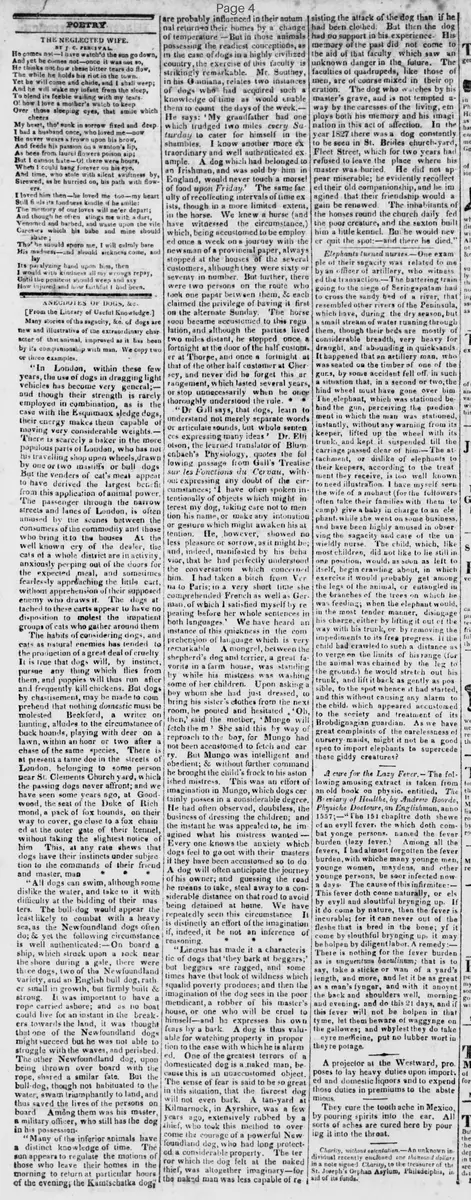
ANECDOTES OF DOGS, &c.
[From the Library of Useful Knowledge.]
Many stories of the sagacity, &c. of dogs are new and illustrative of the extraordinary character of that animal, improved as it has been by its companionship with man. We copy two or three examples.
"In London, within these few years, the use of dogs in dragging light vehicles has become very general;—and though their strength is rarely employed in combination, as is the case with the Esquimaux sledge dogs, their energy makes them capable of moving very considerable weights.—There is scarcely a baker in the more populous parts of London, who has not his travelling shop upon wheels, drawn by one or two mastiffs or bull dogs. But the venders of cat's meat appear to have derived the largest benefit from this application of animal power.
The passenger through the narrow streets and lanes of London, is often amused by the scenes between the consumers of the commodity and those who bring it to the houses. At the well known cry of the dealer, the cats of a whole district are in activity, anxiously peeping out of the doors for the expected meal, and sometimes fearlessly approaching the little cart, without apprehension of their supposed enemy who draws it. The dogs attached to these carts appear to have no disposition to molest the impatient groups of cats who gather around them. The habits of considering dogs, and cats as natural enemies has tended to the production of a great deal of cruelty. It is true that dogs will, by instinct, pursue any thing which flies from them, and puppies will thus run after and frequently kill chickens. But dogs by chastisement, may be made to comprehend that nothing domestic must be molested. Beckford, a writer on hunting, alludes to the circumstance of buckhounds, playing with deer on a lawn, within an hour or two after a chase of the same species. There is at present a tame doe in the streets of London, belonging to some person near St. Clements Church yard, which the passing dogs never affront; and we have seen some years ago, at Goodwood, the seat of the Duke of Richmond, a pack of fox hounds, on their way to cover, go close to a fox chained at the outer gate of their kennel, without taking the slightest notice of him. This, at any rate shews that dogs have their instincts under subjection to the commands of their friend and master, man.
"All dogs can swim, although some dislike the water, and take to it with difficulty at the bidding of their masters. The bull-dog would appear the least likely to combat with a heavy sea, as the Newfoundland dogs often do: & yet the following circumstance is well authenticated:—On board a ship, which struck upon a rock near the shore during a gale, there were three dogs, two of the Newfoundland variety, and an English bull dog, rather small in growth, but firmly built & strong. It was important to have a rope carried ashore; and as no boat could live for an instant in the breakers towards the land, it was thought that one of the Newfoundland dogs might succeed but he was not able to struggle with the waves, and perished. The other Newfoundland dog, upon being thrown over board with the rope, shared a similar fate. But the bull-dog, though not habituated to the water, swam triumphantly to land, and thus saved the lives of the persons on board. Among them was his master, a military officer, who still has the dog in his possession.
"Many of the inferior animals have a distinct knowledge of time. The sun appears to regulate the motions of those who leave their homes in the morning to return at particular hours of the evening; the Kamtschatka dogs are probably influenced in their autumnal return to their homes by a change of temperature—But in those animals possessing the readiest conceptions, as in the case of dogs in a highly civilized country, the exercise of this faculty is strikingly remarkable. Mr. Southey, in his Omniana, relates two instances of dogs who had acquired such a knowledge of time as would enable them to count the days of the week.—He says: 'My grandfather had one which trudged two miles every Saturday to cater for himself in the shambles. I know another more extraordinary and well authenticated example. A dog which had belonged to an Irishman, and was sold by him in England, would never touch a morsel of food upon Friday.' The same faculty of recollecting intervals of time exists, though in a more limited extent, in the horse. We knew a horse (and have witnessed the circumstance,) which, being accustomed to be employed once a week on a journey with the newsman of a provincial paper, always stopped at the houses of the several customers, although they were sixty or seventy in number. But further, there were two persons on the route who took one paper between them, & each claimed the privilege of having it first on the alternate Sunday. The horse soon became accustomed to this regulation, and although the parties lived two miles distant, he stopped once a fortnight at the door of the half customer at Thorpe, and once a fortnight at that of the other half customer at Chersey, and never did he forget this arrangement, which lasted several years, or stop unnecessarily when he once thoroughly understood the rule. * *
"Dr Gall says, that dogs, learn to understand not merely separate words or articulate sounds, but whole sentences expressing many ideas.' Dr. Ellioson, the learned translator of Blumenbach's Physiology, quotes the following passage from Gall's Treatise sur les Fonctions du Cerveau, without expressing any doubt of the circumstances; 'I have often spoken intentionally of objects which might interest my dog, taking care not to mention his name, or make any intimation or gesture which might awaken his attention. He, however, showed no less pleasure or sorrow, as it might be; and, indeed, manifested by his behavior, that he had perfectly understood the conversation which concerned him. I had taken a bitch from Verona to Paris; in a very short time she comprehended French as well as German, of which I satisfied myself by repeating before her whole sentences in both languages.' We have heard an instance of this quickness in the comprehension of language which is very remarkable. A mongrel, between the shepherd's dog and terrier, a great favorite in a farm house, was standing by while his mistress was washing some of her children. Upon asking a boy whom she had just dressed, to bring his sister's clothes from the next room, he pouted and hesitated. Oh, then, said the mother, Mungo will fetch them. She said this by way of reproach to the boy, for Mungo had not been accustomed to fetch and carry. But Mungo was intelligent and obedient; & without further command he brought the child's frock to his astonished mistress. This was an effort of imagination in Mungo, which dogs certainly possess in a considerable degree. He had often observed, doubtless, the business of dressing the children; and the instant he was appealed to, he imagined what his mistress wanted—Every one knows the anxiety which dogs feel to go out with their masters if they have been accustomed so to do. A dog will often anticipate the journey of his owner; and guessing the road he means to take, steal away to a considerable distance on that road to avoid being detained at home. We have repeatedly seen this circumstance. It is distinctly an effort of the imagination if, indeed, it be not an inference of reasoning.
"Linneus has made it a characteristic of dogs that 'they bark at beggars;' but beggars are ragged, and sometimes have that look of wildness which squalid poverty produces; and then the imagination of the dog sees in the poor mendicant, a robber of his master's house, or one who will be cruel to himself—and he expresses his own fears by a bark. A dog is thus valuable for watching property in proportion to the ease with which he is alarmed. One of the greatest terrors of a domesticated dog is a naked man, because this is an unaccustomed object. The sense of fear is said to be so great in this situation, that the fiercest dog will not even bark. A tan-yard at Kilmarnock, in Ayrshire, was a few years ago, extensively robbed by a thief, who took this method to overcome the courage of a powerful New foundland dog, who had long protected a considerable property. The terror which the dog felt at the naked thief, was altogether imaginary—for the naked man was less capable of resisting the attack of the dog than if he had been clothed. But then the dog had no support in his experience. His memory of the past did not come to the aid of that faculty which saw an unknown danger in the future. The faculties of quadrupeds, like those of men, are of course mixed in their operation. The dog who watches by his master's grave, and is not tempted away by the caresses of the living, employs both his memory and his imagination in this act of affection. In the year 1827 there was a dog constantly to be seen in St. Brides church-yard, Fleet Street, which for two years had refused to leave the place where his master was buried. He did not appear miserable; he evidently recollected their old companionship, and he imagined that their friendship would again be renewed. The inhabitants of the houses round the church daily fed the poor creature, and the sexton built him a little kennel. But he would never quit the spot:—and there he died."
[From the Library of Useful Knowledge.]
Many stories of the sagacity, &c. of dogs are new and illustrative of the extraordinary character of that animal, improved as it has been by its companionship with man. We copy two or three examples.
"In London, within these few years, the use of dogs in dragging light vehicles has become very general;—and though their strength is rarely employed in combination, as is the case with the Esquimaux sledge dogs, their energy makes them capable of moving very considerable weights.—There is scarcely a baker in the more populous parts of London, who has not his travelling shop upon wheels, drawn by one or two mastiffs or bull dogs. But the venders of cat's meat appear to have derived the largest benefit from this application of animal power.
The passenger through the narrow streets and lanes of London, is often amused by the scenes between the consumers of the commodity and those who bring it to the houses. At the well known cry of the dealer, the cats of a whole district are in activity, anxiously peeping out of the doors for the expected meal, and sometimes fearlessly approaching the little cart, without apprehension of their supposed enemy who draws it. The dogs attached to these carts appear to have no disposition to molest the impatient groups of cats who gather around them. The habits of considering dogs, and cats as natural enemies has tended to the production of a great deal of cruelty. It is true that dogs will, by instinct, pursue any thing which flies from them, and puppies will thus run after and frequently kill chickens. But dogs by chastisement, may be made to comprehend that nothing domestic must be molested. Beckford, a writer on hunting, alludes to the circumstance of buckhounds, playing with deer on a lawn, within an hour or two after a chase of the same species. There is at present a tame doe in the streets of London, belonging to some person near St. Clements Church yard, which the passing dogs never affront; and we have seen some years ago, at Goodwood, the seat of the Duke of Richmond, a pack of fox hounds, on their way to cover, go close to a fox chained at the outer gate of their kennel, without taking the slightest notice of him. This, at any rate shews that dogs have their instincts under subjection to the commands of their friend and master, man.
"All dogs can swim, although some dislike the water, and take to it with difficulty at the bidding of their masters. The bull-dog would appear the least likely to combat with a heavy sea, as the Newfoundland dogs often do: & yet the following circumstance is well authenticated:—On board a ship, which struck upon a rock near the shore during a gale, there were three dogs, two of the Newfoundland variety, and an English bull dog, rather small in growth, but firmly built & strong. It was important to have a rope carried ashore; and as no boat could live for an instant in the breakers towards the land, it was thought that one of the Newfoundland dogs might succeed but he was not able to struggle with the waves, and perished. The other Newfoundland dog, upon being thrown over board with the rope, shared a similar fate. But the bull-dog, though not habituated to the water, swam triumphantly to land, and thus saved the lives of the persons on board. Among them was his master, a military officer, who still has the dog in his possession.
"Many of the inferior animals have a distinct knowledge of time. The sun appears to regulate the motions of those who leave their homes in the morning to return at particular hours of the evening; the Kamtschatka dogs are probably influenced in their autumnal return to their homes by a change of temperature—But in those animals possessing the readiest conceptions, as in the case of dogs in a highly civilized country, the exercise of this faculty is strikingly remarkable. Mr. Southey, in his Omniana, relates two instances of dogs who had acquired such a knowledge of time as would enable them to count the days of the week.—He says: 'My grandfather had one which trudged two miles every Saturday to cater for himself in the shambles. I know another more extraordinary and well authenticated example. A dog which had belonged to an Irishman, and was sold by him in England, would never touch a morsel of food upon Friday.' The same faculty of recollecting intervals of time exists, though in a more limited extent, in the horse. We knew a horse (and have witnessed the circumstance,) which, being accustomed to be employed once a week on a journey with the newsman of a provincial paper, always stopped at the houses of the several customers, although they were sixty or seventy in number. But further, there were two persons on the route who took one paper between them, & each claimed the privilege of having it first on the alternate Sunday. The horse soon became accustomed to this regulation, and although the parties lived two miles distant, he stopped once a fortnight at the door of the half customer at Thorpe, and once a fortnight at that of the other half customer at Chersey, and never did he forget this arrangement, which lasted several years, or stop unnecessarily when he once thoroughly understood the rule. * *
"Dr Gall says, that dogs, learn to understand not merely separate words or articulate sounds, but whole sentences expressing many ideas.' Dr. Ellioson, the learned translator of Blumenbach's Physiology, quotes the following passage from Gall's Treatise sur les Fonctions du Cerveau, without expressing any doubt of the circumstances; 'I have often spoken intentionally of objects which might interest my dog, taking care not to mention his name, or make any intimation or gesture which might awaken his attention. He, however, showed no less pleasure or sorrow, as it might be; and, indeed, manifested by his behavior, that he had perfectly understood the conversation which concerned him. I had taken a bitch from Verona to Paris; in a very short time she comprehended French as well as German, of which I satisfied myself by repeating before her whole sentences in both languages.' We have heard an instance of this quickness in the comprehension of language which is very remarkable. A mongrel, between the shepherd's dog and terrier, a great favorite in a farm house, was standing by while his mistress was washing some of her children. Upon asking a boy whom she had just dressed, to bring his sister's clothes from the next room, he pouted and hesitated. Oh, then, said the mother, Mungo will fetch them. She said this by way of reproach to the boy, for Mungo had not been accustomed to fetch and carry. But Mungo was intelligent and obedient; & without further command he brought the child's frock to his astonished mistress. This was an effort of imagination in Mungo, which dogs certainly possess in a considerable degree. He had often observed, doubtless, the business of dressing the children; and the instant he was appealed to, he imagined what his mistress wanted—Every one knows the anxiety which dogs feel to go out with their masters if they have been accustomed so to do. A dog will often anticipate the journey of his owner; and guessing the road he means to take, steal away to a considerable distance on that road to avoid being detained at home. We have repeatedly seen this circumstance. It is distinctly an effort of the imagination if, indeed, it be not an inference of reasoning.
"Linneus has made it a characteristic of dogs that 'they bark at beggars;' but beggars are ragged, and sometimes have that look of wildness which squalid poverty produces; and then the imagination of the dog sees in the poor mendicant, a robber of his master's house, or one who will be cruel to himself—and he expresses his own fears by a bark. A dog is thus valuable for watching property in proportion to the ease with which he is alarmed. One of the greatest terrors of a domesticated dog is a naked man, because this is an unaccustomed object. The sense of fear is said to be so great in this situation, that the fiercest dog will not even bark. A tan-yard at Kilmarnock, in Ayrshire, was a few years ago, extensively robbed by a thief, who took this method to overcome the courage of a powerful New foundland dog, who had long protected a considerable property. The terror which the dog felt at the naked thief, was altogether imaginary—for the naked man was less capable of resisting the attack of the dog than if he had been clothed. But then the dog had no support in his experience. His memory of the past did not come to the aid of that faculty which saw an unknown danger in the future. The faculties of quadrupeds, like those of men, are of course mixed in their operation. The dog who watches by his master's grave, and is not tempted away by the caresses of the living, employs both his memory and his imagination in this act of affection. In the year 1827 there was a dog constantly to be seen in St. Brides church-yard, Fleet Street, which for two years had refused to leave the place where his master was buried. He did not appear miserable; he evidently recollected their old companionship, and he imagined that their friendship would again be renewed. The inhabitants of the houses round the church daily fed the poor creature, and the sexton built him a little kennel. But he would never quit the spot:—and there he died."
What sub-type of article is it?
Essay
Prose Fiction
What themes does it cover?
Friendship
Moral Virtue
What keywords are associated?
Dogs
Sagacity
Anecdotes
Intelligence
Companionship
Loyalty
Instincts
What entities or persons were involved?
[From The Library Of Useful Knowledge.]
Literary Details
Title
Anecdotes Of Dogs, &C.
Author
[From The Library Of Useful Knowledge.]
Subject
Illustrative Of The Extraordinary Character Of That Animal, Improved As It Has Been By Its Companionship With Man
Form / Style
Collection Of Anecdotes In Prose
Key Lines
But The Bull Dog, Though Not Habituated To The Water, Swam Triumphantly To Land, And Thus Saved The Lives Of The Persons On Board.
A Dog Which Had Belonged To An Irishman, And Was Sold By Him In England, Would Never Touch A Morsel Of Food Upon Friday.
Mungo Was Intelligent And Obedient; & Without Further Command He Brought The Child's Frock To His Astonished Mistress.
The Dog Who Watches By His Master's Grave, And Is Not Tempted Away By The Caresses Of The Living, Employs Both His Memory And His Imagination In This Act Of Affection.