Thank you for visiting SNEWPapers!
Sign up free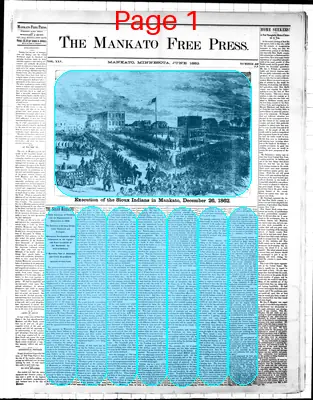
The Mankato Free Press
Mankato, Blue Earth County, Minnesota
What is this article about?
Historical account of the 1862 Sioux uprising in Minnesota, including massacres near New Ulm, citizen militias from Mankato, widespread destruction, capture of perpetrators, and the mass execution of 38 Sioux at Mankato on December 26, 1862.
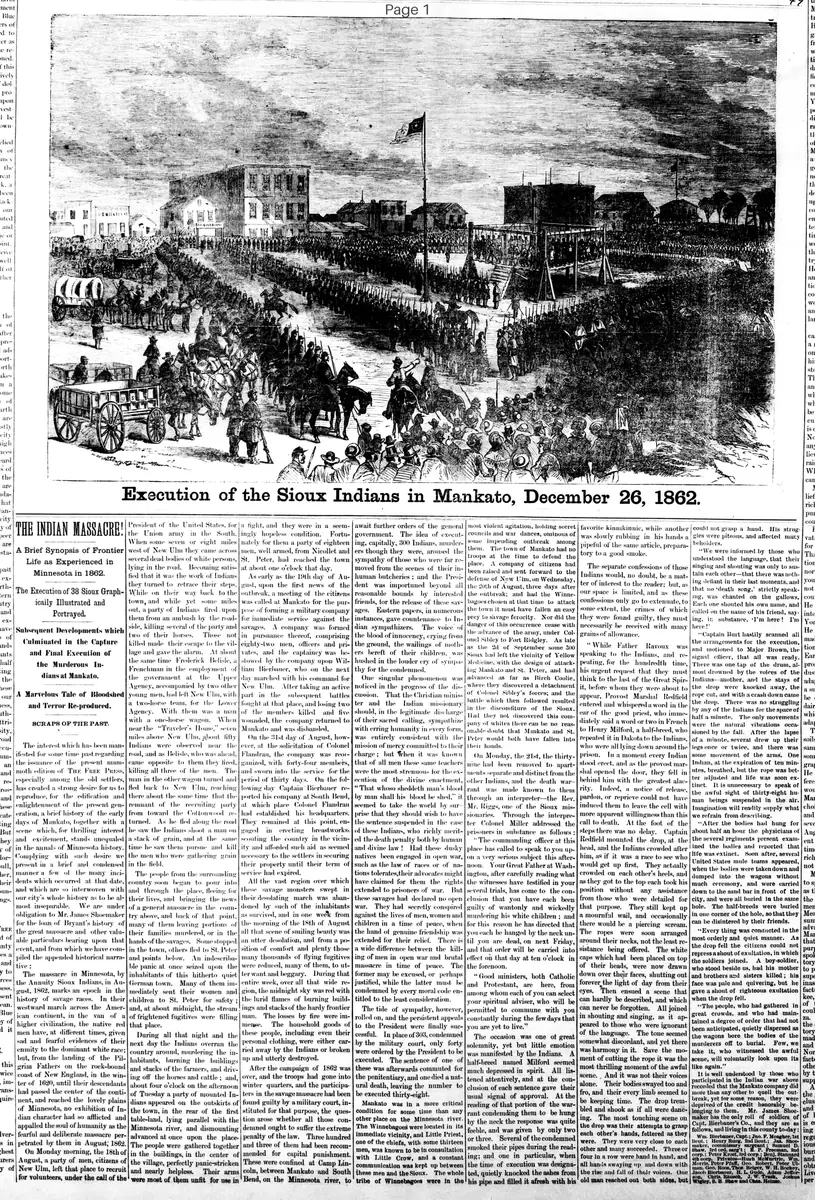
Merged-components note: The image illustrates the Sioux execution described in the historical story text.
Clipping
OCR Quality
Full Text
A Brief Synopsis of Frontier Life as Experienced in Minnesota in 1862.
The Execution of 38 Sioux Graphically Illustrated and Portrayed.
Subsequent Developments which Culminated in the Capture and Final Execution of the Murderous Indians at Mankato.
A Marvelous Tale of Bloodshed and Terror Re-produced.
SCRAPS OF THE PAST.
The interest which has been manifested for some time past regarding the issuance of the present mammoth edition of The Free Press, especially among the old settlers has created a strong desire for us to reproduce, for the edification and enlightenment of the present generation, a brief history of the early days of Mankato, together with a scene which, for thrilling interest and excitement, stands unequaled in the annals of Minnesota history. Complying with such desire we present in a brief and condensed manner a few of the many incidents which occurred at that date, and which are so interwoven with our city's whole history as to be almost inseparable. We are under obligation to Mr. James Shoemaker for the loan of Bryant's history of the great massacre and other valuable particulars bearing upon that event, and from which we have compiled the appended historical narrative:
The massacre in Minnesota, by the Annuity Sioux Indians, in August, 1862, marks an epoch in the history of savage races. In their westward march across the American continent, in the van of a higher civilization, the native red men have, at different times, given sad and fearful evidences of their enmity to the dominant white race; but, from the landing of the Pilgrim Fathers on the rock-bound coast of New England, in the winter of 1620, until their descendants had passed the center of the continent, and reached the lovely plains of Minnesota, no exhibition of Indian character had so afflicted and appalled the soul of humanity as the fearful and deliberate massacre perpetrated by them in August, 1862.
On Monday morning, the 18th of August, a party of men, citizens of New Ulm, left that place to recruit for volunteers, under the call of the President of the United States, for the Union army in the South. When some seven or eight miles west of New Ulm they came across several dead bodies of white persons, lying in the road. Believing satisfied that it was the work of Indians they turned to retrace their steps. While on their way back to the town, and while yet some miles out, a party of Indians fired upon them from an ambush by the road-side, killing several of the party and two of their horses. Those not killed made their escape to the village and gave the alarm. At about the same time: Frederick Belisle, a Frenchman in the employment of the government at the Upper Agency, accompanied by two other young men, had left New Ulm, with a two-horse team, for the Lower Agency. With them was a man with a one-horse wagon. When near the "Trader's House," seven miles below New Ulm, about fifty Indians were observed near the road, and as Belisle, who was ahead, came opposite to them they fired, killing all three of the men. The man in the other wagon turned and fled back to New Ulm, reaching there about the same time that the remnant of the recruiting party returned. As he fled along the road he saw the Indians shoot a man on a load of grain, and at the same time he saw them pursue and kill the men who were gathering grain in the field.
The people from the surrounding country soon began to pour into and through the place, fleeing for their lives, and bringing the news of a general massacre in the country above, and back of that point, many of them leaving portions of their families murdered, or in the hands of the savages. Some stopped in the town, others fled to St. Peter and points below. An indescribable panic at once seized upon the inhabitants of this hitherto quiet German town. Many of them immediately sent their women and children to St. Peter for safety; and, at about midnight, the stream of frightened fugitives were filling that place.
During all that night and the next day the Indians overran the country around, murdering the inhabitants, burning the buildings and stacks of the farmers, and driving off the horses and cattle: and, about four o'clock on the afternoon of Tuesday a party of mounted Indians appeared on the outskirts of the town, in the rear of the first table-land, lying parallel with the Minnesota river, and dismounting advanced at once upon the place The people were gathered together in the buildings, in the center of the village, perfectly panic-stricken and nearly helpless. Their arms were most of them unfit for use in a fight, and they were in a seemingly hopeless condition. Fortunately for them a party of eighteen men, well armed, from Nicollet and St. Peter, had reached the town at about one o'clock that day.
As early as the 19th day of August, upon the first news of the outbreak, a meeting of the citizens was called at Mankato for the purpose of forming a military company for immediate service against the savages. A company was formed in pursuance thereof, comprising eighty-two men, officers and privates, and the captaincy was bestowed by the company upon William Bierbauer, who on the next day marched with his command for New Ulm. After taking an active part in the subsequent battles fought at that place, and losing two of the members killed and five wounded, the company returned to Mankato and was disbanded,
On the 31st day of August, however, at the solicitation of Colonel Flandrau, the company was reorganized, with forty-four members, and sworn into the service for the period of thirty days. On the following day Captain Bierbauer reported his company at South Bend, at which place Colonel Flandrau had established his headquarters. They remained at this point, engaged in erecting breastworks, scouting the country in the vicinity and afforded such aid as seemed necessary to the settlers in securing their property until their term of service had expired.
All the vast region over which these savage monsters swept in their desolating march was abandoned by such of the inhabitants as survived, and in one week from the morning of the 18th of August all that scene of smiling beauty was an utter desolation, and from a position of comfort and plenty those many thousands of flying fugitives were reduced, many of them, to utter want and beggary. During that entire week, over all that wide region, the midnight sky was red with the lurid flames of burning buildings and stacks of the hardy frontier man. The losses by fire were immense. The household goods of these people, including even their personal clothing, were either carried away by the Indians or broken up and utterly destroyed.
After the campaign of 1862 was over, and the troops had gone into winter quarters, and the participators in the savage massacre had been found guilty by a military court, instituted for that purpose, the question arose whether all those condemned ought to suffer the extreme penalty of the law. Three hundred and three of them had been recommended for capital punishment. These were confined at Camp Lincoln, between Mankato and South Bend, on the Minnesota river, to await further orders of the general government. The idea of executing, capitally, 300 Indians, murderers though they were, aroused the sympathy of those who were far removed from the scenes of their inhuman butcheries: and the President was importuned beyond all reasonable bounds by interested friends, for the release of these savages. Eastern papers, in numerous instances, gave countenance to Indian sympathizers. The voice of the blood of innocence, crying from the ground, the wailings of mothers bereft of their children, was hushed in the louder cry of sympathy for the condemned.
One singular phenomenon was noticed in the progress of the discussion. That the Christian minister and the Indian missionary should, in the legitimate discharge of their sacred calling, sympathize with erring humanity in every form, was entirely consistent with the mission of mercy committed to their charge; but when it was known that of all men these same teachers were the most strenuous for the execution of the divine enactment, "That whoso sheddeth man's blood by man shall his blood be shed." it seemed to take the world by surprise that they should wish to have the sentence suspended in the case of these Indians, who richly merited the death penalty both by human and divine law! Had these dusky natives been engaged in open war, such as the law of races or of nations tolerates, their advocates might have claimed for them the rights extended to prisoners of war. But these savages had declared no open war. They had secretly conspired against the lives of men, women and children in a time of peace, when the hand of genuine friendship was extended for their relief. There is a wide difference between the killing of men in open war and brutal massacre in time of peace. The former may be excused, or perhaps justified, while the latter must be condemned by every moral code entitled to the least consideration.
The tide of sympathy, however, rolled on, and the persistent appeals to the President were finally successful. In place of 303, condemned by the military court, only forty were ordered by the President to be executed. The sentence of one of these was afterwards commuted for the penitentiary, and one died a natural death, leaving the number to be executed thirty-eight.
Mankato was in a more critical condition for some time than any other place on the Minnesota river. The Winnebagoes were located in its immediate vicinity, and Little Priest, one of the chiefs, with some thirteen men, was known to be in consultation with Little Crow, and a constant communication was kept up between these men and the Sioux. The whole tribe of Winnebagoes were in the most violent agitation, holding secret councils and war dances, ominous of some impending outbreak among them. The town of Mankato had no troops at the time to defend the place. A company of citizens had been raised and sent forward to the defense of New Ulm, on Wednesday, the 20th of August, three days after the outbreak; and had the Winnebagoes chosen at that time to attack the town it must have fallen an easy prey to savage ferocity. Nor did the danger of this occurrence cease with the advance of the army, under Colonel Sibley to Fort Ridgley. As late as the 2d of September some 300 Sioux had left the vicinity of Yellow Medicine, with the design of attacking Mankato and St. Peter, and had advanced as far as Birch Coolie, where they discovered a detachment of Colonel Sibley's forces; and the battle which then followed resulted in the discomfiture of the Sioux. Had they not discovered this company of whites there can be no reasonable doubt that Mankato and St. Peter would both have fallen into their hands.
On Monday, the 21st, the thirty-nine had been removed to apartments separate and distinct from the other Indians, and the death warrant was made known to them through an interpreter-the Rev. Mr. Riggs, one of the Sioux missionaries. Through the interpreter Colonel Miller addressed the prisoners in substance as follows:
"The commanding officer at this place has called to speak to you upon a very serious subject this afternoon. Your Great Father at Washington, after carefully reading what the witnesses have testified in your several trials, has come to the conclusion that you have each been guilty of wantonly and wickedly murdering his white children; and for this reason he has directed that you each be hanged by the neck until you are dead, on next Friday, and that order will be carried into effect on that day at ten o'clock in the forenoon.
"Good ministers, both Catholic and Protestant, are here, from among whom each of you can select your spiritual adviser, who will be permitted to commune with you constantly during the few days that you are yet to live."
The occasion was one of great solemnity, yet but little emotion was manifested by the Indians. A half-breed named Milford seemed much depressed in spirit. All listened attentively, and at the conclusion of each sentence gave their usual signal of approval. At the reading of that portion of the warrant condemning them to be hung by the neck the response was quite feeble, and was given by only two or three. Several of the condemned smoked their pipes during the reading; and one in particular, when the time of execution was designated, quietly knocked the ashes from his pipe and filled it afresh with his favorite kinnikinnic, while another was slowly rubbing in his hands a pipeful of the same article, preparatory to a good smoke.
The separate confessions of those Indians would, no doubt, be a matter of interest to the reader: but, as our space is limited, and as these confessions only go to extenuate, to some extent, the crimes of which they were found guilty, they must necessarily be received with many grains of allowance.
"While Father Ravoux was speaking to the Indians, and repeating, for the hundredth time, his urgent request that they must think to the last of the Great Spirit, before whom they were about to appear, Provost Marshal Redfield entered and whispered a word in the ear of the good priest, who immediately said a word or two in French to Henry Milford, a half-breed, who repeated it in Dakota to the Indians, who were all lying down around the prison. In a moment every Indian stood erect, and as the provost marshal opened the door, they fell in behind him with the greatest alacrity. Indeed, a notice of release, pardon, or reprieve could not have induced them to leave the cell with more apparent willingness than this call to death. At the foot of the steps there was no delay. Captain Redfield mounted the drop, at the head, and the Indians crowded after him, as if it was a race to see who would get up first. They actually crowded on each other's heels, and as they got to the top each took his position without any assistance from those who were detailed for that purpose. They still kept up a mournful wail, and occasionally there would be a piercing scream. The ropes were soon arranged around their necks, not the least resistance being offered. The white caps which had been placed on top of their heads, were now drawn down over their faces, shutting out forever the light of day from their eyes. Then ensued a scene that can hardly be described, and which can never be forgotten. All joined in shouting and singing, as it appeared to those who were ignorant of the language. The tone seemed somewhat discordant, and yet there was harmony in it. Save the moment of cutting the rope it was the most thrilling moment of the awful scene. And it was not their voices alone. Their bodies swayed too and fro, and their every limb seemed to be keeping time. The drop trembled and shook as if all were dancing.
The most touching scene on the drop was their attempts to grasp each other's hands, fettered as they were. They were very close to each other and many succeeded. Three or four in a row were hand in hand, and all hands swaying up and down with the rise and fall of their voices. One old man reached out both sides, but could not grasp a hand. His struggles were piteous, and affected many beholders.
We were informed by those who understood the language, that their singing and shouting was only to sustain each other—that there was nothing defiant in their last moments, and that no 'death song,' strictly speaking, was chanted on the gallows. Each one shouted his own name, and called on the name of his friend, saying, in substance, 'I'm here! I'm here!'
…Captain Burt hastily scanned all the arrangements for the execution, and motioned to Major Brown, the signal officer, that all was ready. There was one tap of the drum, almost drowned by the voices of the Indians—another, and the stays of the drop were knocked away, the rope cut, and with a crash down came the drop. There was no struggling by any of the Indians for the space of half a minute. The only movements were the natural vibrations occasioned by the fall. After the lapse of a minute, several drew up their legs once or twice, and there was some movement of the arms. One Indian, at the expiration of ten minutes, breathed, but the rope was better adjusted and life was soon extinct. It is unnecessary to speak of the awful sight of thirty-eight human beings suspended in the air. Imagination will readily supply what we refrain from describing.
"After the bodies had hung for about half an hour the physicians of the several regiments present examined the bodies and reported that life was extinct. Soon after, several United States mule teams appeared, when the bodies were taken down and dumped into the wagons without much ceremony, and were carried down to the sand bar in front of the city, and were all buried in the same hole. The half-breeds were buried in one corner of the hole, so that they can be disinterred by their friends.
"Every thing was conducted in the most orderly and quiet manner. As the drop fell the citizens could not repress a shout of exultation, in which the soldiers joined. A boy-soldier, who stood beside us, had his mother and brothers and sisters killed; his face was pale and quivering, but he gave a shout of righteous exultation when the drop fell.
"The people, who had gathered in great crowds, and who had maintained a degree of order that had not been anticipated, quietly dispersed as the wagons bore the bodies of the murderers off to burial. Few, we take it, who witnessed the awful scene, will voluntarily look upon its like again."
It is well understood by those who participated in the Indian war above recorded that the Mankato company did more than any other to quell the outbreak, yet for some reason, they were deprived of the credit honorably belonging to them. Mr. James Shoemaker has the only roll of soldiers of Capt. Bierbauer's Co., and they are as follows, and living in this county to-day:
Wm. Bierbauer, Capt.; Jno. F. Meagher, 1st lieut.; Henry Rueg, 2nd lieut.; Jas. Shoemaker, commissary sergeant; Samuel D. Shaw, 3rd ord. sgt: E. P. Freeman, 2nd corp.; Peter Krost 3rd corp.; Benj. Stannard 4th corp. Privates—Hugh McMurtrie, Wm. Morris, Peter Pfaff, Geo. Robert, Peter Ullman, Geo. Roos, Thos. Reigor, W. H. Rockey, Jacob Bierbauer, H. L. Gude, Adam Jefferson, Chris. Rausch, J. W. Trask, Joshua Wie.
What sub-type of article is it?
What themes does it cover?
What keywords are associated?
What entities or persons were involved?
Where did it happen?
Story Details
Key Persons
Location
Minnesota, New Ulm, Mankato
Event Date
August 1862
Story Details
The Sioux uprising begins with ambushes and massacres near New Ulm on August 18, 1862, leading to panic and flight. Mankato citizens form a militia under Captain Bierbauer to aid defense. Widespread destruction ensues. After capture and trial, 38 Sioux are executed by hanging in Mankato on December 26, 1862, in a mass spectacle.