Thank you for visiting SNEWPapers!
Sign up free
Daily National Intelligencer
Washington, District Of Columbia
What is this article about?
Report from May 22, 1813, on the Anglo-American War: American sloop defeats British counterpart again, highlighting U.S. naval edge; Russia offers mediation, accepted by President Madison but opposed by British press; critiques impressment as unjustified cause, warning of potential U.S.-French alliance.
Clipping
OCR Quality
Full Text
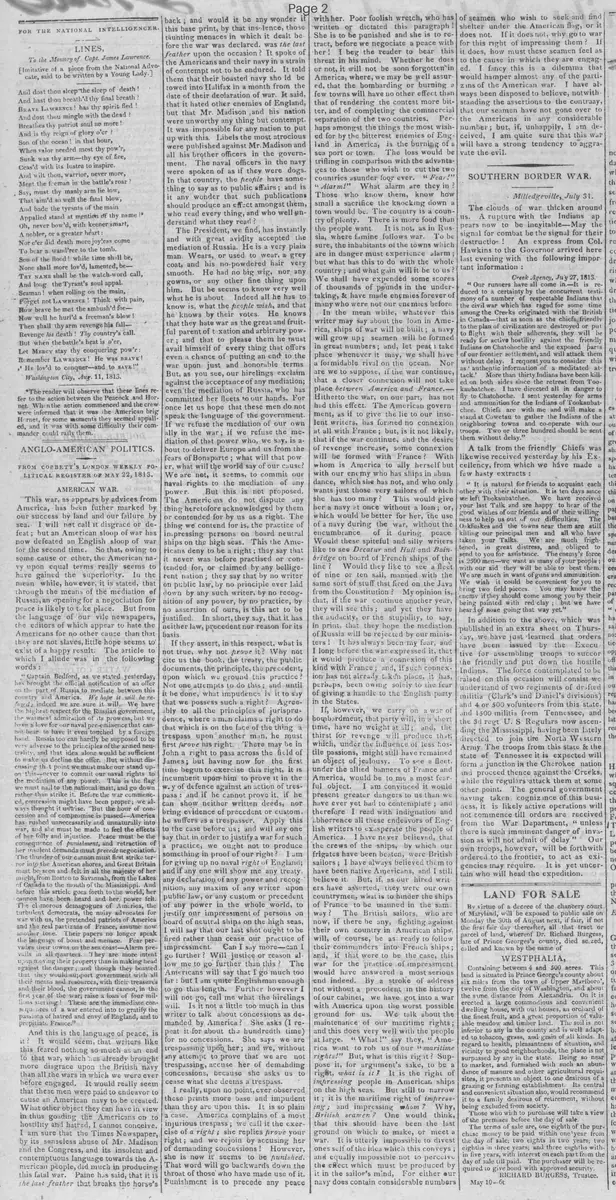
FROM COBBETT'S LONDON WEEKLY POLITICAL REGISTER OF MAY 22, 1813.
AMERICAN WAR.
This war, as appears by advices from America, has been further marked by our success by land and our failure by sea. I will not call it disgrace or defeat; but an American sloop of war has now defeated an English sloop of war for the second time. So that, owing to some cause or other, the American navy upon equal terms really seems to have gained the superiority. In the mean while, however, it is stated, that through the means of the mediation of Russia, an opening for a negociation for peace is likely to take place. But from the language of our vile newspapers, the editors of which appear to hate the Americans for no other cause than that they are not slaves, little hope seems to exist of a happy result. The article to which I allude was in the following words:
"Captain Bedford, as we stated yesterday, has brought the official notification of an offer on the part of Russia to mediate between this country and America. We hope it will be refused, indeed we are sure it will. We have the highest respect for the Russian government, the warmest admiration of its prowess, but we have a love for our naval pre-eminence that cannot bear to have it even touched by a foreign hand. Russia too can hardly be supposed to be very adverse to the principles of the armed neutrality, and that idea alone would be sufficient to make us decline the offer. But without discussing that point we must make our stand upon this—never to commit our naval rights to the mediation of any power. This is the flag we must nail to the national mast, and go down rather than strike it. Before the war commenced, concession might have been proper; we always thought it unwise. But the hour of concession and of compromise is passed—America has rushed unnecessarily and unnaturally into war, and she must be made to feel the effects of her folly and injustice. Peace must be the consequence of punishment, and retraction of her insolent demands must precede negociation. The thunder of our cannon must first strike terror into the American shores, and Great Britain must be seen and felt in all the majesty of her might, from Boston to Savannah, from the Lakes of Canada to the mouth of the Mississippi. And before this article goes forth to the world, her cannon have been heard and her power felt. The clamorous demagogues of America, the turbulent democrats, the noisy advocates for war with us, the pretended patriots of America and the real partizans of France, assume now another tone. Their papers no longer speak the language of boast and menace. Fear pervades their towns on the sea coast—Alarm prevails in all quarters. They are more intent upon removing their property than in making head against the danger; and though they boasted that they would support government with all their means and resources, with their treasures and their blood, the government cannot, in the first year of the war, raise a loan of four millions sterling! These are the immediate consequences of a war entered into to gratify the passions of hatred and envy of England, and to propitiate France."
And this is the language of peace, is it? It would seem, that writers like this cared nothing so much as an end to that war, which has already brought more disgrace upon the British navy than all the wars in which we were ever before engaged. It would really seem that these men were paid to endeavor to cause an American navy to be created. What other object they can have in view in thus goading the Americans on to hostility and hatred, I cannot conceive. I am sure that the Times Newspaper, by its senseless abuse of Mr. Madison and the Congress, and its insolent and contemptuous language towards the American people, did much in producing this fatal war. Paine has said, that it is the last feather that breaks the horse's back; and would it be any wonder if this base print, by that insolence, those taunting menaces in which it dealt before the war was declared, was the last feather upon the occasion? It spoke of the Americans and their navy in a strain of contempt not to be endured. It told them that their boasted navy should be towed into Halifax in a month from the date of their declaration of war. It said that it hated other enemies of England, but that Mr. Madison and his nation were unworthy any thing but contempt. It was impossible for any nation to put up with this. Libels the most atrocious were published against Mr. Madison and all his brother officers in the government. The naval officers in the navy were spoken of as if they were dogs. In that country, the people have something to say as to public affairs; and is it any wonder that such publications should produce an effect amongst them, who read every thing, and who well understand what they read? The President, we find, has instantly and with great avidity accepted the mediation of Russia. He is a very plain man. Wears, or used to wear, a grey coat, and his unpowdered hair very smooth. He had no big wig, nor any gowns, or any other fine thing upon him. But he seems to know very well what he is about. Indeed all he has to know is, what the people wish, and that he knows by their votes. He knows that they hate war as the great and fruitful parent of taxation and arbitrary power; and that to please them he must avail himself of every thing that offers even a chance of putting an end to the war upon just and honorable terms. But, as you see, our hirelings exclaim against the acceptance of any mediation; even the mediation of Russia, who has committed her fleets to our hands. For once let us hope that these men do not speak the language of the government. If we refuse the mediation of our own ally in the war; if we refuse the mediation of that power who, we say, is about to deliver Europe and us from the fears of Bonaparte; what will that power, what will the world say of our cause? We are not, it seems, to commit our naval rights to the mediation of any power. But this is not proposed. The Americans do not dispute any thing heretofore acknowledged by them or contended for by us as a right. The thing we contend for is, the practice of impressing persons on board neutral ships on the high seas. This the Americans deny to be a right; they say that it never was before practised or contended for, or claimed by any belligerent nation; they say that by no writer on public law, by no principle ever laid down by any such writer, by no recognition of any power, by no practice, by no assertion of ours, is this act to be justified. In short, they say, that it has neither law, precedent nor reason for its basis.
If they assert, in this respect, what is not true, why not prove it? Why not cite us the book, the treaty, the public documents, the principle, the precedent, upon which we ground this practice? Not one attempts to do this; and until it be done, what impudence is it to say that we possess such a right? Agreeably to all the principles of jurisprudence, where a man claims a right to do that which is on the face of the thing a trespass upon another man, he must first prove his right. There may be in John a right to pass across the field of James: but having now for the first time begun to exercise this right, it is incumbent upon him to prove it in the way of defence against an action of trespass: and if he cannot prove it, if he can show neither written deeds, nor bring evidence of precedent or custom, he suffers as a trespasser. Apply this to the case before us; and will any one say that in order to justify a war for such a practice, we ought not to produce something in proof of our right? I am for giving up no naval right of England; and if any one will show me any treaty, any declaration of any power and recognition, any maxim of any writer upon public law, or any custom or precedent of any power in the whole world, to justify our impressment of persons on board of neutral ships on the high seas, I will say that our last shot ought to be fired rather than cease our practice of impressment. Can I say more—can I go further? Will justice or reason allow me to go further than this? The Americans will say that I go much too far: but I am quite Englishman enough to go this length. Further however I will not go, call me what the hirelings will. Is it not a little too much in this writer to talk about concessions as demanded by America? She asks (I repeat it for about the hundredth time) for no concessions. She says we are trespassing upon her; and we, without any attempt to prove that we are not trespassing, accuse her of demanding concessions, because she asks us to cease what she deems a trespass. I really, upon no point, ever observed these prints more base and impudent than they are upon this. It is so plain a case. America complains of a most injurious trespass; we call it the exercise of a right; she replies prove your right; and we rejoin by accusing her of demanding concessions! However, she is now it seems to be punished. That word will go backwards down the throat of those who have made use of it. Punishment is to precede any peace with her. Poor foolish wretch, who has written or dictated this paragraph! She is to be punished and she is to retract, before we negociate a peace with her! I beg the reader to bear this threat in his mind. Whether he does or not, it will not be soon forgotten in America, where, we may be well assured, that the bombarding or burning a few towns will have no other effect than that of rendering the contest more bitter, and of completing the commercial separation of the two countries. Perhaps amongst the things the most wished for by the bitterest enemies of England in America, is the burning of a sea port or town. The loss would be trifling in comparison with the advantages to those who wish to cut the two countries asunder for ever. "Fear!" "Alarm!" What alarm are they in? Those who know them, know how small a sacrifice the knocking down a town would be. The country is a country of plenty. There is more food than the people want. It is not, as in Russia, where famine follows war. To be sure, the inhabitants of the towns which are in danger must experience alarm; but what has this to do with the whole country; and what gain will it be to us? We shall have expended some scores of thousands of pounds in the undertaking, & have made enemies forever of many who were not our enemies before. In the mean while, whatever this writer may say about the loan in America, ships of war will be built; a navy will grow up; seamen will be formed in great numbers; and, let peace take place whenever it may, we shall have a formidable rival on the ocean. Nor are we to suppose, if the war continue, that a closer connexion will not take place between America and France. Hitherto the war, on our part, has not had this effect. The American government, as if to give the lie to our insolent writers, has formed no connexion at all with France; but, is it not likely, that if the war continue, and the desire of revenge increase, some connexion will be formed with France? With whom is America to ally herself but with our enemy who has ships in abundance, which she has not, and who only wants just those very sailors of which she has too many? This would give her a navy at once without a loan; or, which would be better for her, the use of a navy during the war, without the encumbrance of it during peace. Would these spiteful and silly writers like to see Decatur and Hull and Bainbridge on board of French ships of the line? Would they like to see a fleet of nine or ten sail, manned with the same sort of stuff that fired on the Java from the Constitution? My opinion is, that, if the war continue another year, they will see this; and yet they have the audacity, or the stupidity, to say, in print, that they hope the mediation of Russia will be rejected by our ministers! It has always been my fear, and I long before the war expressed it, that it would produce a connexion of this kind with France; and, if such connexion has not already taken place, it has, perhaps, been owing solely to the fear of giving a handle to the English party in the States. If, however, we carry on a war of bombardment, that party will, in a short time, have no weight at all; and, the thirst for revenge, will produce that, which, under the influence of less hostile passions, might still have remained an object of jealousy. To see a fleet, under the allied banners of France and America, would be to me a most fearful object. I am convinced it would present greater dangers to us than we have ever yet had to contemplate; and therefore I read with indignation and abhorrence all these endeavors of English writers to exasperate the people of America. I have never believed, that the crews of the ships, by which our frigates have been beaten, were British sailors; I have always believed them to have been native Americans, and I still believe it. But, if, as our hired writers have asserted, they were our own countrymen, what is to hinder the ships of France to be manned in the same way? The British sailors, who are now, if there be any, fighting against their own country in American ships, will, of course, be as ready to follow their commanders into French ships; and, if that were to be the case, this war for the practice of impressment would have answered a most serious end indeed. By a stroke of address not without a precedent in the history of our cabinet, we have got into a war with America upon the worst possible ground for us. We talk about the maintenance of our maritime rights; and this does very well with the people at large. "What!" say they, "America want to rob us of our maritime rights!" But, what is this right? Suppose it, for argument's sake, to be a right, what is it? It is the right of impressing people in American ships on the high seas. But still to narrow it; it is the maritime right of impressing; and impressing whom? Why, British seamen? One would think, that this should have been the last ground on which to make, or meet a war. It is utterly impossible to divest one's self of the idea which this conveys; and equally impossible not to perceive the effect which must be produced by it in the sailor's mind. For either our navy does contain considerable numbers of seamen who wish to seek and find shelter under the American flag, or it does not. If it does not, why go to war for this right of impressing them? If it does, how must these seamen feel as to the cause in which they are engaged. I fancy this is a dilemma that would hamper almost any of the partizans of the American war. I have always been disposed to believe, notwithstanding the assertions to the contrary, that our seamen have not gone over to the Americans in any considerable number; but, if, unhappily, I am deceived, I am quite sure that this War will have a strong tendency to aggravate the evil.
What sub-type of article is it?
What keywords are associated?
What entities or persons were involved?
Where did it happen?
Foreign News Details
Primary Location
America
Event Date
Advices From America As Of May 1813
Key Persons
Outcome
american sloop of war defeats english sloop for second time; opening for peace negotiation via russian mediation; president madison accepts mediation
Event Details
The American War features British land successes but sea failures, with American navy gaining superiority on equal terms. Russia offers mediation, accepted by U.S. President Madison, but British newspapers oppose it, insisting on punishment of America before peace and defending impressment rights without proof. Criticizes press for exacerbating hostility, warns of potential U.S.-French alliance and growth of American navy.