Thank you for visiting SNEWPapers!
Sign up free
Vermont Telegraph
Brandon, Rutland County, Vermont
What is this article about?
Rev. D.M. Crane writes to the Vermont Telegraph defending the Baptist church's decision in Grafton, VT, to continue a protracted religious meeting without interruption for an anti-slavery lecture by Charles C. Burleigh, criticizing R.T. Robinson's biased account. Editorial remarks quote Robinson's original report and rebut Crane's complaints, emphasizing the importance of anti-slavery advocacy.
Merged-components note: Merged the editorial response directly following and quoting the original letter, as they form a single logical unit discussing the controversy over the anti-slavery meeting in Grafton.
Clipping
OCR Quality
Full Text
BRANDON. SATURDAY FEB. 26, 1842.
For the Vermont Telegraph.
Protracted Meeting and Anti-slavery Meeting at Grafton.
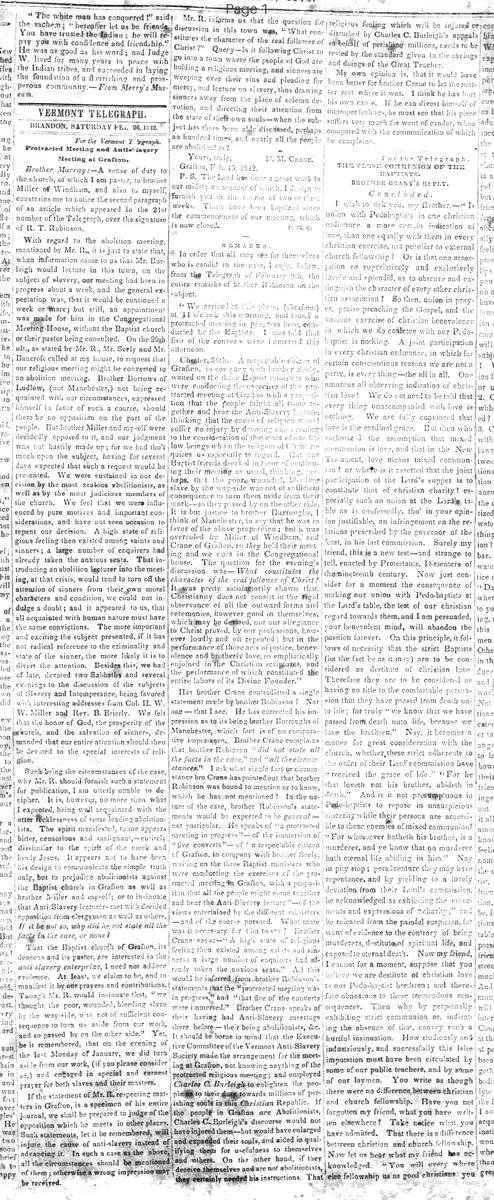
Brother Murray:—A sense of duty to the church, of which I am pastor, to brother Miller of Windham, and also to myself, constrains me to notice the second paragraph of an article which appeared in the 21st number of the Telegraph, over the signature of R. T. Robinson.
With regard to the abolition meeting, mentioned by Mr. R., it is just to state that, when information came to us that Mr. Burleigh would lecture in this town, on the subject of slavery, our meeting had been in progress about a week, and the general expectation was, that it would be continued a week or more; but still, an appointment was made for him in the Congregational Meeting-House, without the Baptist church or their pastor being consulted. On the 29th ult., as stated by Mr. R., Mr. Seely and Mr. Bancroft called at my house, to request that our religious meeting might be converted to an abolition meeting. Brother Burrows of Ludlow, (not Manchester,) not being acquainted with our circumstances, expressed himself in favor of such a course, should there be no opposition on the part of the people. But brother Miller and myself were decidedly opposed to it, and our judgment was not hastily made; for we had thought much upon the subject, having for several days expected that such a request would be presented. We were sustained in our decision by the most zealous abolitionists, as well as by the most judicious members of the church. We feel that we were influenced by pure motives and important considerations, and have not seen occasion to repent our decision. A high state of religious feeling then existed among saints and sinners; a large number of enquirers had already taken the anxious seats. That introducing an abolition lecturer into the meeting, at that crisis, would tend to turn off the attention of sinners from their own moral characters and condition, we could not indulge a doubt; and it appeared to us, that all acquainted with human nature must have the same convictions. The more important and exciting the subject presented, if it has not radical reference to the criminality and state of the sinner, the more likely it is to divert the attention. Besides this, we had of late, devoted two Sabbaths and several evenings to the discussion of the subjects of Slavery and Intemperance, being favored with interesting addresses from Col. H. W. Miller and Rev. B. Brierly. We felt that the honor of God, the prosperity of the church, and the salvation of sinners, demanded that our entire attention should then be devoted to the special interests of religion.
Such being the circumstances of the case, why Mr. R. should furnish such a statement for publication, I am utterly unable to decipher. It is, however, no more than what I expected, being well acquainted with the utter recklessness of some leading abolitionists. The spirit manifested, to me appears bitter, censorious and malignant,—entirely dissimilar to the spirit of the meek and lowly Jesus. It appears not to have been his design to communicate the simple truth only, but to prejudice abolitionists against the Baptist church in Grafton as well as brother Miller and myself; or to insinuate that Anti-Slavery lecturers met with decided opposition from clergymen as well as others. If it be not so, why did he not state all the facts in the case, or none? That the Baptist church of Grafton, its deacons and its pastor, are interested in the anti-slavery enterprise, I need not adduce evidence. At least, we claim to be, and to manifest it by our prayers and contributions. Though Mr. R. would insinuate that, "we thought the poor, wounded, bleeding slave by the way-side, was not of sufficient consequence to turn us aside from our work, and so passed by on the other side." Yet, be it remembered, that on the evening of the last Monday of January, we did turn aside from our work, (if you please consider so,) and engaged in special and earnest prayer for both slaves and their masters. If the statement of Mr. R. respecting matters in Grafton, is a specimen of his entire journal, we shall be prepared to judge of the opposition which he meets in other places. Such statements, let it be remembered, will injure the cause of anti-slavery instead of advancing it. In such a case as the above, all the circumstances should be mentioned of them; otherwise a wrong impression may be received.
Mr. R. informs us that the question for discussion in this town was, "What constitutes the character of the real follower of Christ?" Query—Is it following Christ to go into a town where the people of God are holding a religious meeting, and sinners are weeping over their sins and pleading for mercy, and lecture on slavery, thus drawing sinners away from the place of solemn devotion, and directing their attention from the state of their own souls—when the subject has there been ably discussed, perhaps an hundred times, and nearly all the people are abolitionists?
Yours, truly.
D. M. CRANE.
Grafton, Feb. 15, 1842.
P. S. The Lord has done a great work in our midst; an account of which, I design to furnish you in the course of two or three weeks. Thirty have been baptized since the commencement of our meeting, which is now closed.
D. M. C.
REMARKS.
In order that all may see for themselves who is candid in the case, I copy below, from the Telegraph of February 9th, the entire remarks of brother Robinson on the subject.
"We arrived at this place, (Grafton,) at 11 o'clock this morning, and found a protracted meeting in progress here, conducted by the Baptists. I was told that five of the converts were immersed this afternoon.
Chester, Feb. A respectable citizen of Grafton, in company with brother Seely, waited on the three Baptist ministers who were conducting the exercises of the protracted meeting at Grafton with a proposition that the people might all come together and hear the Anti-Slavery lecture, thinking that the cause of religion would suffer no injury by devoting one evening to the consideration of that class of our fellow beings whom the religion of Christ requires us especially to regard. But our Baptist friends decided in favor of continuing their meeting as usual, thinking, perhaps, that the poor, wounded, bleeding slave by the way-side was not of sufficient consequence to turn them aside from their work—so they passed by on the other side. It is but justice to brother Burroughs, I think of Manchester, to say that he was in favor of the above proposition; but it was overruled by Miller of Windham, and Crane of Grafton, so they held their meeting and we ours in the Congregational house. The question for the evening's discussion was— What constitutes the character of the real follower of Christ? It was pretty satisfactorily shown that, Christianity does not consist in the rigid observance of all the outward forms and ceremonies, however good in themselves, which may be devised, nor our allegiance to Christ proved, by our professions, however loudly and oft repeated: but in the performance of those acts of justice, benevolence and brotherly love, so emphatically enjoined in the Christian scriptures, and the performance of which constituted the entire labors of its Divine Founder.'"
Has brother Crane contradicted a single statement made by brother Robinson? Not one - that I see. He has corrected his impression as to its being brother Burroughs of Manchester, which fact is of no comparative importance. Brother Crane complains that brother Robinson "did not state all the facts in the case," and "all the circumstances." I ask what single fact or circumstance bro. Crane has pointed out that brother Robinson was bound to mention or to know, which he has not mentioned? In the nature of the case, brother Robinson's statements would be expected to be general - not particular. He speaks of "a protracted meeting in progress"- of the immersion of "five converts"- of 'a respectable citizen of Grafton, in company with brother Seely, waiting on the three Baptist ministers who were conducting the exercises of the protracted meeting in Grafton, with a proposition that all the people might come together and hear the Anti-Slavery lecture"-of the views entertained by the different ministers -and of the course pursued. What more was it necessary for him to say? Brother Crane says:-"A high state of religious feeling then existed among saints and sinners: a large number of enquirers had already taken the anxious seats." All this would be inferred from brother Robinson's statements that the protracted meeting was in progress," and "that five of the converts were immersed." "Brother Crane speaks of their having had Anti-Slavery meetings there before- their being abolitionists, &c. It should be borne in mind that the Executive Committee of the Vermont Anti-Slavery Society made the arrangement for the meeting at Grafton, not knowing anything of the protracted religious meeting; and employed Charles C. Burleigh to enlighten the people as to their duty towards millions of perishing souls in this Christian Republic. If the people in Grafton are Abolitionists, Charles C. Burleigh's discourse would not have injured them—but would have enlarged and expanded their souls, and aided in qualifying them for usefulness to themselves and others. On the other hand, if they deceive themselves and are not abolitionists, they certainly needed his instructions. That religious feeling which will be injured or disturbed by Charles C. Burleigh's appeals in behalf of perishing millions, needs to be tested by the standard given in the sayings and doings of the Great Teacher.
My own opinion is, that it would have been better for brother Crane to let the matter rest where it was. I think he has hurt his own cause. If he can divest himself of improper feelings, he must see that his piece suffers very much for want of candor, when compared with the communication of which he complains.
What sub-type of article is it?
What themes does it cover?
What keywords are associated?
What entities or persons were involved?
Letter to Editor Details
Author
D. M. Crane
Recipient
Brother Murray
Main Argument
the baptist church in grafton rightly opposed converting their protracted religious meeting into an anti-slavery event due to the critical stage of religious fervor and conversions, and r.t. robinson's published account was biased, incomplete, and malicious.
Notable Details
- thirty baptisms since meeting start
- prior addresses on slavery and intemperance by col. h. w. miller and rev. b. brierly
- prayer for slaves and masters on january's last monday
- quotation of robinson's original remarks from february 9 telegraph
- editorial response defends robinson's candor and criticizes crane's lack thereof