Thank you for visiting SNEWPapers!
Sign up free
Story
February 25, 1888
The Irish Standard
Minneapolis, Saint Paul, Hennepin County, Ramsey County, Minnesota
What is this article about?
Historical overview of the origins, prehistoric cultivation, and global spread of common vegetables like beans, potatoes, and tomatoes, from ancient Egypt, Europe, Asia, and America.
Clipping
OCR Quality
95%
Excellent
Full Text
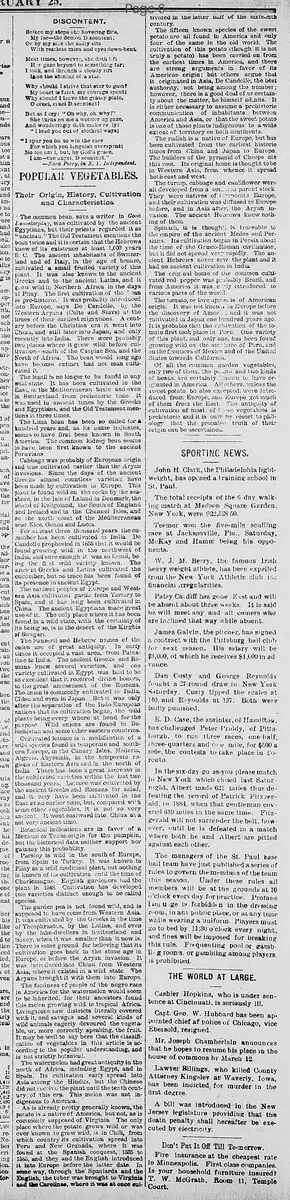
POPULAR VEGETABLES.
Their Origin, History, Cultivation
and Characteristics
"The common bean, says a writer in Good
Housekeeping, was cultivated by the ancient
Egyptians, but their priests regarded it as
"unclean." The Old Testament mentions the
bean twice and it is certain that the Hebrews knew of its existence at least 1,000 years
B. C. The ancient inhabitants of Switzerland and of Italy, in the age of bronze,
cultivated a small fruited variety of this
plant. It was also known to the ancient
Greeks and to the ancient Latins, and it
grew wild in Northern Africa in the days
of Pliny. The first cultivation of the bean
is pre-historic. It was probably introduced
into Europe, says De Candolle, by the
Western Aryans (Celts and Slavs) at the
times of their earliest migrations. A century before the Christian era it went into
China, and still later into Japan, and only
recently into India. There were probably
two places where it grew wild before cultivation—south of the Caspian Sea, and the
North of Africa. The bean would long ago
have become extinct had not man cultivated it.
The lentil is no longer to be found in any
wild state. It has been cultivated in the
East, in the Mediterranean basin and even
in Switzerland from prehistoric time. it
was used in ancient times by the Greeks
and Egyptians, and the Old Testament mentions it three times.
The Lima bean has been so called for a
hundred years and, as its name indicates,
seems to have first been known in South
America. The common kidney bean seems
to have been first known to the ancient
Peruvians.
Cabbage was probably of European origin
and was cultivated earlier than the Aryan
invasions. Since the days of the ancient
Greeks almost countless varieties have
been made by cultivation in Europe. This
plant is found wild on the rocks by the seashore, in the Isle of Iceland in Denmark, the
island of Heligoland, the South of England
and Ireland and in the Channel Isles, and
on the north coast of the Mediterranean
near Nice, Genoa and Lucca
For at least three thousand years the cucumber has been cultivated in India. De
Candolle prophesied in 1855 that it would be
found growing wild in the northwest of
India, and sure enough it was so found, being the first wild variety known.
The
ancient Greeks and Latins cultivated the
cucumber, but no trace has been found of
its presence in ancient Egypt.
The earliest peoples of Europe and Western Asia cultivated garlic from Tartary to
Spain, and it has long been cultivated in
China The ancient Egyptians made great
use of it. The only place where it has been
found in a wild state, with the certainty of
its being so, is in the desert of the Kirghiz
of Sungari.
The Sanscrit and Hebrew names of the
onion are of great antiquity. In early
times it occupied a vast area, from Palestine to India. The ancient Greeks and Romans knew several varieties, and one
variety cultivated in Egypt was held to be
so excellent that it received divine honors,
to the great amusement of the Romans.
The onion is commonly cultivated in India,
China and even in Japan. But it was only
after the separation of the Indo-European
nations that its cultivation began, the wild
plants being everywhere at hand for the
purpose. Wild onions are found in Beichistan and some other eastern countries.
Cultivated lettuce is a modification of a
wild species found in temperate and southern Europe, in the Canary Isles, Madeira,
Algeria, Abyssinia, in the temperate regions of Eastern Asia and in the north of
India. There has been a great increase in
the cultivated varieties within the last two
thousand years. Lettuce was cultivated by
the ancient Greeks and Romans for salad,
and it may have been cultivated in the
East at an earlier time, but, compared with
some other vegetables, it is not so very
ancient. It went eastward into China at a
not very ancient time.
Botanical indications are in favor of a
Mexican or Texan origin for the pumpkin,
but the historical data neither support nor
gainsay this probability.
Parsley is wild in the south of Europe,
from Spain to Turkey. It was known to
Pliny as a wild medicinal plant, but nothing
is known of its cultivation until the time of
Charlemagne. English gardeners had the
plant in 1548. Cultivation has developed
two varieties distinct enough to be called
species.
The garden pea is not found wild, and is
supposed to have come from Western Asia.
It was cultivated by the Greeks in the time
of Theophrastus, by the Latins, and even
by the lake-dwellers in Switzerland and
Savoy, when it was smaller than it now is.
There is some ground for believing that its
cultivation goes back to the stone age in
Europe, or before the Aryan invasion. It
was introduced into China from Western
Asia, where it existed in a wild state. The
Aryans brought it with them into Europe.
The fondness of people of the negro race
in America for the watermelon would seem
to be inherited, for their ancestors found
this melon growing wild in tropical Africa.
Livingstone saw districts literally covered
with it, and savages and several kinds of
wild animals eagerly devoured the vegetable, or, more correctly speaking, the fruit.
It may be well to say here that the classification of vegetables in this article is according to the popular understanding, and
is not strictly botanical.
The watermelon had great antiquity in the
north of Africa, including Egypt, and in
Spain. Its cultivation early spread into
Asia among the Hindus, but the Chinese
did not receive the plant until the tenth century of this era. This melon was not indigenous to America.
—As is already pretty generally known, the
potato is a native of America, but not, as is
commonly supposed of Virginia. The only
place where the potato grows wild or was
ever known to grow wild, is in Chili, from
which country its cultivation spread into
Peru and New Granada, where it was
found at the Spanish conquest, 1535 to
1585, and they and the English introduced
it into Europe before the latter date. In
some way, through the Spaniards and the
English, the tuber was brought to Virginia
and the Carolinas, where it was at once cultivated in the latter half of the sixteenth
century
The fifteen known species of the sweet
potato are all found in America and only
four of the same in the old world. The
cultivation of this potato (though it is not
truly a potato) has been carried on from
the earliest times in America, and there are
strong arguments in favor of its
American origin; but others argue that
it originated in Asia, De Candolle, the best
authority, not being among the number;
however, there is a good deal of uncertainty about the matter, he himself admits. It
is either necessary to assume a prehistoric
communication of inhabitants
between
America and Asia, or that the sweet potato
is one of those plants indigenous to a wide
extent of territory on both continents.
The radish is a native of Europe, but has
been cultivated from the earliest historic
times from China and Japan to Europe.
The builders of the pyramid of Cheops ate
this root. Its original home is thought to be
in Western Asia, from whence it spread
both east and west.
The turnip, cabbage and cauliflower were
all developed from a common parent stock.
They were natives of temperate Europe,
and their cultivation was diffused in Europe before, and in Asia after, the Aryan invasion. The ancient Hebrews knew nothing of them.
Spinach, it is thought, is traceable to
the empire of the ancient Medes and Persians. Its cultivation began in Persia about
the time of the Graeco-Roman civilization,
but it did not spread very rapidly. The ancient Hebrews never saw the plant and it
had no ancient cultivation in India.
The original home of the common cultivated red pepper was probably Brazil, and
from America it was early introduced to
various parts of the world.
The tomato, or love apple, is of American
origin. It was not known in Europe before
the discovery of America, and it was not
cultivated in Japan one hundred years ago.
It is probable that the cultivation of the tomato first took place in Peru. One variety
of this plant, and only one, has been found
growing wild on the seashore of Peru, and
on the frontiers of Mexico and of the United
States towards California.
Of all the common garden vegetables,
only two of them, the potato and two kinds
of beans, are certainly known to have originated in America. All others, unless the
sweet potato be also excepted, were introduced from Europe, and Europe got much
of them from the East. The antiquity of
cultivation of most of these vegetables is
prehistoric and it is only by resort to philology that the probable truth of their
origin can be ascertained.
Their Origin, History, Cultivation
and Characteristics
"The common bean, says a writer in Good
Housekeeping, was cultivated by the ancient
Egyptians, but their priests regarded it as
"unclean." The Old Testament mentions the
bean twice and it is certain that the Hebrews knew of its existence at least 1,000 years
B. C. The ancient inhabitants of Switzerland and of Italy, in the age of bronze,
cultivated a small fruited variety of this
plant. It was also known to the ancient
Greeks and to the ancient Latins, and it
grew wild in Northern Africa in the days
of Pliny. The first cultivation of the bean
is pre-historic. It was probably introduced
into Europe, says De Candolle, by the
Western Aryans (Celts and Slavs) at the
times of their earliest migrations. A century before the Christian era it went into
China, and still later into Japan, and only
recently into India. There were probably
two places where it grew wild before cultivation—south of the Caspian Sea, and the
North of Africa. The bean would long ago
have become extinct had not man cultivated it.
The lentil is no longer to be found in any
wild state. It has been cultivated in the
East, in the Mediterranean basin and even
in Switzerland from prehistoric time. it
was used in ancient times by the Greeks
and Egyptians, and the Old Testament mentions it three times.
The Lima bean has been so called for a
hundred years and, as its name indicates,
seems to have first been known in South
America. The common kidney bean seems
to have been first known to the ancient
Peruvians.
Cabbage was probably of European origin
and was cultivated earlier than the Aryan
invasions. Since the days of the ancient
Greeks almost countless varieties have
been made by cultivation in Europe. This
plant is found wild on the rocks by the seashore, in the Isle of Iceland in Denmark, the
island of Heligoland, the South of England
and Ireland and in the Channel Isles, and
on the north coast of the Mediterranean
near Nice, Genoa and Lucca
For at least three thousand years the cucumber has been cultivated in India. De
Candolle prophesied in 1855 that it would be
found growing wild in the northwest of
India, and sure enough it was so found, being the first wild variety known.
The
ancient Greeks and Latins cultivated the
cucumber, but no trace has been found of
its presence in ancient Egypt.
The earliest peoples of Europe and Western Asia cultivated garlic from Tartary to
Spain, and it has long been cultivated in
China The ancient Egyptians made great
use of it. The only place where it has been
found in a wild state, with the certainty of
its being so, is in the desert of the Kirghiz
of Sungari.
The Sanscrit and Hebrew names of the
onion are of great antiquity. In early
times it occupied a vast area, from Palestine to India. The ancient Greeks and Romans knew several varieties, and one
variety cultivated in Egypt was held to be
so excellent that it received divine honors,
to the great amusement of the Romans.
The onion is commonly cultivated in India,
China and even in Japan. But it was only
after the separation of the Indo-European
nations that its cultivation began, the wild
plants being everywhere at hand for the
purpose. Wild onions are found in Beichistan and some other eastern countries.
Cultivated lettuce is a modification of a
wild species found in temperate and southern Europe, in the Canary Isles, Madeira,
Algeria, Abyssinia, in the temperate regions of Eastern Asia and in the north of
India. There has been a great increase in
the cultivated varieties within the last two
thousand years. Lettuce was cultivated by
the ancient Greeks and Romans for salad,
and it may have been cultivated in the
East at an earlier time, but, compared with
some other vegetables, it is not so very
ancient. It went eastward into China at a
not very ancient time.
Botanical indications are in favor of a
Mexican or Texan origin for the pumpkin,
but the historical data neither support nor
gainsay this probability.
Parsley is wild in the south of Europe,
from Spain to Turkey. It was known to
Pliny as a wild medicinal plant, but nothing
is known of its cultivation until the time of
Charlemagne. English gardeners had the
plant in 1548. Cultivation has developed
two varieties distinct enough to be called
species.
The garden pea is not found wild, and is
supposed to have come from Western Asia.
It was cultivated by the Greeks in the time
of Theophrastus, by the Latins, and even
by the lake-dwellers in Switzerland and
Savoy, when it was smaller than it now is.
There is some ground for believing that its
cultivation goes back to the stone age in
Europe, or before the Aryan invasion. It
was introduced into China from Western
Asia, where it existed in a wild state. The
Aryans brought it with them into Europe.
The fondness of people of the negro race
in America for the watermelon would seem
to be inherited, for their ancestors found
this melon growing wild in tropical Africa.
Livingstone saw districts literally covered
with it, and savages and several kinds of
wild animals eagerly devoured the vegetable, or, more correctly speaking, the fruit.
It may be well to say here that the classification of vegetables in this article is according to the popular understanding, and
is not strictly botanical.
The watermelon had great antiquity in the
north of Africa, including Egypt, and in
Spain. Its cultivation early spread into
Asia among the Hindus, but the Chinese
did not receive the plant until the tenth century of this era. This melon was not indigenous to America.
—As is already pretty generally known, the
potato is a native of America, but not, as is
commonly supposed of Virginia. The only
place where the potato grows wild or was
ever known to grow wild, is in Chili, from
which country its cultivation spread into
Peru and New Granada, where it was
found at the Spanish conquest, 1535 to
1585, and they and the English introduced
it into Europe before the latter date. In
some way, through the Spaniards and the
English, the tuber was brought to Virginia
and the Carolinas, where it was at once cultivated in the latter half of the sixteenth
century
The fifteen known species of the sweet
potato are all found in America and only
four of the same in the old world. The
cultivation of this potato (though it is not
truly a potato) has been carried on from
the earliest times in America, and there are
strong arguments in favor of its
American origin; but others argue that
it originated in Asia, De Candolle, the best
authority, not being among the number;
however, there is a good deal of uncertainty about the matter, he himself admits. It
is either necessary to assume a prehistoric
communication of inhabitants
between
America and Asia, or that the sweet potato
is one of those plants indigenous to a wide
extent of territory on both continents.
The radish is a native of Europe, but has
been cultivated from the earliest historic
times from China and Japan to Europe.
The builders of the pyramid of Cheops ate
this root. Its original home is thought to be
in Western Asia, from whence it spread
both east and west.
The turnip, cabbage and cauliflower were
all developed from a common parent stock.
They were natives of temperate Europe,
and their cultivation was diffused in Europe before, and in Asia after, the Aryan invasion. The ancient Hebrews knew nothing of them.
Spinach, it is thought, is traceable to
the empire of the ancient Medes and Persians. Its cultivation began in Persia about
the time of the Graeco-Roman civilization,
but it did not spread very rapidly. The ancient Hebrews never saw the plant and it
had no ancient cultivation in India.
The original home of the common cultivated red pepper was probably Brazil, and
from America it was early introduced to
various parts of the world.
The tomato, or love apple, is of American
origin. It was not known in Europe before
the discovery of America, and it was not
cultivated in Japan one hundred years ago.
It is probable that the cultivation of the tomato first took place in Peru. One variety
of this plant, and only one, has been found
growing wild on the seashore of Peru, and
on the frontiers of Mexico and of the United
States towards California.
Of all the common garden vegetables,
only two of them, the potato and two kinds
of beans, are certainly known to have originated in America. All others, unless the
sweet potato be also excepted, were introduced from Europe, and Europe got much
of them from the East. The antiquity of
cultivation of most of these vegetables is
prehistoric and it is only by resort to philology that the probable truth of their
origin can be ascertained.
What sub-type of article is it?
Curiosity
Historical Event
What themes does it cover?
Nature
Exploration
What keywords are associated?
Vegetable Origins
Cultivation History
Ancient Agriculture
Plant Spread
Historical Botany
Story Details
Event Date
Prehistoric Times
Story Details
The article provides historical origins, cultivation, and spread of popular vegetables including beans, lentils, cabbage, cucumber, garlic, onion, lettuce, pumpkin, parsley, pea, watermelon, potato, sweet potato, radish, turnip, spinach, pepper, and tomato, from ancient civilizations in Europe, Asia, Africa, and America.