Thank you for visiting SNEWPapers!
Sign up free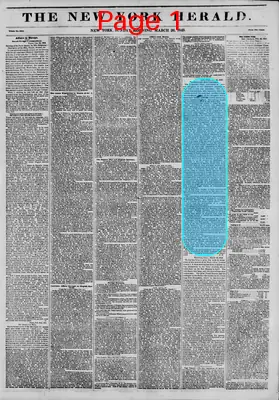
The New York Herald
New York, New York County, New York
What is this article about?
The Democratic State Convention in Iowa City on February 22, 1848, nominated delegates to the Baltimore Convention and Thomas H. Benton, Jr. for superintendent of instruction. Discussions focused on the Mexican War, advocating continued U.S. occupation. Speeches emphasized Democratic unity and expansion of republican principles.
Clipping
OCR Quality
Full Text
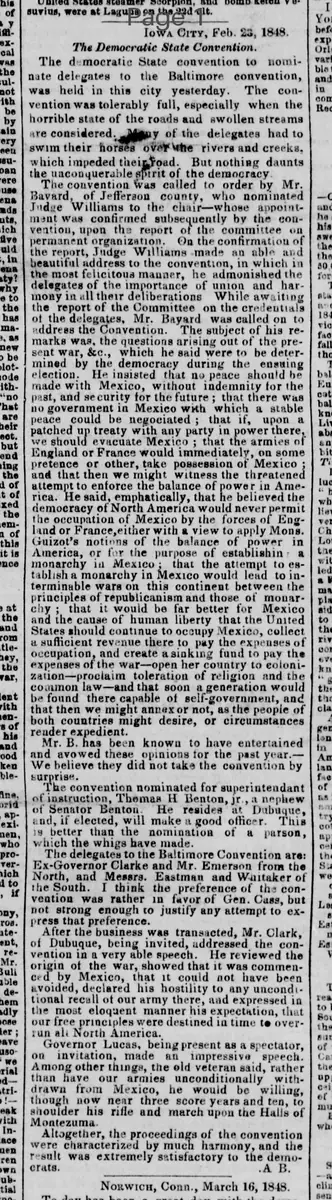
The Democratic State Convention.
The democratic State convention to nominate delegates to the Baltimore convention, was held in this city yesterday. The convention was tolerably full, especially when the horrible state of the roads and swollen streams are considered. Many of the delegates had to swim their horses over the rivers and creeks, which impeded their road. But nothing daunts the unconquerable spirit of the democracy.
The convention was called to order by Mr. Bayard, of Jefferson county, who nominated Judge Williams to the chair—whose appointment was confirmed subsequently by the convention, upon the report of the committee on permanent organization. On the confirmation of the report, Judge Williams made an able and beautiful address to the convention, in which in the most felicitous manner, he admonished the delegates of the importance of union and harmony in all their deliberations. While awaiting the report of the Committee on the credentials of the delegates, Mr. Bayard was called on to address the Convention. The subject of his remarks was, the questions arising out of the present war, &c., which he said were to be determined by the democracy during the ensuing election. He insisted that no peace should be made with Mexico, without indemnity for the past, and security for the future; that there was no government in Mexico with which a stable peace could be negotiated; that if, upon a patched up treaty with any party in power there, we should evacuate Mexico; that the armies of England or France would immediately, on some pretence or other, take possession of Mexico; and that then we might witness the threatened attempt to enforce the balance of power in America. He said, emphatically, that he believed the democracy of North America would never permit the occupation of Mexico by the forces of England or France, either with a view to apply Mons. Guizot's notions of the balance of power in America, or for the purpose of establishing a monarchy in Mexico; that the attempt to establish a monarchy in Mexico would lead to interminable wars on this continent between the principles of republicanism and those of monarchy; that it would be far better for Mexico and the cause of human liberty that the United States should continue to occupy Mexico, collect a sufficient revenue there to pay the expenses of occupation, and create a sinking fund to pay the expenses of the war—open her country to colonization—proclaim toleration of religion and the common law—and that soon a generation would be found there capable of self-government, and that then we might annex or not, as the people of both countries might desire, or circumstances render expedient.
Mr. B. has been known to have entertained and avowed these opinions for the past year. We believe they did not take the convention by surprise.
The convention nominated for superintendent of instruction, Thomas H. Benton, jr., a nephew of Senator Benton. He resides at Dubuque, and, if elected, will make a good officer. This is better than the nomination of a parson, which the whigs have made.
The delegates to the Baltimore Convention are: Ex-Governor Clarke and Mr. Emerson from the North, and Messrs. Eastman and Whitaker of the South. I think the preference of the convention was rather in favor of Gen. Cass, but not strong enough to justify any attempt to express that preference.
After the business was transacted, Mr. Clark, of Dubuque, being invited, addressed the convention in a very able speech. He reviewed the origin of the war, showed that it was commenced by Mexico, that it could not have been avoided, declared his hostility to any unconditional recall of our army there, and expressed in the most eloquent manner his expectation, that our free principles were destined in time to overrun all North America.
Governor Lucas, being present as a spectator, on invitation, made an impressive speech. Among other things, the old veteran said, rather than have our armies unconditionally withdrawn from Mexico, he would be willing, though now near three score years and ten, to shoulder his rifle and march upon the Halls of Montezuma.
Altogether, the proceedings of the convention were characterized by much harmony, and the result was extremely satisfactory to the democrats.
A. B.
What sub-type of article is it?
What keywords are associated?
What entities or persons were involved?
Where did it happen?
Domestic News Details
Primary Location
Iowa City
Event Date
Yesterday (February 22, 1848)
Key Persons
Outcome
nominated thomas h. benton, jr. for superintendent of instruction and delegates ex-governor clarke, mr. emerson, messrs. eastman, and whitaker to the baltimore convention. preference leaned toward gen. cass but not formally expressed. proceedings harmonious and satisfactory to democrats.
Event Details
The Democratic State Convention nominated delegates to the Baltimore Convention and discussed the Mexican War, with speakers advocating no peace without indemnity, continued U.S. occupation of Mexico to promote self-government and prevent European intervention, and expansion of republican principles. Judge Williams presided and addressed on unity; Mr. Bayard and Mr. Clark spoke on war issues; Governor Lucas expressed willingness to fight.