Thank you for visiting SNEWPapers!
Sign up free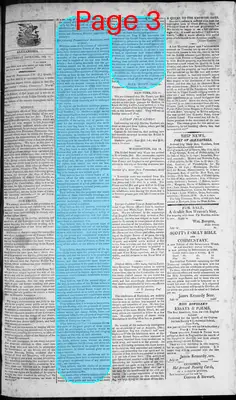
Alexandria Daily Gazette, Commercial & Political
Alexandria, Virginia
What is this article about?
On July 4, 1812, Federal Republicans in Fauquier County held a meeting to oppose the U.S. war with Great Britain, adopting a preamble and resolutions expressing dismay at the conflict and urging Congress to seek peace. Chaired by Alexander Scott, with Thornton Buckner as secretary.
Clipping
OCR Quality
Full Text
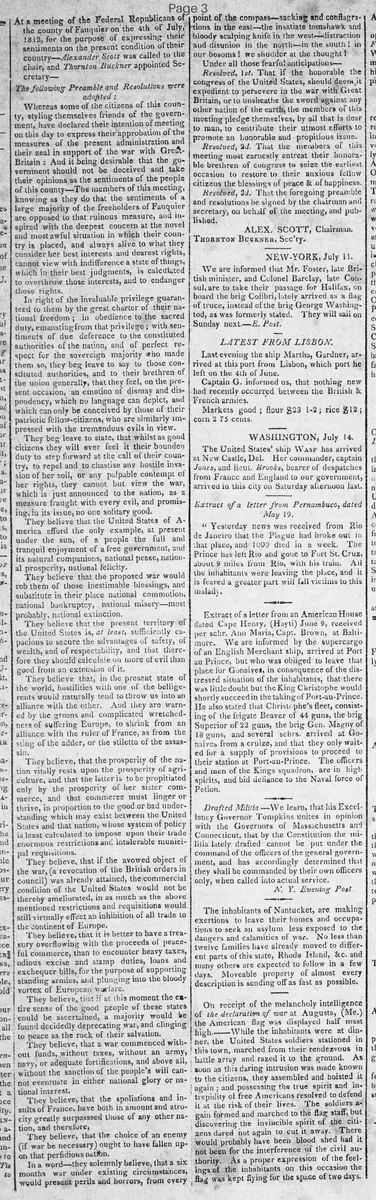
The following Preamble and Resolutions were adopted:
Whereas some of the citizens of this county, styling themselves friends of the government, have declared their intention of meeting on this day to express their approbation of the measures of the present administration and their zeal in support of the war with Great Britain: And it being desirable that the government should not be deceived and take their opinions as the sentiments of the people of this county—The members of this meeting, knowing as they do that the sentiments of a large majority of the freeholders of Fauquier are opposed to that ruinous measure, and inspired with the deepest concern at the novel and most awful situation in which their country is placed, and always alive to what they consider her best interests and dearest rights, cannot view with indifference a state of things, which in their best judgments, is calculated to overthrow those interests, and to endanger those rights.
In right of the invaluable privilege guaranteed to them by the great charter of their national freedom; in obedience to the sacred duty, emanating from that privilege; with sentiments of due deference to the constituted authorities of the nation, and of perfect respect for the sovereign majority who made them so, they beg leave to say to those constituted authorities, and to their brethren of the union generally, that they feel, on the present occasion, an emotion of dismay and despondency, which no language can depict, and which can only be conceived by those of their patriotic fellow-citizens, who are similarly impressed with the tremendous evils in view.
They beg leave to state, that whilst as good citizens they will ever feel it their bounden duty to step forward at the call of their country, to repel and to chastise any hostile invasion of her soil, or any palpable contempt of her rights, they cannot but view the war, which is just announced to the nation, as a measure fraught with every evil, and promising, in its issue, no one solitary good.
They believe that the United States of America afford the only example, at present under the sun, of a people the full and tranquil enjoyment of a free government, and its natural companions, national peace, national prosperity, national felicity.
They believe that the proposed war would rob them of those inestimable blessings, and substitute in their place national commotion, national bankruptcy, national misery—most probably, national extinction.
They believe that the present territory of the United States is, at least, sufficiently capacious to secure the advantages of safety, of wealth, and of respectability, and that therefore they should calculate on more of evil than good from an extension of it.
They believe that, in the present state of the world, hostilities with one of the belligerents would naturally tend to throw us into an alliance with the other. And they are warned by the groans and complicated wretchedness of suffering Europe, to shrink from an alliance with the ruler of France, as from the sting of the adder, or the stiletto of the assassin.
They believe, that the prosperity of the nation vitally rests upon the prosperity of agriculture, and that the latter is to be propitiated only by the prosperity of her sister commerce, and that commerce must linger or thrive, in proportion to the good or bad understanding which may exist between the United States and that nation, whose system of policy is least calculated to impose upon their trade enormous restrictions and intolerable municipal requisitions.
They believe, that if the avowed object of the war, (a revocation of the British orders in council) was already attained, the commercial condition of the United States would not be thereby ameliorated, in as much as the above mentioned restrictions and requisitions would still virtually effect an inhibition of all trade to the continent of Europe.
They believe, that it is better to have a treasury overflowing with the proceeds of peaceful commerce, than to encounter heavy taxes, odious excise and stamp duties, loans and exchequer bills, for the purpose of supporting standing armies, and plunging into the bloody vortex of European warfare.
They believe, that if at this moment the entire sense of the good people of these states could be ascertained, a majority would be found decidedly deprecating war, and clinging to peace as the rock of their salvation.
They believe, that a war commenced without funds, without taxes, without an army, navy, or adequate fortifications, and above all, without the sanction of the people's will cannot eventuate in either national glory or national interest.
They believe, that the spoliations and insults of France, have both in amount and atrocity greatly surpassed those of any other nation, and therefore,
They believe, that the choice of an enemy (if war be necessary) ought to have fallen upon that perfidious nation.
In a word—they solemnly believe, that a six months war under existing circumstances, would present perils and horrors, from every point of the compass—sacking and conflagrations in the east—the insatiate tomahawk and bloody scalping knife in the west—distraction and disunion in the north—in the south! in our bosoms! we shudder at the thought!
Under all those fearful anticipations—
Resolved, 1st. That if the honorable the congress of the United States, should deem it expedient to persevere in the war with Great Britain, or to unsheathe the sword against any other nation of the earth, the members of this meeting pledge themselves, by all that is dear to man, to contribute their utmost efforts to promote an honorable and propitious issue.
Resolved, 2d. That the members of this meeting most earnestly entreat their honorable brethren of congress to seize the earliest occasion to restore to their anxious fellow citizens the blessings of peace & of happiness.
Resolved, 3d. That the foregoing preamble and resolutions be signed by the chairman and secretary, on behalf of the meeting, and published.
ALEX. SCOTT, Chairman.
THORNTON BUCKNER, Sec'ry.
What sub-type of article is it?
What keywords are associated?
What entities or persons were involved?
Where did it happen?
Domestic News Details
Primary Location
Fauquier County
Event Date
4th Of July, 1812
Key Persons
Outcome
preamble and resolutions adopted expressing opposition to the war with great britain and urging peace; signed by chairman and secretary for publication.
Event Details
Federal Republicans met to express sentiments against the war, believing it ruinous and preferring peace; they pledged support if war continued but entreated Congress to end it.